
Diffraction examples are everywhere once you know what to look for. Picture this: you are standing in a hallway and hear someone talking in the room next door before you reach the doorway. The sound waves are bending around the doorframe — that is diffraction. Now picture the rainbow colours flashing across a CD as you tilt it under a lamp. Those colours come from light bending around the microscopic spiral tracks on the disc — also diffraction. Water waves, light waves, sound waves: all of them spread when they meet an obstacle comparable to their wavelength. Here are 15 diffraction examples you encounter regularly, with pictures and a simple explanation of what is happening in each one.
Think of it like this: when a marching band turns a corner, the musicians on the outside of the turn have to cover more ground than those on the inside, so the line curves. Waves do the same thing when part of the wave is blocked by an obstacle — the unblocked parts spread into the space behind it.
1. Rainbow colours on a CD or DVD
This is the most familiar diffraction example. The surface of a CD or DVD contains a single spiral track of microscopic pits, spaced about 1.6 micrometres apart. These closely spaced tracks act as a diffraction grating — they split white light into its component colours, just like a prism, but by diffraction rather than refraction.
The rainbow pattern changes as you tilt the disc because the angle at which each colour is diffracted depends on the angle of the incoming light. The equation is the same one that governs all diffraction gratings: d sin θ = mλ, where d is the track spacing, θ is the diffraction angle, and λ is the wavelength of each colour.
2. Hearing sound around a corner
Sound waves have wavelengths ranging from about 17 millimetres (very high pitch) to 17 metres (deep bass). A typical doorway or building corner is roughly the same size as many sound wavelengths, so sound diffracts around them easily. This is why you hear someone calling your name from another room before you see them.
Low-frequency sounds diffract more than high frequencies because their longer wavelengths are more comparable to the size of everyday obstacles. This is why bass from a subwoofer seems to fill an entire house while higher notes feel more directional.

3. Ocean waves spreading through a harbour mouth
Stand on a pier beside a narrow harbour entrance. The waves rolling in from the open sea pass through the gap and then spread out in circular arcs inside the harbour. The narrower the gap, the wider the spread. This is water wave diffraction, and it is exactly the same physics that governs light passing through a slit.
Engineers design breakwaters knowing that diffraction will carry wave energy into sheltered areas. The same effect explains why ripples from a stone dropped in a pond spread outward in expanding circles.
4. Soft edges of shadows
If light travelled in perfectly straight lines, shadows would have razor-sharp edges. They do not. Look at your shadow on a sunny day, especially near the edges — there is always a soft blur where light and dark meet. This blur is caused by light diffraction around the edges of the object casting the shadow.
The effect is more noticeable the smaller the light source. A point source like a distant streetlamp produces much softer shadow edges than the Sun, because diffraction from a smaller effective source is more pronounced.
5. The Moon's halo (lunar corona)
On a night with thin high cloud, look at the Moon and you may see a coloured ring or halo around it — a lunar corona. Tiny water droplets or ice crystals in the cloud diffract the moonlight, spreading it into a ring. The ring size depends on the size of the droplets: smaller droplets produce larger rings.
The same effect can be seen around the Sun (solar corona), though you should never look directly at the Sun to observe it. The corona is different from the 22-degree halo caused by ice crystal refraction — the corona is a pure diffraction effect.
6. Iridescent clouds
Those pastel patches of pink, green, and blue that sometimes appear in thin clouds are cloud iridescence — diffraction of sunlight around water droplets of roughly uniform size. The colours occur because different wavelengths are diffracted at different angles, similar to how a diffraction grating separates white light.
Cloud iridescence is most commonly seen in altocumulus, cirrocumulus, and lenticular clouds, usually within about 30 degrees of the Sun. The distinctive feature is the soft, pastel quality of the colours, which distinguishes them from the sharper colours of a rainbow.
7. Laser pointer beam spread
Shine a laser pointer at a distant wall. The spot is not a perfect point — it has a central bright disc surrounded by faint rings, and its size grows as you move the pointer further from the wall. Part of this spread is diffraction at the laser's output aperture.
Even a theoretically perfect laser cannot avoid this. The narrower the beam at the source, the faster it diverges due to diffraction. This is a fundamental physical limit, not a design flaw.
8. The silver lining of a cloud
The bright glow around the edge of a dark cloud — the proverbial silver lining — is caused by diffraction of sunlight around the cloud's edge. Light waves that pass very close to the cloud's boundary bend slightly into the shadowed region behind it, creating a bright fringe.
This is the same single-edge diffraction that makes the edges of shadows soft. The effect is especially visible with clouds because the contrast between the bright sky and the dark cloud makes the diffracted light stand out.
9. Camera diffraction at small apertures
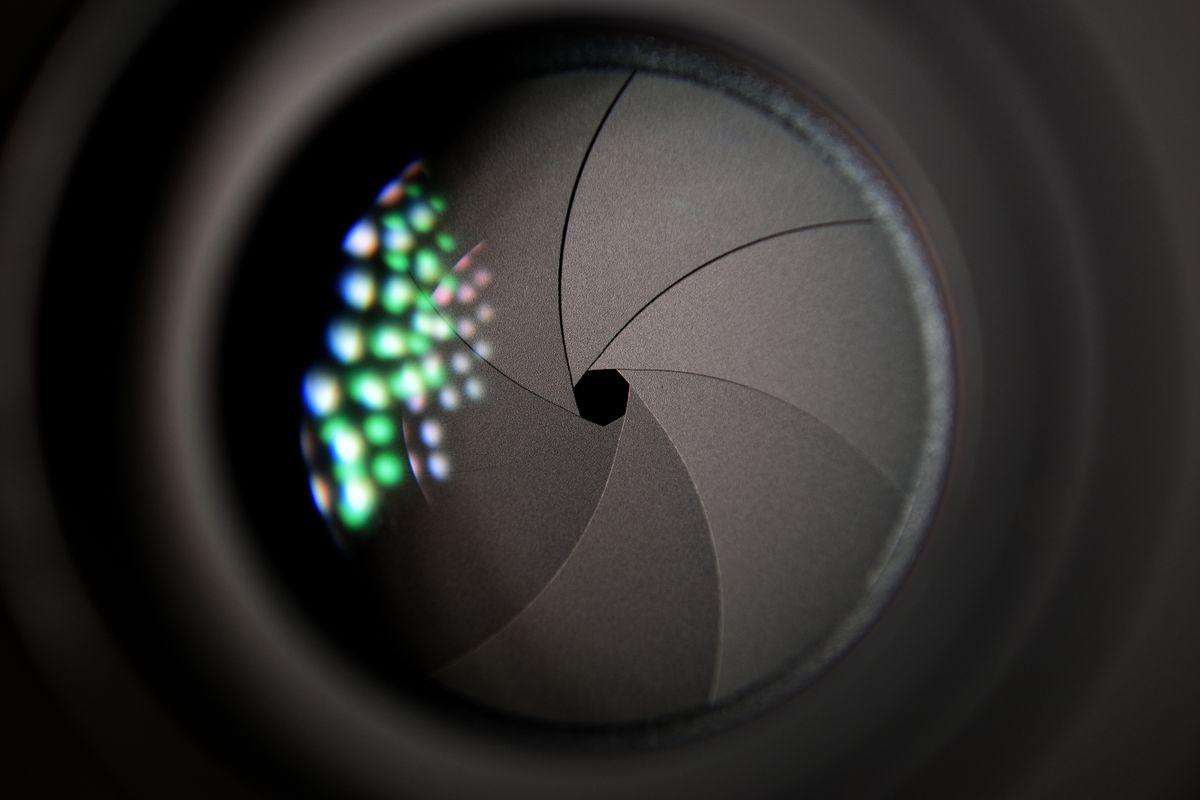
When you set your camera to a small aperture (high f-number like f/16 or f/22), the image may lose sharpness — even with the best lens. This is not a lens defect. It is diffraction of light around the edges of the aperture blades.
The smaller the aperture, the more the light diffracts, and the more the fine detail blurs. Every lens has an optimum aperture (usually around f/5.6 to f/8) where it is sharpest. Beyond that, diffraction takes over. This is called the diffraction-limited regime.
10. Hologram security stickers
The two-dimensional hologram on a credit card or passport looks three-dimensional because it contains a complex diffraction grating. The grating is engineered to diffract light in specific directions, creating the illusion of depth and movement as you tilt the card.
This is an intentional application of diffraction. The grating pattern is so fine that it is extremely difficult to counterfeit, which is why holograms are used on banknotes, passports, and branded goods for security.
11. Spider web iridescence
On a misty morning, spider webs often display shimmering colours. This iridescence comes from diffraction of sunlight by the web's silk fibres, which are comparable in diameter to the wavelength of visible light — roughly a few hundred nanometres to a few micrometres.
Each fibre acts as a tiny obstacle, and the pattern of diffracted light from many fibres produces the colourful sheen. The same effect can be seen on fine hairs and some types of fabric.
12. Smartphone screen pixel gratings
Hold a smartphone screen at arm's length and look at the display at a shallow angle. You may see rainbow patterns spreading from bright areas. The individual pixels on the screen form a regular grid that acts as a two-dimensional diffraction grating.
This is most noticeable on OLED screens, where the sub-pixel arrangement is often non-uniform. The effect is particularly visible when viewing the screen through a diffraction grating or even through your eyelashes.
13. Iridescent meat or fish
Cold cuts of ham or turkey sometimes show green or rainbow iridescence, and fresh fish can appear iridescent on the surface. This is caused by diffraction of light from the regular arrangement of muscle fibres, which form a natural diffraction grating.
The effect is more common in processed meats where the fibres are aligned in a consistent direction by the manufacturing process. It is harmless and purely optical.
14. The glory (heiligenschein)
From an aeroplane window, look at the shadow of the plane on the cloud layer below. Around the shadow's head you may see a bright, coloured ring — a glory. This is caused by light diffracting backward (backscattering) off water droplets in the cloud.
The glory requires the droplets to be spherical, and it always appears around the antisolar point — the point directly opposite the Sun from the observer's perspective. It is a common sight for pilots and frequent flyers.
15. Diffraction spikes in astronomy photos
Images from telescopes often show bright stars with four, six, or eight diffraction spikes radiating outward. These spikes are caused by light diffracting around the support struts that hold the secondary mirror in reflecting telescopes, or around the non-circular aperture itself.
Some photographers deliberately add diffraction spikes to images of bright light sources (streetlamps, the Sun through trees) for artistic effect. In astrophotography, software can sometimes remove them, but the physical cause is pure diffraction.
For the full physics behind what diffraction is and how it works, see our guide on what is diffraction. To understand how diffraction compares with related wave phenomena, read the refraction vs diffraction comparison and the reflection, refraction and diffraction overview.
Common misconception: all iridescent colours are caused by diffraction
Iridescence can come from several different optical effects. Soap bubble colours, for instance, are caused by thin-film interference (light reflecting from the top and bottom surfaces of the film), not diffraction. Butterfly wing colours can come from diffraction, interference, or even structural colour from photonic crystals.
The rule of thumb: if the colour comes from a regularly spaced pattern of lines or dots (like a CD or a grating), it is probably diffraction. If it comes from a thin transparent layer (like a soap bubble or oil slick), it is thin-film interference. Both are wave effects, but the mechanism is different.
For a deeper look at how diffraction applies in laboratory techniques, the Evident Scientific diffraction tutorial covers the single-slit experiment and circular aperture in detail. The Wikipedia diffraction page has a comprehensive list of everyday occurrences. The Britannica entry on diffraction provides the foundational physics behind all of these examples.
Frequently Asked Questions
What are 5 examples of diffraction?
Five common examples of diffraction are: (1) the rainbow pattern on a CD or DVD surface caused by light diffracting off the closely spaced tracks, (2) hearing sound around a corner because sound waves bend around obstacles, (3) the soft, blurry edges of shadows where light has bent around the object's edge, (4) ocean waves spreading out after passing through a narrow harbour mouth, and (5) the coloured rings (corona) around the Moon on a cloudy night caused by light diffracting through tiny water droplets in the air.
What is a real life example of diffraction of light?
One of the most common real life examples of light diffraction is the rainbow pattern you see on the surface of a CD or DVD. The disc's surface contains closely spaced spiral tracks — about 1.6 micrometres apart — that act as a diffraction grating. When white light hits these tracks, different colours are diffracted at different angles, producing the familiar rainbow sheen.
What is an example of diffraction of sound?
Hearing someone speak from around a corner or through a doorway is the classic example of sound diffraction. Sound waves have wavelengths comparable to the size of doorways and building edges (roughly 0.5 to 17 metres), so they bend around these obstacles easily. This is why you can hear someone in the next room before you see them.
How does diffraction affect photography?
In photography, diffraction limits how sharp an image can be at small apertures (high f-numbers like f/16 or f/22). When the aperture blades close down to a very small opening, light diffracts around the edges of the blades, causing fine detail to blur. This is called the diffraction limit — every lens has an aperture where diffraction starts to soften the image, regardless of lens quality.
What is the difference between diffraction and refraction?
Diffraction is the bending of waves around obstacles or through openings. Refraction is the bending of waves when they pass from one medium to another (like air to water). Diffraction depends on the size of the obstacle relative to the wavelength. Refraction depends on the change in wave speed between the two media. Both cause waves to change direction, but for completely different reasons.
Can you see diffraction in clouds?
Yes. Cloud iridescence — pastel shades of pink, green, and blue seen in thin clouds — is caused by diffraction of sunlight around tiny water droplets in the cloud. A silver lining around the edge of a cloud is also a diffraction effect: sunlight bends around the cloud's edge and creates a bright glow. The halo or corona around the Moon through thin cloud is another example.

About Umar Farooq
Umar Farooq writes in-depth guides on the physics of light and optics — from reflection, refraction, and lenses to diffraction, lasers, and fiber optics, explained from first principles.
Read more about Umar Farooq →