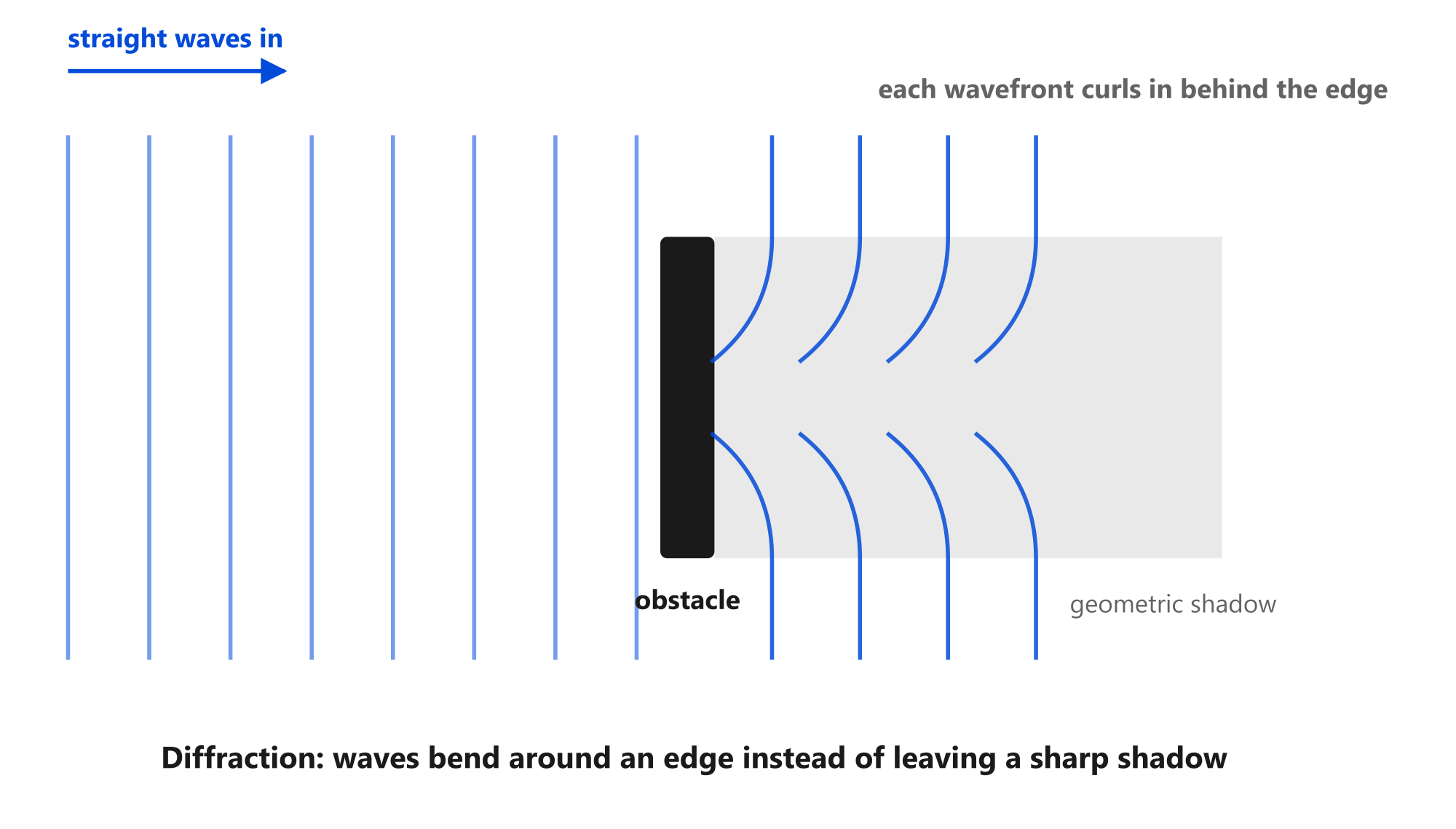
Diffraction is the spreading of waves around obstacles or through openings. Picture sea waves arriving at a narrow harbour mouth: instead of passing through in a straight narrow beam, the waves spread out in curves on the other side, bending into the sheltered water. The narrower the gap, the wider the spread. Light does the same thing, but because its wavelength is tiny — around 500 nanometres — you usually need a very narrow slit to see it. Here is what diffraction is, how the Huygens-Fresnel principle explains it, and 7 examples you have seen without realising it.
Think of it like sound: you hear someone talking in the next room before you turn the corner into the doorway. The sound waves bend around the doorframe and spread into the hallway. If light behaved the same way around everyday objects, shadows would not exist — the world would be a soft blur. Light does diffract, just on a scale so small you need a microscope or a laser to notice.
What is diffraction in physics?
In physics, diffraction is the bending and spreading of waves when they encounter an obstacle or pass through an aperture. The wave does not continue in a straight line — it fans out into the region behind the obstacle or beyond the opening.
Diffraction is not unique to light. Every wave diffracts:
- Sound waves diffract around doorways and buildings — that is why you hear sounds from around a corner.
- Water waves diffract through harbour openings and around islands.
- Light waves diffract through narrow slits and around sharp edges.
- X-rays diffract off the atomic planes in crystals — this is how scientists determine the structure of molecules.
- Electron beams diffract through atomic lattices, proving that particles have wave-like behaviour.
Diffraction definition waves
The formal diffraction definition from wave physics is: the redistribution of wave energy in space caused by an obstacle or aperture, resulting from the interference of secondary wavelets originating from different points on the same wavefront.
In plain terms: every point on a wave acts like a tiny new source of waves. When part of the wave is blocked by an obstacle, the remaining unblocked points send out overlapping ripples. Where those ripples line up, you get a bright spot (constructive interference). Where they cancel, you get a dark spot (destructive interference). The resulting pattern of light and dark is the diffraction pattern.
When does diffraction happen? The condition
Diffraction is always happening, but you only notice it when the obstacle or opening is about the same size as the wavelength. The key condition:
Significant diffraction occurs when the size of the obstacle or aperture (a) is comparable to the wavelength (λ). Roughly, λ ≥ a gives strong diffraction. When λ ≪ a, the wave passes by with negligible bending.
This is why:
- Sound diffracts around doorways. Sound waves have wavelengths from about 17 mm (high pitch) to 17 metres (low bass). A typical doorway is about 0.8 metres wide — comparable to mid-range sound wavelengths, so sound bends around it easily.
- Light does not diffract around doorways. Visible light has a wavelength of roughly 380–700 nm — about 100 times thinner than a human hair. A doorway is millions of times wider, so the diffraction is undetectably small.
- Light does diffract through a narrow slit. When you shine a laser through a slit just a few micrometres wide, the beam spreads into a clear pattern of bright and dark bands.
The mechanism: Huygens-Fresnel principle
Diffraction happens because of the Huygens-Fresnel principle: every point on a wavefront acts as a source of spherical secondary wavelets. The shape of the new wavefront is the envelope of all these wavelets.
Here is the key point for diffraction: when part of a wave is blocked by an obstacle, only certain points on the wavefront contribute. The secondary wavelets from the unblocked points spread out in all directions and interfere with each other. Some directions produce constructive interference (bright), others destructive (dark). The result is a diffraction pattern.
The wider the opening, the more directional the beam stays. The narrower the opening, the more the beam spreads. This is the opposite of what you might expect — a narrower slit gives a wider diffraction pattern.
The mathematics uses the diffraction grating equation: d sin θ = mλ
Where d is the spacing between slits or grating lines, θ is the angle of the diffracted beam, m is the order number (0, 1, 2, ...), and λ is the wavelength. This equation is at the heart of how spectrometers work.
Types of diffraction: Fresnel vs Fraunhofer
Diffraction is divided into two regimes:
Fresnel (near-field) diffraction: the wavefront is curved because the source or screen is close to the obstacle. The pattern changes with distance. This is the kind you see in the fuzzy edge of a shadow cast by a small light source.
Fraunhofer (far-field) diffraction: the wavefront is effectively flat (parallel rays) because the source and screen are very far from the obstacle. The pattern is stable with distance. This is the kind you get when a laser shines through a slit onto a distant wall.
Most textbook diffraction patterns — the single-slit pattern, the Airy disc of a circular aperture, the diffraction grating pattern — are Fraunhofer diffraction.
7 everyday examples of diffraction
1. Hearing sound around a corner
Sound waves have wavelengths comparable to doorways and building edges. That is why you hear someone approaching before you see them. Low bass notes diffract more than high treble notes because their longer wavelengths match obstacles more closely.
2. Rainbow colours on a CD or DVD
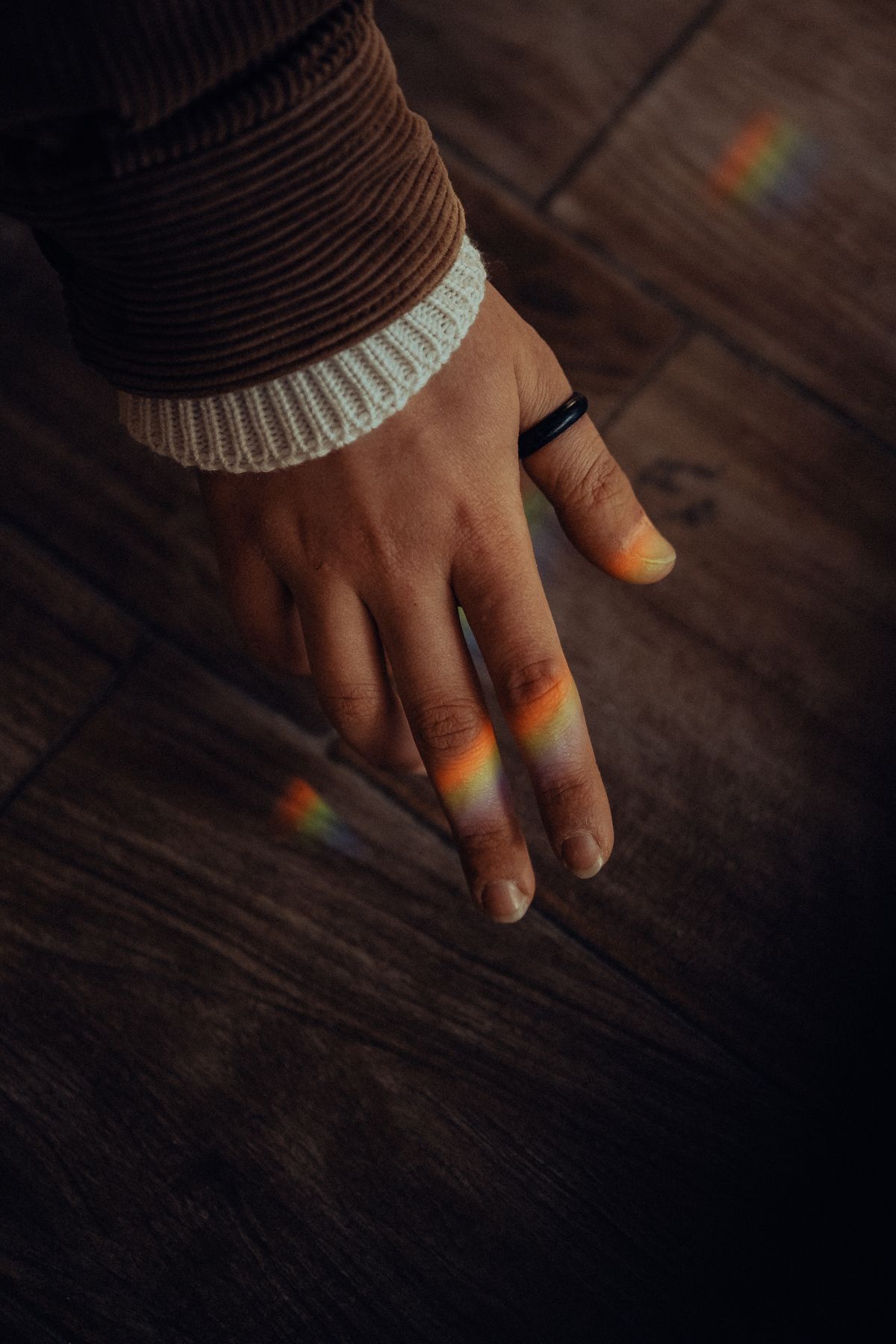
The closely spaced tracks on a CD act as a diffraction grating. White light contains all colours; the grating splits them into their separate wavelengths, producing a rainbow pattern. The same effect gives the shimmering colours on a butterfly wing or a hologram security sticker.
3. Soft edges of shadows
If light travelled in perfectly straight lines, shadows would have razor-sharp edges. They do not. Diffraction at the edge of the object causes light to bend slightly into the shadow region, creating a soft blur around the edge.
4. The Moon's halo on a cloudy night
Tiny ice crystals or water droplets in high cloud diffract moonlight. The diffracted light spreads into a ring or halo around the Moon, typically at a radius of about 22 degrees.
5. Laser pointer spread
A laser beam is narrow when it leaves the pointer, but over distance it spreads into a wider spot. Part of this divergence is caused by diffraction at the laser's output aperture. Even a perfect laser cannot avoid this — it is a fundamental physical limit.
6. Ocean waves through a harbour mouth
Sea waves arriving at a narrow harbour opening spread out in circular arcs on the inside. Engineers design breakwaters knowing that the narrower the opening, the more the waves diffract inside.
7. Camera aperture blur (diffraction-limited photography)
When you close a camera lens to a very small aperture (high f-number like f/22), diffraction at the aperture blades blurs fine detail. The smaller the aperture, the worse the blur — the opposite of what intuition suggests.
Simple experiment: try at home
Hold two fingers close together in front of a bright light source — a lamp or your phone's flashlight. Slowly bring your fingers together until they are almost touching, with a narrow gap between them. You will see a series of faint dark lines running parallel to your fingers. Those are diffraction fringes: light bending around the edges of your fingers and interfering with itself.
The narrower the gap, the wider the spacing between the dark lines. This is the same physics that governs diffraction in the most advanced spectrometers.
For the full history of how scientists discovered that light behaves as a wave, see our guide on how light bends during diffraction. For how diffraction compares with other wave phenomena, read the refraction vs diffraction comparison and the reflection, refraction and diffraction three-way guide.
Common misconception: diffraction and interference are the same thing
Many sources treat diffraction and interference as separate phenomena. They are not. Diffraction is the result of interference between wavelets from different points on the same wavefront. Interference usually refers to waves from separate sources (like two slits). But the underlying mechanism — waves adding and cancelling — is identical.
The physicist Richard Feynman put it simply: "No one has ever been able to define the difference between interference and diffraction satisfactorily. It is just a question of usage, and there is no specific, important physical difference between them."
What matters is the pattern: wherever waves overlap, they interfere. Diffraction is just the name we give to interference from a continuous wavefront interrupted by an obstacle.
You can explore the mathematics in depth with the Britannica entry on diffraction, the Molecular Expressions diffraction tutorial, or the Wikipedia article on diffraction for the full historical development from Grimaldi through Fresnel.
Frequently Asked Questions
What is diffraction in physics?
In physics, diffraction is the spreading or bending of waves when they encounter an obstacle or pass through an aperture. It is a wave phenomenon that affects all types of waves — light, sound, water, and even matter waves like electrons. The effect is most noticeable when the obstacle or opening size is comparable to the wavelength of the wave.
What is the difference between diffraction and interference?
Interference is the superposition of waves from two or more coherent sources (like the two slits in Young's experiment). Diffraction is the superposition of wavelets from different points on the same wavefront (like the many points across a single slit). In practice, diffraction patterns always contain interference effects — you cannot have one without the other.
What conditions are necessary for diffraction to occur?
For significant diffraction to occur, the size of the obstacle or aperture must be comparable to the wavelength of the wave (λ ≈ a). If the obstacle is much larger than the wavelength, diffraction is negligible and the wave appears to travel in straight lines. If the obstacle is much smaller, the wave passes around it with little disturbance.
Why is diffraction of light not noticeable in everyday life?
Visible light has a very short wavelength — about 500 nanometres, or 100 times thinner than a human hair. Everyday objects (doors, windows, furniture) are millions of times larger than this, so the diffraction is too small to see. Light noticeably diffracts only through very narrow slits, around sharp edges, or through materials with closely spaced structures like CDs.
What is a diffraction grating?
A diffraction grating is an optical component with many closely spaced parallel lines or grooves. When light passes through or reflects off a grating, it diffracts into several beams travelling in different directions. The angles of these beams follow the grating equation d sin θ = mλ. Gratings are used in spectrometers to split light into its component wavelengths.
What are examples of diffraction?
Everyday examples include: hearing sound around a corner, the rainbow colours on a CD or DVD surface, the soft edges of shadows, the halo around the Moon on a cloudy night, the central bright spot in a laser pointer dot, the spreading of ocean waves through a harbour mouth, and the blurring of fine detail in a camera at small apertures.

About Umar Farooq
Umar Farooq writes in-depth guides on the physics of light and optics — from reflection, refraction, and lenses to diffraction, lasers, and fiber optics, explained from first principles.
Read more about Umar Farooq →