Light energy is the energy carried by light — the energy a beam delivers as it travels from a source to your eyes, a leaf, or a solar panel. In physics terms, it is the energy of electromagnetic waves in and around the visible range, and it behaves as a form of kinetic energy because light is never at rest. Here's where we're going: a clear definition, a pile of everyday examples, the types and properties of light, and the simple physics that ties it all together.
What is light energy? A clear definition
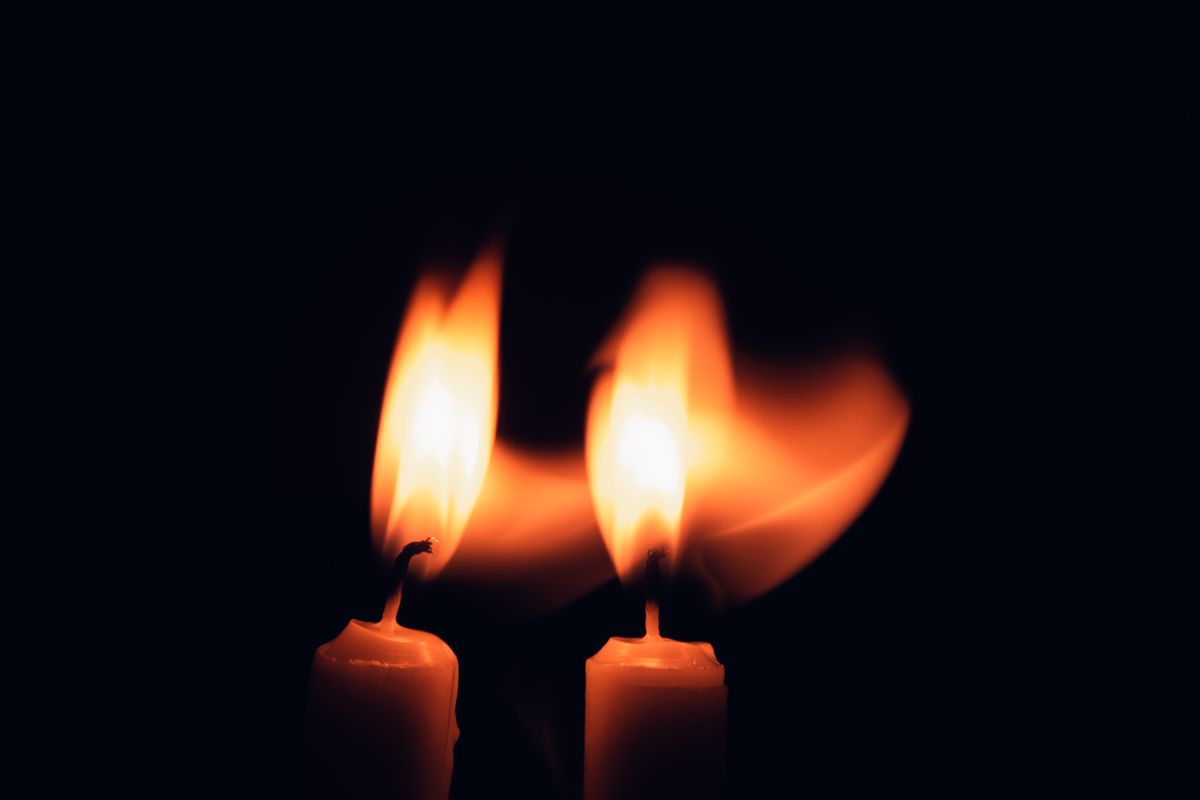
It is the energy a beam of light transports. Strike a match and you feel it: the flame sends out energy that crosses the gap to your hand without anything in between carrying it. That crossing — energy on the move as light — is the whole idea.
Here's the key idea. Light is an electromagnetic wave: a self-sustaining ripple of electric and magnetic fields that races through space. Those fields carry energy, just as a swell rolling across the sea carries energy from a distant storm to the shore. When the wave arrives and is absorbed, it hands that energy over — warming a surface, freeing electrons in a solar cell, or triggering the cells in your retina.
Light energy, defined: the energy carried by electromagnetic radiation, most often the part we can see (visible light), travelling at the speed of light and delivered when the light is absorbed. It is measured in joules (J), like all energy.
One thing that trips people up: light is kinetic, not potential. Potential energy is stored — a stretched spring, a book on a shelf. Light is the opposite. From the moment it is created until the moment it is absorbed, light moves at 299,792,458 metres per second in a vacuum — fast enough to circle the Earth about 7.5 times in a single second. It is pure energy in motion.
Light energy definition in simple words (for kids)
In plain terms: light energy is the energy that lets us see. It comes from things that glow or shine — the Sun, a fire, a torch, a phone screen. That light travels outward, lands on objects, bounces into your eyes, and your brain turns it into the picture of the world you see.
No glowing source, no light, no seeing. That's why a sealed cupboard is pitch black — there's nothing inside making light for your eyes to catch.
Examples of light energy
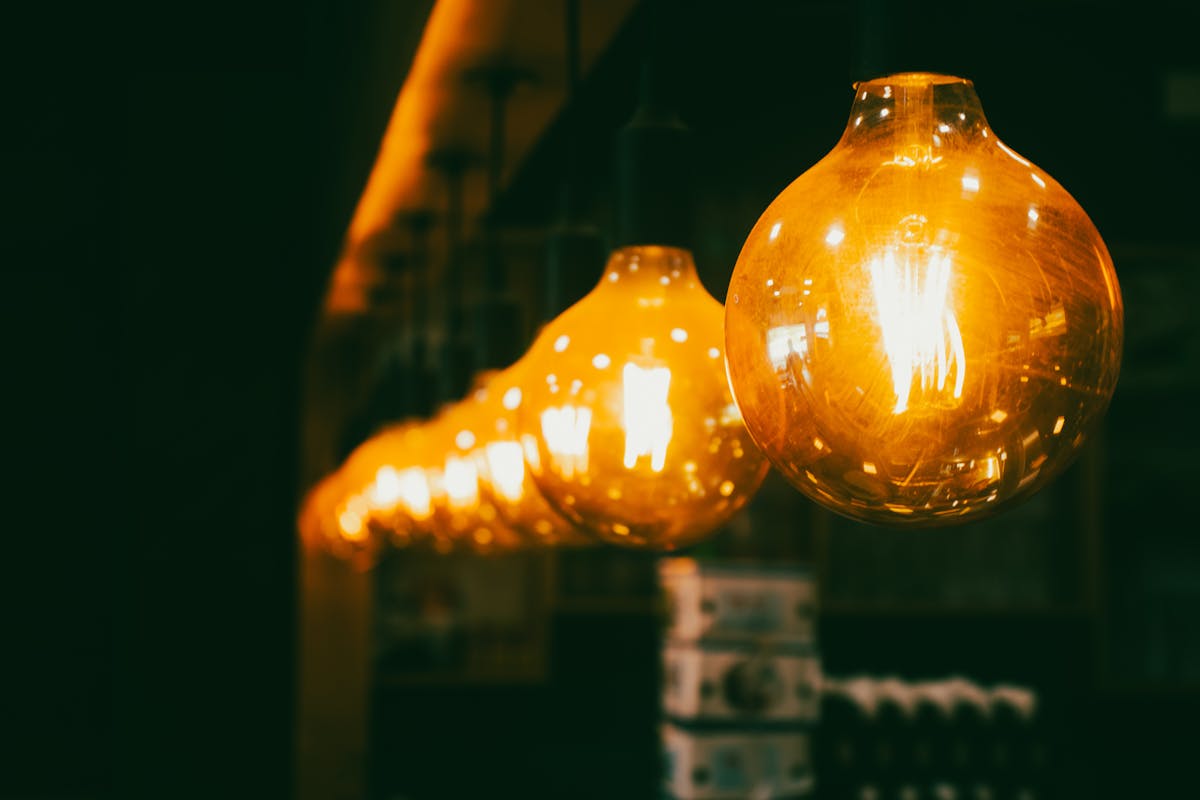
The easiest way to feel what light energy is, is to spot it. Here are 12 examples, natural and artificial, that you meet on an ordinary day.
Natural sources of light
- The Sun — by far the biggest source you'll ever meet. Its light takes about 8 minutes 20 seconds to reach Earth.
- Stars — distant suns, each pouring out light across the galaxy.
- Fire — a candle, a campfire, a match: chemical energy turning into light and heat.
- Lightning — a sudden, enormous discharge that floods the sky with light.
- Bioluminescence — fireflies, deep-sea fish, and some fungi make their own cold light through chemistry.
Artificial sources of light
- Light bulbs — incandescent, LED, or fluorescent lamps lighting a room.
- Screens — your phone, laptop, and TV emit light straight at your eyes.
- Lasers — barcode scanners, laser pointers, and fibre-optic links.
- Torches and headlights — focused beams for seeing in the dark.
- Fireworks — burning metal salts that release light in vivid colours.
- Camera flash — a brief, bright burst of stored electrical energy released as light.
- Glow sticks — a chemical reaction (chemiluminescence) giving off light with almost no heat.
Notice the pattern: in every case, some other form of energy — chemical, electrical, nuclear — is being converted into light. Light is rarely the start of the story; it's the messenger that carries energy onward.
Types of light energy: the electromagnetic spectrum
The light your eyes can see is a thin slice of a much wider family. All of it is the same thing — electromagnetic waves — just at different wavelengths. Think of it like a piano: visible light is one octave you can hear, but the keyboard runs far past both ends.
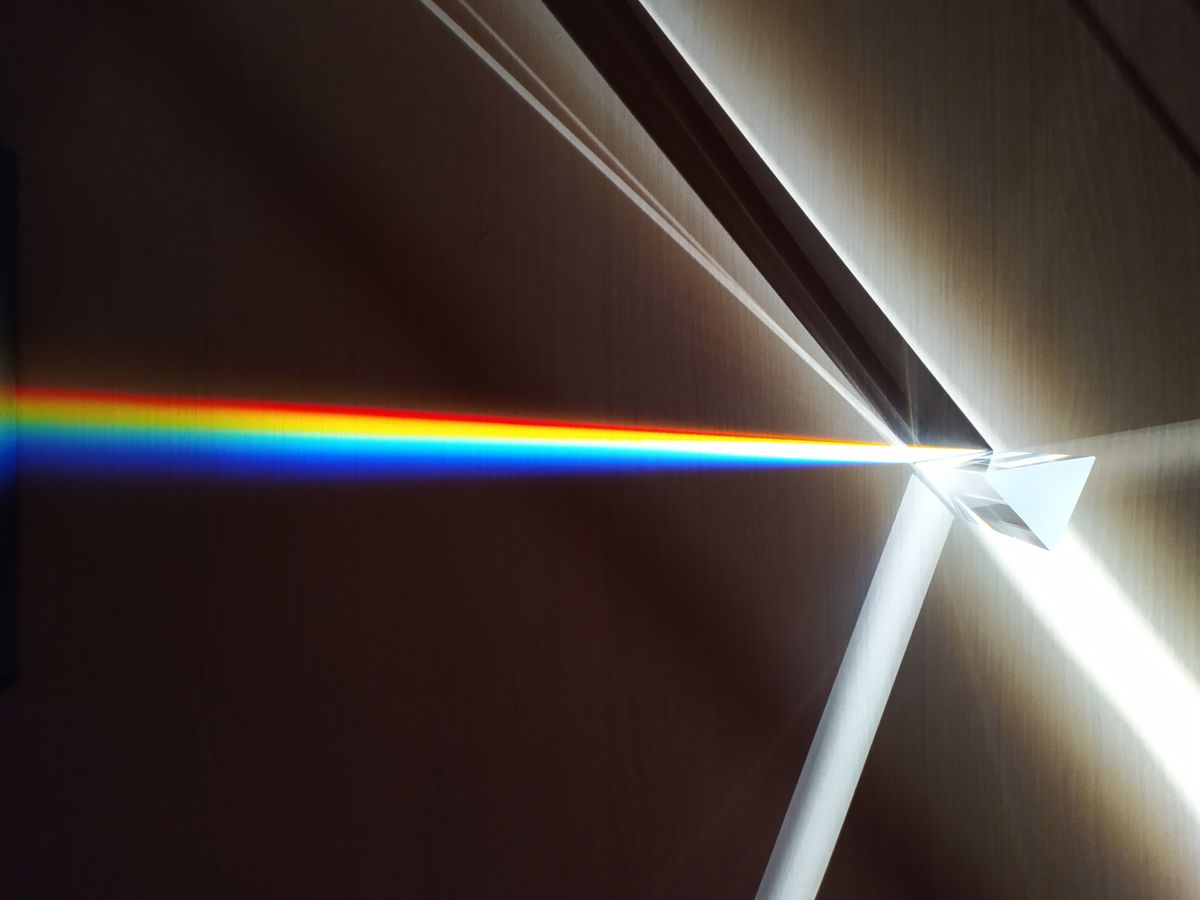
In the 1660s, plague closed Cambridge and a young Isaac Newton went home to Lincolnshire. He let a beam of sunlight pass through a glass prism and watched it fan out into a band of colours. The accepted idea then was that the prism added colour to the light. Newton's clever move was to send the spread-out colours through a second prism and recombine them back into white light — proving the colours were already inside the white light. The prism only sorted them by wavelength.
That sorted band is the visible spectrum, and it sits in the middle of the full range of light:
| Type of light | Wavelength (shorter = more energy) | Where you meet it |
|---|---|---|
| Gamma rays | < 0.01 nm | Nuclear reactions, some cancer treatment |
| X-rays | 0.01–10 nm | Medical imaging |
| Ultraviolet (UV) | 10–380 nm | Sunburn, sterilising lamps |
| Visible light | 380–700 nm | Everything you see |
| Infrared (IR) | 700 nm–1 mm | Heat lamps, TV remotes, thermal cameras |
| Microwaves | 1 mm–1 m | Ovens, Wi-Fi, radar |
| Radio waves | > 1 m | Broadcast, phones, GPS |
Within the visible slice, wavelength sets the colour:
| Colour | Approx. wavelength |
|---|---|
| Violet | 380–450 nm |
| Blue | 450–485 nm |
| Green | 500–565 nm |
| Yellow | 565–590 nm |
| Orange | 590–625 nm |
| Red | 625–700 nm |
A green photon sits around 500 nm — roughly 100–200 times thinner than a human hair. (NASA's primer on visible light walks through where our slice fits in the spectrum.)
Properties of light energy
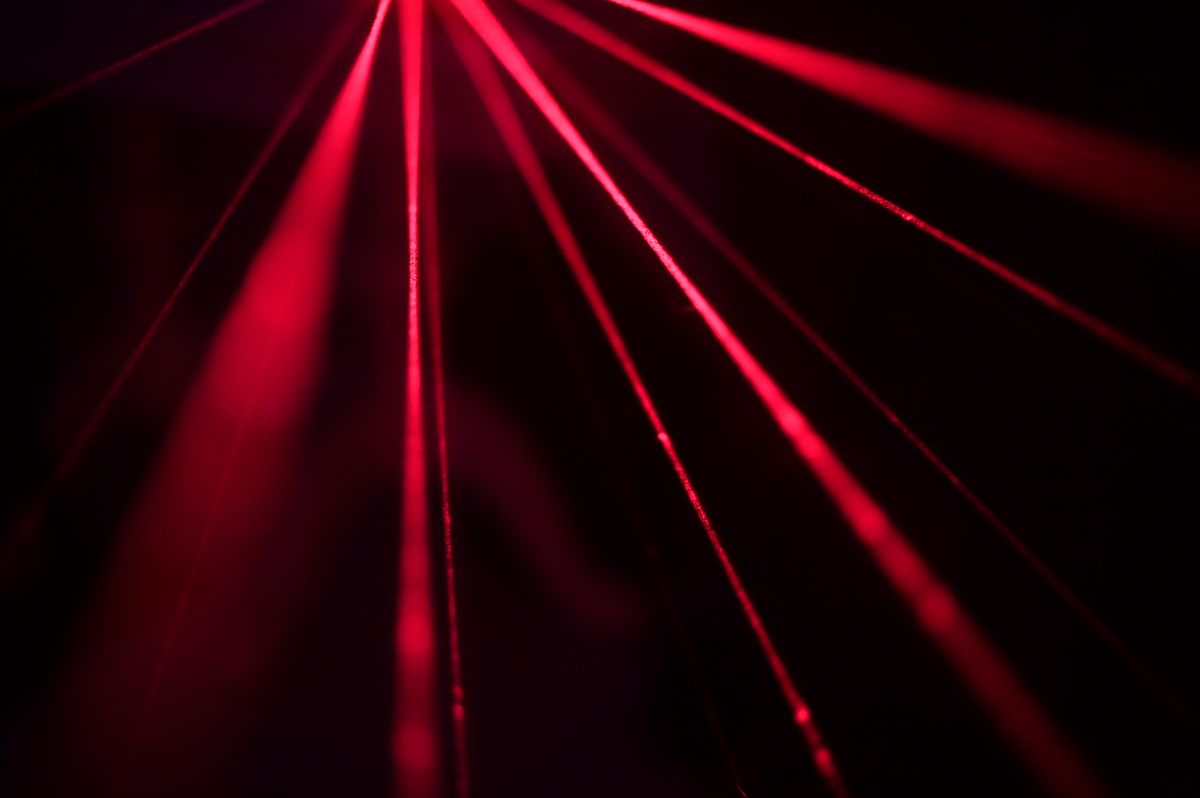
Light energy behaves in a handful of reliable ways. These are the 7 properties worth knowing.
- It travels in straight lines. In a uniform medium, light moves in straight paths called rays — which is why a torch casts a sharp-edged shadow.
- It needs no medium. Unlike sound, light crosses the vacuum of space. That's how sunlight reaches us across 150 million kilometres of nothing.
- It travels at a fixed top speed. In a vacuum, always 299,792,458 m/s. It slows in glass or water, then speeds back up on the way out.
- It carries energy and momentum. Light can push on things — the principle behind solar sails — even though it has no mass.
- It comes in colours set by wavelength. Different wavelengths are different colours; white light is a mix of them all.
- It reflects, refracts, diffracts, and can be polarised. These wave behaviours are the whole field of optics — light bouncing off mirrors, bending into water, spreading around edges, and being filtered by polarisers.
- Its energy is quantised. Light comes in indivisible packets called photons. You can't have half a photon's worth of light at a given wavelength.
That last property is the strange and important one, so let's open it up.
The physics: how does light carry energy?
Here's what's actually happening. Light energy arrives in packets — photons — and each photon carries an amount of energy set entirely by its frequency.
Think of it like coins of different value. A red photon is a low-value coin; a violet photon is a higher-value one; an X-ray photon is a gold piece. The colour (frequency) fixes the size of the coin, and the brightness just tells you how many coins are arriving per second.
In plain words: the energy of a photon is proportional to its frequency. Crank the frequency up and each packet carries more energy. Now the symbols:
$$E = hf$$
Here E is the photon's energy, f is its frequency, and h is the Planck constant, 6.626 × 10⁻³⁴ J·s. Because a wave's speed, frequency, and wavelength are tied together by c = fλ, you can swap frequency for wavelength and write the same law as E = hc/λ. Shorter wavelength, higher energy.
Worked example. Take a green photon at 500 nm. Plug the numbers into E = hc/λ and you get about 4 × 10⁻¹⁹ joules — which physicists usually quote as roughly 2.5 electronvolts (eV) per photon. A single visible photon carries a tiny sliver of energy; what makes sunlight warm is the staggering number of them landing on your skin every second.
This dual nature — light as a spread-out wave and a stream of energy packets — is the foundation of the famous wave–particle duality. For the energy bookkeeping here, the photon picture is the one that pays.
One original diagram for this article: an energy ladder. Draw the spectrum left (long wavelength, low energy: radio) to right (short wavelength, high energy: gamma), with the visible band coloured in the middle. Label the rung height E = hf so the reader sees energy climbing as wavelength shrinks — the single idea that ties "types of light" to "light energy."
Where light energy comes from — and what it does
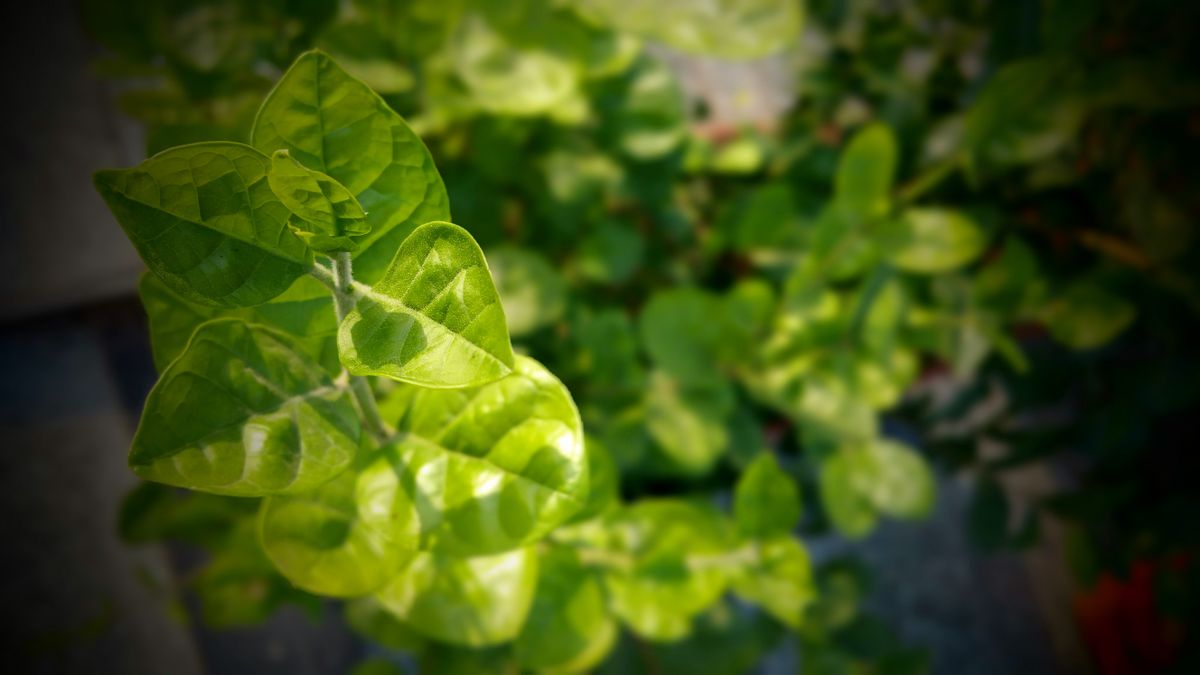
Almost every scrap of light energy on Earth traces back to one place: the Sun, where nuclear fusion turns mass into radiation. That radiation then drives most of the planet.
- Photosynthesis. Plants capture sunlight and store its energy in sugars. Nearly every food chain starts here — sunlight converted into chemical energy you can eat.
- Solar power. Photovoltaic panels turn light directly into electricity by knocking electrons loose with arriving photons.
- Vision. Your eyes are light-energy detectors; absorbed photons trigger the signals your brain reads as sight.
- Communication. Pulses of light carry almost all of the world's internet traffic down hair-thin glass fibres.
- Heat and warmth. Absorbed light raises the temperature of soil, oceans, and skin — the engine behind weather and climate.
It's a clean chain: the Sun makes light, it crosses space, and on arrival it becomes the food, power, and warmth that life runs on.
A common myth: light energy is not the same as heat
Here's a misconception worth clearing up, because it's so easy to believe: light and heat are the same thing. They're not.
The myth is tempting for good reasons. Many sources of light — the Sun, a fire, an old incandescent bulb — are hot, and they pour out heat alongside their glow. And when light is absorbed by your skin, it often becomes heat. So light and warmth seem to arrive together.
But light energy is energy carried by electromagnetic waves, while heat is energy transferred because of a temperature difference. They're different quantities. The proof is everywhere once you look: an LED gives off bright light while staying cool to the touch, a firefly glows with almost no warmth at all, and the cold light of a glow stick comes purely from chemistry. Light can turn into heat when something absorbs it — but the light itself is not heat.
For a careful, encyclopaedic take on what light fundamentally is, Britannica's article on light is a solid next stop. And the deep history runs through one of the great optics discoveries: in 1865, James Clerk Maxwell showed that light is an electromagnetic wave — the same phenomenon as radio and X-rays — a story the 2009 Nobel Prize work on fibre optics later turned into the backbone of the internet.
Want to go deeper into how that light then bends, bounces, and splits? Browse the rest of our optics guides, or start at the Physics Optics home page for the full first-principles tour.
Frequently Asked Questions
What is the definition of light energy?
Light energy is the energy carried by electromagnetic waves in and around the visible range. It is a form of kinetic energy, because light is always moving — at 299,792,458 metres per second in a vacuum — and it can travel through empty space with no medium at all.
Is light energy kinetic or potential energy?
Light energy is a form of kinetic energy. Kinetic energy is the energy of motion, and light never sits still — every photon travels at the speed of light from the instant it is created until it is absorbed. It is not stored or positional like potential energy.
What are 5 examples of light energy?
Five everyday examples of light energy are: sunlight, a candle flame, a light bulb, a phone or laptop screen, and a laser pointer. Each one is a source releasing energy as visible light that your eyes can detect.
What is light energy for kids?
Light energy is the energy that lets us see. It comes from things that glow or shine, like the Sun, a torch, a fire, or a lamp. The light travels into your eyes, and that is how you see colours and shapes around you.
Is light energy the same as heat energy?
No. Light energy is energy carried by light waves; heat is energy transferred because of a temperature difference. They feel linked because many hot objects glow and because skin turns absorbed light into heat — but light itself is not heat. A cold star and a cool LED both give off light without much warmth.
What is the formula for light energy?
The energy of a single photon is E = hf, where h is the Planck constant (6.626 × 10⁻³⁴ J·s) and f is the light's frequency. Because frequency and wavelength are linked by c = fλ, you can also write it as E = hc/λ. Higher frequency (shorter wavelength) means more energy per photon.

About Umar Farooq
Umar Farooq writes in-depth guides on the physics of light and optics — from reflection, refraction, and lenses to diffraction, lasers, and fiber optics, explained from first principles.
Read more about Umar Farooq →