Diffraction of a wave is the bending and spreading that happens when a wave meets an obstacle or passes through an opening. Picture a straight line of ocean waves approaching a narrow gap in a harbour wall. On the far side of the gap, the waves do not continue as a straight line — they spread out in curves, like ripples from a stone dropped in a pond. The narrower the gap, the wider the spread. This is wave diffraction, and it happens with water waves, sound waves, light waves, and even matter waves. Here is how diffraction works for each type of wave, what determines how much bending occurs, and why the Huygens-Fresnel principle explains it all.
Think of the Huygens principle like a crowd leaving a stadium through a single exit. Each person in the exit acts as a new source of motion, spreading out in all directions once through the gate. If the exit is narrow relative to the size of the crowd, the people fan out widely on the other side. If the exit is wide, most keep going straight. Waves do the same thing.

The Huygens-Fresnel principle: why waves diffract
Before you can understand diffraction of a wave, you need the Huygens-Fresnel principle. It is surprisingly simple:
Every point on a wavefront acts as a source of spherical secondary wavelets. The new wavefront is the envelope of all these wavelets.
Here is what that means for diffraction. When a wave hits a barrier with a gap in it, most of the wavefront is blocked. Only the points inside the gap are free to emit secondary wavelets. Those wavelets spread in all directions from each point in the gap. Where the wavelets from different points arrive in step, they reinforce (constructive interference). Where they arrive out of step, they cancel (destructive interference). The resulting pattern of bright and dark — or high and low amplitude — is the diffraction pattern.
The key insight: a narrow gap produces wider diffraction because fewer points contribute, so the wavelets from those points have to cover a larger angular range to form the new wavefront.
What determines diffraction: the wavelength condition
Diffraction of a wave depends on one ratio: the size of the obstacle or opening (a) compared to the wavelength (λ).
| Condition | Diffraction | What happens |
|---|---|---|
| λ ≈ a (wavelength same as obstacle) | Strong | Wave spreads widely behind the obstacle |
| λ ≪ a (wavelength much smaller) | Weak | Wave passes with little bending |
| λ ≫ a (wavelength much larger) | Wave passes around with minimal disturbance | The obstacle is effectively invisible to the wave |
This condition is the reason different types of waves diffract differently in everyday life.
Water wave diffraction
Water waves are the easiest to observe because their wavelengths can be tens of centimetres to metres — the same size as many obstacles.
Stand at a harbour wall with a narrow entrance. Waves arriving from the open sea pass through the gap and spread into circular arcs inside the harbour. Engineers must account for this when designing breakwaters: diffraction carries wave energy into areas that would otherwise be sheltered.
In a ripple tank — a shallow glass tray of water with a light shining through it — you can see the effect clearly. Straight waves produced by a vibrating bar hit a barrier with a slit. On the other side, the waves are circular. Make the slit narrower, and the circles spread wider. This is the classic ripple tank demonstration of wave diffraction.
Sound wave diffraction
Sound waves have wavelengths in the range that matches everyday objects. A 340 Hz sound (middle C) has a wavelength of roughly 1 metre — about the width of a doorway. This matching of scales is why sound diffraction is so familiar.
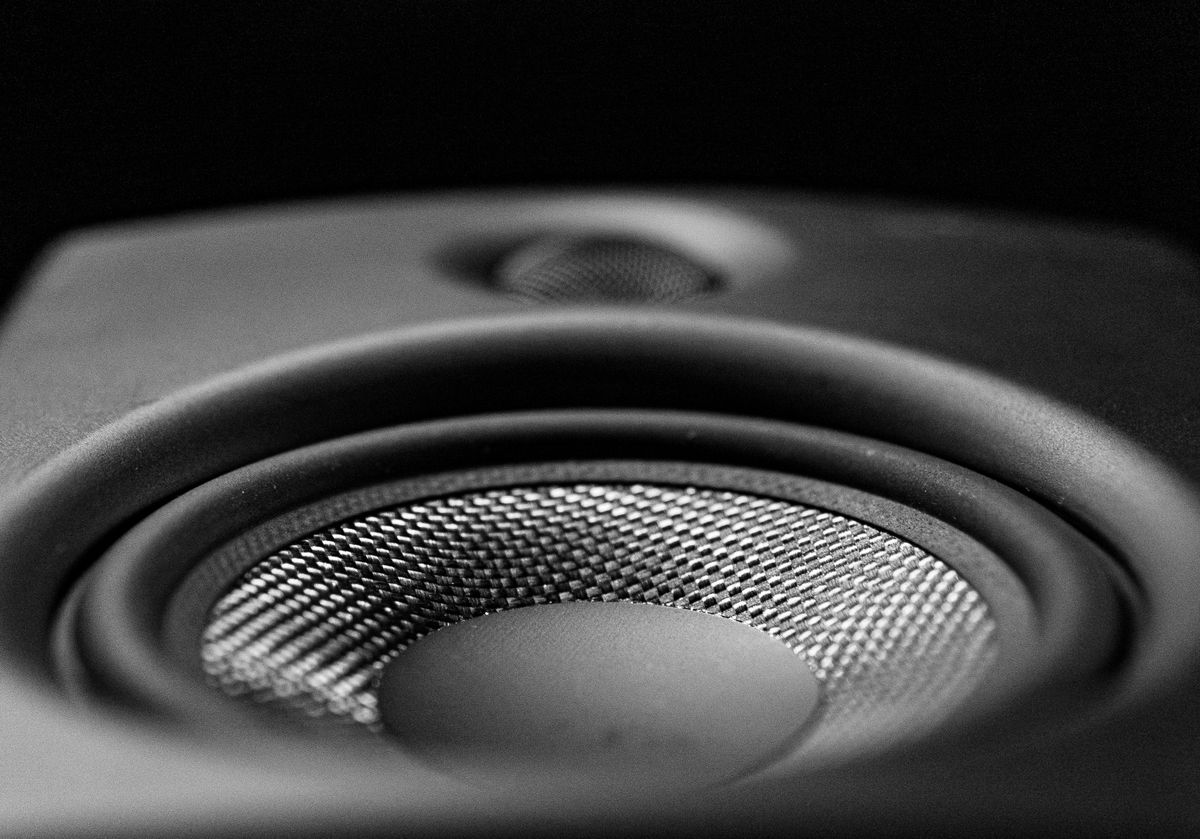
When someone speaks in the room next door, the sound waves bend around the doorframe and spread into the hallway. The bending is strongest for low frequencies. Bass notes from a subwoofer fill an entire house because their long wavelengths (several metres) diffract around walls and corners. High-frequency sounds are more directional because their shorter wavelengths diffract less.
This is also why a loudspeaker in an open field sounds different from the same speaker indoors. Indoors, the walls and corners diffract and reflect the sound, creating a complex pattern of interference that changes the perceived timbre.
Light wave diffraction
Visible light has a wavelength of roughly 380 to 700 nanometres — about 100 times thinner than a human hair. Almost every obstacle in everyday life is millions of times larger than this, so light diffraction is invisible in normal situations.
Light noticeably diffracts only in specific conditions:
- Through a narrow slit. Shine a laser through a slit just a few micrometres wide and the beam spreads into the classic single-slit diffraction pattern: a bright central band flanked by fainter side bands.
- Around a sharp edge. The edge of a razor blade or a strand of hair produces a faint diffraction pattern visible under magnification.
- From a diffraction grating. The closely spaced tracks on a CD or DVD (about 1.6 micrometres apart) act as a grating that diffracts different colours at different angles.
The equation for single-slit diffraction is d sin θ = λ, where d is the slit width and θ is the angle to the first minimum. This is the same mathematics that governs water wave diffraction through a gap — the physics is identical, just the scale is different.
Matter wave diffraction
Even particles show wave diffraction. Electrons, neutrons, and atoms have a de Broglie wavelength given by λ = h/p, where h is Planck's constant and p is the particle's momentum. For electrons accelerated through a few hundred volts, this wavelength is about 0.1 nanometres — comparable to the spacing between atoms in a crystal.
When a beam of electrons is fired at a thin crystal, the electrons diffract off the atomic planes, producing a pattern of spots on a detector. This is electron diffraction, and it is the basis for techniques like transmission electron microscopy (TEM) and low-energy electron diffraction (LEED). Neutron diffraction is used to study magnetic structures. Both are direct experimental evidence that particles have wave-like properties.
Common misconception: diffraction is a separate phenomenon from interference
Many textbooks list diffraction and interference as separate topics. They are not. Diffraction is the interference of wavelets from a continuous wavefront interrupted by an obstacle. The bright and dark bands in a diffraction pattern come from constructive and destructive interference — exactly the same mechanism as in Young's double-slit experiment.
The only difference is terminology. Interference usually refers to a small number of discrete sources (like two slits). Diffraction usually refers to a continuous distribution of sources (like every point across a single slit). The physics is identical.
For a full introduction to the topic, start with our guide on what is diffraction. For everyday examples, see 15+ diffraction examples in everyday life. To understand how diffraction compares with refraction, read the refraction vs diffraction guide.
The Wikipedia diffraction page provides a thorough technical treatment of diffraction across all wave types. The Britannica entry on diffraction covers the history and the Huygens-Fresnel principle. For the mathematics of single-slit and circular-aperture diffraction, the EBSCO research starter on diffraction gives a clear summary of how the wavelength condition determines diffraction strength.
Frequently Asked Questions
What is diffraction of a wave?
Diffraction of a wave is the bending and spreading that occurs when a wave encounters an obstacle or passes through an opening. Instead of continuing in a straight line, the wave fans out into the region behind the obstacle or beyond the opening. This happens because each point on a wavefront acts as a source of secondary wavelets (Huygens principle), and when part of the wavefront is blocked, the remaining wavelets spread into the shadow region.
What determines how much a wave diffracts?
The amount of diffraction depends on the size of the obstacle or opening relative to the wavelength of the wave. When the obstacle is about the same size as the wavelength (λ ≈ a), diffraction is strong. When the obstacle is much larger than the wavelength (λ ≪ a), diffraction is negligible and the wave appears to travel in straight lines. This is why sound (λ ≈ 1 m) diffracts around doorways but light (λ ≈ 500 nm) does not.
Do water waves diffract?
Yes. Water waves diffract prominently. A classic example is ocean waves spreading into circular arcs after passing through a narrow harbour mouth. Ripple tank demonstrations in physics classrooms show this clearly: straight waves passing through a gap emerge as curved waves on the other side. The narrower the gap, the wider the spread.
Do sound waves diffract?
Yes. Sound waves diffract around obstacles because their wavelengths are comparable to everyday objects. A sound wave with a frequency of 340 Hz has a wavelength of about 1 metre — roughly the width of a doorway. This is why you hear someone talking in the next room before you see them. Low-frequency (bass) sounds diffract more than high-frequency sounds because their longer wavelengths match obstacles more closely.
What is the Huygens-Fresnel principle in wave diffraction?
The Huygens-Fresnel principle states that every point on a wavefront acts as a source of spherical secondary wavelets. The new wavefront at any later time is the envelope of all these wavelets. For diffraction, this explains why a wave spreads after passing through an opening: each point in the gap emits wavelets that spread in all directions, and the interference between these wavelets creates the diffraction pattern.
Which term describes the wave phenomenon of bending around an obstacle?
Diffraction is the term that describes the bending of waves around obstacles. This is a common exam question in physics (JAMB, WAEC, GCSE). The correct answer is always diffraction — not refraction (bending between media), reflection (bouncing off surfaces), or polarisation (filtering wave orientation).

About Physics Optics
Physics Optics writes in-depth guides on the physics of light and optics — from reflection, refraction, and lenses to diffraction, lasers, and fiber optics, explained from first principles.
Read more about Physics Optics →