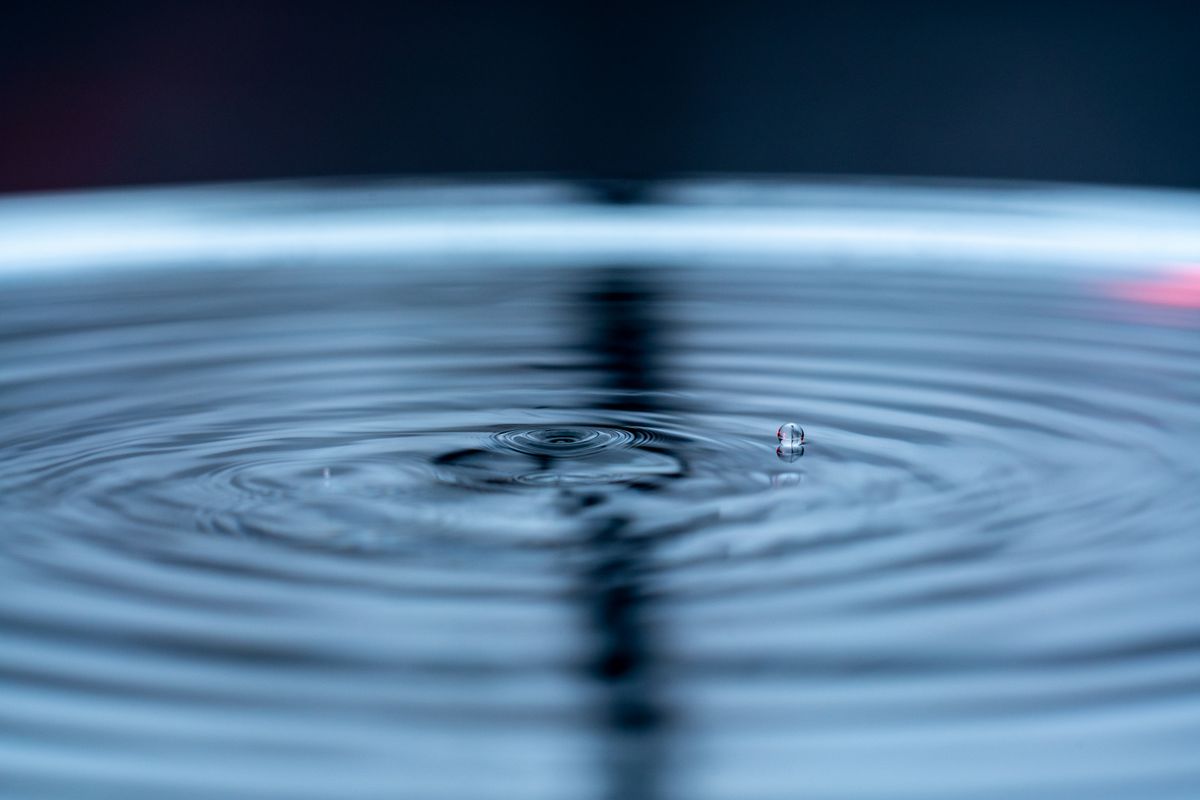
Diffraction of water waves is the easiest wave diffraction to see with your own eyes — and a ripple tank is how physics classrooms have shown it for over a century. Picture a straight line of ripples marching across a shallow tray of water. They hit a barrier with a narrow gap. On the other side, the ripples are no longer straight. They curve outward in circular arcs, spreading into the region behind the barrier. The narrower the gap, the wider the spread. That is diffraction of water waves, and it is the same physics that makes sound bend around a corner and light spread through a narrow slit.
Think of it like a crowd leaving a stadium through a single narrow gate. Before the gate, the crowd is a wide, organised line. As people push through the narrow opening, they fan out in all directions on the other side. The narrower the gate, the wider the fan. A water wave does the same thing when it passes through a slit in a barrier: each point in the gap acts as a new source of circular ripples (the Huygens-Fresnel principle), and those ripples spread into the space beyond.
What is a ripple tank?
A ripple tank is a shallow tray of water — usually glass-bottomed, about 1 metre square — with a light source above and a white screen below. A small electric motor drives a vibrating arm (the dipper) that just touches the water surface, producing a steady train of ripples. The light casts sharp shadows of the wave crests and troughs onto the screen, making the invisible pattern of peaks and dips visible to the whole room.
The key components are simple:
| Component | What it does |
|---|---|
| Glass-bottomed tank | Holds water at a uniform depth (1–2 cm) |
| Vibrating dipper (motor + off-centre weight) | Produces steady waves at a chosen frequency |
| Light source (lamp or xenon arc) | Shines through the water to cast wave shadows on the screen |
| Projection screen | Shows the wave pattern in real time for viewing |
| Barriers and obstacles | Plastic or metal strips to create slits, edges, and obstacles |
You can change the wave frequency (and therefore wavelength) by adjusting the motor speed. You can change wave speed by varying the water depth. And you can insert different barriers to demonstrate the full range of wave phenomena: reflection, refraction, interference, and diffraction.
Demonstration 1: plane wave diffraction through a slit
This is the classic diffraction demonstration and the one every physics student remembers.
Setup: Use the straight dipper (a horizontal dowel) to produce plane waves — parallel straight ripples moving from one side of the tank to the other. Place a barrier with a single adjustable slit in the path of the waves.
What you see: On the far side of the slit, the straight waves become circular. The waves spread into the region behind the barrier. The narrower you make the slit, the more the waves spread.
The physics: This is the direct application of Huygens principle. When plane waves arrive at the slit, only the points inside the gap are free to emit secondary wavelets. If the slit is wide compared to the wavelength, many points contribute and their combined wavefront stays mostly straight. If the slit is narrow (comparable to λ), only a few points contribute and each wavelet spreads in a wide arc. The pattern on the screen is the interference pattern of all those secondary wavelets.
Try this: Gradually close the slit from wide to narrow while watching the projected pattern. You will see the transition from nearly straight transmitted waves to widely spreading curved waves. This is the same transition that happens when you close the aperture on a camera: at small apertures, diffraction blurs the image.
Demonstration 2: diffraction around a single edge
Setup: Remove the slit barrier and replace it with a single straight barrier — a plastic strip about 10 cm wide — placed partway across the tank, leaving one side open.
What you see: Plane waves approach the edge of the barrier. On the far side, the waves curve around the edge and spread into what would otherwise be a shadow region. The pattern is not a sharp cutoff — it is a gradual fade with alternating bands of high and low amplitude.
The physics: This is edge diffraction. The portion of the wavefront that passes the edge unimpeded generates secondary wavelets that curl into the shadow. The closer you are to the geometrical edge of the shadow, the stronger the diffracted wave. In the deeper shadow, only the most oblique wavelets reach, so the amplitude is smaller.
Why it matters: Edge diffraction is how sound bends around a corner and how a knife-edge produces a faint diffraction pattern in laser light. Water waves make this effect large enough to trace with your finger on the projection screen.
Demonstration 3: double-slit interference and Huygens principle
Setup: Use the plane wave dipper again. Place a barrier with two parallel slits in the path of the waves. Start with both slits at roughly the same width, each comparable to the wavelength.
What you see: Beyond the two slits, the diffracted waves from each slit spread and overlap. Where two wave crests meet, the wave height doubles (constructive interference). Where a crest meets a trough, the wave height goes to zero (destructive interference). The result is a distinctive pattern of alternating high- and low-amplitude bands — the classic interference pattern.
The physics: Each slit acts as a point source of circular waves (Huygens principle). When the two sets of circular waves overlap, they interfere. The interference pattern depends on the slit spacing d, the wavelength λ, and the angle θ from the centre line. The condition for constructive interference is d sin θ = mλ, where m = 0, 1, 2… is the order.
This is the water-wave version of Young's double-slit experiment, which proved that light is a wave.
Try this: Keep one slit open and observe the single-slit diffraction pattern. Then open the second slit. The pattern changes from a broad single-slit envelope to a finer double-slit interference pattern within that envelope. This is exactly what happens in optics — and seeing it in water first makes the optical version much easier to understand.
How wavelength controls the diffraction pattern
The most important thing a ripple tank teaches is how wavelength changes diffraction.
| Wavelength relative to slit | Diffraction angle | Pattern shape |
|---|---|---|
| λ ≪ slit width | Very small | Waves pass through nearly straight |
| λ ≈ slit width | Large (30°–90°) | Waves spread widely in circular arcs |
| λ ≫ slit width | Maximum (180°) | Waves emerge as if from a point source |
You can change the wavelength in the tank by adjusting the motor speed. Higher frequency = shorter wavelength = less diffraction. Lower frequency = longer wavelength = more diffraction. This is the same relationship that governs sound and light, but in a ripple tank you can see it happening in real time.
Common misconception: diffraction only happens at small openings
This is not true. Diffraction of water waves happens at every opening and every obstacle. The question is how much. At large openings (a ≫ λ), the bending is too small to notice. At small openings (a ≈ λ or a < λ), the bending dominates. But diffraction is always present — it is not a special effect that switches on below a threshold. The ripple tank makes this clear: even a wide slit produces a tiny amount of curvature at the edges of the transmitted wave.
Where you see water wave diffraction in the real world
The ripple tank is not just a classroom toy. The same physics governs real water wave behaviour:
- Harbour entrances. Engineers design breakwaters knowing that waves diffract through the harbour mouth and spread into the basin. A harbour is a giant ripple tank.
- Coastal erosion. Wave diffraction around headlands and islands determines where wave energy concentrates along a shoreline.
- Tsunami propagation. A tsunami wave has a wavelength of hundreds of kilometres — so large that it diffracts around entire islands and continents.
For more on how diffraction applies to other wave types, see what is diffraction and diffraction of a wave. If you want to try these demonstrations yourself, most school physics departments have a ripple tank, and the components are also available from educational suppliers.
External resources
- Harvard Natural Sciences: Ripple Tank Wave Phenomena — detailed setup instructions and theory
- Wikipedia: Ripple tank — overview of components and demonstrations
Frequently Asked Questions
What is diffraction of water waves?
Diffraction of water waves is the bending and spreading of water ripples when they encounter an obstacle or pass through an opening. It happens because each point on a wavefront acts as a source of secondary circular wavelets (Huygens principle). When part of the wavefront is blocked, the remaining wavelets spread into the shadow region. Water waves diffract strongly because their wavelengths are commonly centimetres to metres — the same scale as many obstacles.
How does a ripple tank demonstrate diffraction?
A ripple tank is a shallow glass tray of water illuminated from above or below. A motor-driven dipper vibrating at a set frequency produces straight (plane) or circular water waves. When barriers with slits, edges, or obstacles are placed in the tank, the waves bend around them and the pattern is projected onto a screen below. This lets the entire class see diffraction in real time.
What determines how much water waves diffract?
The amount of diffraction depends on the width of the slit or obstacle relative to the wavelength. When the slit width (a) is about the same size as the wavelength (λ), diffraction is strong and the waves spread widely. When a ≫ λ, diffraction is weak and the waves pass through with little bending. The same condition governs diffraction for sound, light, and all waves.
What is the difference between water wave diffraction and refraction?
Diffraction is the bending of waves around obstacles or through openings. Refraction is the bending of waves when they change speed — for water waves, this happens when they move from deep to shallow water. In a ripple tank, you can demonstrate both: place a glass plate in the water to create a shallow region and watch the waves bend as they slow down.
Why do water waves diffract more than light waves?
Water waves diffract more than light waves in everyday situations because their wavelengths are much larger. A typical water ripple has a wavelength of 1–10 cm, comparable to the size of a slit or barrier you might set up. Visible light has a wavelength around 500 nanometres — about 100 times thinner than a hair. Everyday obstacles are millions of times larger than light's wavelength, so light diffraction is invisible without special apparatus.
What is the ripple tank formula for wavelength?
The wavelength of water waves in a ripple tank is given by v = fλ, where v is the wave speed, f is the frequency of the dipper, and λ is the wavelength. You can measure λ directly from the projected shadow pattern by measuring the distance between successive bright (or dark) bands. The wave speed v depends on water depth: v ≈ √(gh) for shallow water, where g is gravity and h is the water depth.

About Umar Farooq
Umar Farooq writes in-depth guides on the physics of light and optics — from reflection, refraction, and lenses to diffraction, lasers, and fiber optics, explained from first principles.
Read more about Umar Farooq →