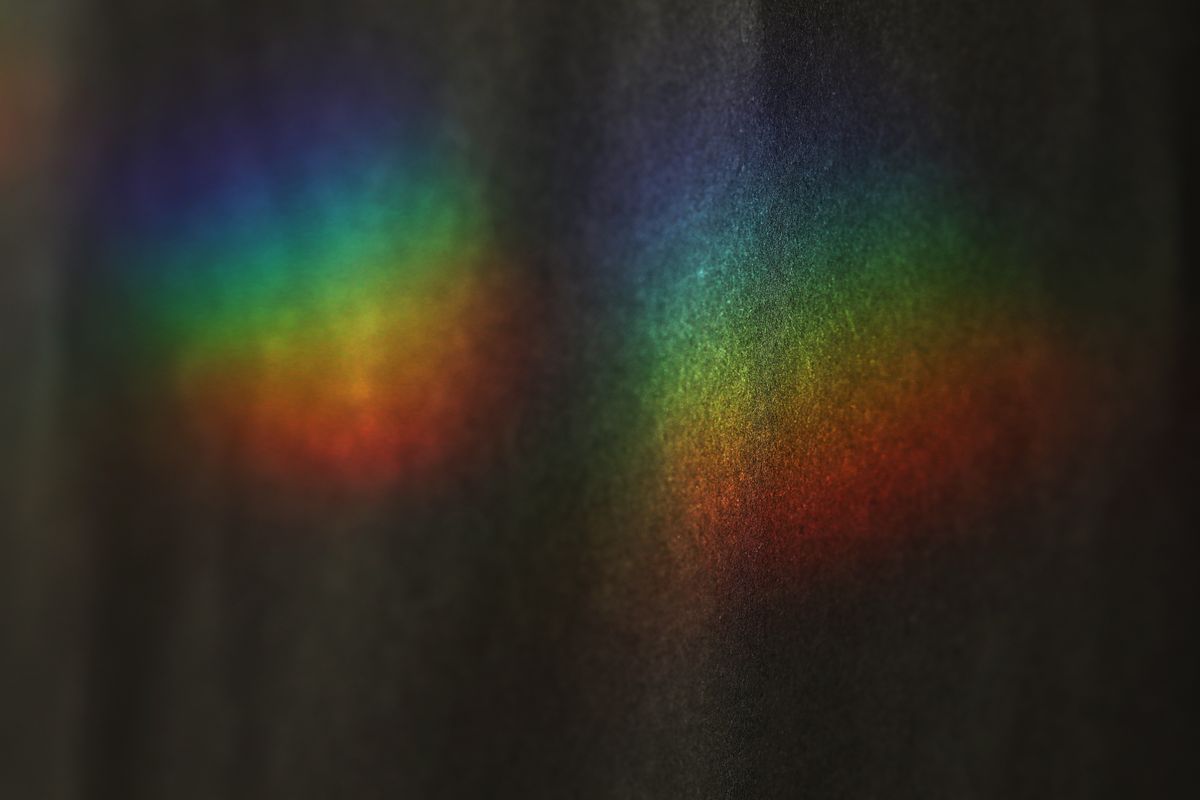
Diffractive optics controls light using microscopic surface patterns instead of curved lenses or mirrors. A diffractive optical element — or DOE — is a flat piece of glass, silicon, or polymer with a carefully engineered surface relief. The features are tiny: for visible and near-infrared light, they range from about 100 nm to a few micrometres. When light hits these patterns, it diffracts in specific directions determined by the pattern geometry. By designing the right pattern, engineers can make a DOE split one laser beam into 100 beams, turn a round spot into a square, or focus light with a surface that is perfectly flat.
Think of it like a rubber stamp. A refractive lens is like a carved spoon — it bends light because of its curved shape. A diffractive element is like a flat stamp with a precise pattern: when you press it onto the wavefront, it leaves an imprint that reshapes the light through interference. The stamp itself is flat. The pattern does all the work.
How does a diffractive optical element work?
A DOE works by introducing a controlled phase shift across the wavefront of light. The surface is divided into microscopic zones, each with a different depth (or, in some designs, a different refractive index). Light passing through each zone travels a slightly different optical path length.
When the wavefronts from all the zones recombine beyond the element, they interfere. Where they are in phase, they reinforce. Where they are out of phase, they cancel. The pattern of interference produces the desired output — a focused spot, a grid of spots, or a shaped beam.
This is not fundamentally different from what a diffraction grating does. The difference is that a DOE is not a simple periodic grating. It is a custom-designed pattern — often generated by computer algorithms — that performs a specific optical function. The design process is essentially the inverse of calculating a diffraction pattern: you start with the desired output and work backwards to the surface relief that produces it.
Diffractive vs refractive optics: key differences
| Property | Refractive optics | Diffractive optics |
|---|---|---|
| Operating principle | Light bends via Snell's law at curved surfaces | Light diffracts via interference from micro-structures |
| Element thickness | Thick (mm–cm), curved surfaces | Thin (µm–mm), flat surfaces |
| Wavelength dependence | Moderate (dispersion) | Strong (designed for a specific λ) |
| Multiple functions | Single beam, single function per element | One DOE can split, shape, and redirect simultaneously |
| Fabrication | Grinding and polishing (macroscopic) | Lithography and etching (microscopic) |
| Cost at scale | High per element | Low per element when replicated |
The main trade-off: refractive elements work well across a broad wavelength range, while DOEs are typically designed for a single wavelength. This is why DOEs are most commonly used with lasers, which are monochromatic.
Types of diffractive optical elements
Diffraction gratings are the simplest DOEs — a periodic array of lines or grooves that disperses light into its component wavelengths. They are used in spectrometers and monochromators.
Fresnel zone plates focus light using concentric circular zones. The zones alternate between transparent and opaque (or between different phase depths). Light diffracted from adjacent zones arrives in phase at the focal point. Zone plates are used in X-ray microscopy where conventional lenses cannot be made.
Beam splitters (fan-out gratings) divide a single incident laser beam into an array of beams — typically 2 × 2, 3 × 3, or larger. The beams can be equal in intensity or weighted as needed. Applications include parallel laser processing and structured-light 3D sensing.
Beam shapers convert a Gaussian laser beam (brightest in the centre) into a uniform-intensity flat-top beam — essential for lithography, welding, and medical laser treatments.
Diffractive diffusers spread light over a controlled angular range to create uniform illumination. Unlike ground-glass diffusers, which scatter randomly, diffractive diffusers produce a precisely defined pattern.
Diffractive lenses focus light using a flat surface with concentric phase zones — effectively a Fresnel zone plate optimised for high efficiency. They are much thinner than conventional refractive lenses.
How DOEs are fabricated
The manufacturing process is borrowed from the semiconductor industry. A typical fabrication sequence:
- Design. Computer algorithms calculate the surface relief needed to produce the desired optical function.
- Mask writing. The pattern is transferred to a photomask using electron-beam lithography.
- Photolithography. The mask pattern is projected onto a photosensitive coating on the substrate.
- Etching. The pattern is transferred into the substrate using reactive-ion etching (dry etching) or wet chemical etching.
- Replication. For volume production, the master DOE is used to create nickel shims for injection moulding or UV embossing — replicating thousands of copies at low cost per element.
The minimum feature size is limited by the Abbe diffraction limit: roughly λ / (2 NA) for the lithography system. For visible light, this means features down to about 200 nm are possible with standard UV lithography, and below 100 nm with advanced techniques.
5 applications of diffractive optics
1. LiDAR and 3D sensing. DOEs in automotive LiDAR systems split a single laser into multiple beams or project structured-light patterns onto the scene. The compact size and low weight of DOEs are critical for integrating into vehicles and consumer devices.
2. Laser material processing. Beam shapers and fan-out gratings enable parallel laser drilling, cutting, and welding. A single laser can be split into dozens of beams, dramatically increasing throughput.
3. Spectroscopy. Diffraction gratings (the most widely used DOEs) disperse light into its spectrum for chemical analysis, environmental monitoring, and astronomical observation.
4. Medical lasers. DOEs shape laser beams for dermatology, ophthalmology, and dental treatments — converting Gaussian beams into uniform profiles for even tissue exposure.
5. Optical communications. Grating couplers couple light between optical fibres and photonic integrated circuits. They are essential components in silicon photonics for high-speed data transmission.
Common misconception: DOEs are the same as holograms
Holograms and DOEs both use interference and diffraction, but they are not the same thing. A hologram records the interference pattern between an object beam and a reference beam — it is a photographic record of a real scene. A DOE is a computer-designed phase pattern optimised to perform a specific function, such as splitting or shaping a laser beam. While a hologram recreates the image of an object, a DOE manipulates light in a precisely engineered way. The two technologies overlap — computer-generated holograms are essentially DOEs — but the intent and design process are different.
For the physics of diffraction that makes DOEs possible, see what is diffraction and what is a diffraction grating. For more on the Fraunhofer diffraction model used in DOE design, our guide on Fraunhofer vs Fresnel diffraction covers the theory.
External resources
- ScienceDirect: Diffractive Optics — Overview — comprehensive academic treatment of DOEs
- Ansys: What is Diffractive Optics? — industry guide with beam shaping and diffuser applications
- NIL Technology: Diffractive Optical Elements — fabrication process and real DOE examples
Frequently Asked Questions
What is diffractive optics?
Diffractive optics is a branch of optics that uses micro-structured surface patterns to control light through diffraction. Unlike refractive optics (which bends light by slowing it in a curved lens) or reflective optics (which bounces light off mirrors), diffractive optics splits and redirects light by creating precise interference patterns. The surface features — typically etched into glass, silicon, or polymer — are comparable in size to the wavelength of light, ranging from about 100 nm to tens of micrometres.
How does a diffractive optical element (DOE) work?
A DOE works by imprinting a specific phase pattern onto an incoming light wave. When the wave passes through or reflects off the micro-structured surface, different parts of the wavefront experience different phase delays. After the element, the wavefront recombines through interference. By carefully designing the pattern, engineers can make the light split into multiple beams, focus to a point, form a specific shape, or produce a uniform intensity distribution.
What is the difference between diffractive and refractive optics?
Refractive optics uses curved surfaces (like a conventional lens) to bend light gradually across a large area. The bending depends on the refractive index of the material and follows Snell's law. Diffractive optics uses flat surfaces with microscopic patterns that redirect light by diffraction. DOEs are thinner, lighter, and can perform functions impossible with refractive elements — such as splitting one beam into many. However, DOEs are strongly wavelength-dependent: a DOE designed for a red laser will not work correctly with blue light.
What are the types of diffractive optical elements?
Common types include diffraction gratings (periodic lines that disperse light), Fresnel zone plates (circular rings that focus light), beam splitters (fan-out gratings that create arrays of beams), beam shapers (convert Gaussian to flat-top profiles), diffusers (homogenise light over a wide angle), and diffractive lenses (flat lenses that focus without curvature). More advanced types include computer-generated holograms, metalenses, and grating couplers for photonic integrated circuits.
What is the Abbe diffraction limit?
The Abbe diffraction limit, formulated by Ernst Abbe in 1873, states that the smallest resolvable feature in a conventional optical microscope is approximately d = λ / (2 NA), where λ is the wavelength of light and NA is the numerical aperture of the objective. For visible light, this limit is roughly 200 nm. The diffraction limit sets the minimum feature size that a diffractive optical element can resolve, and also the minimum spot size that a diffractive lens can focus to.
What are the limitations of diffractive optics?
The main limitations are wavelength sensitivity (a DOE optimised for one wavelength performs poorly at others), zero-order diffraction losses (some light passes straight through without being diffracted, especially at non-optimal wavelengths), and fabrication complexity (high-precision etching or lithography is required). DOEs also tend to have lower overall efficiency than simple refractive lenses for single-beam focusing tasks.

About Umar Farooq
Umar Farooq writes in-depth guides on the physics of light and optics — from reflection, refraction, and lenses to diffraction, lasers, and fiber optics, explained from first principles.
Read more about Umar Farooq →