The single slit diffraction equation a sin θ = mλ predicts exactly where the dark fringes appear when light passes through a narrow opening. Picture a laser shining at a slit the width of a human hair. Behind the slit, the light does not form a sharp stripe on the screen. It spreads into a pattern: a bright central band with fainter bands on either side, separated by strips of darkness. The narrower the slit, the wider the spread. This is single-slit diffraction, and it is the foundation of understanding all diffraction patterns — including the double-slit and the diffraction grating. Here is the equation, the derivation from first principles, and how to work with real numbers.
Think of the slit divided into halves, like a queue at a ticket booth split into two lines. For every person in the front half, there is a matching person in the back half whose path to the screen is exactly half a wavelength longer. They cancel each other. This pairing is the heart of the derivation.
The single slit diffraction pattern
When monochromatic light passes through a single narrow slit and hits a distant screen, you see:
- A bright central maximum — the widest and brightest feature, twice the width of any other fringe.
- Dark fringes (minima) on either side at specific angles.
- Secondary maxima between the dark fringes, each fainter than the last.
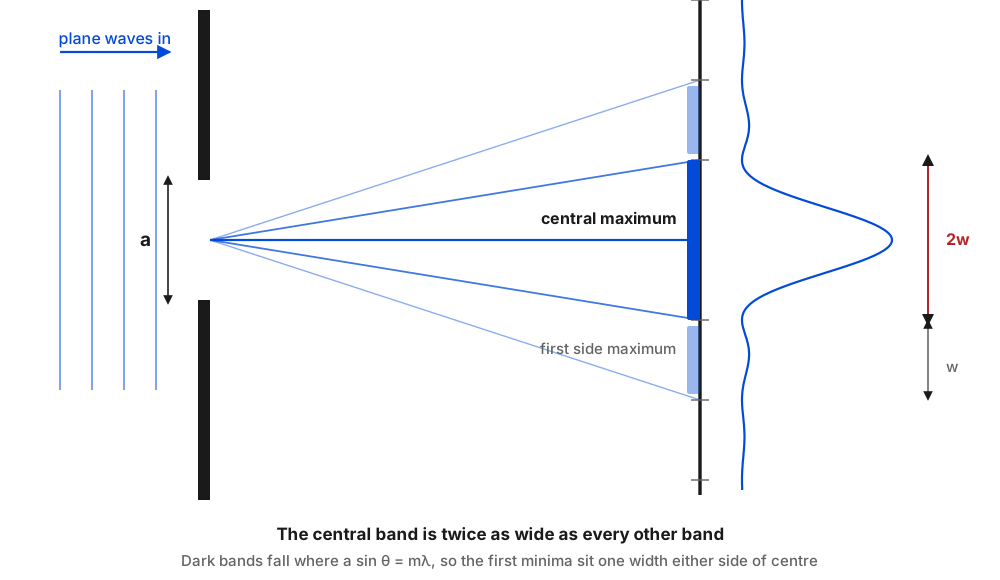
The first secondary maximum has only about 4.5% of the central peak's intensity. The second is about 1.6%. By the third or fourth, you can barely see them. Most of the light energy is in the central maximum.
The pattern is symmetrical. The angles of the minima on the left match those on the right.
The single slit diffraction equation: condition for minima
The equation for the dark fringes (minima) is:
a sin θ = mλ
- a = width of the slit
- θ = angle from the central axis to the minimum
- m = order number (1, 2, 3, ...) — note that m = 0 is NOT a minimum; the centre is always bright
- λ = wavelength of the light
For the first minimum (m = 1), the angle is given by sin θ₁ = λ/a. The central maximum is the region between the first minima on either side, so its angular width is 2θ₁. For small angles, sin θ ≈ θ, so θ₁ ≈ λ/a.
This means: narrower slit → larger θ₁ → wider central maximum. A slit of width 0.1 mm with red light (λ = 632.8 nm) gives θ₁ ≈ 0.36°. Halving the slit to 0.05 mm doubles the angle to about 0.72°.
Derivation from Huygens principle
Here is how the equation comes from first principles.
Step 1: Divide the slit into two equal halves. Imagine the slit of width a split into a top half and a bottom half.
Step 2: Pair up points. For every point in the top half, there is a corresponding point in the bottom half at a distance a/2 below it.
Step 3: Find the path difference. At an angle θ, the ray from the lower point travels an extra distance of (a/2) sin θ compared with the ray from the upper point.
Step 4: Set the cancellation condition. When this extra distance equals half a wavelength (λ/2), the waves arrive exactly out of phase and cancel:
(a/2) sin θ = λ/2 ⟹ a sin θ = λ
This is the first minimum. The pairing works for every corresponding point in the two halves, so the entire slit cancels at this angle.
Step 5: For higher minima, divide the slit into 2m equal parts. For m = 2, divide into four parts and pair the top quarter with the second quarter, and the third quarter with the fourth. This gives a sin θ = 2λ. In general:
a sin θ = mλ (m = 1, 2, 3, ...)
Intensity formula
The full intensity distribution is given by:
I = I₀ [sin(α) / α]² where α = (πa / λ) sin θ
At the centre (θ = 0), α = 0 and the limit of sin(α)/α is 1, so I = I₀. This is the central maximum — the brightest point in the pattern.
Minima occur when α = mπ (m = 1, 2, 3, ...), which gives a sin θ = mλ.
Secondary maxima occur approximately at α ≈ (m + ½)π for m = 1, 2, 3, ..., but their positions are not exact because the sinc² function is not perfectly periodic. The first few occur at roughly ±1.43π, ±2.46π, ±3.47π.
Worked example
A helium-neon laser (λ = 632.8 nm) shines through a slit of width a = 0.08 mm. A screen is placed 1.5 m behind the slit.
Find the position of the first minimum.
- First minimum condition: a sin θ₁ = λ
- sin θ₁ = λ / a = 632.8 × 10⁻⁹ / 0.08 × 10⁻³ = 0.00791
- θ₁ ≈ 0.453°
- Using the small-angle approximation, y₁ = L tan θ₁ ≈ L sin θ₁ = 1.5 × 0.00791 = 0.0119 m = 11.9 mm
Width of the central maximum: 2 × 11.9 mm = 23.8 mm.
Find the position of the second minimum.
- a sin θ₂ = 2λ
- sin θ₂ = 2 × 632.8 × 10⁻⁹ / 0.08 × 10⁻³ = 0.01582
- y₂ = 1.5 × 0.01582 = 0.0237 m = 23.7 mm
The second minimum is at 23.7 mm from the centre. The first secondary maximum sits between y₁ = 11.9 mm and y₂ = 23.7 mm.
Comparison: single-slit vs double-slit vs diffraction grating
| Feature | Single-slit | Double-slit | Diffraction grating |
|---|---|---|---|
| Number of sources | Continuous across one slit | Two slits | Hundreds of slits |
| Central maximum | Twice as wide, much brighter | Same width as others | Same width as others |
| Fringe spacing | Even in angle, not position | Even on screen | Even on screen |
| Intensity drop-off | Rapid (∝ 1/θ²) | Slow (∝ cos²) | Very slow (many orders) |
| Minima equation | a sin θ = mλ | d sin θ = (m+½)λ (dark) | d sin θ = mλ (bright) |
The single slit pattern is the envelope that shapes the double-slit and grating patterns. In any multiple-slit experiment, the overall intensity is the single-slit diffraction pattern multiplied by the interference pattern from the slits. You cannot fully understand gratings or Young's experiment without first understanding single-slit diffraction.
Common applications
- Measuring slit width or object thickness. Diffract a laser off a hair or wire of unknown width. Measure the fringe spacing and use a sin θ = mλ to calculate the width. A human hair typically gives a pattern corresponding to about 50–100 µm.
- Wavelength measurement. If the slit width is known, measure the fringe positions and solve for λ.
- Resolution limits. The Airy disc from a circular aperture (the 2D version of single-slit) sets the fundamental resolution limit for telescopes and microscopes. The Rayleigh criterion states that two points are just resolved when the central maximum of one falls on the first minimum of the other: θ = 1.22 λ/D.

Common misconception: constructive interference formula
Many sources list a sin θ = (m + ½)λ as the formula for bright fringes in single-slit diffraction. This is not quite right. It gives the approximate positions of the secondary maxima, but the exact positions are given by solving d/dα [sin(α)/α]² = 0 — a condition that does not land exactly at (m + ½)π. The (m+½) formula comes from double-slit interference, where it is exact. For single-slit, use the sinc² intensity formula for precise positions.
A better approach: remember that single-slit has a clear formula only for minima (a sin θ = mλ). The maxima fall between them but not at neat fractions.
For the full introduction to diffraction, start with our guide on what is diffraction. To see how water, sound, and light waves diffract in different ways, read the diffraction of a wave guide. For the multiple-slit version where hundreds of grooves produce sharp spectra, see the diffraction grating article.
The HyperPhysics single-slit diffraction page provides an interactive calculator with clear geometry. The UNSW Physclips tutorial on single-slit diffraction uses phasor diagrams to show how the sinc² pattern emerges. The Wikipedia diffraction from slits article gives the complete mathematical treatment from Huygens integral to intensity.
Frequently Asked Questions
What is the equation for single-slit diffraction?
The equation for the minima (dark fringes) in single-slit Fraunhofer diffraction is a sin θ = mλ, where a is the slit width, θ is the angle from the central axis to the minimum, m is the order number (1, 2, 3, ...), and λ is the wavelength. There is no m = 0 minimum — the centre is always bright. The intensity pattern follows I = I₀ [sin(α)/α]² where α = (πa/λ) sin θ.
How do you derive the single-slit diffraction formula?
The derivation uses Huygens principle: divide the slit into two equal halves. For the first minimum, a ray from the top of the slit and a ray from the midpoint have a path difference of (a/2) sin θ. When this equals λ/2, they cancel. This gives a sin θ = λ for the first minimum. For higher minima, divide the slit into 2m equal parts, giving a sin θ = mλ.
What does the single-slit diffraction pattern look like?
The pattern has a bright central maximum that is twice as wide as the other bright fringes. On either side, alternating dark and bright fringes decrease rapidly in intensity. The first secondary maxima have about 4.5% of the central peak's intensity, the next about 1.6%. The dark fringes are evenly spaced in angle.
How does slit width affect the diffraction pattern?
A narrower slit produces a wider diffraction pattern. The angular width of the central maximum is 2λ/a (from the first minimum on one side to the first minimum on the other). Halving the slit width doubles the pattern width. When a ≫ λ, the pattern collapses and ray optics applies — the light passes straight through. When a ≈ λ, diffraction is maximum.
What is the intensity formula for single-slit diffraction?
The intensity at angle θ is I = I₀ [sin(α)/α]² where α = (πa/λ) sin θ. At θ = 0, α = 0 and the limit sin(α)/α = 1, so I = I₀ (central maximum). Minima occur at α = mπ (m = 1, 2, 3, ...), which gives a sin θ = mλ. Secondary maxima occur approximately at α ≈ (m + ½)π but are much fainter.
What is the difference between single-slit and double-slit diffraction?
In single-slit diffraction, the fringes come from interference across one continuous wavefront. The central maximum is twice as wide and much brighter than the others. In double-slit, two separate sources produce evenly spaced fringes of roughly equal intensity. The double-slit pattern is actually the single-slit pattern multiplied by a finer interference pattern — each slit has its own diffraction envelope.

About Umar Farooq
Umar Farooq writes in-depth guides on the physics of light and optics — from reflection, refraction, and lenses to diffraction, lasers, and fiber optics, explained from first principles.
Read more about Umar Farooq →