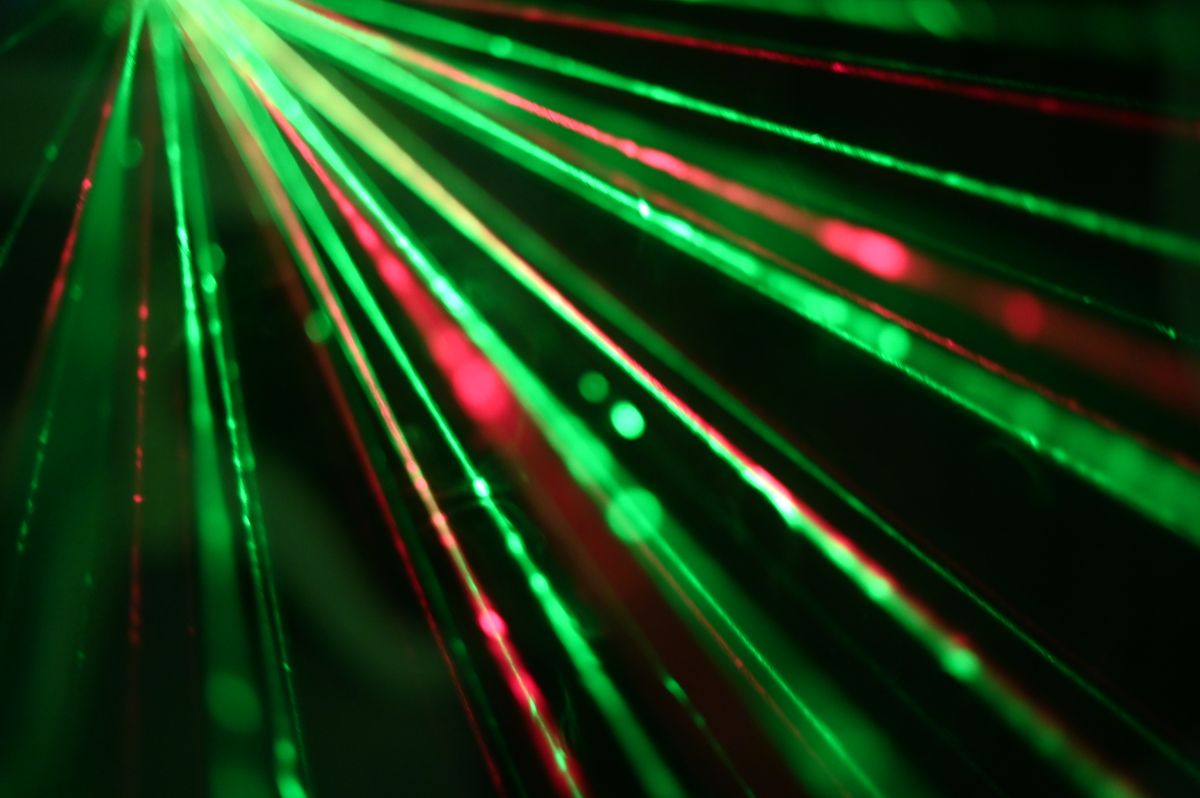
Laser light is not like the light from a bulb or the Sun. It is a single colour, all its waves march precisely in step, and the beam barely spreads even over kilometres. This combination — monochromatic, coherent, collimated — is what makes lasers powerful enough to cut steel, precise enough for eye surgery, and stable enough to measure the distance to the Moon.
Here is what we cover: what laser light is, the 3 components every laser needs, how stimulated emission creates laser light step by step, 5 properties that make laser light unique, how a real laser is built, the history of the first laser, and common misconceptions.
What Is Laser Light?
Laser light is light produced by stimulated emission — a process where one photon triggers atoms to release identical photons, creating a chain reaction.
The word LASER is an acronym: Light Amplification by Stimulated Emission of Radiation.
Unlike ordinary light — where photons have random wavelengths, phases, and directions — laser photons are clones of each other. They share the same colour (wavelength), the same timing (phase), and the same path (direction). This is why a laser pointer spot stays small across a room while a flashlight beam turns into a wide, dim cone after a few metres.
Diagram of a Laser: The 3 Essential Components
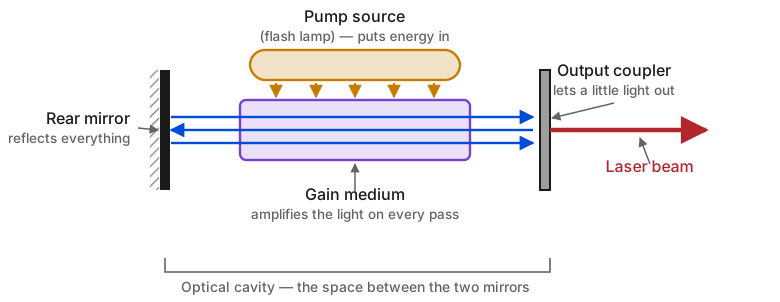
Every laser — from a cheap keychain pointer to a multi-kilowatt industrial cutter — has exactly three parts:
The gain medium. The material that amplifies light. It can be a solid (ruby crystal, Nd:YAG, semiconductor), a gas (helium-neon, CO2), or a liquid (dye). When energised, it becomes capable of releasing photons.
The pump source. The energy supply that excites the gain medium. Usually an electrical current (for gas and diode lasers) or a bright flash lamp (for solid-state lasers). Without pumping, no laser action occurs.
The optical cavity. Two mirrors facing each other with the gain medium between them. One mirror is 100% reflective. The other is partially reflective — it lets some light escape as the laser beam. Light bounces back and forth between these mirrors, passing through the gain medium each time and growing stronger with every pass.
How Stimulated Emission Creates Laser Light
Here is the step-by-step process that turns ordinary atoms into a laser beam:
Step 1. The pump source adds energy to the gain medium. Electrons in the atoms absorb this energy and jump from their normal orbit (ground state) to a higher orbit (excited state).
Step 2. Some of these excited electrons spontaneously fall back to ground state and release a photon. This is spontaneous emission — it happens naturally and is the first photon in the chain.
Step 3. That first photon travels through the gain medium. When it passes near another excited atom, it triggers that atom to release an identical photon. This is stimulated emission — the defining process of laser light. The new photon has the same wavelength, direction, and phase as the original.
Step 4. The two photons continue through the medium, stimulating more emissions. Two become four, four become eight, and so on. The light is amplified with every pass.
Step 5. The photons bounce between the two mirrors at each end of the optical cavity. Each pass through the gain medium adds more energy. After many round trips, the beam is strong enough to escape through the partially reflective mirror. That escaping beam is the laser output.
Picture an ordinary torch as a noisy crowd walking every direction at every pace. A laser is a trained squad marching in lockstep — same stride, same direction, same timing. That is the difference between incoherent light and coherent laser light. (The analogy stops here: a marching squad does not amplify itself, which is what stimulated emission does inside the cavity.)
5 Properties That Make Laser Light Unique
1. Monochromatic
Laser light is a single colour. A helium-neon laser emits at exactly 632.8 nm (red). A green laser pointer emits at 532 nm. Unlike a light bulb that produces a rainbow of wavelengths, a laser produces one precise wavelength. This is essential for applications like spectroscopy, where you need to target specific atomic transitions.
2. Coherent
All the light waves in a laser beam are in phase — the crests and troughs of every wave align. This coherence is what makes laser light so useful for interferometry (measuring tiny distances) and holography. Ordinary light has random phase relationships. See our guide on diffraction gratings for how coherent light creates sharp interference patterns.
3. Collimated
A laser beam barely spreads out. A typical laser pointer beam diverges by less than 1 milliradian — about 3.4 arcminutes. That means a 1 mm beam spreads to only about 1 metre after 1 kilometre. A flashlight beam would be hundreds of metres wide at the same distance. Collimation comes from the parallel mirrors in the optical cavity.
4. High Intensity
Because laser light is concentrated into a small, coherent beam, its power density can be enormous. A 5-watt laser pointer can pop balloons and ignite matches. Industrial lasers deliver kilowatts of power focused to a spot smaller than a millimetre — enough to cut through steel.
5. Directional
Unlike every other light source that emits in all directions, a laser beam travels in one direction. This makes it possible to deliver energy precisely to a target, whether that target is a barcode in a supermarket, a tumour in a hospital, or the retroreflectors left on the Moon by Apollo astronauts.
For a detailed comparison of how lasers differ from other light sources, see our guide on types of light.
How a Real Laser Is Built
A practical laser is more than the three basic components. Here is what is inside a typical solid-state laser:
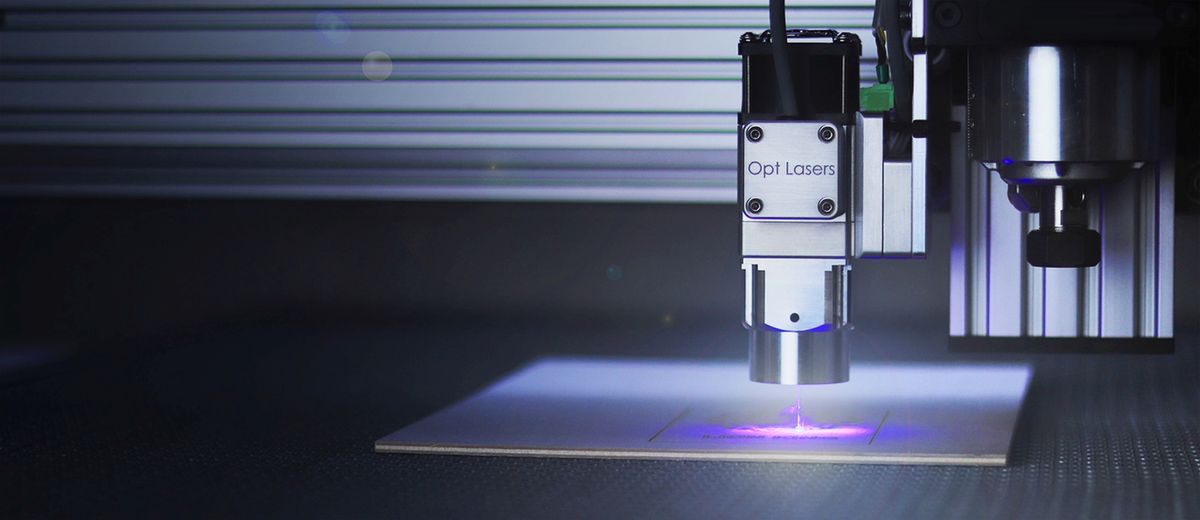
A rod of synthetic crystal (ruby, Nd:YAG, or Ti:sapphire) is the gain medium. It is surrounded by a flash lamp or laser diodes that act as the pump. The rod's ends are polished flat and parallel, coated with reflective layers to form the optical cavity. One end has a partial coating — about 95% reflective — which lets 5% of the light escape as the beam.
Around this core is a cooling system (lasers generate heat), a power supply for the pump, and sometimes a Q-switch or mode-locker to control pulse timing.
In a semiconductor laser diode — the kind in laser pointers, barcode scanners, and fibre-optic communications — the gain medium is a tiny chip of gallium arsenide. The mirrors are the cleaved edges of the chip itself. The entire laser is smaller than a grain of rice.
A Brief History of Laser Light
The idea behind laser light goes back to Albert Einstein, who described stimulated emission in 1917. For decades it remained a theoretical curiosity.
In 1953, Charles Townes built the first maser — the microwave predecessor of the laser. Then on 16 May 1960, Theodore Maiman at Hughes Research Laboratories in Malibu, California, fired up the first working laser. It used a synthetic ruby rod (4 cm long, 0.5 cm diameter) with silvered ends, wrapped in a photographer's flash lamp. When he fired the flash, the ruby emitted a pulse of deep red light at 694 nanometres — lasting only nanoseconds but a hundred thousand times brighter than the Sun for that instant.
Within a decade, lasers were reading barcodes, performing eye surgery, and carrying telephone calls through glass fibres. Today they are everywhere — from Blu-ray players to self-driving car sensors to the Large Hadron Collider.
Read the full story in our article on when lasers were invented.
Common Misconception: A Laser Is Just a Really Bright Flashlight
Many people think a laser is simply a focused, powerful light — like a spotlight on steroids. That misses what makes laser light fundamentally different.
A spotlight shines ordinary incoherent light that happens to be somewhat directional. Its photons are still random in phase and wavelength. You cannot use a spotlight to read a barcode, measure the distance to the Moon, or cut a metal sheet.
A laser produces coherent, monochromatic light. The special properties come from the light itself, not just its brightness. A 5 mW laser pointer has less total power than a flashlight, but it can cause eye damage because all that power is concentrated into a single wavelength and direction that the eye's lens focuses onto a tiny spot on the retina.
The brightness is a side effect of the coherence, not the point of it.
External resources
- HowStuffWorks: How Lasers Work — accessible guide covering laser components, classes, and real-world applications
- NIF's Guide to How Lasers Work (LLNL) — illustrated educational guide from the Lawrence Livermore National Laboratory
- Britannica: How Does a Laser Work? — encyclopedia entry with laser physics, diagrams, and historical context
Frequently Asked Questions
What is laser light?
Laser light is light that is monochromatic (single wavelength), coherent (waves in phase), and collimated (tightly directional). Unlike light from a bulb or the Sun, laser light does not spread out significantly and can be focused to an extremely small spot. The word LASER stands for Light Amplification by Stimulated Emission of Radiation.
How does laser light work?
Laser light works through a process called stimulated emission. Atoms in a gain medium are energised by a pump source, pushing electrons into higher orbits. When a passing photon with the right energy hits an excited atom, it triggers the atom to emit an identical photon — same wavelength, same direction, same phase. These photons bounce between mirrors in an optical cavity, amplifying until a coherent beam exits through a partially reflective mirror.
What are the 3 components of a laser?
Every laser has three essential components: a gain medium (solid, liquid, or gas that amplifies light), a pump source (electrical current or flash lamp that energises the medium), and an optical cavity (two mirrors at each end — one fully reflective, one partially reflective — that bounce light back and forth to amplify it).
What is the difference between laser light and ordinary light?
Ordinary light (from the Sun or a bulb) is incoherent — its waves are jumbled with different wavelengths and phases, and it spreads in all directions. Laser light is coherent (all waves in step), monochromatic (one colour/wavelength), and collimated (tight beam that barely spreads). These properties make laser light focusable to a microscopic spot and able to travel vast distances without significant divergence.
What is laser light made of?
Laser light is made of photons — the same fundamental particles as all light. What makes laser photons special is that they are identical to each other: same energy, same wavelength, same phase, and same direction. This uniformity is what gives laser light its coherence and power.
Is laser light visible?
Not all laser light is visible. Common visible laser colours include red (635–650 nm), green (532 nm), and blue (445 nm). However, many lasers operate in the infrared (e.g., 780 nm CD lasers, 1064 nm Nd:YAG) or ultraviolet (e.g., 193 nm excimer lasers) — invisible to the human eye.
What colour laser is most powerful?
Power depends on the laser design, not the colour. However, in practical terms, infrared lasers (CO2 at 10.6 µm and fiber lasers at 1 µm) achieve the highest continuous power levels — industrial CO2 lasers can exceed 10 kW. For visible lasers, green (532 nm) appears brighter to the human eye per unit of power than red or blue, but actual power output depends on the specific laser.
How was laser light discovered?
The theoretical foundations were laid by Albert Einstein in 1917 when he described stimulated emission. The first working laser was built by Theodore Maiman on 16 May 1960 at Hughes Research Laboratories, using a synthetic ruby crystal as the gain medium and a flash lamp as the pump. It produced a pulsed red beam at 694 nm and lasted only a few nanoseconds.

About Umar Farooq
Umar Farooq writes in-depth guides on the physics of light and optics — from reflection, refraction, and lenses to diffraction, lasers, and fiber optics, explained from first principles.
Read more about Umar Farooq →