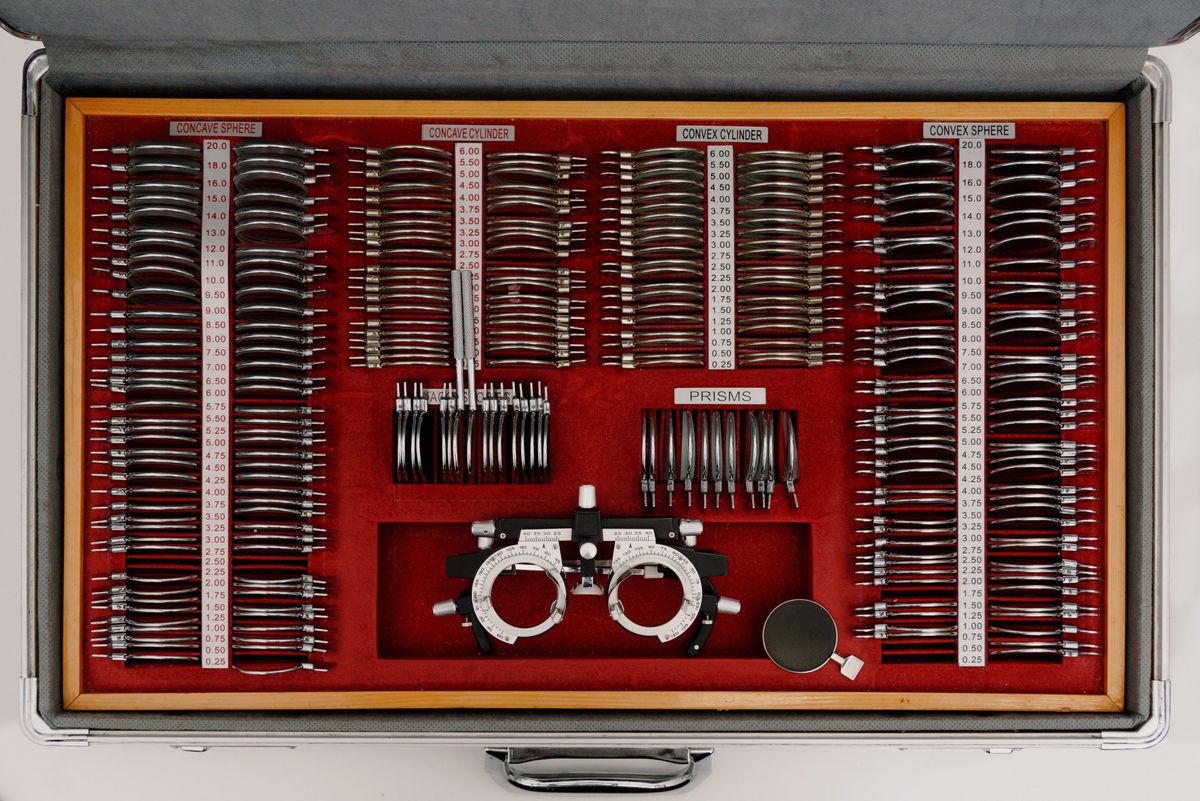
A concave lens is a transparent lens that is thinner in the middle and thicker at the edges. When light passes through it, the lens bends the rays outward — it diverges them — so they spread apart instead of meeting at a point. This is why it is called a diverging lens. A concave lens is the unsung hero of optics: it corrects myopia (nearsightedness), gives you a wide-angle view through a door peephole, and shapes the beam of a flashlight. Here is how it works, the different types, how ray diagrams work, and where you use it every day.
Think of a concave lens as the optical opposite of a funnel. Where a convex lens funnels light inward to a point, a concave lens does the reverse — like a garden spray nozzle that spreads water in a wide cone. The middle of the lens is thinner, so light passing through the centre bends less, while the thicker edges push the outer rays further outward. The net effect: parallel rays enter, and diverging rays leave.
What is a concave lens? Definition
A concave lens is a piece of transparent material — usually glass or plastic — with at least one surface curved inward. The centre is thinner than the edges. When light rays enter it, they refract toward the normal at the first surface and away from the normal at the second. Because of the inward curve, the combined effect of these two bends is that the rays spread apart on the other side.
The point where the outgoing rays appear to come from — if you trace the diverging rays backward — is called the virtual focus (or principal focus). The distance from the centre of the lens to this virtual focus is the focal length. The focal length is always negative.
This lens type has two virtual focal points — one on each side — at equal distances from the centre. Unlike a convex lens, these focal points are virtual: the rays never actually meet there, but they look like they came from there.
How does a concave lens work?
A concave lens works by refraction, just like any other lens. Light travels slower in glass (about 197,000 km/s in crown glass) than in air (299,792,458 m/s in vacuum — fast enough to circle the Earth about 7.5 times in one second). When a light ray hits the curved inward surface, it bends toward the normal as it enters the glass. But because the surface curves inward, the ray hits the second surface at a steeper angle and bends away from the normal — and away from the centre line — as it exits. The combined effect of the two bends is that the ray diverges from the centre.
The stronger the inward curve (shorter radius of curvature), the more the rays spread apart. A very shallow curve produces only slight divergence; a deep curve produces wide divergence. This is why your myopia prescription has a negative power — the minus sign means the lens is diverging light before it reaches your eye.
The BBC Bitesize guide on lenses explains how converging and diverging lenses compare side by side.
Types of concave lenses
These lenses come in three main shapes, though all work on the same diverging principle:
Biconcave lens (double concave). Both surfaces curve inward. This is the most symmetrical type and produces the strongest divergence for a given curvature. It is common in simple optical systems where maximum divergence is needed.
Plano-concave lens. One surface is flat (plane) and the other curves inward. These are used when you need to spread a beam of light in one direction or when one side of the lens must sit against a flat mount. They appear in beam expanders and laser systems.
Concavo-convex lens (meniscus). One surface curves inward (concave) and the other curves outward (convex), but the lens is still thinner in the centre than at the edges. These are used in combination lenses where you need divergence with reduced spherical aberration.
Key terms
- Optical centre: the central point of the lens. Light passing through this point is not bent.
- Principal axis: the imaginary line passing through the centre of the lens perpendicular to both surfaces.
- Virtual focus (F): the point from which diverging rays appear to originate after passing through the lens.
- 2F: the point at twice the focal length from the lens centre. Important for image formation.
- Focal length (f): the distance from the optical centre to the virtual focus. Always negative for concave lenses.
- Aperture: the diameter of the lens. A larger aperture lets in more light and can produce wider divergence.
Image formation
The image is always virtual, upright, and diminished — regardless of where the object is placed. This is one of the key differences from a convex lens. Here is how it works for each position along the principal axis:
| Object Position | Image Position | Image Nature | Image Size | Example |
|---|---|---|---|---|
| At infinity | At F | Virtual, upright | Point-sized | Distant star through concave lens |
| Beyond 2F | Between F and O | Virtual, upright | Diminished | Landscape through a peephole |
| At 2F | Between F and O | Virtual, upright | Diminished | Scene at twice focal length |
| Between 2F and F | Between F and O | Virtual, upright | Diminished | Typical peephole viewing |
| At F | Between F and O | Virtual, upright | Highly diminished | Extreme wide-angle |
| Between F and O | Between F and O | Virtual, upright | Diminished | Object close to lens |
The key takeaway: a concave lens always produces a virtual, upright, diminished image. The image is always on the same side of the lens as the object and is always smaller than the object.
Concave lens ray diagram
The ray diagram works with three principal rays:
- A ray parallel to the principal axis refracts as if it came from F on the object side.
- A ray through the optical centre passes straight through without bending.
- A ray directed toward F on the other side refracts parallel to the principal axis.
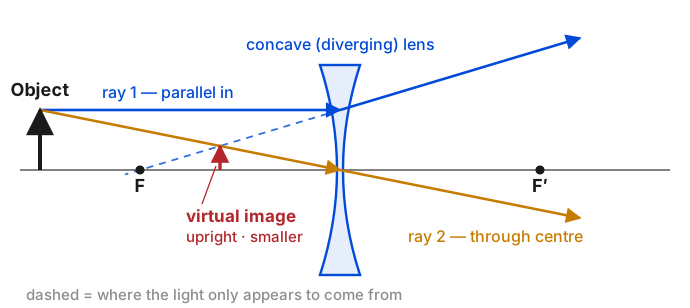
To draw a ray diagram: start with the object, draw these three rays, and look for where the outgoing rays appear to originate. The rays diverge after passing through, so you extend them backward (with dashed lines) to find the virtual image. The image is always on the same side as the object, upright, and smaller than the object.
Understanding these three rays lets you draw a ray diagram for any object position in about five minutes.
Formulas
The same formulas that govern convex lenses also apply here, but the sign convention is critical:
Lens formula: 1/f = 1/v - 1/u
Where f is the focal length (negative for a diverging lens), v is the image distance, and u is the object distance. Here, v is always negative — the image is virtual and on the same side as the object.
Magnification formula: M = v/u = hi/ho
The magnification is always less than 1 and positive. This means the image is always smaller than the object (diminished) and upright (positive sign). The average peephole lens produces a magnification of about 0.2x to 0.5x — the visitor appears much smaller than life size, which is exactly what lets you see the whole hallway.
Power of a lens: P = 1/f (in metres)
The power is measured in dioptres (D). A lens with a focal length of -0.5 m has a power of -2 D. The negative sign indicates a diverging lens. Your eyeglass prescription for myopia will show a negative power — for example, -3.00 D means you need a concave lens with a focal length of about -0.33 m.
Uses
Concave lenses have fewer standalone uses than convex ones, but they are indispensable for specific applications:
Eyeglasses for myopia (nearsightedness). This is the most common use. In myopia, the eyeball is too long or the cornea is too curved, so the image forms in front of the retina. This lens diverges light before it enters the eye, shifting the image backward onto the retina. Around 30% of the population in the UK and the US is affected by myopia — and virtually all of them rely on these lenses in their glasses or contact lenses.
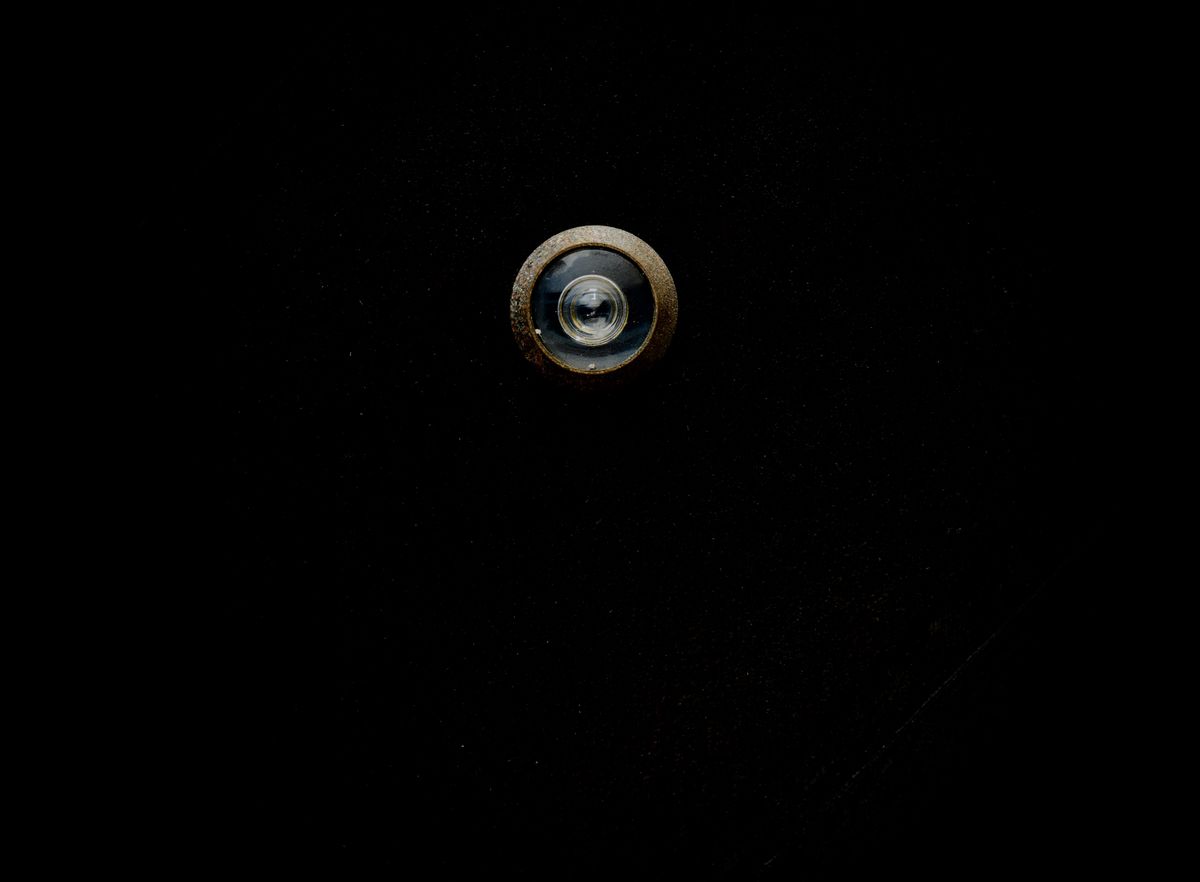
Door peepholes (door viewers). A door peephole uses a diverging lens on the outside to capture a wide-angle, diminished image of the visitor, and a convex lens on the inside to magnify it. The outer lens provides the wide field of view — you see the entire hallway, not just the person's nose.
Flashlights and headlamps. Some flashlights use this type of lens in front of the bulb to spread the beam into a wide, even floodlight rather than a narrow spot. This creates the broad, even illumination you want when walking at night or working close-up.
Laser beam expanders. A diverging lens can expand a narrow laser beam into a wider, safer beam. The laser is first diverged by the lens, then collimated by a convex one. This technique is used in laser levelling tools, barcode scanners, and LIDAR systems.
Optical instruments (aberration correction). These lenses are used inside cameras, microscopes, and telescopes to correct spherical aberration. A convex lens can suffer from spherical aberration — rays at the edge focus at a different point than rays at the centre — and pairing it with a diverging lens cancels this effect. The HyperPhysics page on ray diagrams provides a more detailed breakdown of how these lenses form images in such systems.

Common misconception: "a concave lens is just a convex lens in reverse"
Many people think a concave lens is exactly a convex lens flipped around. This is true in terms of shape, but the image-forming behaviour is fundamentally different. A convex lens can produce real images (projectable onto a screen) and virtual images depending on the object distance. A concave lens produces only virtual images — you can never project its image onto a screen because the rays never actually meet.
A related myth: "both lens types follow the same rules — just with swapped signs." The sign convention is real, but the physics difference goes deeper. A convex lens can magnify, reduce, or produce same-size images. A concave lens has only one mode: diminished, upright, and virtual. Always. The lens formula produces the same qualitative result for every object position, which is why it is less versatile but more predictable than a convex one.
Summary
A concave lens is a diverging lens that is thinner in the middle and spreads light outward. It comes in three types (biconcave, plano-concave, and concavo-convex) and always produces a virtual, upright, diminished image regardless of object position. The image forms on the same side of the lens as the object, and the focal length is always negative. These lenses are used in eyeglasses for myopia, door peepholes, flashlights, laser beam expanders, and combination lens systems. For the opposite, see our guide on the convex lens. The physics behind both types — how light bends through transparent materials — is covered in our guide on how lenses use refraction.
Frequently Asked Questions
What is a concave lens?
A concave lens is a transparent lens that is thinner in the middle than at the edges. It is also called a diverging lens because it bends parallel light rays outward so they spread apart. Concave lenses are used in eyeglasses for myopia (nearsightedness), door peepholes, flashlights, and laser beam expanders.
What type of image does a concave lens produce?
A concave lens always produces a virtual, upright, and diminished image. Unlike a convex lens, it can never produce a real image because the rays diverge and never actually meet. The image is always on the same side of the lens as the object.
Why is a concave lens called a diverging lens?
A concave lens is called a diverging lens because it refracts parallel rays of light so they diverge (spread apart) on the other side. The outgoing rays appear to come from a virtual focus on the object side. The opposite type — a convex lens — brings rays together, so it is called a converging lens.
What are the uses of a concave lens?
Concave lenses are used in eyeglasses to correct myopia (nearsightedness), door peepholes to give a wide-angle view, flashlights to spread light into a flood beam, laser beam expanders, and combined with convex lenses in optical instruments to correct aberrations.
What is the difference between a concave and a convex lens?
A concave lens is thinner in the middle and diverges light — it always produces a virtual, upright, diminished image and has a negative focal length. A convex lens is thicker in the middle and converges light to a point — it can produce real or virtual images and has a positive focal length.
What is the lens formula for a concave lens?
The lens formula is 1/f = 1/v - 1/u, where f is the focal length, v is the image distance, and u is the object distance. For a concave lens, f is always negative. The magnification formula is M = v/u, and the result is always positive and less than 1, confirming the image is upright and diminished.

About Umar Farooq
Umar Farooq writes in-depth guides on the physics of light and optics — from reflection, refraction, and lenses to diffraction, lasers, and fiber optics, explained from first principles.
Read more about Umar Farooq →