Light bends — refracts — because it changes speed when crossing from one transparent material into another, and it hits the boundary at an angle. If the speed didn't change, there'd be no bend. If it hit straight on, there'd be no bend either. Both conditions are needed, and the amount of bending follows a precise rule called Snell's law. Here's the full physics from first principles.
What causes refraction?
What causes refraction is a change in the speed of light. Light travels at 299,792,458 metres per second in a vacuum — fast enough to circle the Earth about 7.5 times in one second. But inside a material like glass or water, it slows. In water (refractive index 1.333) it drops to about 225,000 km/s; in crown glass (1.52) to about 197,000 km/s; and in diamond (2.417) to roughly 124,000 km/s.
Here's the picture that makes it click. Imagine a car rolling at an angle off smooth tarmac onto soft sand. The wheel that reaches the sand first slows first, so the whole car pivots toward that side. Light does the same at the surface of a pond: the part of the wavefront that reaches the water first slows first, and the beam swings. Physicists call this bending refraction, and it happens for any wave — light, sound, or water — that crosses a speed-changing boundary.
But there's a subtlety: the car isn't "dragged" sideways. Light isn't dragged either. A common misconception is that light slows in glass because photons bounce off atoms like billiard balls. That's not it — bouncing would scatter the light randomly, not send it cleanly in a new direction. In reality, the light wave drives the electric charges in the material, those charges re-radiate their own tiny waves, and the combination of the original and re-radiated waves travels more slowly. In plain terms, the medium responds to the wave, and the combined wave moves slower — so the beam turns. (The Wikipedia article on refraction and Britannica's refraction entry go deeper into the wave mechanism.)
Two conditions required for refraction
For what causes refraction to happen at all, two conditions must be met simultaneously.
Condition 1: the light must change speed. If the two media have the same refractive index — think light moving between two identical panes of glass separated by air — there's no speed change and no refraction at the second boundary. The beam would simply pass straight through.
Condition 2: the light must approach the boundary at an angle. If the ray hits the surface head-on (along the normal, at 90°), every part of the wavefront enters the new medium at the same instant. The whole front slows together, but nothing pivots. The light keeps going straight.
Both conditions together are what causes refraction. Change speed but hit straight on? No bend. Hit at an angle but don't change speed? No bend. It's only when both are satisfied that the beam changes direction.
Why does light change speed in a different medium?
The deeper answer to what causes refraction lies in what light is. Light is an electromagnetic wave — a self-sustaining ripple of electric and magnetic fields. When it enters a material like water or glass, those oscillating fields interact with the charged particles (mostly electrons) inside the material.
The incoming wave makes the electrons oscillate. Those oscillating electrons emit their own electromagnetic waves, which interfere with the original wave. The resulting combined wave — the superposition of the original plus all the re-radiated waves — has a lower phase velocity. The material hasn't "slowed down" individual photons; it has produced a composite wave that propagates more slowly. When the light leaves the material, the interaction stops, and the speed returns to c.

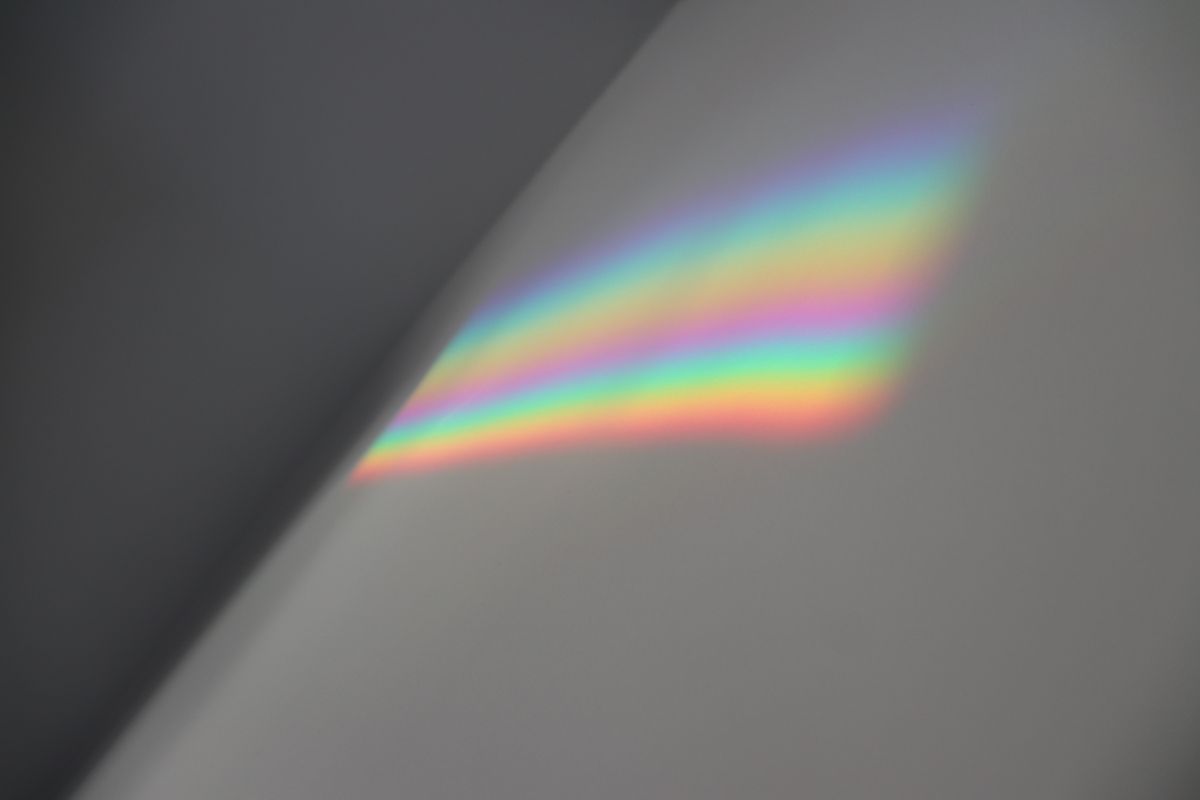
This wave-interference explanation is the honest physics behind what causes refraction. It also explains why different colours bend by different amounts in a prism — a phenomenon called dispersion. Blue light has a higher frequency than red light, interacts more strongly with the material's electrons, and so slows more and bends more. The OpenStax refraction chapter gives a textbook treatment of dispersion and the full mathematical framework.
The wavefront picture: how speed change turns into a bend
The clearest way to see what causes refraction geometrically is to follow a single wavefront.
Imagine a straight line of marching soldiers approaching a patch of mud at an angle. The soldier who steps onto the mud first slows first, while the others keep marching at the original pace. The line pivots toward the mud side. Once all soldiers are on the mud, they're marching in a new, rotated direction.
A wavefront does exactly this. When it meets the boundary at an angle:
- The side that reaches the new medium first changes speed first
- The other side keeps moving at the original speed a little longer
- The whole front rotates
The rotation direction depends on whether the new medium is slower or faster:
- Entering a slower (denser) medium: the wavefront pivots toward the normal — the ray bends toward the perpendicular
- Entering a faster (less dense) medium: the wavefront pivots away from the normal — the ray bends away from the perpendicular
This is why a straw in a glass of water looks bent: light from the underwater part leaves the water (going from slower to faster) and bends away from the normal, so your eye traces it back to a different, shallower position.
Snell's law: the rule that predicts the bend
The exact angle of refraction follows a mathematical relationship discovered by the Dutch mathematician Willebrord Snell in 1621 (and independently by René Descartes in 1637). It's known as Snell's law:
n₁ sin θ₁ = n₂ sin θ₂
Where:
- n₁ and n₂ are the refractive indices of the two media
- θ₁ is the angle of incidence (measured from the normal)
- θ₂ is the angle of refraction
The higher the refractive index, the slower light travels in that medium, and the more the ray bends toward the normal.
Worked example. Suppose light passes from air (n ≈ 1.00) into water (n = 1.333) at 30° to the normal. How much does it bend?
sin θ₂ = (1.00 × sin 30°) ÷ 1.333 sin θ₂ = 0.500 ÷ 1.333 = 0.375 θ₂ ≈ 22°
The light bends toward the normal by about 8°. Going from air into diamond (n = 2.417) at the same angle, it would bend to about 11.9° — nearly three times more, which is why diamonds sparkle so intensely.
What does NOT cause refraction
Now that we've covered what causes refraction, let's clear up what doesn't.
- Density alone. A denser material usually has a higher refractive index, but density isn't the direct cause. The refractive index depends on how the material's electrons respond to the light wave's electric field, not simply on how tightly packed the atoms are.
- Friction or resistance. Light isn't slowed by friction. The slowing is a wave-interference effect, not a drag force.
- The medium "adding colour." When a prism splits white light into colours, it's not adding them. Every colour was inside the white light all along. Newton proved this in the 1660s by recombining the colours back into white with a second prism.
Where you see refraction every day
What causes refraction is at work all around you. Here are some of the most common places:
| Example | What's happening |
|---|---|
| Straw looks bent in water | Light bends away from the normal leaving the water, shifting the apparent position |
| Pool looks shallower than it is | The bottom's reflected light bends away from the surface as it exits, raising the apparent floor |
| Eyeglasses and contact lenses | Curved lenses refract light by precisely the right amount to focus images on the retina |
| Rainbow | Sunlight refracts entering each raindrop, reflects inside, and refracts again on exit — each colour bends differently |
| Mirages on hot roads | Light refracts through layers of air at different temperatures, creating the illusion of water |
| Diamond sparkles | Diamond's high refractive index (2.417) bends light strongly and its small critical angle (24.4°) traps it inside, creating brilliant flashes |
For more of this, see our full collection of refraction examples or the broader guide to the properties of light.
Summary of what causes refraction
What causes refraction comes down to two simple ideas:
- Light changes speed when it enters a different transparent material
- If it hits the boundary at an angle, the asymmetric speed change pivots the wavefront
The pivot direction is always consistent: toward the normal when entering a slower medium, away from the normal when entering a faster one. And the exact amount of bending — every time, in every transparent material — follows Snell's law.
For a broader look at the science built on this principle, start with our guide to what light is or browse the full optics collection.
Frequently Asked Questions
What causes refraction of light?
Refraction is caused by a change in the speed of light as it crosses from one transparent medium into another. If the light hits the boundary at an angle, the side of the wavefront that enters the new medium first changes speed first, causing the whole beam to pivot. Two conditions are required: the light must change speed, and it must approach the boundary at an angle.
Why does light bend when it refracts?
Light bends because different parts of the same wavefront enter the new medium at different times. Picture a car driving from smooth tarmac onto sand at an angle — the wheel that hits sand first slows first, so the car pivots. Light does the same: the part of the wavefront entering the slower medium first slows first, and the beam swings toward the normal.
When does refraction occur?
Refraction occurs whenever a wave passes from one medium into another at an angle and the wave speed differs between the two media. If the wave hits the boundary straight on (perpendicular), it still changes speed but does not change direction. Refraction also affects sound waves and water waves, not just light.
Does light always refract when entering a new material?
No. Light only refracts if it enters the new material at an angle. If the light ray is perpendicular to the surface (along the normal), it passes straight through without bending, even though its speed still changes. At the opposite extreme, if the angle is large enough, the light might reflect entirely instead — a phenomenon called total internal reflection.
What is the difference between reflection and refraction?
Reflection is light bouncing off a surface, returning into the same medium. Refraction is light passing through a boundary into a new medium and bending as it changes speed. In reflection, the angle of incidence equals the angle of reflection. In refraction, the relationship is given by Snell's law: n1 sin θ1 = n2 sin θ2.

About Umar Farooq
Umar Farooq writes in-depth guides on the physics of light and optics — from reflection, refraction, and lenses to diffraction, lasers, and fiber optics, explained from first principles.
Read more about Umar Farooq →