A convex lens and a concave mirror both converge light to a point; a concave lens and a convex mirror both spread it apart. Despite the different physics — refraction vs reflection — the image outcomes are strikingly similar. A lens bends light through a transparent material; a mirror bounces it off a coated surface. Here are the five key differences between lenses and mirrors, how they pair up, and when you would choose one over the other.
Think of a mirror as a door that says "no entry" — the light hits it and turns around. A lens is a door that lets light walk right through, but it changes direction on the way out. Both reshape the light, but by completely different rules. Our concave vs convex lens guide covers the lens-versus-lens comparison; this article steps up to the bigger question of lenses vs mirrors.
Quick comparison table
| Feature | Lens | Mirror |
|---|---|---|
| How it works | Refraction (light passes through) | Reflection (light bounces off) |
| Number of focal points | Two (one each side) | One |
| Focal length sign | Convex = positive, Concave = negative | Concave = positive, Convex = negative |
| Light side | Transparent | Opaque with reflective coating |
| Image types | Real or virtual | Real or virtual |
| Equation | 1/f = 1/v − 1/u | 1/f = 1/v + 1/u |
| Convex form | Converges light | Diverges light |
| Concave form | Diverges light | Converges light |
What is a mirror?
A mirror is a smooth surface coated with a reflective material (usually silver or aluminium) that bounces light back according to the law of reflection: the angle of incidence equals the angle of reflection. There are three main types:
- Plane mirror. A flat surface. It produces a virtual, upright, same-size image. The image appears as far behind the mirror as the object is in front.
- Concave mirror. Curved inward like a cave. It converges parallel light to a focal point in front of the mirror. It can form real or virtual images depending on the object's distance.
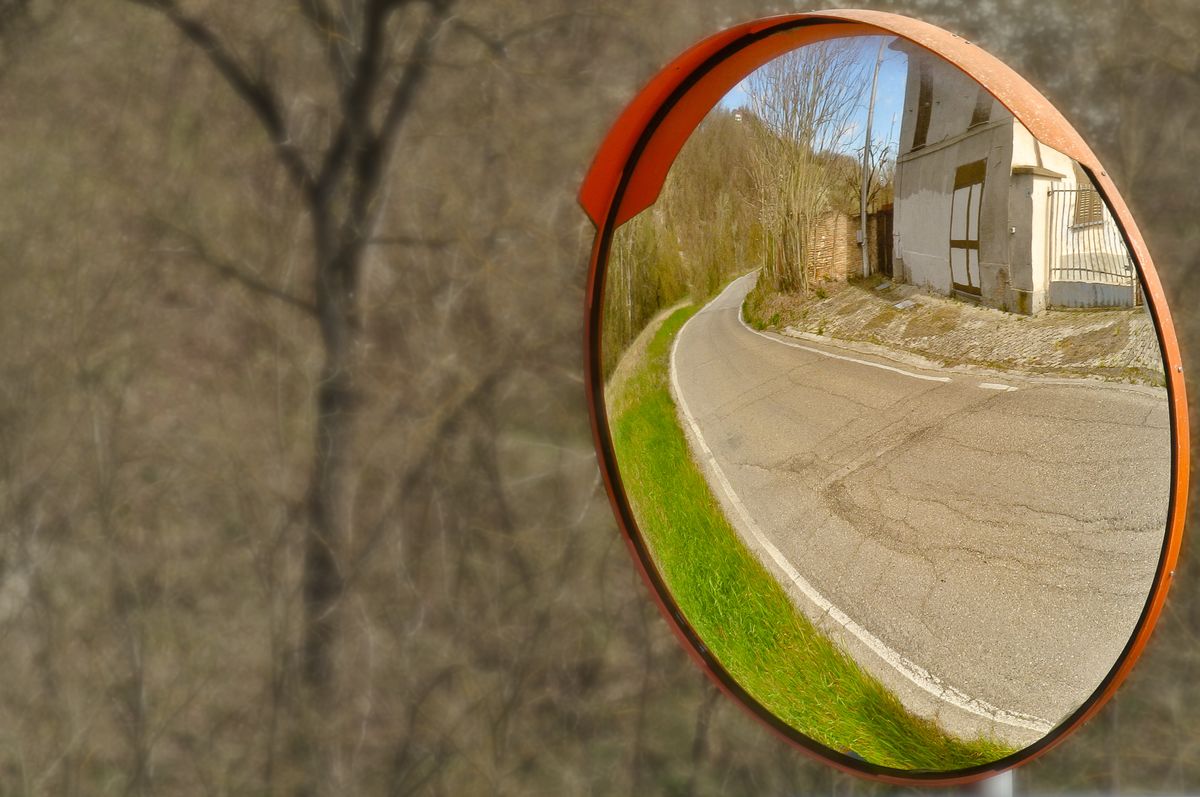
- Convex mirror. Curved outward like a dome. It diverges parallel light, producing only virtual, upright, diminished images — the kind you see in a car's passenger-side mirror.
Mirrors reflect 100% of incident light in theory (practical mirrors reflect about 85-95%). No light passes through.

What is a lens?
A lens is a transparent piece of glass or plastic that refracts light as it passes through. Light slows down in the lens material and speeds up again when it exits, bending at both surfaces. There are two main types:
- Convex lens. Thicker in the middle. It converges parallel light to a focal point on the far side. It can form real or virtual images. See the convex lens guide for details.
- Concave lens. Thinner in the middle. It diverges parallel light, producing only virtual, upright, diminished images. The concave lens guide covers how it works.
Lenses transmit most incident light (about 90-96% with anti-reflective coatings). No light is reflected — that is the job of a mirror.
The 5 key differences between a lens and a mirror
1. How they interact with light
A mirror reflects light. The light never enters the mirror — it bounces off the surface. The law of reflection governs the path: the incoming and outgoing angles are equal.
A lens refracts light. The light enters the lens material, slows down (for glass, from 299,792,458 m/s in vacuum to about 197,000 km/s), bends at the first surface, travels through, and bends again at the second surface. Snell's law governs the path.
Analogy. A mirror is a wall that the light bounces off; a lens is a window that the light passes through but gets bent. This is why the convex lens and concave mirror pairing matters: both windows and walls can converge light, just by different mechanisms.
2. Number of focal points
Every lens has two focal points — one on each side — because light can enter from either direction. If you shine light from the left, it focuses at F on the right; shine from the right, it focuses at F on the left.
A mirror has only one focal point. Light always approaches from the same side (the front), so there is only one focal point — in front for concave mirrors, behind for convex.
3. The pairing: convex lens and concave mirror
This is the most useful insight for students. The pairing of a convex lens and concave mirror is one of the most common exam topics in optics. They behave almost identically:
Both converge parallel light to a focal point. Both can form real, inverted images when the object is beyond F, and virtual, upright images when the object is inside F. Both have positive focal lengths. If you understand ray diagrams for a convex lens and concave mirror, you understand both.
A concave lens and a convex mirror also pair up:
Both diverge parallel light. Both produce only virtual, upright, diminished images. Both have negative focal lengths.
The BU physics page on lens-mirror differences explains this pairing clearly with worked ray diagrams.
4. Image formation
The image formation of a convex lens and concave mirror follows the same pattern. Both produce real, inverted images when the object is beyond F, and virtual, upright images when the object is inside F. The image size depends on the object distance in the same way.
A concave lens and a convex mirror are more restricted: they always produce virtual, upright, diminished images, no matter where the object is placed.
| Component | Converges? | Real images? | Virtual images? | Focal length |
|---|---|---|---|---|
| Convex lens | Yes | Yes | Yes (inside F) | Positive |
| Concave mirror | Yes | Yes | Yes (inside F) | Positive |
| Concave lens | No (diverges) | No | Yes | Negative |
| Convex mirror | No (diverges) | No | Yes | Negative |
5. Uses
Lenses and mirrors each dominate different applications:
Where lenses win: Eyeglasses, contact lenses, camera lenses, microscopes, magnifying glasses, projectors. Any application where the light needs to pass through a transparent medium favours lenses.
Where mirrors win: Large telescopes (reflecting telescopes use mirrors because they can be made much larger than lenses without sagging), rear-view mirrors, shaving mirrors, solar concentrators, laser cavities, periscopes.
Some instruments combine both. A reflecting telescope uses a concave primary mirror to gather light and a convex lens as an eyepiece to magnify the image. The HyperPhysics mirror equation page shows how the same mathematical framework describes both.
Common misconception: "mirrors and lenses are basically the same"
People often say "a concave mirror is the same as a convex lens because both converge light." The convergence is the same, but the mechanism is fundamentally different: one reflects, the other refracts. A mirror works in air only (the reflective coating is on the back), while a lens works because light moves through it. The pairing is a useful memory aid, not an equivalence — they are different devices that happen to produce similar results.
Summary
A lens refracts light through a transparent material; a mirror reflects light off a coated surface. A convex lens pairs with a concave mirror (both converge, both can form real images), and a concave lens pairs with a convex mirror (both diverge, both form only virtual images). Lenses have two focal points; mirrors have one. The mirror and lens equations produce mathematically identical results with the right sign convention. For a broader overview of how the two lens types compare, see concave vs convex lens.
Frequently Asked Questions
What is the main difference between a lens and a mirror?
A lens is a transparent material that refracts (bends) light as it passes through. A mirror is a reflective surface that bounces light back. Lenses work by refraction; mirrors work by reflection. A convex lens acts like a concave mirror (both converge light), and a concave lens acts like a convex mirror (both diverge light).
Does a lens have one or two focal points?
A lens has two focal points — one on each side — because light can travel through it from either direction. A mirror has only one focal point because light only reflects off one surface.
Which is better for a telescope: a lens or a mirror?
Large telescopes almost always use mirrors (reflecting telescopes) because mirrors can be made much larger than lenses without sagging under their own weight, and they do not suffer from chromatic aberration. Small telescopes and binoculars typically use lenses (refracting telescopes).
Can a concave mirror form a real image like a convex lens?
Yes. A concave mirror converges light to a focal point and can form real, inverted images — just like a convex lens. The image characteristics depend on the object's distance from the mirror, following the same pattern as a convex lens.
What is the mirror equation compared to the lens equation?
The mirror equation is 1/f = 1/v + 1/u with a sign convention where distances in front of the mirror are positive. The thin-lens equation is 1/f = 1/v − 1/u. With the correct sign conventions, they produce the same results — the physics is mathematically identical even though the mechanisms differ.
Why does a convex mirror always form a virtual image?
A convex mirror diverges reflected rays outward. The rays never actually meet on the mirror's side, so the image is always virtual, upright, and smaller than the object. This is the same behaviour as a concave lens.

About Umar Farooq
Umar Farooq writes in-depth guides on the physics of light and optics — from reflection, refraction, and lenses to diffraction, lasers, and fiber optics, explained from first principles.
Read more about Umar Farooq →