
A convex lens is a transparent lens that is thicker in the middle and thinner at the edges. When light passes through it, the lens bends the rays inward so they meet at a single point called the focus. This is why it is called a converging lens. A convex lens is the most important optical component in the world — it is the heart of every camera, microscope, telescope, magnifying glass, and projector. Here is how it works, the different types, how ray diagrams work, and where you use it every day.
Think of a convex lens as a slice from the side of a rugby ball — wider in the middle and tapering at the edges. When parallel light rays hit it, the middle part of the lens bends the light less because the glass is flatter relative to the surface, while the edges bend the light more because the surface is steeper. The result is that all the rays converge at a point on the other side. It is like a funnel for light.
What is a convex lens? Definition
A convex lens is a piece of transparent material — usually glass or plastic — with at least one surface curved outward. The centre is thicker than the edges. When light rays enter a convex lens, they refract toward the normal at each surface. Since the lens is shaped so that the two refractions add up, the rays converge on the opposite side.
The exact point where parallel rays meet after passing through the lens is called the principal focus (or focal point). The distance from the centre of the lens to the focus is the focal length. In a convex lens, the focal length is always positive.
Every convex lens has two focal points — one on each side — at equal distances from the centre. This symmetry is important for understanding how images form at different distances.
How does a convex lens work?
A convex lens works by refraction. Light travels slower in glass than in air (about 197,000 km/s in crown glass versus 299,792,458 m/s in a vacuum). When a light ray hits the curved surface of a convex lens at an angle, it bends toward the normal as it enters the glass. When it exits the other side, it bends away from the normal. The combined effect of these two bends — at entry and exit — is that the ray changes direction toward the centre line.
The shape of the lens determines how much the rays converge. A lens with a shorter radius of curvature (more curved) has a shorter focal length and bends light more sharply. A lens that is flatter has a longer focal length.
This is why the human eye uses a convex lens — the crystalline lens in your eye converges incoming light onto your retina. If your lens is too weak (image forms behind the retina), you get farsightedness. If it is too strong (image forms in front), you get nearsightedness. The BBC Bitesize guide on lenses explains how lenses are used to correct these conditions.

Types of convex lenses
Convex lenses come in three main shapes, though all work on the same converging principle:
Biconvex lens (double convex). Both surfaces curve outward. This is the most common type, found in magnifying glasses, camera lenses, and human eyes. It provides the strongest convergence for a given curvature.
Plano-convex lens. One surface is flat (plane) and the other curves outward. These are used when you need to focus parallel light into a point, such as in laser collimators and simple optical systems where one side of the lens sits against a flat mount.
Convexo-concave lens (meniscus). One surface curves outward (convex) and the other curves inward (concave), but the lens is still thicker in the centre than at the edges. These are used in eyeglasses and combined lens systems where you need to correct for aberrations while maintaining convergence.
Key terms for a convex lens
- Optical centre: the central point of the lens. Light passing through this point is not bent.
- Principal axis: the imaginary line passing through the centre of the lens perpendicular to both surfaces.
- Principal focus (F): the point where parallel rays converge after passing through the lens.
- 2F: the point at twice the focal length from the lens centre. Important for image formation.
- Focal length (f): the distance from the optical centre to the principal focus. Positive for convex lenses.
- Aperture: the diameter of the lens. A larger aperture lets in more light.
Convex lens ray diagram: how the image forms
The type of image a convex lens produces depends entirely on where the object is placed. Here is how it works for each position along the principal axis:
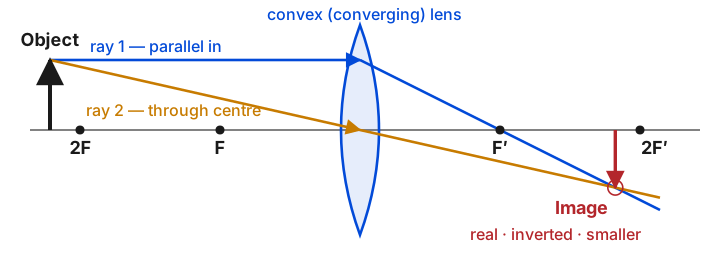
| Object Position | Image Position | Image Nature | Image Size | Example Use |
|---|---|---|---|---|
| At infinity | At F | Real, inverted | Point-sized | Focusing sunlight |
| Beyond 2F | Between F and 2F | Real, inverted | Diminished | Camera (distant objects) |
| At 2F | At 2F | Real, inverted | Same size | 1:1 imaging |
| Between 2F and F | Beyond 2F | Real, inverted | Magnified | Projector |
| At F | At infinity | Real, inverted | Highly magnified | Spotlights |
| Between F and O | Same side as object | Virtual, upright | Magnified | Magnifying glass |
The ray diagram for a convex lens works with three principal rays:
- A ray parallel to the principal axis refracts through F on the other side.
- A ray through the optical centre passes straight through without bending.
- A ray through F on the object side refracts parallel to the principal axis.
Understanding these three rays lets you draw a ray diagram for any object position in about five minutes. The image forms where the refracted rays intersect (real image) or where they appear to originate (virtual image).
Convex lens formulas
The behaviour of a convex lens is described by two simple formulas:
Lens formula: 1/f = 1/v - 1/u
Where f is the focal length (positive for convex), v is the image distance, and u is the object distance. All distances are measured from the optical centre. For a convex lens, u is always negative (object on the left), and v can be positive (real image on the right) or negative (virtual image on the left).
Magnification formula: M = v/u = hi/ho
Magnification tells you how much larger or smaller the image is compared to the object. A magnification greater than 1 means the image is larger. For a magnifying glass, M is typically between 2x and 10x.
Power of a lens: P = 1/f (in metres)
The power is measured in dioptres (D). A convex lens with a focal length of 0.5 m has a power of +2 D. The positive sign indicates a converging lens. Your eyeglass prescription uses dioptres — a prescription of +2.50 D means you need a convex lens with a focal length of 0.4 m. The HyperPhysics page on lens power provides a more detailed breakdown of how lens power relates to focal length for compound optical systems.
Uses of convex lenses
Convex lenses are everywhere. Here are the most important applications:
Magnifying glass. The simplest convex lens use. When you hold an object closer than the focal length (between F and O), the lens produces a magnified, upright, virtual image. The image appears larger and on the same side as the object.
Camera. The camera lens is a system of convex (and sometimes concave) elements that focus light onto the image sensor. The lens produces a real, inverted, diminished image when the object is beyond 2F.
Microscope. A compound microscope uses two convex lenses: the objective lens (short focal length) produces a real, magnified image, and the eyepiece lens magnifies it further. The total magnification is the product of the two lenses.
Telescope. A refracting telescope uses a large convex objective lens to gather light from distant stars and a smaller convex eyepiece to magnify the image. The OpenStax textbook on geometric optics covers how these lens combinations work in both microscopes and telescopes.
Eyeglasses for farsightedness (hypermetropia). If your eyeball is too short or your lens is too weak, the image forms behind the retina. A convex lens (positive power) adds extra convergence, bringing the image forward onto the retina.
Projector. A convex lens projects a magnified, real, inverted image onto a screen when the slide or film is placed between F and 2F.

Common misconception: "convex lenses always produce magnified images"
Many people think a convex lens always magnifies. This is false. A convex lens can produce diminished, same-size, or magnified images depending on where you place the object. When the object is beyond 2F, the image is smaller than the object — this is how a camera fits a mountain onto a tiny sensor. Only when the object is between the lens and the focal point does the lens act as a magnifier.
A second misconception: "convex lenses produce only real images." In fact, they produce virtual images when the object is between the lens and the focal point — exactly what happens when you use a magnifying glass. The ability to produce both real and virtual images is what makes convex lenses so versatile.
Summary
A convex lens is a converging lens that is thicker in the middle and bends light inward to a focus. It comes in three types (biconvex, plano-convex, and convexo-concave) and produces different images depending on the object distance — from diminished and real at long distances to magnified and virtual at close range. The lens formula 1/f = 1/v - 1/u and the power formula P = 1/f describe its behaviour precisely. Convex lenses are used in cameras, microscopes, telescopes, eyeglasses, projectors, and magnifying glasses — making them the most important optical component in the world. For a comparison with the opposite type, see our guide on concave lens. The broader physics of how lenses bend light is covered in our guide on how lenses use refraction.
Frequently Asked Questions
What is a convex lens?
A convex lens is a transparent lens that is thicker in the middle than at the edges. It is also called a converging lens because it bends parallel light rays inward to meet at a single point called the focus. Convex lenses are used in magnifying glasses, cameras, microscopes, telescopes, and to correct farsightedness.
Why is a convex lens called a converging lens?
A convex lens is called a converging lens because it refracts parallel rays of light so they converge (meet) at a single point on the other side of the lens. This point is the principal focus. The opposite type — a concave lens — spreads rays apart, so it is called a diverging lens.
What are the 3 types of convex lenses?
The three main types are: plano-convex (one flat side, one curved side), biconvex or double convex (both sides curved outward), and convexo-concave (one side convex, one side concave, but overall thicker in the middle). Biconvex lenses are the most common.
What are the uses of convex lenses?
Convex lenses are used in magnifying glasses (to magnify nearby objects), cameras (to focus light onto film or a sensor), microscopes (to magnify tiny specimens), telescopes (to gather and focus light from distant objects), eyeglasses for farsightedness (hypermetropia correction), and projectors (to project enlarged images onto a screen).
What is the difference between a convex and a concave lens?
A convex lens is thicker in the middle and converges light to a point — it is a converging lens that can form both real and virtual images. A concave lens is thinner in the middle and spreads light apart — it is a diverging lens that always produces a virtual, upright, and diminished image.
What is the lens formula for a convex lens?
The lens formula is 1/f = 1/v - 1/u, where f is the focal length, v is the image distance, and u is the object distance. For a convex lens, f is positive. The magnification formula is M = v/u = height of image / height of object.

About Umar Farooq
Umar Farooq writes in-depth guides on the physics of light and optics — from reflection, refraction, and lenses to diffraction, lasers, and fiber optics, explained from first principles.
Read more about Umar Farooq →