
A converging mirror is another name for a concave mirror — it curves inward and focuses parallel light to a single point. A diverging mirror is another name for a convex mirror — it curves outward and spreads light apart. The type of mirror determines whether light comes together or spreads apart, and that behaviour decides everything else: what kinds of images form, whether they can be projected, and where the mirror is useful. Here are the 3 key differences between converging and diverging mirrors.
Think of a converging mirror as a funnel for light. It catches rays across its surface and directs them to a single spot — like a satellite dish concentrating signals. A diverging mirror does the opposite: it takes incoming light and spreads it wide, like a dome scattering rain. Both are curved mirrors, but their curvature points in opposite directions, and so does their effect on light.
What is a converging mirror?
A converging mirror is a spherical mirror where the reflecting surface curves inward — the concave shape. When parallel light rays strike this surface, the mirror reflects them so they all meet at a point in front of the mirror called the principal focus. The name comes from the Latin "convergere" — to incline together — and that is exactly what the reflected light does.
The converging action happens because of geometry. At each point on the mirror's surface, the normal (the line perpendicular to the surface) points toward the centre of curvature. Since the law of reflection keeps each ray at the same angle to its local normal, rays hitting different parts of the mirror are all angled inward. The result is natural focusing without any lenses. The converging mirror is why reflecting telescopes can gather starlight and why headlights can project a narrow beam.
Concave (converging) mirror ray diagram
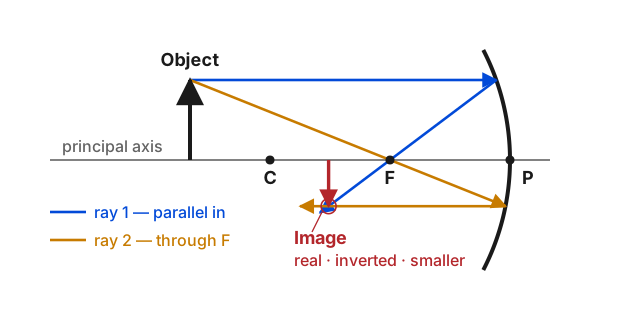
Converging (concave) mirrors are the only mirrors that can produce a real image — one you can project onto a screen. They also produce magnified virtual images when the object sits between the focal point and the mirror. This dual-image ability makes them the choice for telescopes, headlights, shaving mirrors, and solar concentrators.
What is a diverging mirror?
A diverging mirror is a spherical mirror where the reflecting surface curves outward — the convex shape. When parallel rays hit this surface, the mirror reflects them outward so they spread apart. The rays never meet in front of the mirror. If you trace them backward, they appear to come from a virtual focal point behind the mirror.
The outward curve means the normals at each point point away from the centre of curvature. Each ray reflects with an outward component, and the overall beam gets wider. This is why convex mirrors give such a wide field of view — they are literally taking light from a broad area and compressing it into a narrower angle for your eye.

Diverging mirrors always produce virtual, upright, and diminished images. They can never create a real image because the reflected rays never converge in front. This makes them ideal for safety and surveillance where the goal is to see more area, not to focus light.
3 key differences between converging and diverging mirrors
1. How they affect light
A converging (concave) mirror brings parallel rays together at a real focal point in front of the mirror. A diverging (convex) mirror spreads parallel rays apart to a virtual focal point behind the mirror. One focuses; the other disperses.
2. The images they form
Converging mirrors produce real, inverted images when the object is beyond F, and virtual, upright, magnified images when the object is between F and the pole. Diverging mirrors always produce virtual, upright, diminished images regardless of the object's position — no exceptions.
3. Focal length sign
By the Cartesian sign convention, a converging (concave) mirror has a negative focal length because the focus lies in front of the mirror. A diverging (convex) mirror has a positive focal length because the focus lies behind. The mirror formula 1/f = 1/u + 1/v works for both, and the sign of f tells you the mirror type instantly.
| Property | Converging mirror | Diverging mirror |
|---|---|---|
| Also called | Concave mirror | Convex mirror |
| Surface curve | Inward (like a cave) | Outward (like a dome) |
| What it does to light | Brings rays together | Spreads rays apart |
| Focal point location | In front of mirror | Behind mirror (virtual) |
| Image types | Real or virtual | Virtual only |
| Focal length sign | Negative | Positive |
| Real image possible? | Yes (object beyond F) | No |
| Typical uses | Telescopes, headlights | Rearview, security mirrors |
Which mirror do you actually need?
Pick by the job, not by the shape.
Converging (concave) — when the light has to end up somewhere. Focusing sunlight, projecting a real image onto a screen, collecting faint light in a telescope, magnifying your face at close range. It is the only one of the two that can put a real image on a surface.
Diverging (convex) — when you need to see more at once. Shop security mirrors, vehicle wing mirrors, blind-corner traffic mirrors. It trades image size for field of view, and it gives an upright image no matter where the object sits.
The question that settles it: do you need the light gathered, or the view widened? Gathered means concave. Widened means convex. There is no job where the two are interchangeable.
Is a concave mirror always converging?
Yes. Every concave mirror converges light because the inward curve guarantees that reflected rays head toward the centre line. Even a very shallow concave arc still converges — just to a more distant focal point. The relationship is one-to-one:
- Converging mirror = concave mirror
- Diverging mirror = convex mirror
There is no such thing as a concave mirror that diverges or a convex mirror that converges. The surface curvature dictates the behaviour completely. If you see a mirror that curves inward, it is converging. If it curves outward, it is diverging. The shape is the answer.
The Physics Monster guide on spherical mirrors explains how the geometry of curvature leads to convergence or divergence with clear diagrams. The TutorChase tutorial on concave mirrors walks through the ray tracing that shows convergence in action. For a deeper look at how spherical mirrors form images, the BYJU'S guide on concave and convex mirrors covers the principal ray rules and image formation for both types.
Which type of mirror can create a real image?
Only a converging (concave) mirror can create a real image. A real image forms when actual reflected rays converge at a point in front of the mirror. A diverging mirror's rays never meet in front, so the image is always virtual.
For a converging mirror to produce a real image, the object must be placed beyond the focal point. The image will be real and inverted. It can be captured on a screen — this is exactly how a reflecting telescope works, with the concave primary mirror forming a real image of a distant star.
This is a common exam question: "which mirror can form a real image?" The answer is always the converging (concave) mirror only.
Common misconception: "converging mirrors always magnify"
Because shaving mirrors and makeup mirrors are concave and produce magnified images, many people assume all converging mirrors magnify. In fact, a converging mirror produces a reduced image when the object is beyond the centre of curvature (C) and an equal-sized image when the object is at C. Magnification happens only when the object is between F and the mirror. The same mirror can magnify, reduce, or produce a life-size image depending solely on object placement.
The reverse mistake: thinking diverging mirrors always give an extremely tiny image. While diverging mirrors do diminish, a nearby object through a shallow convex mirror may look only slightly smaller. The image is always smaller than the object, but the degree varies with distance.
Why the terminology matters
Calling a mirror "converging" or "diverging" tells you more than calling it "concave" or "convex." The terms "concave" and "convex" describe shape; "converging" and "diverging" describe function. A converging mirror is named for what it does — it gathers light — and that functional name makes its application obvious. In optics, the function determines the application:
- Need to focus light to a point? Converging (concave) mirror.
- Need to spread light for wide-area viewing? Diverging (convex) mirror.
- Need to project a real image onto a screen? Only a converging mirror works.
The function-first naming also aligns with lens terminology (converging lens = convex, diverging lens = concave), creating a consistent mental model across optics.
For a more detailed look at each mirror type, see our guides on concave mirrors and convex mirrors. The concave vs convex mirror comparison provides a complete side-by-side table covering all image positions. For the physics of how spherical mirrors reflect, see our guide on how mirrors work.
Frequently Asked Questions
What is a converging mirror?
A converging mirror is another name for a concave (spherical) mirror. Its reflecting surface curves inward, which causes parallel light rays to reflect and meet at a single point in front of the mirror called the principal focus. Converging mirrors can produce both real and virtual images depending on the object's distance from the mirror.
What is a diverging mirror?
A diverging mirror is another name for a convex (spherical) mirror. Its reflecting surface curves outward, which causes parallel light rays to reflect and spread apart. The rays never meet in front of the mirror, but if traced backward they appear to come from a virtual focal point behind the mirror. Diverging mirrors always produce virtual, upright, and diminished images.
What is the spherical mirror where rays converge name?
The spherical mirror that converges light rays is called a converging mirror — which is the same as a concave mirror. The inward-curving surface reflects parallel rays inward to a focal point. Its opposite is the diverging (convex) mirror, which spreads rays apart.
Is a concave mirror converging or diverging?
A concave mirror is always converging. Its inward-curved surface guarantees that parallel light rays come together at a focal point in front of the mirror. There is no such thing as a concave mirror that diverges light — the shape forces convergence.
Which type of mirror can create a real image?
Only a converging (concave) mirror can create a real image. Real images form when actual reflected rays converge in front of the mirror. A diverging (convex) mirror can never produce a real image because its reflected rays always diverge. For a converging mirror to create a real image, the object must be placed beyond the focal point.
What is surface concave?
A surface concave describes a curved surface that bows inward like the inside of a bowl or a cave. In optics, a concave mirror uses this inward-curving surface as its reflective side. This inward curve is what makes it a converging mirror — the normals at each point on the surface all point toward the centre of curvature, directing reflected rays inward to a common focal point.

About Umar Farooq
Umar Farooq writes in-depth guides on the physics of light and optics — from reflection, refraction, and lenses to diffraction, lasers, and fiber optics, explained from first principles.
Read more about Umar Farooq →