
A convex mirror is a spherical mirror with a reflecting surface that curves outward, like the outside of a dome or a fish-eye lens. When parallel light rays strike it, the mirror reflects them outward so they appear to diverge from a single point behind the mirror. This is why it is called a diverging mirror. Because a convex mirror always produces an upright, smaller image and gives a much wider view than a flat mirror, it is the standard choice for vehicle side mirrors, security mirrors in shops, and traffic mirrors at dangerous corners. Here is how convex mirrors work, their ray diagrams, image formation, the mirror formula, and where you see them every day.
Picture a security mirror in the corner of a shop. One glance shows you the entire aisle — shelves, customers, the lot — all reduced in size but visible at once. That wide, compressed view is the signature of a convex mirror. It trades image size for field of view, and that trade makes it indispensable for safety.
What is a convex mirror? Definition
A convex mirror is a type of spherical mirror where the reflecting surface is the outer (convex) side of a spherical shell. Imagine taking a hollow sphere and using the outside surface as your mirror — that is a convex mirror. The inner surface does not reflect.
Because the reflecting surface bulges outward toward the incoming light, the normals at each point point away from the centre of the original sphere. When parallel rays hit different parts of the mirror, each ray reflects according to its local normal, and the result is divergence: the reflected rays spread apart. If you trace these diverging rays backward, they appear to meet at a single point behind the mirror — the principal focus.
The focus and centre of curvature of a convex mirror lie behind the mirror, not in front. This is the opposite of a concave mirror and is the key to understanding why convex mirrors always form virtual images.
Key terms of a convex mirror
The same reference points define every convex mirror. Knowing them is essential for drawing ray diagrams and using the mirror formula.
- Pole (P): The geometric centre of the mirror's reflecting surface.
- Centre of curvature (C): The centre of the imaginary sphere from which the mirror is cut. For a convex mirror, C lies behind the mirror.
- Radius of curvature (R): The distance from the pole to the centre of curvature.
- Principal axis: The straight line through the pole and the centre of curvature.
- Principal focus (F): The point on the principal axis where parallel rays appear to diverge from after reflection. For a convex mirror, F lies behind the mirror.
- Focal length (f): The distance from the pole to the principal focus. For a convex mirror, the focal length is positive by the Cartesian sign convention, and f = R/2.
The focal length of a convex mirror follows the same simple rule as for concave: f = R/2. However, because C and F are behind the mirror, the sign is positive. A convex mirror with R = 30 cm has a focal length of +15 cm.

How does a convex mirror work?
A convex mirror follows the law of reflection — angle of incidence equals angle of reflection — the same as every other mirror. The difference comes from the curve. At each point on a convex mirror, the normal points outward from the centre of curvature. When parallel rays strike the surface, each ray reflects at a different angle, and the reflected rays spread apart.
Think of it like a dome-shaped surface covered in marbles. If you roll marbles toward the dome from different directions, each marble bounces off at an angle determined by the local slope. The result is that no two marbles go in the same direction — they all diverge. A convex mirror does the same with light.
The diverging behaviour means the reflected rays never meet in front of the mirror. They can only be traced backward to a meeting point behind the mirror, which is why the image is always virtual. This is fundamentally different from a concave mirror, where the reflected rays converge and can form a real image on a screen.
The Physics Classroom tutorial on convex mirrors provides step-by-step guidance for drawing ray diagrams for convex mirrors along with interactive practice exercises.
Convex mirror ray diagram rules
Unlike a concave mirror with six image positions, a convex mirror has only two cases — but the result is always the same: a virtual, upright, diminished image behind the mirror. Here are the two standard rays used in convex mirror ray diagrams:
- Parallel ray: A ray parallel to the principal axis reflects so that its extension passes through the principal focus F behind the mirror.
- Focus ray: A ray directed toward the principal focus F (on the other side of the mirror) reflects parallel to the principal axis.
- Centre ray: A ray directed toward the centre of curvature C reflects back along the same path (for diagram completeness, though the first two suffice).
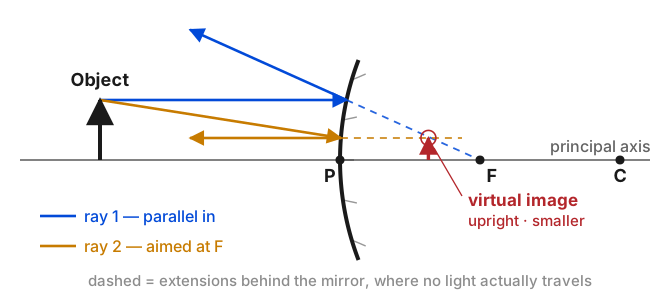
To draw a ray diagram, pick a point on the top of the object, draw the incident rays toward the mirror, reflect them according to the rules above, and extend the reflected rays behind the mirror with dashed lines. Where the extensions intersect is the top of the virtual image. The image forms between P and F, behind the mirror, and is always upright and diminished.
Image formation by a convex mirror
A convex mirror has only two object positions, and both produce the same type of image:
Object at infinity. The rays arrive parallel. After reflection, they diverge as if coming from the focus F. The image is a point-sized, virtual, upright image at F behind the mirror.
Object between infinity and the pole. This covers every real-world use of a convex mirror. The image forms between P and F behind the mirror. It is virtual, upright, and diminished (smaller than the object). The closer the object gets to the mirror, the larger the image becomes — but it never exceeds the size of the object and never becomes real.
| Object Position | Image Position | Image Size | Image Nature |
|---|---|---|---|
| At infinity | At F behind mirror | Point-sized | Virtual, upright |
| Between infinity and P | Between P and F behind mirror | Diminished | Virtual, upright |
This simplicity is why convex mirrors are so practical. No matter where the object is, you know exactly what type of image you will get.
Mirror formula and magnification for convex mirrors
The mirror formula for a convex mirror is the same as for all spherical mirrors:
1/f = 1/u + 1/v
By the Cartesian sign convention for convex mirrors:
- f is positive (focus behind the mirror)
- u is always negative (object in front)
- v is always positive (image behind the mirror, virtual)
Magnification (m) = -v/u = height of image / height of object
For a convex mirror, m is always positive and less than 1, confirming the image is upright and diminished.
Worked example: An object is placed 20 cm in front of a convex mirror with a focal length of 15 cm. Where does the image form and what is the magnification?
Using f = +15 cm, u = -20 cm: 1/v = 1/f - 1/u = 1/15 - 1/(-20) = 1/15 + 1/20 = 4/60 + 3/60 = 7/60 So v = 60/7 ≈ +8.57 cm.
The positive v means the image is 8.57 cm behind the mirror — virtual. Magnification m = -v/u = -(8.57)/(-20) = +0.43. The image is upright and about 43% of the object's size. This matches the real-world experience of seeing a diminished image in a rearview mirror.
The BYJU's guide to image formation in convex mirrors provides additional worked examples and detailed sign convention explanations for convex mirrors.
Uses of convex mirrors
Convex mirrors are everywhere once you start noticing them. Here are the most important applications:
Vehicle side-view mirrors. This is the most familiar use. The passenger-side mirror in almost every car is convex, giving the driver a wide-angle view of the lane beside and behind. The warning "objects in mirror are closer than they appear" is a direct consequence of the diminished image — the mirror trades accurate distance perception for a broader view. For a full comparison with the other type, see our guide on concave vs convex mirror.
Security mirrors in shops and warehouses. A single convex mirror mounted at a corner lets staff see an entire aisle or warehouse bay. The wide field of view reduces blind spots and improves safety for both customers and workers operating forklifts and other vehicles.
Traffic safety mirrors. Convex mirrors are mounted at blind intersections, driveways, and sharp turns on narrow roads. Drivers can see oncoming traffic around the corner without having to edge forward. This is especially common on mountain roads and in underground parking garages.
ATM security mirrors. Many automated teller machines have a small convex mirror above the screen. The user can see the area behind them while using the machine, adding a layer of personal security.
Street light reflectors. Some street lights use convex reflectors to spread light over a wide area. The diverging shape scatters the beam outward rather than focusing it in a narrow spot.

Convex mirror vs concave mirror at a glance
| Property | Convex mirror | Concave mirror |
|---|---|---|
| Shape | Curves outward (dome) | Curves inward (cave) |
| Light behaviour | Diverges (spreads apart) | Converges (brings together) |
| Image type | Always virtual | Real or virtual |
| Image orientation | Always upright | Inverted (real) or upright (virtual) |
| Image size | Always diminished | Diminished, same, or magnified |
| Common uses | Rearview mirrors, security | Telescopes, headlights, shaving |
| Focal length sign | Positive | Negative |
Common misconception: "Convex mirrors always show objects farther away"
The diminished image in a convex mirror makes objects look smaller and therefore farther than they really are. Many drivers instinctively believe the car behind them is further back than it actually is — which is exactly why the warning label exists. The mirror does not distort distance arbitrarily; the image distance follows the mirror formula precisely. Understanding this helps drivers use convex mirrors safely rather than being surprised by the "appearing" vehicle.
A second misconception is that "convex mirrors can produce real images under certain conditions." They cannot. Because convex mirrors diverge reflected rays, the rays never converge in front of the mirror. Only virtual images are possible, regardless of the object's position. This is fundamentally different from concave mirrors, which can produce both.
Summary
A convex mirror is a diverging spherical mirror with the reflecting surface bulging outward. It always produces a virtual, upright, and diminished image behind the mirror, regardless of the object's position. Its key advantage is a wider field of view compared to plane or concave mirrors, making it the standard for vehicle rearview mirrors, security surveillance, traffic safety, and ATM monitoring. The mirror formula 1/f = 1/u + 1/v applies with a positive focal length, and magnification is always positive and less than 1. For the opposite type, see our guide on concave mirror. The broader physics of how light reflects from curved surfaces is covered in our reflection of light examples guide.
Frequently Asked Questions
What is a convex mirror?
A convex mirror is a spherical mirror whose reflecting surface curves outward, away from the incoming light. It is called a diverging mirror because it reflects parallel light rays outward so they appear to come from a focal point behind the mirror. Convex mirrors always produce virtual, upright, and diminished images regardless of the object's position.
What is the image formed by a convex mirror?
A convex mirror always forms a virtual, erect (upright), and diminished image regardless of where the object is placed. The image appears behind the mirror, between the pole and the principal focus. It is smaller than the object, which gives the viewer a wider field of view.
Why are convex mirrors used in vehicles?
Convex mirrors are used as side-view and rearview mirrors in vehicles because they provide a wider field of view than plane mirrors. The diminished image means more of the surrounding area fits into the mirror, helping drivers see vehicles and obstacles beside and behind them. The warning 'objects in mirror are closer than they appear' reminds drivers that the diminished image is smaller than the actual distance.
What does a convex mirror do to light?
A convex mirror diverges (spreads apart) incoming parallel light rays. After reflection, the rays move outward as if they originated from a focal point behind the mirror. This diverging behaviour is the opposite of a concave mirror, which converges rays to a point in front.
Is a rearview mirror convex or concave?
Vehicle side-view mirrors and most rearview mirrors are convex. Passenger-side mirrors in many countries are explicitly labelled 'objects in mirror are closer than they appear' because the convex shape makes objects appear smaller and farther away. Some vehicles have flat interior rearview mirrors, but exterior side mirrors are almost always convex.
What are the uses of convex mirrors?
Convex mirrors are used as vehicle side-view mirrors, security mirrors in stores and warehouses, traffic safety mirrors at blind corners and driveways, ATM security mirrors, and street light reflectors. They are chosen whenever a wide field of view or safety monitoring of a large area is needed.
What is the mirror formula for a convex mirror?
The mirror formula is 1/f = 1/u + 1/v, the same as for all spherical mirrors. For a convex mirror, the focal length f is positive by the Cartesian sign convention. The object distance u is always negative, and the image distance v is always positive for the virtual image formed behind the mirror.

About Umar Farooq
Umar Farooq writes in-depth guides on the physics of light and optics — from reflection, refraction, and lenses to diffraction, lasers, and fiber optics, explained from first principles.
Read more about Umar Farooq →