The optical density formula is OD = -log₁₀(I/I₀), where I₀ is the incident light intensity and I is the intensity after passing through a sample. It tells you how much light a material absorbs — the higher the OD, the more light is blocked. Optical density is dimensionless and is the standard way to quantify light absorption in physics, chemistry, and biology labs.
Think of it like sunglasses on a bright day. Put on a light pair and you still see pretty well — low optical density. Put on welding goggles and you barely see anything — high optical density. The formula simply puts a number on that dimming.
Here is how the formula works, how to use it, and how it connects to absorbance, transmittance, and the Beer-Lambert law.
The Optical Density Formula
The optical density formula is straightforward:
OD = -log₁₀(I / I₀)
Where:
- OD = optical density (dimensionless)
- I₀ = intensity of light incident on the sample (before)
- I = intensity of light transmitted through the sample (after)
Because it is a ratio of two intensities with the same units, OD has no units. It is a pure number.
The negative sign can be confusing. Here is the intuition: when a sample absorbs light, I is smaller than I₀, so I/I₀ is less than 1. The logarithm of a number less than 1 is negative. The negative sign in front flips it to a positive OD value. That way, a strongly absorbing sample gives a large positive OD.
If no light is absorbed (I = I₀), then I/I₀ = 1, log₁₀(1) = 0, and OD = 0. If 90% of light is absorbed (only 10% gets through), then I/I₀ = 0.1, log₁₀(0.1) = -1, and OD = 1.
Absorbance and Transmittance: The Three Sisters
Optical density is part of a trio of interrelated quantities:
Transmittance (T) is the fraction of light that passes through: T = I / I₀. It is often expressed as a percentage (%T = T × 100).
Absorbance (A) is the positive logarithm of the intensity ratio: A = log₁₀(I₀ / I) = -log₁₀(T) = OD.
In most practical contexts, optical density and absorbance are the same number. Strictly speaking, absorbance refers to pure absorption losses, while optical density includes both absorption and scattering. But in everyday spectroscopy, the terms are used interchangeably.
The relationship between them is simple:
| Quantity | Formula | Example (90% absorbed) |
|---|---|---|
| Transmittance | T = I/I₀ | 0.10 (or 10%) |
| Absorbance | A = -log₁₀(T) | A = 1.0 |
| Optical density | OD = -log₁₀(T) | OD = 1.0 |
If you know any one of these, you can calculate the other two. This is the first thing to master about the optical density formula.
Step-by-Step: How to Calculate Optical Density
Here is how to use the optical density formula in practice.
Step 1 — Measure I₀ and I. Use a spectrophotometer or photometer. First measure the intensity of the light beam with no sample (I₀), then with the sample in place (I).
Step 2 — Calculate the transmittance. Divide I by I₀ to get T. For example, if the incident light measures 100 units and the transmitted light measures 25 units, T = 25/100 = 0.25 (or 25%).
Step 3 — Take the base-10 logarithm. Find log₁₀(T). For T = 0.25, log₁₀(0.25) ≈ -0.602.
Step 4 — Apply the negative sign. OD = -log₁₀(T) = -(-0.602) = 0.602.
Step 5 — Interpret the result. An OD of 0.602 means roughly 75% of the light is absorbed at that wavelength. More absorbing samples give higher OD values.
Worked Example: Finding OD from Transmittance
Let us walk through a complete calculation using the optical density formula.
Problem: A green laser beam (532 nm) passes through a cuvette containing a dye solution. The incident intensity is 200 mW. The transmitted intensity is 8 mW. Calculate the transmittance, absorbance, and optical density.
Solution:
- Transmittance: T = I / I₀ = 8 / 200 = 0.04 (4%)
- Absorbance: A = -log₁₀(0.04) = -(-1.398) = 1.398
- Optical density: OD = 1.398 (same as absorbance here)
Interpretation: An OD of 1.398 means only 4% of the light gets through. This is a strongly absorbing sample.
If the path length of the cuvette is 1 cm, the absorption coefficient per centimetre is 1.398 cm⁻¹. This number is useful because it is independent of the cuvette size — a standardised measure of how strongly the material absorbs.
The Beer-Lambert Law: Connecting OD to Concentration
The optical density formula tells you how much light is absorbed. But to find out why or how much of a substance is present, you need the Beer-Lambert law.
A = εcl
Where:
- A = absorbance (optical density)
- ε = molar absorptivity (L mol⁻¹ cm⁻¹) — a constant for each substance at a given wavelength
- c = concentration (mol L⁻¹)
- l = path length (cm)
This law says that absorbance is directly proportional to both concentration and path length. If you double the concentration, the absorbance doubles. If you use a wider cuvette, the absorbance goes up proportionally.

The Beer-Lambert law is the reason the optical density formula is so widely used. By measuring OD and knowing ε (from tables or calibration), you can calculate the concentration of an unknown sample. This is how UV-Vis spectrophotometers quantify DNA, proteins, and thousands of other compounds.
Rearranged to find concentration:
c = A / (ε × l)
For example, if a sample has an absorbance of 0.45 at 260 nm, and the molar absorptivity of DNA at 260 nm is 0.020 (µg/mL)⁻¹ cm⁻¹ with a 1 cm path length, the concentration is:
c = 0.45 / (0.020 × 1) = 22.5 µg/mL
This is the core calculation behind countless lab measurements every day.
A Common Misconception: OD Is an Absolute Property of the Material
A common misconception is that optical density is an intrinsic property of a material — like density or melting point — with a single fixed value. It is not.
Optical density depends on three variables that are often forgotten:
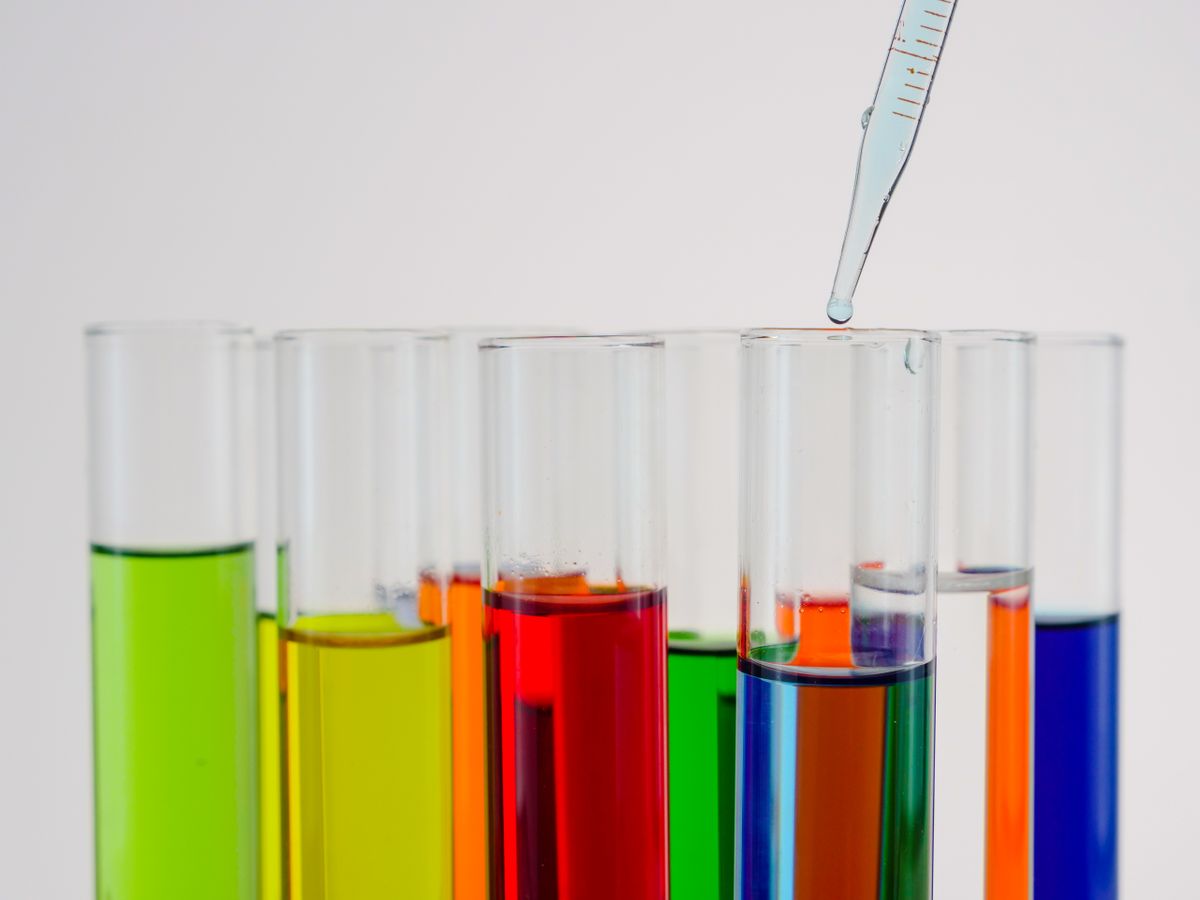
Wavelength. A material may have OD = 2.0 at 400 nm (strongly absorbing) and OD = 0.05 at 700 nm (nearly transparent). This is why OD is always reported with the measurement wavelength. A red solution looks red because it absorbs blue-green light strongly (high OD around 500 nm) and red light weakly (low OD around 650 nm).
Concentration. For solutions, OD scales linearly with concentration via the Beer-Lambert law. The same dye at 1 mM and 10 mM will have very different OD values.
Path length. Double the cuvette width and the OD doubles for the same solution. This is why OD measurements always specify the path length (usually 1 cm).
Always report OD with the wavelength, and for solutions, normalise by path length. A value of "OD = 0.5" by itself is meaningless.
Applications of the Optical Density Formula
The optical density formula appears in nearly every field that works with light and materials:
- Spectroscopy and analytical chemistry — quantifying concentrations of substances in solution. UV-Vis spectrophotometers measure OD at specific wavelengths to determine the concentration of everything from pharmaceuticals to pollutants.
- Microbiology — measuring bacterial growth. A culture's OD at 600 nm (OD₆₀₀) tracks population density over time. As bacteria multiply, the solution becomes cloudier and OD increases.
- Thin film optics — characterising optical filters, anti-reflection coatings, and sunglasses. Manufacturers specify OD at different wavelengths to describe how much light a filter blocks.
- DNA and protein quantification — Nanodrop and similar instruments measure OD at 260 nm (DNA) and 280 nm (proteins). The 260/280 ratio indicates purity.
- Atmospheric physics — measuring the optical density of the atmosphere or cloud layers to study aerosol content and climate effects.
For more on how light behaves when it passes through materials, see our guide on reflection refraction and absorption. The Snell's law article covers another critical optics formula for calculating angles of refraction, and types of lasers explains how specific wavelengths are generated for spectroscopy.
External Resources
- Wikipedia: Absorbance — comprehensive technical reference on absorbance, optical density, and the Beer-Lambert law
- UCLA ChemLab: Beer's Law Tutorial — clear step-by-step guide to using Beer's law for concentration calculations with worked examples
- Omni Calculator: Optical Density Calculator — practical online tool for calculating OD from intensity or transmittance values
Frequently Asked Questions
What is the optical density formula?
The optical density formula is OD = -log₁₀(I/I₀), where I₀ is the incident light intensity and I is the transmitted light intensity. It measures how much light a material absorbs. Optical density has no units — it is a logarithmic ratio. A higher OD means more light is absorbed.
How do you calculate optical density from transmittance?
Optical density is calculated from transmittance using OD = -log₁₀(T), where T = I/I₀ is the transmittance. For example, if 10% of light passes through a sample (T = 0.1), then OD = -log₁₀(0.1) = 1. If 1% transmits, OD = 2.
What is the difference between optical density and absorbance?
In most contexts, optical density and absorbance are used interchangeably, both defined as A = log₁₀(I₀/I). However, absorbance strictly refers to light absorption only, while optical density includes both absorption and scattering losses. In spectroscopy, they are effectively the same quantity.
What is the Beer-Lambert law?
The Beer-Lambert law states that absorbance is directly proportional to the concentration of the absorbing species and the path length: A = εcl, where ε is the molar absorptivity (L mol⁻¹ cm⁻¹), c is concentration (mol L⁻¹), and l is path length (cm). This is the foundation of quantitative absorption spectroscopy.
What is the relationship between optical density and concentration?
Optical density (absorbance) is linearly proportional to concentration under the Beer-Lambert law: A = εcl. This means if you double the concentration, the absorbance doubles. This linear relationship is used to determine unknown concentrations by measuring absorbance and using a calibration curve.
What units does optical density use?
Optical density is dimensionless — it has no units. It is a logarithmic ratio of two light intensities. However, it is often reported in 'absorbance units' (AU) or 'optical density units' (ODU). When divided by path length, optical density per centimetre (OD/cm or AU/cm) is used.

About Umar Farooq
Umar Farooq writes in-depth guides on the physics of light and optics — from reflection, refraction, and lenses to diffraction, lasers, and fiber optics, explained from first principles.
Read more about Umar Farooq →