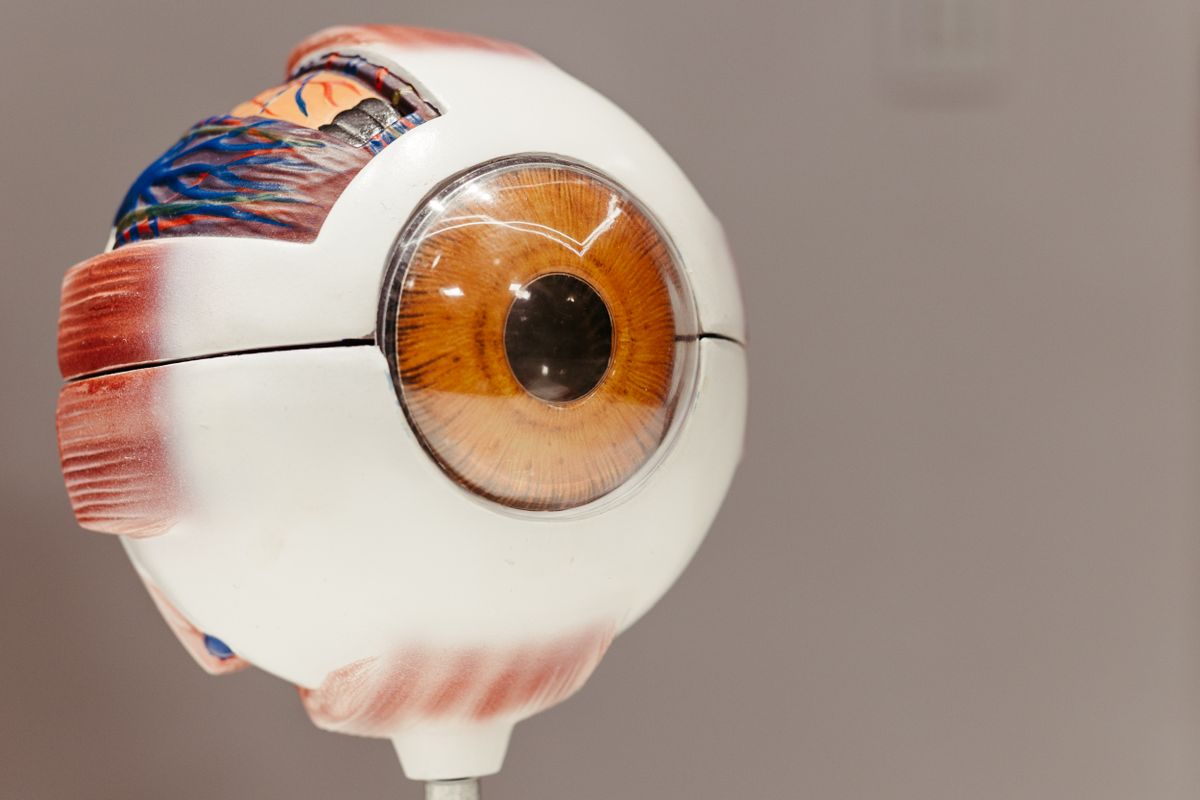
The phrase "optic nerve formula" is not a physics equation — it is a medical supplement for optic nerve health. But the human eye itself is a remarkable optical instrument, governed by clear physical principles. Here are the five essential optics principles every eye uses to turn light into vision.
1. Refraction — Where the Eye Does Most of Its Bending
When light enters your eye, it bends. About two-thirds of that bending happens at the cornea — the clear dome at the front of the eye.
Think of a car rolling from smooth tarmac onto sand at an angle. The wheel that hits the sand first slows first, and the car pivots toward that side. Light does the same when it passes from air (refractive index 1.0003) into the cornea (index 1.376). The wave slows and turns, directing the light toward the back of the eye.
The word "formula" in the phrase "optic nerve formula" makes it sound like a mathematical expression. The closest real formula in this step is Snell's law: n₁ sin θ₁ = n₂ sin θ₂. It describes exactly how much the light bends at the cornea-air boundary.
The cornea is fixed — it bends light but cannot change shape. That is why the eye needs a second, adjustable element to fine-tune the focus.
2. Accommodation — How the Lens Changes Focus
Behind the cornea sits the crystalline lens. It changes shape to adjust focus — a process called accommodation.
Picture a pair of binoculars. When you turn the focusing ring, the internal lenses shift and the image snaps into place. The eye's lens does the same by flattening for distant objects and rounding up for nearby ones. The ciliary muscles control this shape change, and it happens without you thinking about it.
While the medical optic nerve formula targets cellular health in the nerve tissue, the lens follows a purely physical formula: optical power measured in dioptres. The cornea delivers roughly 40 dioptres of fixed power. The lens adds another 10–20 dioptres of adjustable power, letting you switch from a mountain to a book in a fraction of a second.
3. Aperture — How the Iris Controls the Light
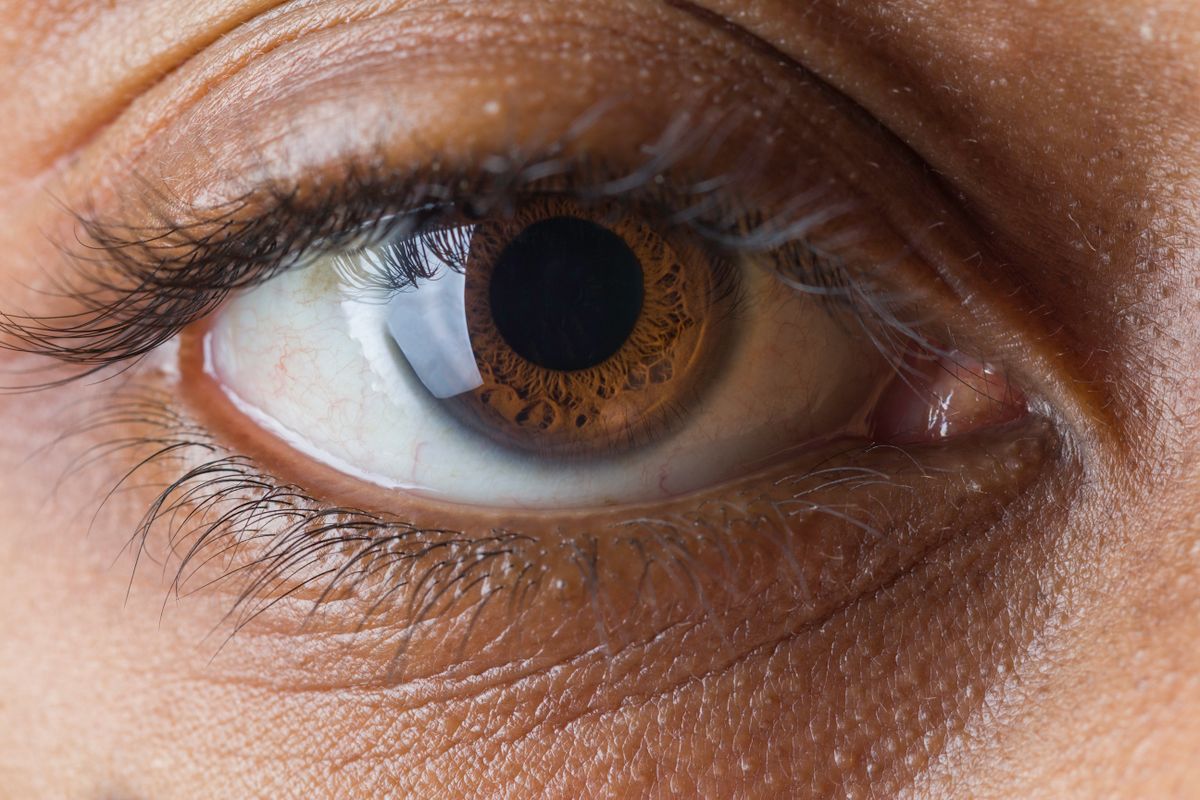
The iris is the coloured ring around your pupil. It expands and contracts, changing the pupil from about 2 mm in bright light to 8 mm in the dark.
Think of a camera's aperture ring. A narrow aperture gives a sharper image with more depth of field but lets in less light — which is why squinting helps you see more clearly in bright sun. A wide aperture gathers more light but reduces depth of field and sharpness.
In the eye, a smaller pupil also reduces optical aberrations from the lens edges, giving you a sharper image overall. The iris aperture is another piece of the eye's optic nerve formula puzzle — it controls how much light reaches the retina and affects the image quality through diffraction limits.
4. Image Formation — How the Retina Captures the Picture
After refraction, the light projects an inverted, real image onto the retina — the light-sensitive layer at the back of the eye. The retina carries about 120 million rods (for dim light) and 6 million cones (for colour vision).
This follows the thin-lens equation:
1/f = 1/v − 1/u
In words: the focal length of the eye's combined optical system determines exactly where the image lands. In a healthy eye, it lands squarely on the retina. In myopia (nearsightedness), the image falls short. In hyperopia (farsightedness), it falls behind. This is why glasses adjust the effective focal length — they move the image back onto the retina.
The real optical "formula" behind the optic nerve formula concept is the thin-lens equation — it governs how every eye forms a clear image, and it is the same equation that optometrists use to write your prescription.
5. The Optic Nerve — Data Cable, Not Lens
The optic nerve is often misunderstood. It does not bend light or participate in image formation. Its job is purely electrical: it carries signals from the retina to the brain.
The "nerve" part of "optic nerve formula" refers to this biological cable. Picture a fibre optic cable instead. A single fibre carries data as light pulses bouncing down the glass core by total internal reflection. The optic nerve works on the same data-transmission principle but in reverse — it converts chemical signals from the retina into electrical impulses for the brain's visual cortex.
The nerve contains about 1.2 million fibres. The retina has 126 million photoreceptors. That means the optic nerve compresses the visual data by roughly 100-to-1 before the brain ever sees it. This compression is the final piece of the optic nerve formula from the optics side — the nerve does not process images, it transmits them.
Eye vs Camera: A Quick Comparison
| Eye component | Camera equivalent | Function |
|---|---|---|
| Cornea | Front lens element | Fixed refraction, two-thirds of focusing power |
| Iris / Pupil | Aperture diaphragm | Controls how much light enters |
| Crystalline lens | Zoom lens group | Adjustable fine-focus (accommodation) |
| Retina | Image sensor / film | Captures the projected image |
| Optic nerve | Data cable | Transmits signal to processor (brain) |
The "Optic Nerve Formula" Misconception to Correct
People who search for "optic nerve formula" sometimes expect a mathematical equation from physics. There is no such equation. The phrase "optic nerve formula" belongs to ophthalmology, where it refers to a specific supplement formulation for optic nerve health.
The formulas that matter in the eye are the ones governing refraction (Snell's law), image formation (the thin-lens equation), and optical power measured in dioptres. The optic nerve is part of the biological readout — it does not perform any optical computation.
Where You See This in Everyday Life
Every time you adjust to a dark room, your irises dilate. Every time you switch focus from a phone screen to a distant horizon, your crystalline lenses change shape. Every time an optometrist measures your prescription, they are calculating the exact dioptre correction needed to bring your eye's optical system back into focus.
Understanding the optic nerve formula — both the medical supplement and the optical principles — helps you see how your eyes work from two different angles. The human eye is one of nature's finest optical instruments, and the optic nerve is its vital communication channel. For more on how lenses work, see our guide on how a lens works.
Frequently Asked Questions
What is the optic nerve formula?
In medicine, optic nerve formula is a registered nutritional supplement (OpticNerve Formula®) designed to support optic nerve health with antioxidants, vitamins, and omega-3 fatty acids. In optics, the phrase is informal and refers to the optical principles the human eye uses to form images — refraction, accommodation, aperture control, and retinal image formation.
How does the human eye focus light?
The cornea provides about 40 dioptres of fixed refractive power. The crystalline lens adds another 10–20 dioptres through accommodation — changing shape to bring near and far objects into focus. Together they form a variable-focus optical system comparable to a zoom lens.
What is the total optical power of the human eye?
The total refractive power of a healthy human eye is roughly 60 dioptres — approximately 40 dioptres from the cornea and 20 dioptres from the crystalline lens. This power is enough to focus parallel light from infinity onto the retina.
How does the optic nerve transmit visual information?
The optic nerve carries electrical impulses from the retina's 126 million photoreceptors to the brain via about 1.2 million nerve fibres. This compresses the visual data by roughly 100:1 before it reaches the visual cortex. The optic nerve does not transmit or bend light — it is a biological data cable, not an optical element.
Can an optic nerve formula improve vision?
That is a medical question, not an optics one. The supplement is designed to support optic nerve health at a cellular level, not to change the eye's refractive properties. Vision problems from refractive errors (myopia, hyperopia, astigmatism) are optical issues corrected by lenses, not supplements.
What is the difference between the optic nerve and an optical fibre?
An optical fibre guides light by total internal reflection — the light itself travels through the glass core. The optic nerve conducts electrical signals; it does not carry light. The similarity is conceptual: both are data transmission channels, but the physical mechanism is completely different.
How do the cornea and lens work together?
Light enters the eye through the cornea, which does about two-thirds of the bending (refraction). It then passes through the pupil (controlled by the iris) and reaches the crystalline lens, which fine-tunes the focus. The lens changes shape — flattening for distance, rounding for near — to ensure the image lands precisely on the retina.
What happens to the image on the retina?
The cornea and lens project an inverted, real image onto the retina. The retina's photoreceptors — about 120 million rods for dim-light vision and 6 million cones for colour vision — convert the light pattern into electrical signals. The brain then interprets these signals and flips the image right-side-up.

About Umar Farooq
Umar Farooq writes in-depth guides on the physics of light and optics — from reflection, refraction, and lenses to diffraction, lasers, and fiber optics, explained from first principles.
Read more about Umar Farooq →