There are three types of polarisation — linear, circular, and elliptical — and they cover every way light can be polarised. Linearly polarised light has its electric field oscillating in a single fixed plane. Circularly polarised light has a rotating electric field that traces a circle. Elliptically polarised light traces an ellipse — the most general form, which includes the other two as special cases. The difference comes down to the phase relationship between the two perpendicular components of the wave.
Here is a quick reference for what makes each type:
| Type | Amplitude ratio (x:y) | Phase difference | Path traced by E-field |
|---|---|---|---|
| Linear | Any | 0° or 180° | Straight line |
| Circular | Equal (1:1) | 90° or 270° | Circle |
| Elliptical | Any | Anything else | Ellipse |
Think of a light wave as a point moving in a circle as it travels forward, like the end of a corkscrew. If you squash that circle down from the sides, you get an ellipse. If you squash it all the way flat, you get a straight line. That, in essence, is the relationship between the three types.
Linear polarisation — the single-plane wave
Linear polarisation is the simplest type. The electric field oscillates back and forth in one fixed plane as the wave travels. It never rotates or changes direction.
Picture a skipping rope held by two people. One person shakes their end up and down. The wave travels along the rope, but it only moves in the vertical plane. Every point along the rope goes up and down in the same line. That is a linearly polarised wave.
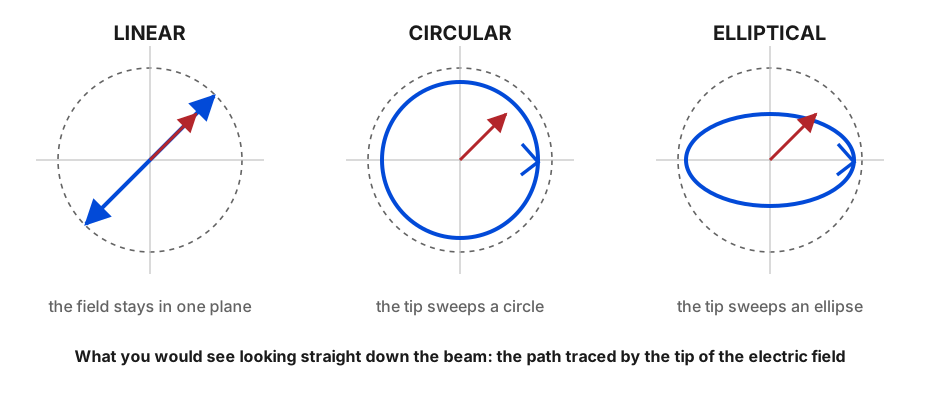
The physics: the electric field has only one non-zero component, or the two perpendicular components are perfectly in phase (0° phase difference) or perfectly out of phase (180°). In all cases, the field direction is constant — it just oscillates in magnitude and sign.
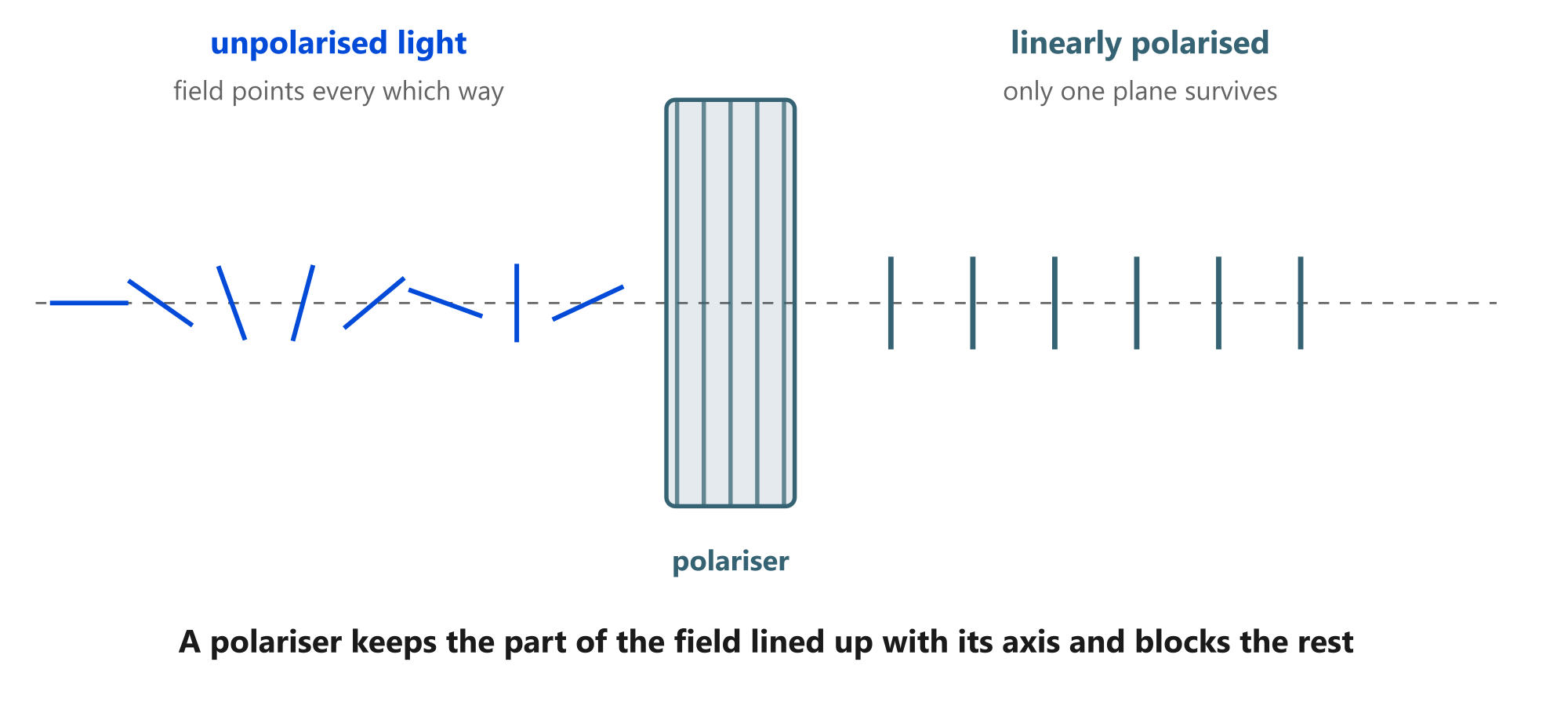
How it is produced. Standard polarising filters produce linear polarisation by absorbing light vibrating in one direction while transmitting the perpendicular direction. Lasers typically emit linearly polarised light. Reflection at Brewster's angle also yields completely linearly polarised light — when light reflects off water or glass at that specific angle (about 53° for water, 57° for crown glass), the reflected beam is 100% horizontally polarised.
Where you see it. Polarised sunglasses use vertically oriented linear polarisers to block horizontal glare from roads and water. LCD screens have a linear polariser at the back and another at the front, with a liquid crystal layer between them that twists the polarisation to control brightness per pixel. Camera polarising filters screw onto lenses to reduce reflections and deepen blue skies. For a more detailed look at how polarisers work, see our guide on what is polarised light.
Circular polarisation — the rotating field
Circular polarisation is more subtle. The electric field does not oscillate back and forth — it rotates in a circle as the wave moves forward. The field magnitude stays constant, but its direction spins around the propagation axis.
Picture a corkscrew going into a cork. The tip of the corkscrew traces a circular path as it moves forward. The light wave's electric field does the same thing — it rotates in a circle while the wave travels. Another way to picture it: imagine a spot of light moving in a circle on a wall. If that spot also moves away from you, it carves out a helix in space. That helix is the path of the electric field in a circularly polarised wave.
The condition for circular polarisation is precise: the two perpendicular electric field components must be equal in amplitude and exactly 90° (one quarter-wavelength) out of phase. If the x-component leads the y-component by 90°, the rotation is right-handed (RHCP). If it lags by 90°, the rotation is left-handed (LHCP).
RHCP vs LHCP: why it matters. Right-handed and left-handed circular polarisation are mirror images of each other. They are used to separate left-eye and right-eye images in 3D cinema — the projector sends both images simultaneously, each with opposite circular polarisation, and your glasses filter out one for each eye. In satellite communications, RHCP and LHCP antennas can transmit and receive independently on the same frequency, effectively doubling channel capacity without interference.
How it is produced. The most common method is to pass linearly polarised light through a quarter-wave plate oriented at 45° to the polarisation axis. The waveplate introduces a 90° phase shift between the two components, converting linear to circular. Circular polarisation also occurs naturally in some beetles — the rose chafer's shell reflects almost exclusively left-handed circularly polarised light.
Elliptical polarisation — the general case
Elliptical polarisation is the full picture. Linear and circular are just special cases of it.
Picture a figure skater spinning. If the skater spins perfectly upright, the path traced by their shoulder is a circle. But if they lean to one side, the path becomes an oval — an ellipse. That is elliptical polarisation: the electric field rotates like circular polarisation, but the amplitude is not the same in all directions, so it traces an oval.
The conditions: the two perpendicular components can have any amplitudes and any phase difference that is not exactly 0°, 180°, or 90° (with equal amplitudes). The shape of the ellipse — its orientation and how stretched it is — depends on the amplitude ratio and the phase difference.
Elliptical polarisation is the rule, not the exception. In most real-world situations, light is elliptically polarised to some degree. Perfect linear polarisation requires exact phase alignment. Perfect circular polarisation requires equal amplitudes and an exact 90° shift. Real optics produce something in between.
Where you see it. Elliptical polarisation appears in ellipsometry — a technique that measures thin film thickness and optical properties by analysing the elliptical polarisation of reflected light. Stress-induced birefringence in plastics and glass also produces elliptical polarisation patterns visible under crossed polarisers.
How to detect the type of polarisation
You can identify which type of polarisation a light beam has using just a linear polariser and a quarter-wave plate.
Test with a linear polariser only. Rotate the polariser while looking through it at the light. Three possible outcomes:
- Bright-dim-bright cycle as you rotate → the light is linearly polarised. The darkest point tells you the polarisation direction.
- No change in brightness → the light could be unpolarised or circularly polarised. (Unpolarised light also shows no variation through a rotating polariser.)
- Partial variation → the light is elliptically polarised or partially polarised.
Test with a quarter-wave plate plus linear polariser. Place a quarter-wave plate in front of the polariser and rotate the polariser. If the light now shows a clear bright-dim cycle, the original light was circularly polarised. The quarter-wave plate converts circular polarisation to linear polarisation, which the rotating polariser then reveals. If there is still no variation, the light was unpolarised.
This is the standard method used in optics labs and is how engineers test antenna polarisation in the field. For a comparison of unpolarised vs polarised light, see our guide on unpolarised light.
Converting between types with waveplates
Waveplates (also called retarders) are optical devices that introduce a controlled phase shift between the two perpendicular components of light.
- Quarter-wave plate introduces a 90° (λ/4) phase shift. It converts linear to circular polarisation when oriented at 45°, and circular back to linear polarisation.
- Half-wave plate introduces a 180° (λ/2) phase shift. It rotates the plane of linear polarisation and flips the handedness of circular polarisation: RHCP becomes LHCP and vice versa.
- Full-wave plate introduces a 360° (λ) phase shift, effectively doing nothing — but the effect is wavelength-dependent, so it can be used as a sensitive filter.
Waveplates are made from birefringent crystals like quartz or calcite, where light travels at different speeds along different crystal axes. The thickness of the plate determines the phase shift. Because waveplates are wavelength-specific, a quarter-wave plate designed for 550 nm (green light) will not produce exactly 90° of phase shift for red or blue light.
Common misconception: circular polarisation is rare
Many people assume circular polarisation is an exotic laboratory curiosity. It is not. Circularly polarised light is produced every time you watch a 3D movie, communicate via satellite, or look at the shell of certain beetles. FM radio stations often use circular polarisation to improve signal reception in vehicles and buildings.
Circular polarisation is also fundamental in nature. The mantis shrimp can detect circularly polarised light — the only animal known to have dedicated visual channels for it. Several species of scarab beetle reflect circularly polarised light, possibly as a form of communication or camouflage. Albert Abraham Michelson first discovered this in 1911 when he observed that the golden scarab beetle reflects preferentially left-handed circularly polarised light.
Key takeaways
- The three types of polarisation are linear, circular, and elliptical.
- Linear: electric field oscillates in a fixed plane (0° or 180° phase shift).
- Circular: electric field rotates in a circle (equal amplitudes, 90° phase shift).
- Elliptical: electric field traces an ellipse — the general case that includes linear and circular as special types.
- Circular polarisation comes in two handednesses: right-handed (RHCP) and left-handed (LHCP).
- You can detect the type using a linear polariser and a quarter-wave plate.
- Waveplates convert between types by introducing controlled phase shifts.
- Everyday applications include 3D movies, satellite communications, LCD screens, polarised sunglasses, and scientific instrumentation.
External resources
- Wikipedia: Circular Polarization — detailed technical reference covering mathematics, handedness conventions, and antenna applications
- Britannica: Polarization — authoritative encyclopedia entry on all types of light polarisation
- Physics LibreTexts: Polarization — textbook section with diagrams, worked examples, and Brewster's angle
Frequently Asked Questions
What are the three types of polarization?
The three types are linear polarization (electric field oscillates in a fixed plane), circular polarization (electric field rotates in a circle as the wave travels, requiring two equal-amplitude components 90 degrees out of phase), and elliptical polarization (the electric field traces an ellipse, the most general form with linear and circular as special cases).
What is circular polarization in simple terms?
Circular polarization is a state where the electric field of a light wave rotates in a circle as the wave moves forward. It requires two perpendicular components of equal strength with a quarter-wave (90 degree) phase difference. The rotation can be right-handed (clockwise) or left-handed (anti-clockwise).
What is the difference between linear and circular polarization?
In linear polarization, the electric field oscillates back and forth along a single fixed direction. In circular polarization, the electric field rotates continuously in a circle so its direction changes at a constant rate. Linear polarization is like a guitar string vibrating in one plane; circular polarization is like a corkscrew.
What is elliptical polarization of light?
Elliptical polarization is the most general polarization state. The electric field vector traces an ellipse as the wave propagates. It occurs when the two perpendicular components have different amplitudes or a phase difference that is not exactly 0 degrees or 90 degrees. Both linear and circular polarization are special cases of elliptical polarization.
How do you detect the type of polarization?
Use a linear polariser (analyser). Rotate it while observing the transmitted light. If the light goes from bright to dark and back, it is linearly polarised. If the brightness does not change, it may be circularly or unpolarised light. Add a quarter-wave plate before the analyser: if the light then shows bright-dark variation, the original light was circularly polarised.
What is the plane of polarization of light?
The plane of polarization is the plane containing the electric field vector and the direction of propagation. For linearly polarized light this is a fixed plane. For circularly polarised light the plane rotates as the wave travels. For elliptically polarised light the plane also rotates but the field magnitude varies.
What is the difference between circular polarised and linearly polarised light?
Linearly polarised light has its electric field confined to one plane and oscillates back and forth. Circularly polarised light has its electric field rotating in a circle with constant magnitude. The key difference is the phase relationship: linear has 0 degree or 180 degree phase difference between components; circular requires exactly 90 degree phase difference with equal amplitudes.
What is rotation of plane polarized light?
Rotation of plane polarized light, also called optical rotation, occurs when linearly polarized light passes through an optically active substance such as a sugar solution. The molecule's asymmetrical shape causes the plane of polarization to rotate. The amount of rotation depends on concentration, path length, and wavelength. This is the principle behind polarimetry used to measure sugar concentrations.

About Umar Farooq
Umar Farooq writes in-depth guides on the physics of light and optics — from reflection, refraction, and lenses to diffraction, lasers, and fiber optics, explained from first principles.
Read more about Umar Farooq →