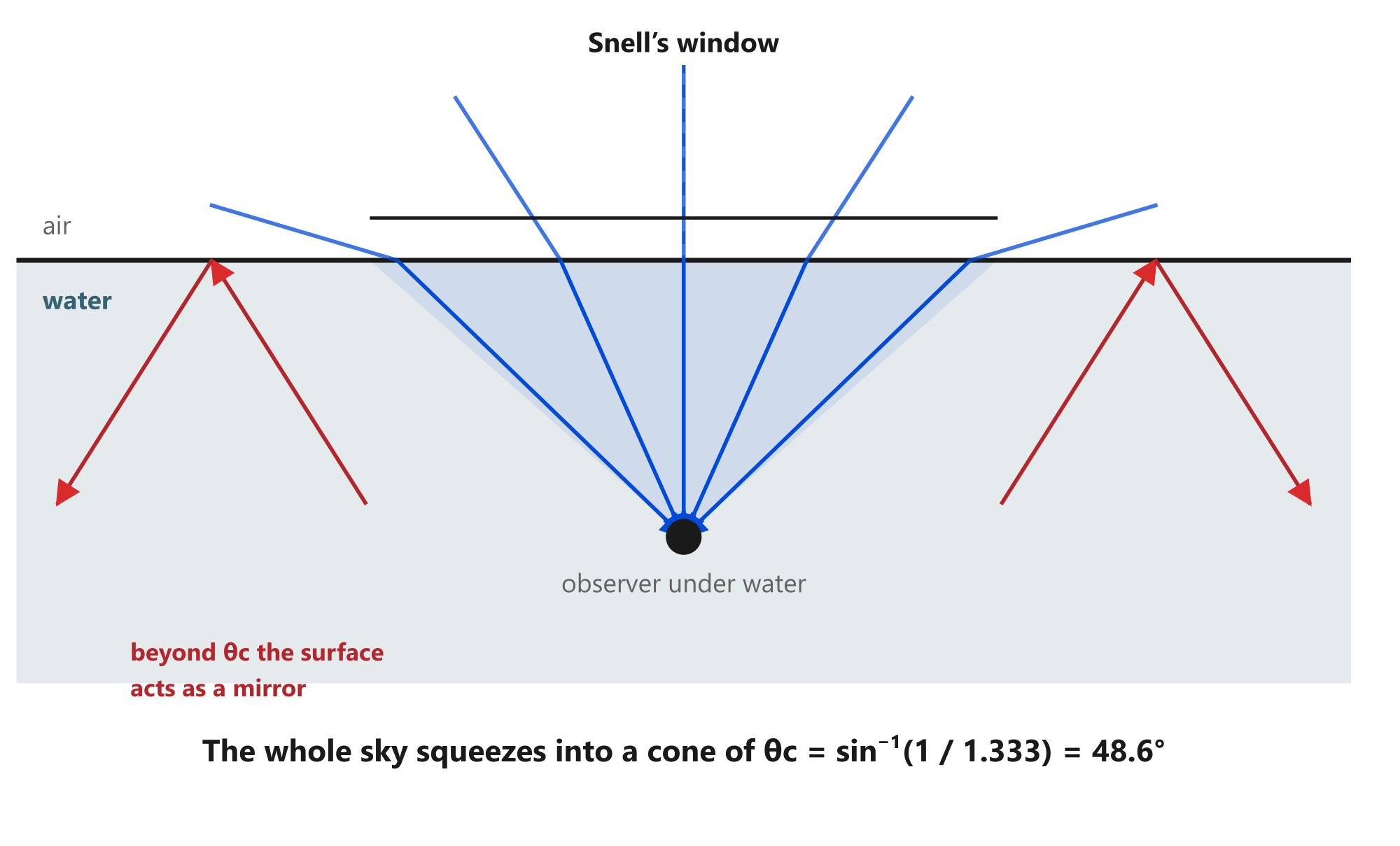
The critical angle of reflection marks the exact angle where light stops partially transmitting through a boundary and starts reflecting entirely. Below it, you get a mix of refraction and reflection. Beyond it, total internal reflection takes over and no light escapes. Here is what happens to reflection at every angle relative to the critical angle, why the relationship works this way, and where it matters in real optical design.
Picture light approaching the inside of a water surface from below, like a fish looking up at the sky. At a shallow angle (nearly straight up), most light passes through and you can see out. Tilt the angle a little more, and some light reflects back down, some still escapes. Tilt it past a certain point, and suddenly the surface becomes a perfect mirror — all the light reflects back, and the outside world disappears entirely. That threshold is the critical angle, and the way reflection behaves around it is the subject of this guide.
How reflection changes with angle — the three regimes
Every time light hits a boundary between two transparent media, part of it reflects and part of it transmits. The exact split depends on the angle of incidence and the refractive indices of the two media. The critical angle splits this behaviour into three distinct regimes.
Below the critical angle: partial reflection
When the angle of incidence is smaller than the critical angle, the light both reflects and refracts. The reflected portion is relatively small at near-normal incidence and grows gradually as the angle increases toward θc. The refracted portion exits into the rarer medium, bending away from the normal.
For a water-air boundary at an incident angle of 30 degrees (well below the 48.6 degree critical angle), most of the light escapes into the air. A small fraction reflects back into the water — you can see this as a faint reflection when looking at a pond from above at an angle.
The exact split between reflection and transmission at each angle is given by the Fresnel equations, which are beyond this guide. The key point is that the reflection intensity climbs steadily as you approach the critical angle.
At the critical angle: minimum reflection, maximum transmission
At exactly the critical angle, something specific happens to the refracted ray: it bends to exactly 90 degrees relative to the normal, running along the boundary surface. The refracted ray neither enters the rarer medium nor reflects — it skims the interface.
At this exact angle, the reflection is at its minimum value right before the regime flips entirely. The light energy is concentrated into the grazing refracted ray and the evanescent wave that extends a fraction of a wavelength into the rarer medium.
Beyond the critical angle: total internal reflection
Past the critical angle, the physics changes completely. There is no longer a solution to Snell's law that gives a real angle of refraction. The light cannot escape, and 100 percent of it reflects back into the denser medium. This is total internal reflection.
The jump is not gradual. At 48.5 degrees inside water (just below θc), some light still escapes. At 48.7 degrees (just above θc), all of it reflects. The transition from partial reflection to total reflection is effectively a step function at the critical angle.
The HyperPhysics guide on total internal reflection includes an interactive plot of internal reflection coefficients showing exactly how the reflected intensity climbs to 100 percent at the critical angle.
How refractive index controls the critical angle of reflection
The critical angle is not a fixed number — it depends on the refractive indices of the two media. The formula is sinθc = n2/n1, where n1 is the denser medium and n2 is the rarer medium (usually air at approximately 1.00).
This means the relationship between critical angle and reflection changes depending on the materials involved:
| Boundary | Refractive indices | Critical angle | Reflection behaviour |
|---|---|---|---|
| Water to air | 1.33 to 1.00 | 48.6 degrees | Gradual climb to TIR |
| Crown glass to air | 1.52 to 1.00 | 41.8 degrees | Faster climb, earlier TIR |
| Diamond to air | 2.42 to 1.00 | 24.4 degrees | Very fast climb, early TIR |
| Glass to water | 1.52 to 1.33 | 61.0 degrees | Slow climb, later TIR |
A higher refractive index in the denser medium means a smaller critical angle, which means total internal reflection kicks in at a shallower angle. This is why a diamond (n = 2.42, θc = 24.4 degrees) traps light so effectively — almost any ray entering the diamond hits an internal facet at an angle exceeding 24.4 degrees and reflects back inside.
The Britannica entry on the critical angle illustrates this with a clear diagram showing the transition from refraction to total reflection at the glass-air boundary.
Why this relationship matters in practice
The critical angle reflection link is not just textbook physics — it has real engineering consequences. It shapes how several important optical devices are designed.
Oil immersion microscopy
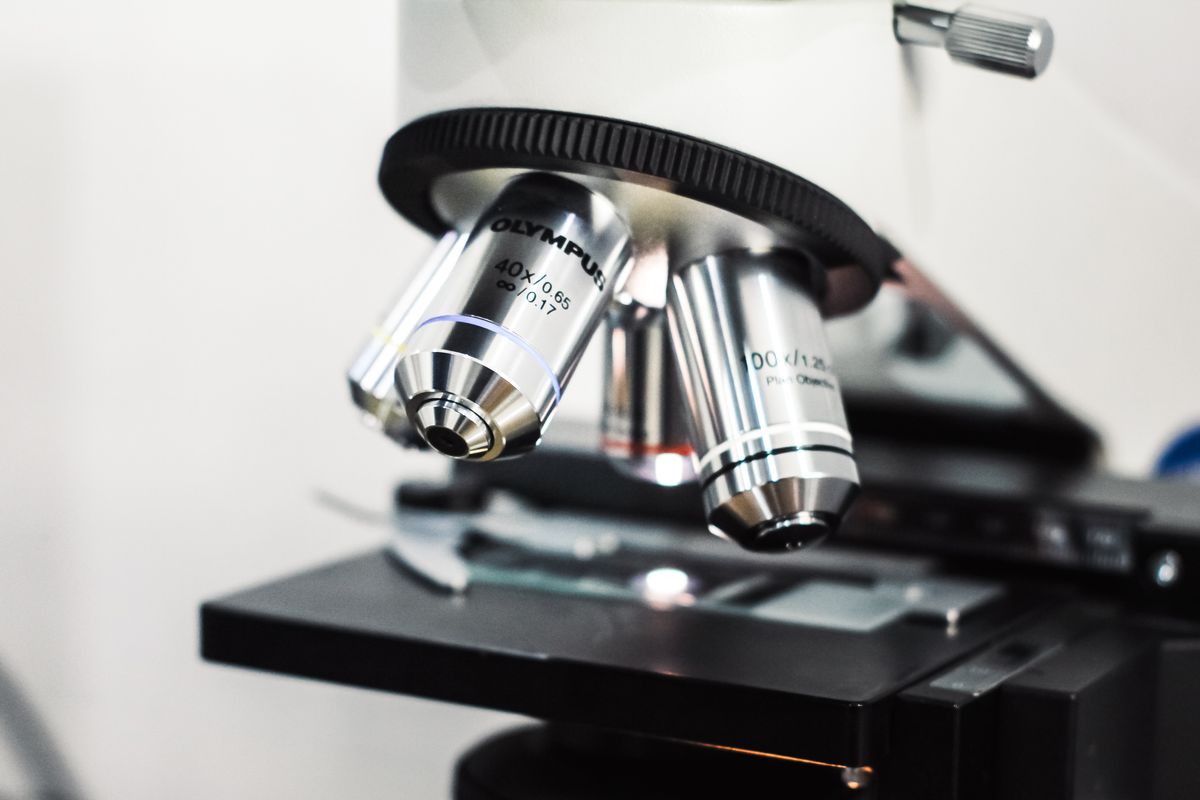
In a standard dry microscope objective, light travels from the glass cover slip to air and then to the objective lens. The glass-air boundary has a critical angle of about 41.8 degrees. Any light arriving at that boundary at a steeper angle undergoes TIR and never reaches the objective — it is lost.
Oil immersion solves this by replacing the air gap with oil that has the same refractive index as glass (approximately 1.52). This removes the glass-air boundary entirely. There is no critical angle to worry about because there is no index mismatch, so more light reaches the objective and the image is brighter and sharper.
The Evident Scientific tutorial on the critical angle of reflection provides an excellent interactive demonstration of how changing the incident angle affects reflection and transmission at the boundary.
Diamond cut design
Diamond cutters shape diamonds specifically to exploit the critical angle relationship. The crown and pavilion facets are angled so that light entering through the top undergoes TIR at the lower facets and bounces back up toward the viewer. A diamond cut too shallow or too deep lets light escape through the bottom instead of reflecting inside — that is what makes a poorly cut diamond look dull.
Fibre optic cables
Optical fibres rely on the fact that beyond the critical angle, reflection is perfect. The core has a higher refractive index than the cladding, so light injected at the right angle continuously undergoes TIR along the entire length of the fibre. Because the reflection is 100 percent efficient, the signal can travel for kilometres without significant loss — modern fibre loses as little as 0.14 dB/km.
For a detailed comparison of reflection phenomena, see our guide on reflection vs refraction. The broader topic of light behaviour at boundaries is covered in total internal reflection explained.
Prisms in optical instruments
Binoculars and periscopes use right-angle prisms instead of mirrors because TIR at the glass-air boundary reflects 100 percent of the light — no metal coating needed. The light enters the prism, hits the internal face at 45 degrees (above the 41.8 degree critical angle for glass to air), and reflects entirely. Two such reflections steer the beam through the instrument with no energy loss.
Common misconception: "Reflection critical angle is the strongest reflection"
Some people assume that because the critical angle leads to TIR, the reflection at exactly θc must be the strongest. In fact, at exactly the critical angle, the reflection is at its minimum right before TIR takes over. The refracted ray runs along the boundary, and most of the energy goes into that grazing transmission rather than into reflection. Past θc, the reflection jumps to 100 percent — there is no gradual increase, but a sudden flip.
This matters in optical design because it means operating right at the critical angle is not useful for reflection — you want to be significantly above it to guarantee total internal reflection, or significantly below it to maximise transmission.
For the complete picture of how refraction and reflection compare, see our guide on reflection, refraction and absorption. The physics of how light bends at boundaries in the first place is covered in Snell's law and the angle of refraction.
Frequently Asked Questions
What is the critical angle of reflection?
The critical angle of reflection (θc) is the angle of incidence in a denser medium at which the angle of refraction reaches 90 degrees. Below this angle, light partially reflects and partially transmits. Above it, all light reflects by total internal reflection. It marks the boundary between partial reflection and total reflection.
How does reflection change as you approach the critical angle?
As the angle of incidence approaches the critical angle from below, the reflection gradually increases in intensity. At exactly the critical angle, the refracted ray grazes the boundary surface. Past the critical angle, reflection jumps to 100 percent — total internal reflection takes over and no light escapes.
What is the relationship between critical angle and reflection?
The critical angle is the dividing line between two reflection regimes. Below θc, you get partial reflection (a fraction of light reflects, the rest refracts out). Above θc, you get total internal reflection (all light reflects back into the denser medium). The higher the refractive index of the denser medium, the smaller θc becomes, and the easier it is to achieve total reflection.
Why does the critical angle exist only from denser to rarer media?
The critical angle exists only when light travels from a medium with a higher refractive index to one with a lower refractive index. This is because Snell's law requires n1 > n2 for the equation sinθc = n2/n1 to produce a valid result (a value less than or equal to 1). From rarer to denser, light always refracts toward the normal and the angle of refraction is always smaller than the angle of incidence, so no critical angle exists.
How do oil immersion microscope objectives use the critical angle?
Oil immersion objectives use oil with a refractive index matching glass (about 1.52) to eliminate the air gap between the cover slip and the objective. This removes the glass-air boundary that would otherwise have a critical angle of about 41.8 degrees, allowing more light to enter the objective and improving resolution. Without oil, some light undergoes TIR at the glass-air boundary and never reaches the lens.
What determines whether a material has a large or small critical angle?
The critical angle is determined by the ratio of refractive indices: sinθc = n2/n1. A high refractive index in the denser medium (like diamond at 2.42) produces a small critical angle (24.4 degrees). A lower index (like water at 1.33) produces a larger critical angle (48.6 degrees). The larger the index difference between the two media, the smaller the critical angle.

About Umar Farooq
Umar Farooq writes in-depth guides on the physics of light and optics — from reflection, refraction, and lenses to diffraction, lasers, and fiber optics, explained from first principles.
Read more about Umar Farooq →