The critical angle formula θc = sin⁻¹(n₂/n₁) tells you the exact angle of incidence at which light switches from refracting out of a medium to reflecting entirely back inside it. Below this angle, some light escapes. Above it, total internal reflection takes over and no light escapes. Here is how the formula works, how to derive it, and how to use it with practical worked examples.
Picture a car driving off smooth tarmac onto sand at an angle. The wheel that hits the sand first slows first, so the car pivots toward the slow side. Light does the same thing at the boundary between two materials — one side slows it more than the other, and the beam bends. The critical angle formula is the mathematical expression of the point at which the bending is so extreme that the light cannot escape at all.
What is the critical angle formula?
The formula comes in two equivalent forms depending on what you are solving for:
Form 1 — finding the critical angle:
θc = sin⁻¹(n₂ / n₁)
- θc = critical angle (degrees)
- n₁ = refractive index of the denser medium (where the light is coming from)
- n₂ = refractive index of the rarer medium (where the light is trying to go)
Form 2 — simplified for air or vacuum:
θc = sin⁻¹(1 / n₁)
This works when the rarer medium is air (n₂ ≈ 1.0003, taken as 1.00 for most calculations) or a vacuum (n₂ = 1 exactly).
Both forms say the same thing: the critical angle equation depends only on the ratio of the two refractive indices. A bigger index difference means a smaller critical angle.
Deriving the critical angle formula from Snell's law
The formula is not arbitrary — it follows directly from Snell's law, which governs how light bends at boundaries:
n₁ sin θ₁ = n₂ sin θ₂
At the critical angle, two things are true simultaneously:
- The angle of incidence θ₁ equals the critical angle θc.
- The angle of refraction θ₂ equals 90 degrees — the refracted ray runs along the boundary.
Substitute these into Snell's law:
n₁ sin θc = n₂ sin 90°
Since sin 90° = 1, this simplifies to:
n₁ sin θc = n₂
Divide both sides by n₁:
sin θc = n₂ / n₁
Take the inverse sine of both sides:
θc = sin⁻¹(n₂ / n₁)
This is the full derivation in four lines. The Physics Classroom provides an excellent step-by-step derivation of the critical angle with clear diagrams showing how the refracted ray approaches 90 degrees as the incident angle increases.
How to use the critical angle formula in 3 steps
Using the critical angle formula is straightforward:
Step 1 — Identify n₁ (denser medium, higher refractive index) and n₂ (rarer medium, lower refractive index). Make sure n₁ > n₂, otherwise no critical angle exists.
Step 2 — Divide n₂ by n₁. The result will be a number between 0 and 1.
Step 3 — Take the inverse sine (sin⁻¹) of that number. The result is your critical angle in degrees.
Most scientific calculators have a sin⁻¹ button (often labelled as sin⁻¹, arcsin, or asin). On phone calculators, rotate to landscape mode to access the scientific functions.
6 worked examples
Each example uses a different material pair. The first four are to-air boundaries (the most common case). The last two show what happens when neither medium is air.
Example 1: Flint glass to air
Flint glass has n₁ = 1.62. Air is n₂ = 1.00.
sin θc = 1.00 / 1.62 = 0.617
θc = sin⁻¹(0.617) = 38.1 degrees
Flint glass has a higher refractive index than crown glass (1.52), so its critical angle is smaller. This means TIR kicks in at a shallower angle — useful in specialised optical components where compact light guiding is needed.
Example 2: Acrylic (Perspex) to air
Acrylic has n₁ = 1.49. Air is n₂ = 1.00.
sin θc = 1.00 / 1.49 = 0.671
θc = sin⁻¹(0.671) = 42.2 degrees
Acrylic is commonly used in demonstration experiments because it is easy to shape and its critical angle is close enough to 45 degrees to work well with common prism angles.
Example 3: Ethanol to air
Ethanol has n₁ = 1.36. Air is n₂ = 1.00.
sin θc = 1.00 / 1.36 = 0.735
θc = sin⁻¹(0.735) = 47.3 degrees
Ethanol's critical angle is close to water's (48.6 degrees) because their refractive indices are similar. This makes ethanol a good substitute for water-based demonstrations in cold environments where water might freeze.
Example 4: Diamond to air
Diamond has n₁ = 2.42. Air is n₂ = 1.00.
sin θc = 1.00 / 2.42 = 0.413
θc = sin⁻¹(0.413) = 24.4 degrees
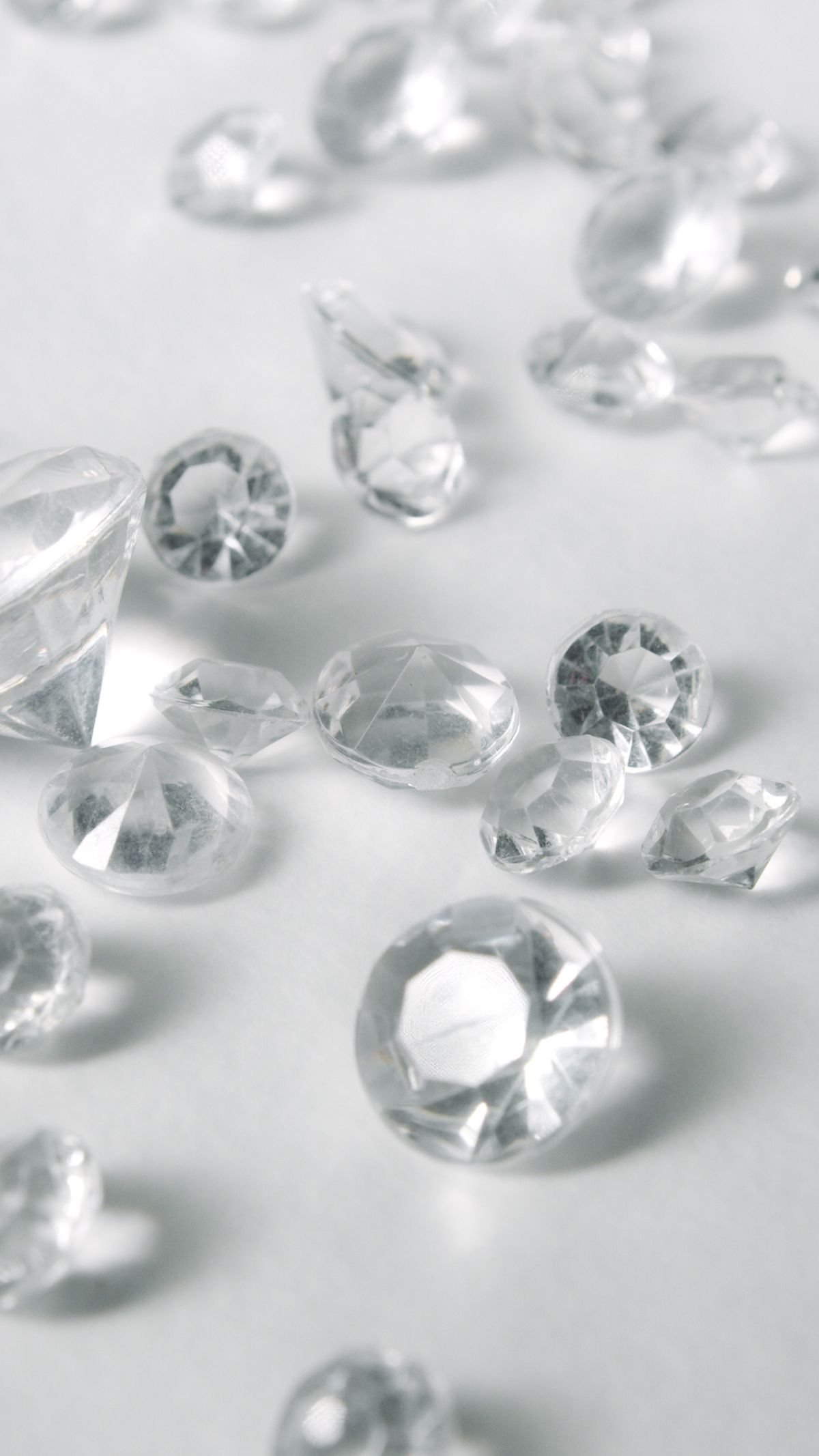
Diamond's tiny critical angle is the reason it sparkles. Any light that enters the diamond hits an internal facet at an angle almost certain to exceed 24.4 degrees, triggering TIR and bouncing the light around inside. This is covered in more detail in our guide on total internal reflection.
Example 5: Glass to water (neither medium is air)
Crown glass has n₁ = 1.52. Water is n₂ = 1.33.
sin θc = 1.33 / 1.52 = 0.875
θc = sin⁻¹(0.875) = 61.0 degrees
When the rarer medium is not air, the ratio n₂/n₁ is closer to 1, so the critical angle is larger. A glass-water boundary has a critical angle of 61.0 degrees — significantly bigger than the 41.8 degrees for a glass-air boundary. This is relevant for underwater optical instruments and aquarium design.
Example 6: Finding refractive index from measured critical angle
Suppose you measure the critical angle of an unknown material in air as 37 degrees. What is its refractive index?
Rearrange the formula to solve for n₁:
n₁ = n₂ / sin θc
Since the rarer medium is air (n₂ = 1.00):
n₁ = 1.00 / sin 37°
n₁ = 1.00 / 0.602
n₁ = 1.66
The material has a refractive index of approximately 1.66 — close to flint glass. This technique (using a refractometer) is a standard method for measuring the refractive index of transparent solids and liquids.
The Siyavula guide on critical angles provides additional worked examples with step-by-step solutions for different material combinations.
Critical angle values for common materials
The table below shows critical angles for common material pairs when the rarer medium is air (n = 1.00).
| Material | Refractive index (n₁) | Critical angle (to air) |
|---|---|---|
| Diamond | 2.42 | 24.4 degrees |
| Flint glass | 1.62 | 38.1 degrees |
| Crown glass | 1.52 | 41.8 degrees |
| Acrylic (Perspex) | 1.49 | 42.2 degrees |
| Ethanol | 1.36 | 47.3 degrees |
| Water | 1.33 | 48.6 degrees |
| Ice | 1.31 | 49.8 degrees |
| Air | 1.00 | No critical angle (n₁ must > n₂) |
The pattern is clear: higher refractive index means smaller critical angle. Diamond sits at the extreme end with its tiny 24.4-degree threshold. The Testbook guide on the critical angle formula provides additional derivation steps and alternative problem types.
3 common mistakes with the critical angle formula
Mistake 1: Swapping n₁ and n₂.
The most frequent error. The formula is θc = sin⁻¹(n₂/n₁), not sin⁻¹(n₁/n₂). Always put the rarer medium index (smaller number) on top. Swapping them gives sin⁻¹(n₁/n₂), which will be greater than 1 for most materials — your calculator will return an error.
Mistake 2: Using the formula from rarer to denser.
The critical angle formula only applies when light travels from a denser medium to a rarer medium (n₁ > n₂). From air to water, for instance, TIR can never happen, so calculating a critical angle for that direction is meaningless — the formula would give sinθc > 1, which has no real solution.
Mistake 3: Forgetting to use degrees mode.
The inverse sine function returns an angle, but it will be in radians if your calculator is in radian mode. Always check that your calculator is set to degrees when working with critical angles. A result of 0.848 radians (48.6 degrees) would be meaningless if you interpreted it as degrees.
For a broader discussion of how refraction works and where these formulas come from, see our guide on Snell's law and the angle of refraction. The relationship between reflection and the critical angle is explored in critical angle of reflection.
Practice problems
Test your understanding with these problems:
Problem 1: Calculate the critical angle for sapphire (n = 1.77) to air.
Solution: θc = sin⁻¹(1.00/1.77) = sin⁻¹(0.565) = 34.4 degrees
Problem 2: A material has a critical angle of 32 degrees in air. What is its refractive index?
Solution: n = 1/sin 32° = 1/0.530 = 1.89
Problem 3: Light travels from glass (n = 1.52) into ethanol (n = 1.36). What is the critical angle?
Solution: θc = sin⁻¹(1.36/1.52) = sin⁻¹(0.895) = 63.5 degrees
The Pearson Snell's Law calculator lets you check your answers by plugging in refractive indices and angles to see the critical angle and whether TIR occurs.
Why the critical angle formula matters in real optics
The critical angle formula is not just an exam question. It is used daily in:
- Fibre optics: Engineers use the formula to choose the right core and cladding materials so that light stays trapped inside the fibre by TIR. The difference in refractive indices between core and cladding sets the acceptance angle of the fibre.
- Gemstone cutting: Diamond cutters use the critical angle (24.4 degrees for diamond to air) to determine the ideal facet angles. A poorly cut diamond lets light escape through the bottom instead of reflecting internally.
- Microscope design: The formula explains why oil immersion objectives work — replacing the air gap with oil eliminates the glass-air critical angle and allows more light to enter the objective.
- Optical coating design: Anti-reflective coatings and thin-film optics rely on understanding how reflection behaves at boundaries, which starts with the critical angle formula.
For a complete comparison of how refraction differs from reflection in various optical phenomena, see our guide on reflection, refraction and absorption.
Frequently Asked Questions
What is the critical angle formula?
The critical angle formula is θc = sin⁻¹(n₂/n₁), where θc is the critical angle, n₁ is the refractive index of the denser medium, and n₂ is the refractive index of the rarer medium. When the rarer medium is air (n₂ ≈ 1.00), it simplifies to θc = sin⁻¹(1/n₁).
How do you calculate the critical angle?
To calculate the critical angle, divide the refractive index of the rarer medium by the refractive index of the denser medium, then take the inverse sine of the result. The formula is θc = sin⁻¹(n₂/n₁). For example, water to air: θc = sin⁻¹(1.00/1.33) = sin⁻¹(0.752) ≈ 48.6 degrees.
What is the relationship between critical angle and refractive index?
The critical angle is inversely related to the refractive index. A higher refractive index in the denser medium produces a smaller critical angle. Diamond (n = 2.42) has a critical angle of only 24.4 degrees, while water (n = 1.33) has a much larger critical angle of 48.6 degrees. The formula sinθc = n₂/n₁ directly relates the two.
Can the critical angle formula be used for light going from air to water?
No. The critical angle formula only applies when light travels from a denser medium to a rarer medium (n₁ > n₂). From air to water, n₁ < n₂, so the ratio n₂/n₁ would be greater than 1, and the inverse sine would have no real solution. Total internal reflection does not occur in that direction.
What is the critical angle for water to air?
The critical angle for a water-air boundary is approximately 48.6 degrees. Using the formula with n₁ = 1.33 (water) and n₂ = 1.00 (air): θc = sin⁻¹(1.00/1.33) = sin⁻¹(0.752) ≈ 48.6 degrees.
How do you find the refractive index from the critical angle?
Rearrange the critical angle formula to solve for n₁: n₁ = n₂/sinθc. If the rarer medium is air (n₂ = 1.00), this simplifies to n₁ = 1/sinθc. For example, if the measured critical angle of an unknown material is 37 degrees, its refractive index is n = 1/sin(37°) ≈ 1.66.

About Umar Farooq
Umar Farooq writes in-depth guides on the physics of light and optics — from reflection, refraction, and lenses to diffraction, lasers, and fiber optics, explained from first principles.
Read more about Umar Farooq →