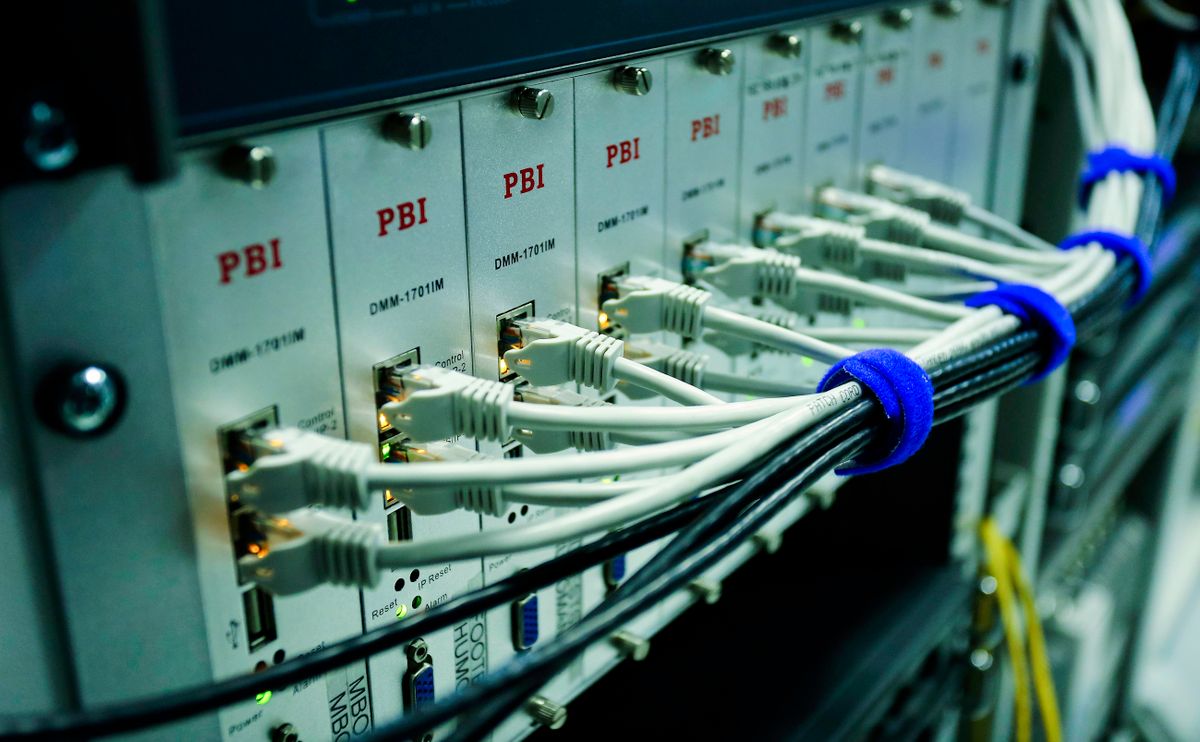
A fiber optic network is a high-speed communications system that transmits data as pulses of light through glass or plastic fibres. It is the backbone of the modern internet, carrying over 99% of the world's intercontinental data traffic through a vast web of terrestrial and submarine cables.
Here is what we cover: the 5 key components every fiber network needs, the different architectures from FTTH to long-haul, how the data gets from the central office to your home, and what makes fiber networks fundamentally different from copper.
What Is a Fiber Optic Network?
A fiber optic network is any communications network that uses optical fibre — thin strands of glass — as the transmission medium instead of copper wire. Data travels as pulses of infrared light, guided along the fibre by total internal reflection.
Think of it like a motorway system. Copper is a winding country road. Fiber is a 100-lane superhighway. But the superhighway is only as good as its on-ramps, off-ramps, and junctions — which is where the network components come in.
The network is not just the cable. It is the entire system: the lasers that generate the light, the fibre that carries it, the amplifiers that boost it over distance, the switches that route it, and the receivers that turn it back into data your computer can use.
The 5 Key Components of a Fiber Optic Network
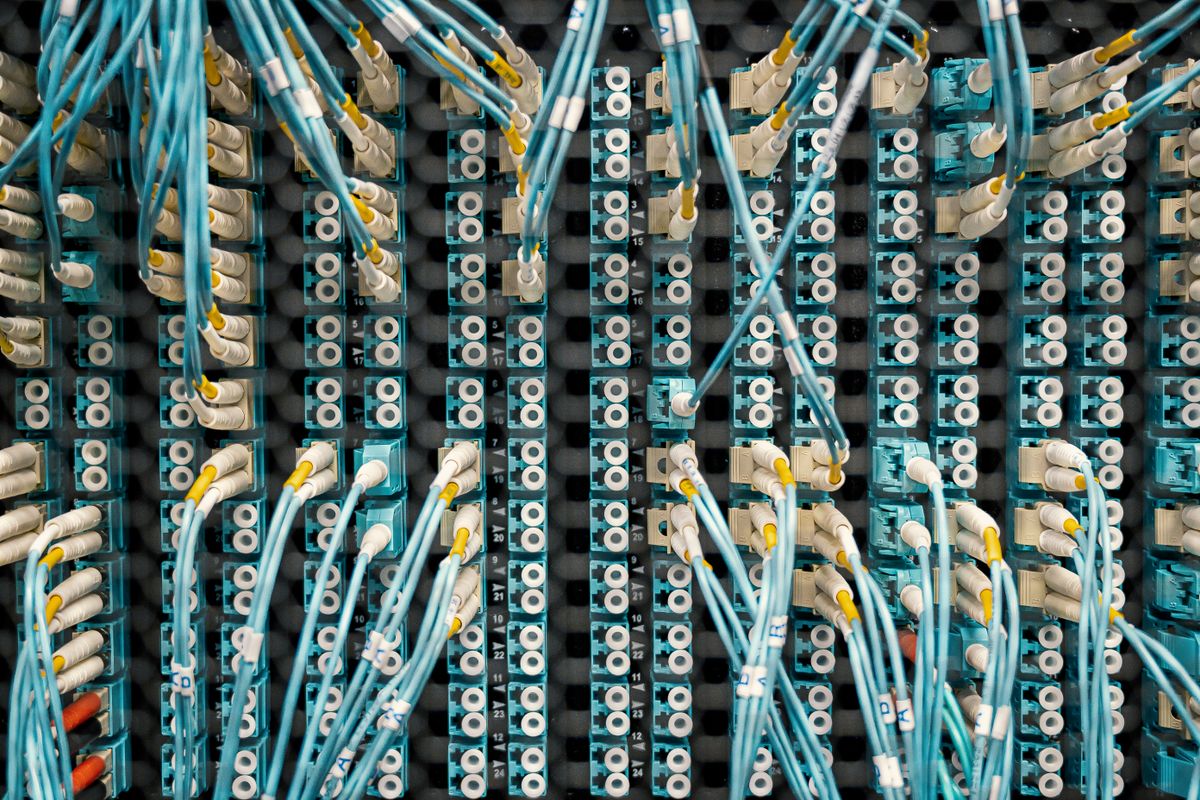
Every fiber optic network, from a home FTTH connection to a transatlantic cable, relies on the same five building blocks.
1. Optical Fibre Cable
The cable is the physical medium. A single fibre consists of a glass core (typically 9 µm for single-mode or 50–62.5 µm for multimode), surrounded by a cladding layer with a lower refractive index that keeps the light trapped inside, and a protective outer jacket.
A single cable can contain anywhere from 1 to over 1,000 individual fibres, bundled together for protection and ease of installation.
2. Optical Transmitter
The transmitter converts electrical data into light. For short distances (data centres, LANs), low-cost VCSELs or LEDs at 850 nm are common. For long-haul networks, precision laser diodes at 1310 nm or 1550 nm are used — the same wavelengths covered in our fiber optic bandwidth guide.
3. Optical Receiver
At the destination, a photodetector (typically a PIN diode or avalanche photodiode) converts the incoming light pulses back into an electrical signal. The receiver must be sensitive enough to detect dim signals after kilometres of travel, and fast enough to keep up with gigabit data rates.
4. Optical Amplifier
For long-distance networks, the signal weakens as it travels. Optical amplifiers — most commonly erbium-doped fibre amplifiers (EDFAs) at 1550 nm — boost the signal optically without converting it to electricity. This is what makes transoceanic cables possible: a signal can be amplified and re-amplified dozens of times across thousands of kilometres.
5. Switching and Routing Equipment
Switches, routers, and multiplexers direct data to the correct destination. In a passive optical network (PON), the splitter is a simple unpowered device that divides one fibre into many. In an active optical network, powered switches route individual signals to specific users.
Network Architectures: How the Pieces Fit Together
The way these components are arranged determines the network type. The most common architectures are:
FTTH (Fiber to the Home)
Fibre runs all the way from the provider's central office (CO) directly to the user's home. This is the gold standard for residential internet. At the CO, an OLT (Optical Line Terminal) sends data downstream. At the home, an ONT (Optical Network Terminal) converts the light signal to an electrical one for the router.
Between them sits the ODN (Optical Distribution Network) — the passive fibre infrastructure including splitters, distribution frames, and termination boxes. A single fibre from the OLT can be split to serve 32, 64, or even 128 homes using unpowered optical splitters.
FTTN (Fiber to the Node)
Fibre runs to a street cabinet (the "node"), and the final connection to the home uses existing copper telephone wires (VDSL). This is cheaper to deploy but limited to about 100 Mbps, because the copper bottleneck remains.
FTTC (Fiber to the Curb)
Similar to FTTN, but the fibre terminates closer to the home — typically at a pedestal at the end of the street. The remaining copper run is shorter, allowing speeds up to about 300 Mbps.
Long-Haul and Submarine Networks
These are the backbone networks that connect cities and continents. They use single-mode fibre, 1550 nm lasers with EDFAs, and dense wavelength division multiplexing (DWDM) to carry hundreds of thousands of simultaneous connections on a single fibre pair.
Modern submarine cables — like the ones that carry 99% of intercontinental data traffic — use fibre with attenuation as low as 0.15 dB/km, allowing signals to travel 80–120 km between amplifiers.
Active vs Passive Optical Networks
One of the key design decisions in any fiber optic network is whether to use active or passive components between the central office and the user.
| Feature | Passive Optical Network (PON) | Active Optical Network (AON) |
|---|---|---|
| Power between CO and user | None (passive splitters) | Powered switches/routers |
| Bandwidth | Shared among users | Dedicated per user |
| Range | Up to 20 km typical | Up to 70+ km |
| Cost per user | Lower | Higher |
| Maintenance | Lower (no powered equipment) | Higher |
| Best for | Residential FTTH | Enterprise, campus |
PON is by far the most common architecture for residential FTTH because it is cheaper to deploy and maintain. GPON (Gigabit PON) and XGS-PON (10 Gigabit symmetric PON) are the dominant standards in 2026.
How Data Travels Through a Fiber Network
Here is the path data takes from the internet backbone to your home:
- The backbone — Data arrives at the provider's central office through a long-haul fibre link, often using DWDM at 1550 nm.
- The OLT — The Optical Line Terminal at the central office converts the data to light at a specific wavelength (typically 1490 nm downstream, 1310 nm upstream for GPON).
- The splitter — A passive optical splitter divides the signal to serve multiple homes. A 1:32 splitter sends 1/32 of the original power to each home.
- The ONT — The Optical Network Terminal in your home converts the light back to an electrical signal your router can use.
- Your router — Distributes the internet connection to your devices via Ethernet or Wi-Fi.
The whole process happens in milliseconds, even for data coming from across the ocean.
Common Misconception: "Fiber Networks Are Fragile"
A common concern is that glass fibre is brittle and breaks easily. In fact, modern fibre cables are remarkably tough. The glass fibre is protected by multiple layers of coating, buffer, and strength members (often Kevlar or fibreglass), plus a rugged outer jacket. Fibre cables can be bent to tight radii, buried underground, pulled through ducts, and even deployed across the ocean floor.
The real fragility is not the fibre — it's the connectors. Dust, dirt, or damage at a connector end-face is the most common cause of signal loss in a fiber optic network.
How to Choose the Right Network Architecture
The right architecture depends on who you are and what you need.
| Scenario | Recommended architecture | Why |
|---|---|---|
| Residential home | FTTH with GPON or XGS-PON | Highest speed, future-proof, shared cost |
| Business campus | Active Ethernet or AON | Dedicated bandwidth, longer reach |
| City-wide deployment | FTTH with PON | Lowest cost per home, proven at scale |
| Rural / low-density | FTTN or fixed wireless | Lower deployment cost, adequate for lower density |
| Inter-city backbone | DWDM long-haul | Maximum capacity, amplifier spacing of 80–120 km |
| Transoceanic | Submarine cable with EDFA | Lowest loss fibre, DWDM, redundant paths |
Summary
- A fiber optic network transmits data as light through glass fibres, offering vastly more bandwidth than copper
- The 5 key components are the cable, transmitter, receiver, amplifier, and switching equipment
- FTTH (Fiber to the Home) is the gold standard for residential internet, using a PON architecture with OLTs and ONTs
- FTTN and FTTC use fibre to a point and then copper for the final connection — faster than pure copper but slower than FTTH
- Active networks offer dedicated bandwidth per user at higher cost; passive networks share bandwidth but cost less per user
- The majority of the world's internet traffic travels through submarine fibre cables using 1550 nm lasers and EDFA amplifiers
For a deeper look at the cable types and wavelengths that make these networks possible, see our types of fiber optic cable guide and optical fibre invention article.
Sources used in this article: Zayo — What is a Fiber Optic Network, TailWind — Fiber Optic Network Components, and Optika — 10 Key Fiber Optic Components.
Frequently Asked Questions
What is a fiber optic network?
A fiber optic network is a communications network that transmits data as pulses of light through thin glass or plastic fibres. It consists of optical cables, transmitters, receivers, and switching equipment. Fiber networks carry the majority of the world's internet, telephone, and television traffic because they offer far higher bandwidth and lower latency than copper-based networks.
How does a fiber optic network work?
A fiber optic network works by converting electrical data into light pulses at the transmitter, sending those pulses through an optical fibre using total internal reflection, and converting them back to electrical signals at the receiver. The network architecture determines how the fibre is routed from the central office to individual users, with different configurations for long-haul, metro, and last-mile connections.
What are the main components of a fiber optic network?
The five main components are: optical fibre cables (the transmission medium), transmitters (LEDs or lasers that send light), receivers (photodetectors that convert light back to electricity), optical amplifiers (to boost signals over long distances), and switching/routing equipment (to direct data to the correct destination). Additional components include connectors, splitters, and patch panels.
What is the difference between FTTH and FTTN?
FTTH (Fiber to the Home) runs fibre directly from the provider's central office to the user's premises, providing the highest possible speed. FTTN (Fiber to the Node) runs fibre to a street cabinet and then uses existing copper telephone wires for the final connection to the home, which creates a bottleneck that limits speed.
What is an OLT in fiber optic networks?
OLT stands for Optical Line Terminal. It is the device at the service provider's central office that converts electrical data into optical signals and transmits them downstream to users. It also receives upstream optical signals from users and converts them back to electrical data. A single OLT can serve hundreds or thousands of subscribers through a passive optical network.
What is an ONT in fiber optic networks?
ONT stands for Optical Network Terminal. It is the device installed at the user's premises that converts the optical signal from the fibre into an electrical signal that standard routers and devices can use. It also converts electrical data from the user back into optical signals for upstream transmission. ONTs are also called ONUs (Optical Network Units).
What is a passive optical network (PON)?
A passive optical network (PON) is a fiber optic network architecture that uses unpowered optical splitters to distribute a single fibre connection to multiple users. No active electronics (amplifiers or switches) exist between the central office and the user. This reduces power consumption and maintenance costs. GPON and XGS-PON are the most common PON standards.
What is the difference between active and passive optical networks?
Active optical networks (AON) use electrically powered switches or routers to direct signals to specific users, giving each user a dedicated fibre connection. Passive optical networks (PON) use unpowered splitters to divide a single fibre among multiple users, sharing the bandwidth. AON offers dedicated bandwidth but costs more. PON is cheaper per user but bandwidth is shared.
How fast is a fiber optic network?
Commercial fiber optic networks typically offer speeds from 100 Mbps to 10 Gbps for residential connections and up to 400 Gbps per wavelength for backbone links. The world record for a single fibre is 402 Tbps (IEEE Spectrum, 2024). Speed depends on the network architecture, the transceiver equipment, and the service plan chosen.
What is the difference between fiber optic network and cable internet?
Fiber optic networks use light through glass fibres and offer symmetrical speeds (equal upload and download), lower latency, and immunity to electromagnetic interference. Cable internet uses electrical signals through coaxial copper cables, offers slower upload speeds, and is more susceptible to interference and network congestion during peak hours.

About Umar Farooq
Umar Farooq writes in-depth guides on the physics of light and optics — from reflection, refraction, and lenses to diffraction, lasers, and fiber optics, explained from first principles.
Read more about Umar Farooq →