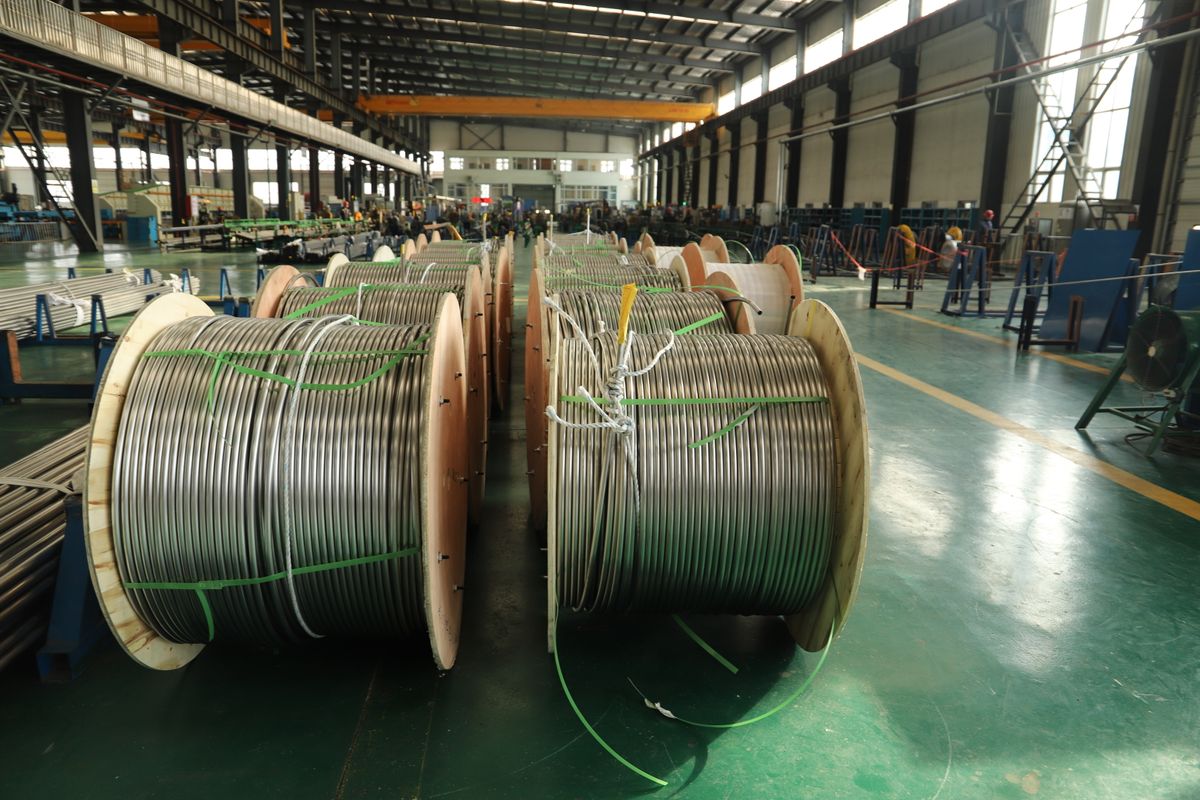
How is fiber optic cable made? It is made in a seven-step process that starts with ultra-pure silica glass, forms it into a precisely engineered glass rod called a preform, draws that rod into a hair-thin fibre on a towering machine, coats the fibre for protection, then assembles it into a finished cable with strength members and an outer jacket. Each step demands extreme precision — a single contaminant measured in parts per billion can ruin the fibre's ability to carry light.
Picture making a single strand of spaghetti by pulling a thick piece of dough through a tiny hole. Now imagine the "dough" is ultra-pure glass, the "hole" is a furnace at 2,000 °C, and the "spaghetti" has to be precisely 125 millionths of a metre wide — for 10,000 kilometres without a break. That is the scale of precision in how is fiber optic cable made. The process is part chemistry lab, part steel mill, and part clean room, all rolled into one.
Here is how the whole process works, from raw sand to the cable that carries the internet.
Step 1: Making the Glass Preform
Every optical fibre begins as a preform — a thick, solid glass rod about 2–3 metres long and 20–40 mm in diameter. The preform is not ordinary glass. It is ultra-pure silica (silicon dioxide, SiO₂) with precisely controlled layers that will become the core and cladding of the final fibre. Understanding how is fiber optic cable made starts with understanding the preform.
The most common method for making preforms is Modified Chemical Vapor Deposition (MCVD) . Here is how it works. A hollow silica tube about 1–2 metres long is mounted on a glass-working lathe and rotated slowly. A stream of gases — silicon tetrachloride (SiCl₄), germanium tetrachloride (GeCl₄), and pure oxygen — flows through the tube. An oxy-hydrogen flame passes back and forth along the outside, heating the tube to roughly 1,700 °C. The heat causes the gases to oxidise, depositing a thin layer of glassy "soot" on the inner wall.
Layer by layer, the tube builds up. The first layers form the cladding (lower refractive index). Later layers include more germanium, which raises the refractive index, forming the core. After anywhere from 100 to 500 layers, the tube is heated further until it collapses into a solid, transparent rod — the preform.
Other methods exist too. Outside Vapor Deposition (OVD) deposits soot on the outside of a bait rod. Vapor Axial Deposition (VAD) builds the soot axially on a rotating target. Both produce ultra-low-loss fibre suitable for long-haul cables. The MadeHow guide to optical fibre manufacturing walks through each technique in detail.
Step 2: Sintering and Collapsing
Once the soot layers are deposited, the preform is not yet ready. The soot is porous — think of it like a white, chalky cylinder filled with microscopic air gaps. These gaps would scatter light and ruin the fibre's performance.
The preform goes through a sintering stage. It is heated to 1,600–1,800 °C in a chlorine atmosphere. The chlorine drives out any remaining moisture — water molecules that would later absorb infrared light signals. The heat fuses the soot particles into solid, bubble-free glass. For the MCVD method, this happens during the collapsing step: the tube is heated until it shrinks inward and seals into a solid rod.
The finished preform looks like a giant icicle — crystal clear. At this stage, it contains the exact refractive index profile that will guide light in the final fibre. The entire preform-making process takes several hours, but that time is an investment: a single preform contains enough glass to produce over 10,000 kilometres of finished fibre.
Step 3: Drawing the Fibre
Drawing is where the preform — nearly as thick as your wrist — becomes a fibre thinner than a human hair. This happens on a drawing tower, a vertical machine that can stand 30 to 45 metres tall. The scale of this equipment is central to how is fiber optic cable made at industrial volumes.
The preform is lowered into a graphite resistance furnace at the top of the tower. The furnace heats the tip to about 2,000 °C — just above the softening point of silica glass. The tip melts and a droplet of molten glass, called a "gob", forms and falls. As it falls, it pulls a thin strand behind it. That strand is the optical fibre.
The fibre is captured by a capstan at the base of the tower and pulled downward at high speed. Modern towers run at 40 to 50 metres per second — up to 3,000 metres per minute. Laser micrometers measure the fibre diameter in real time, feeding back to the draw speed to hold the diameter at exactly 125 micrometres, with a tolerance of ±1 micrometre. The Corning optical fibre manufacturing page demonstrates the precision of this process.
Think of it like pulling taffy. Pull slowly and the strand is thick. Pull fast and it thins out. The draw tower controls this continuously, adjusting speed within milliseconds if the diameter drifts.
A critical fact about how is fiber optic cable made: at the instant the glass exits the furnace, it is still pristine. The surface has no microcracks — yet. That protection has to come immediately, which is why the next step happens in the same machine, without the fibre touching any roller.
Step 4: Coating the Fibre
The bare glass fibre is fragile. A microscopic scratch on its surface would propagate into a crack under tension, snapping the fibre. Coating happens immediately after drawing — in milliseconds, before the fibre even touches anything.
The fibre passes through coating cups that apply two layers of UV-curable acrylate polymer. The primary coating is soft (low modulus, around 1 MPa), acting as a shock absorber that cushions the glass from microbending. The secondary coating is hard (high modulus, around 800 MPa), providing abrasion resistance. Together they bring the fibre diameter from 125 µm to about 250 µm.
UV lamps cure the coating instantly as the fibre passes through — each layer solidifies within a fraction of a second. This inline coating step is one of the most elegant parts of how is fiber optic cable made: the glass never sees the open air unprotected.
Without this dual-layer system, a fibre optic cable would fail within hours of installation. Moisture and handling would create surface flaws that grow under tension. The coating is arguably as important as the glass itself.
Step 5: Proof Testing and Colour Coding
After coating, the fibre is not yet ready for cabling. It must pass a proof test. The entire length of fibre is pulled through a capstan system that applies a controlled tensile load — typically 100,000 PSI (about 690 MPa). Any weak point snaps during this test, not during installation. Every kilometre of commercial fibre is proof-tested; there is no sampling.
Next comes colour coding. The coated fibre passes through a UV ink application line where a thin layer of pigmented ink is applied to the surface. The colours follow the TIA-598 standard: blue, orange, green, brown, slate, white, red, black, yellow, violet, rose, aqua — repeated for each group of 12 fibres. In a cable with 288 fibres, colour coding is the only way a technician can identify individual strands.
The coloured fibre is wound onto spools holding 25 to 100 kilometres each and sent to the cabling stage.
Step 6: Cable Assembly
A single coated fibre is still too delicate for real-world use. It needs to be bundled with strength members, buffer tubes, and water-blocking materials to become a cable you can pull through conduits or bury underground.
First, individual fibres are placed inside buffer tubes. There are two approaches:
- Loose tube construction: 6–12 fibres sit inside a gel-filled PBT tube. The gel blocks moisture. The fibres have extra length inside the tube (about 0.2–0.5% more fibre than tube), allowing them to flex without strain as the cable expands and contracts with temperature. This is the standard for outdoor cables.
- Tight buffer construction: A thermoplastic material — nylon 12 or PVDF — is extruded directly over each coated fibre, bringing the diameter to 900 µm. Tight-buffered fibres are easier to terminate and are standard for indoor cables.
Multiple buffer tubes are stranded around a central strength member using an S-Z stranding machine. The "S-Z" name comes from the alternating left-right twist pattern, which prevents the assembly from unwinding and allows mid-span access without cutting the entire cable.
Around the stranded core, aramid yarn (the same material as Kevlar) is wrapped helically. Aramid provides tensile strength — it takes the pull during installation so that the glass fibres do not have to. Water-blocking tapes or yarns are added between layers. For outdoor cables, a corrugated steel tape armour may be wrapped for rodent protection.
The types of fibre optic cable guide explains how single-mode and multimode cables differ at this stage, and the fibre optic cable materials article goes deeper into what each layer is made of.
Step 7: Jacketing
The final step in how is fiber optic cable made is extruding the outer jacket over the assembled cable core. A wire and cable extruder melts thermoplastic pellets and applies a uniform layer around the core.
The jacket material depends on the installation environment:
| Jacket Material | Where Used | Key Property |
|---|---|---|
| Polyethylene (PE) | Outdoor, buried, aerial | UV-resistant, waterproof |
| PVC | Indoor general purpose | Flexible, flame-retardant, low cost |
| LSZH | Public buildings, tunnels, data centres | Emits minimal toxic smoke in fire |
| Plenum | Air-handling spaces | Self-extinguishing |
| Nylon (PA12) | Industrial, fuel exposure | Chemical resistant |
The jacket is not just a wrapper. It is the cable's first line of defence against water, UV radiation, chemicals, and abrasion. Laser gauges measure jacket thickness in real time, typically maintaining it within ±0.1 mm of the specification.
After jacketing, the finished cable undergoes a final battery of tests: OTDR (Optical Time Domain Reflectometer) checks for signal loss along every fibre. Tensile and crush tests verify mechanical strength. The cable is then wound onto shipping reels, labelled, and sent out.
The entire process — from raw silicon tetrachloride to a finished cable reel — takes 1 to 3 days. What is optical fibre covers how that fibre transmits data once it is installed, and our guide on total internal reflection explains the physics that makes it all possible.
A Common Misconception About How Is Fiber Optic Cable Made
Many people imagine a fibre optic cable as a hollow glass tube with a mirrored inner surface, like a pipe lined with silver. This is wrong on both counts.
A fibre optic cable is solid glass. There is no hollow centre and no mirror lining. The light reflects off the core-cladding boundary not because of a reflective coating but because of total internal reflection — a purely optical phenomenon that depends on the refractive index difference between two transparent materials.
People think this myth is intuitive. But light in a fibre does not bounce off a shiny surface. It passes through a transparent boundary and gets reflected back because the angle is too shallow for it to escape. The cladding is not a mirror — it is clear glass. The reflection is intrinsic to the physics, the same way a swimming pool looks like a mirror when you view the surface from underwater.
The same physics applies to the glass in every fibre optic cable on the planet. That is the real story behind how is fiber optic cable made.
External resources
- MadeHow: How Optical Fiber Is Made — detailed manufacturing guide covering MCVD, drawing, and coating processes
- Corning: Optical Fiber Manufacturing Excellence — manufacturer's overview of the OVD process and quality control
- Wikipedia: Optical Fiber — Manufacturing — comprehensive reference on fibre fabrication techniques
For the physics behind how the fibre guides light, see our guide on total internal reflection. To understand what makes up each layer of the cable, read what is fiber optic cable made of. For the light source used in fibre systems, see how laser light works.
Frequently Asked Questions
How is fiber optic cable manufactured step by step?
Fiber optic cable is manufactured in seven steps: (1) making the glass preform using chemical vapour deposition, (2) sintering and collapsing the preform into a solid rod, (3) drawing the fibre on a vertical tower at 2,000°C, (4) applying a protective dual-layer coating, (5) proof testing and colour coding the fibre, (6) assembling the cable with strength members and buffer tubes, and (7) jacketing the cable with an outer polymer layer.
What raw materials are used to make fiber optic cable?
The primary raw material is high-purity silicon dioxide (SiO₂), sourced as silicon tetrachloride gas. Dopants like germanium tetrachloride adjust the refractive index. The coating uses UV-curable acrylate polymers. For the finished cable, materials include aramid yarn (Kevlar) for strength, steel or fibreglass for the central member, and polyethylene, PVC, or LSZH for the outer jacket.
What is a fiber optic preform?
A preform is a thick glass rod — typically 2–3 metres long and 20–40 mm in diameter — that contains the exact refractive index profile of the final optical fibre. It is the starting point for fibre drawing. A single preform can yield over 10,000 kilometres of continuous optical fibre.
What is MCVD in fiber optic manufacturing?
MCVD stands for Modified Chemical Vapor Deposition. It is the most common method for making fibre preforms. A silica tube rotates in a lathe while gases like SiCl₄, GeCl₄, and O₂ flow through it. An oxy-hydrogen flame heats the tube, causing the gases to oxidise and deposit layers of glass soot on the inner wall. After hundreds of layers, the tube is collapsed into a solid preform.
How long does it take to make fiber optic cable?
Making the preform takes several hours. The fibre drawing process runs continuously — a single draw tower can pull fibre at 40–50 metres per second, producing thousands of kilometres from one preform. The cabling stage runs at lower speeds, typically 100–200 metres per minute. From raw materials to finished cable on a spool, the entire process can take 1–3 days depending on cable complexity.
How is fiber optic cable made from sand?
Fiber optic cable starts as silicon dioxide — the same compound found in ordinary sand. But the manufacturing process refines it to extraordinary purity: 99.9999% or better. The silicon is converted to silicon tetrachloride gas, purified, then oxidised back into solid silica glass through vapour deposition. The resulting glass is so pure that contaminant levels are measured in parts per billion.

About Umar Farooq
Umar Farooq writes in-depth guides on the physics of light and optics — from reflection, refraction, and lenses to diffraction, lasers, and fiber optics, explained from first principles.
Read more about Umar Farooq →