
Interference happens whenever two waves meet. It is not a rare or exotic effect — it happens every time waves overlap. Drop two stones into a still pond and watch the ripples cross. Where two crests meet, the water jumps higher. Where a crest meets a trough, the surface flattens. That is interference, pure and simple. Light does the same thing. Sound does the same thing. All waves do.
The only difference is what you see or hear. Water waves show as visible ripples. Sound waves show as changes in loudness. Light waves show as bright and dark bands — because your eye cannot see the wave itself, only the intensity pattern it creates.
Wave interference definition
In physics, interference is the phenomenon that occurs when two or more waves superpose while travelling through the same medium. The waves combine according to the principle of superposition: the net displacement at any point is the sum of the displacements of the individual waves.
If the waves arrive in step — crest aligned with crest — the amplitudes add and the resulting wave is larger. If they arrive out of step — crest aligned with trough — the amplitudes subtract and the resulting wave is smaller. These are the two fundamental types of interference.
The word "interference" can sound negative (like radio interference), but in physics it is neutral. It simply describes what waves naturally do when they meet.
Constructive vs destructive interference
Constructive interference occurs when two waves are exactly in phase. The crests line up, the troughs line up, and the amplitude of the combined wave equals the sum of the individual amplitudes. If each wave has amplitude A, the combined amplitude is 2A. The intensity (which depends on amplitude squared) becomes four times greater.
The condition for constructive interference is:
Path difference = nλ (n = 0, 1, 2, 3, ...)
Destructive interference occurs when two waves are exactly out of phase — shifted by half a wavelength. The crest of one wave aligns with the trough of another. The amplitudes subtract. If the two waves have equal amplitude, the result is zero. Complete silence. Complete darkness. Cancellation.
The condition for destructive interference is:
Path difference = (n + 1/2)λ (n = 0, 1, 2, 3, ...)
Picture two speakers playing the same tone. Stand exactly halfway between them and you hear the tone clearly — constructive interference. Move one speaker back by half a wavelength and stand in the same spot: the sound almost vanishes. That is destructive interference.
The principle of superposition
The principle of superposition is the mathematical rule that governs interference. It states that when two or more waves overlap at a point, the total displacement is the vector sum of the individual displacements.
This is straightforward for mechanical waves like sound and water — you can see or measure the displacement directly. For light, it is trickier because you cannot see the electric field oscillating. But the maths is the same. Two light waves arriving in phase produce a bright spot because their electric fields add. Two light waves arriving out of phase produce a dark spot because the fields cancel.
Superposition works for all linear wave phenomena. It is why you can have multiple conversations in the same room — each sound wave passes through the others and emerges unchanged, because the waves add linearly at every point.

Conditions for interference
For interference to produce a stable, visible pattern, the wave sources must meet three conditions:
- Coherence. The sources must maintain a constant phase difference over time. Laser light is coherent because all the photons are emitted in step. Ordinary light bulbs emit incoherent light — the phase changes randomly billions of times per second, so any interference pattern would average out instantly.
- Same frequency. Waves of different frequencies produce a pattern that shifts too quickly to see. For sound, slightly different frequencies produce beats — a slow throbbing that is itself an interference pattern. For light, different frequencies (colours) produce separate, overlapping patterns.
- Overlapping paths. The waves must actually meet at the same point in space. This sounds obvious, but it is the reason two separate laser pointers pointing at the same wall do not produce interference — the lasers are not coherent with each other.
For a detailed comparison of how interference relates to diffraction, see our guide on interference vs diffraction.
5 examples of interference in everyday life
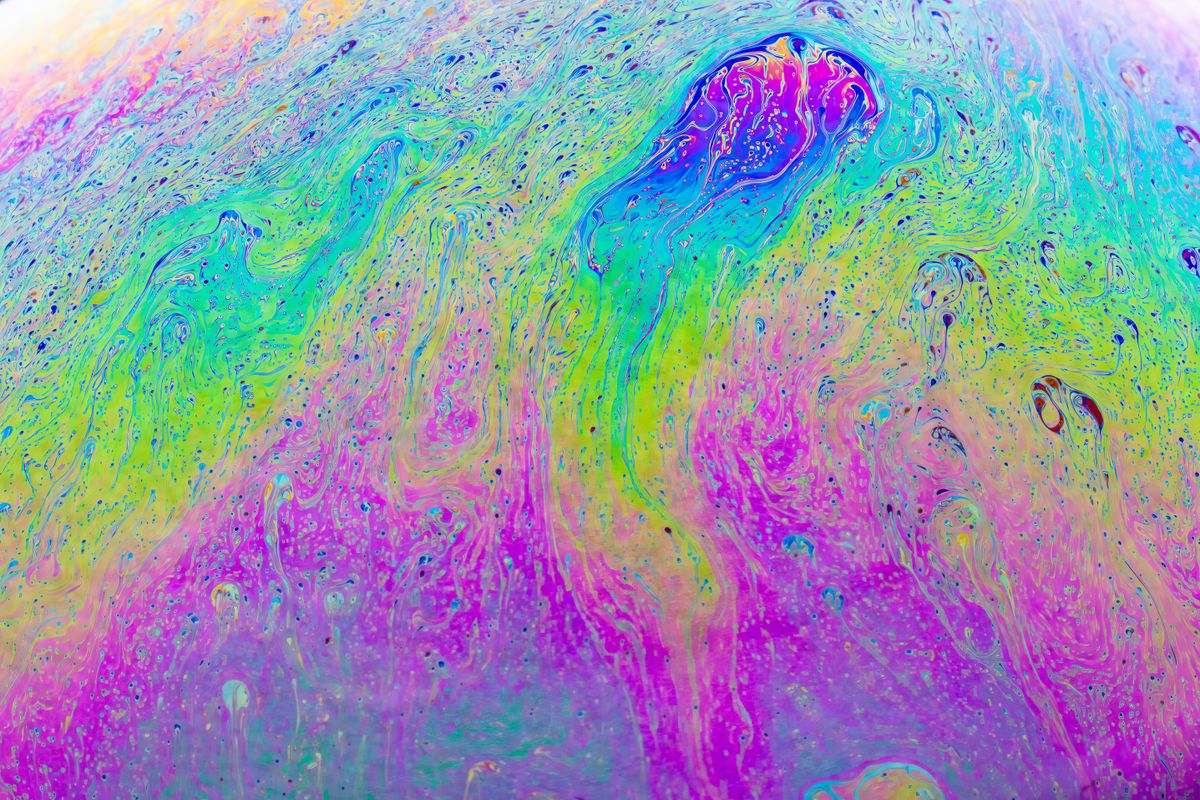
1. Soap bubbles and oil slicks. The rainbow colours on a soap bubble are caused by interference between light reflecting off the outer surface and light reflecting off the inner surface of the thin soap film. Depending on the film thickness, different wavelengths interfere constructively or destructively, producing different colours. This is called thin film interference.
2. Young's double-slit experiment. In 1801, Thomas Young passed light through two narrow slits and observed alternating bright and dark bands on a screen. The bright bands are positions where light from the two slits arrives in phase (constructive interference). The dark bands are where it arrives out of phase (destructive interference). This experiment was the first direct proof that light behaves as a wave.
3. Noise-cancelling headphones. A microphone picks up ambient noise, and a tiny speaker produces an inverted copy of that sound wave — shifted by exactly half a wavelength. The original noise and the inverted wave meet at your ear and undergo destructive interference. The sound cancels. The effect works best for low-frequency, continuous sounds like engine hum.
4. Beats in music. When two musical notes with slightly different frequencies are played together, the sound grows louder and softer in a slow, regular pattern called beats. This is interference between the two sound waves — at some moments they are in phase (louder), and at others they are out of phase (softer). The beat frequency equals the difference between the two original frequencies.
5. CD and DVD rainbow patterns. The data tracks on a CD or DVD are spaced at about 1600 nm — comparable to the wavelength of visible light. This regular pattern acts as a diffraction grating, separating white light into its component colours by constructive interference at specific angles. The rainbow shimmer you see on a CD surface is an interference pattern.
For a full introduction to the wave nature of light, start with our pillar guide on what is diffraction. For more everyday examples of wave phenomena, see examples of diffraction in everyday life — many overlap with interference.
Common misconception: interference destroys energy
A common question: if two waves cancel completely, where does the energy go? The answer is that destructive interference does not destroy energy — it redistributes it. In the double-slit experiment, the dark bands are dark because energy has been moved from those positions to the bright bands. The total energy integrated across the whole pattern is exactly the sum of the energies of the two individual waves. Energy is conserved. It just appears in different places.
External resources
- Wikipedia: Wave Interference — comprehensive technical reference with history, theory, and mathematical treatment
- Physics LibreTexts: Interference — university-level textbook chapter on interference of light
- Albert.io: Wave Interference Review — clear explanations with diagrams and practice problems for students
Frequently Asked Questions
What is interference in physics?
In physics, interference is a phenomenon in which two or more waves superpose to form a resultant wave of greater, lower, or the same amplitude. When the waves are in phase (crest meets crest), the amplitudes add, producing constructive interference. When they are out of phase (crest meets trough), they cancel, producing destructive interference.
What are the two types of wave interference?
The two types are constructive interference (waves in phase, amplitudes add, resulting wave is larger) and destructive interference (waves out of phase, amplitudes cancel, resulting wave is smaller or zero). Constructive interference occurs when the path difference between waves is a whole number of wavelengths (nλ). Destructive interference occurs when the path difference is a half-integer number of wavelengths ((n + 1/2)λ).
What is the principle of superposition?
The principle of superposition states that when two or more waves overlap at a point, the resultant displacement at that point is equal to the sum of the displacements of the individual waves. This principle applies to all types of waves — light, sound, water, and matter waves — and is the foundation of all interference phenomena.
What conditions are needed for interference?
For a stable interference pattern, the wave sources must be coherent — they must have a constant phase difference and the same frequency. Laser light is ideal because it is naturally coherent. For incoherent sources like ordinary light bulbs, the phase relationship changes randomly too quickly to form a stable pattern.
What are examples of interference in everyday life?
Common examples include: the rainbow colours in soap bubbles and oil slicks (thin film interference), the bright and dark bands in Young's double-slit experiment, the beats heard when two slightly different musical notes are played together, noise-cancelling headphones (destructive interference of sound), and the colourful patterns on a CD surface.
Who discovered wave interference?
The English physicist Thomas Young demonstrated interference of light in 1801 with his famous double-slit experiment. He passed light through two closely spaced slits and observed alternating bright and dark bands on a screen — a pattern that could only be explained if light was behaving as a wave. This was the decisive evidence for the wave theory of light.

About Umar Farooq
Umar Farooq writes in-depth guides on the physics of light and optics — from reflection, refraction, and lenses to diffraction, lasers, and fiber optics, explained from first principles.
Read more about Umar Farooq →