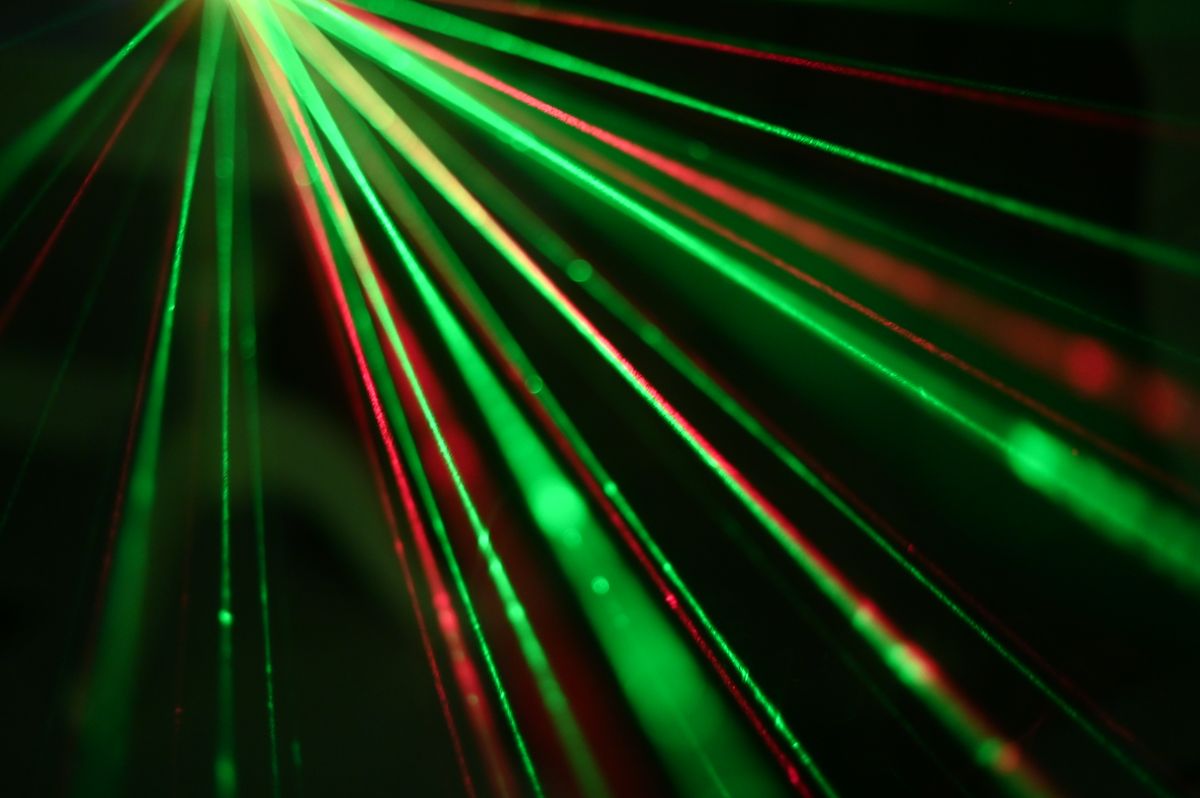
A laser wavelength is not arbitrary — it is fixed by the physics of the gain medium. Every laser emits light at a specific laser wavelength determined by the energy structure of the atoms or molecules inside it. A helium-neon laser always produces deep red at 632.8 nm. A CO2 laser always produces invisible infrared at 10.6 μm. The gain medium decides the laser wavelength, and the wavelength decides the colour.
Here is what we cover: what laser wavelength means, what determines it, how it maps to visible colours, a chart of common laser wavelengths by type, how wavelength affects real-world use, and a common misconception about laser colour.
What Is Laser Wavelength?
Wavelength is the distance between two consecutive peaks of a light wave. For lasers, it is measured in nanometres (nm) — billionths of a metre. The laser light wavelength determines everything about the beam. A helium-neon laser emits at 632.8 nm. A Blu-ray laser emits at 405 nm. The numbers are tiny, but they make all the difference.
The wavelength determines three things about a laser beam:
- Colour — if the wavelength falls in the visible range (roughly 380-700 nm), you see it as a specific colour.
- Photon energy — shorter wavelengths carry more energy per photon. A UV photon at 193 nm has about 6.4 eV; an infrared photon at 10.6 μm has about 0.12 eV.
- How it interacts with materials — a wavelength that cuts steel may pass straight through glass, and vice versa.
Wavelength and laser frequency are two sides of the same coin. The product of wavelength (λ) and frequency (f) equals the speed of light: c = λf. A shorter wavelength means a higher laser frequency and more energy per photon.
What Determines a Laser's Wavelength?
The answer lies in the gain medium — the material that actually produces the laser light. This is the single most important factor in any laser wavelength. Picture a staircase. Electrons in an atom can only sit on specific steps (energy levels), not in between. When an electron drops from a higher step to a lower one, it releases the energy difference as a photon.
The size of that step determines the photon's energy, and the photon's energy determines its wavelength through the equation E = hc/λ, where h is Planck's constant and c is the speed of light.
Different atoms have different staircase arrangements:
- Helium-neon: the neon atom's transition releases a photon at 632.8 nm — deep red.
- Ruby (chromium in sapphire): the chromium ion's transition gives 694.3 nm — red.
- Nd:YAG (neodymium in YAG crystal): the neodymium ion's transition gives 1064 nm — infrared.
- CO2: the CO2 molecule's vibrational transition gives 10.6 μm — far infrared.
- Gallium arsenide diode: the semiconductor bandgap determines the wavelength, typically 650-850 nm depending on the exact composition.
Think of it like a guitar string. A short, tight string produces a high note; a long, loose string produces a low note. The gain medium is the string — its atomic structure fixes the note (laser wavelength) it can play. You cannot make a helium-neon laser emit green light, just as you cannot make a bass string sound like a violin string. The laser wavelength is baked into the choice of gain medium from the start.
Laser Wavelength vs Colour: The Visible Spectrum
When a laser's wavelength falls between about 380 nm and 700 nm, we perceive it as coloured light. This range is called the laser spectrum — the portion of the electromagnetic spectrum that lasers can produce in visible light. The table below shows how wavelength maps to perceived colour:
| Colour | Wavelength Range | Common Laser Example |
|---|---|---|
| Violet | 380-450 nm | Blu-ray diode (405 nm) |
| Blue | 450-485 nm | Argon-ion (488 nm) |
| Cyan | 485-500 nm | Some diode lasers |
| Green | 500-565 nm | Frequency-doubled Nd:YAG (532 nm) |
| Yellow | 565-590 nm | Helium-neon (593.9 nm) |
| Orange | 590-625 nm | Some diode lasers |
| Red | 625-700 nm | Helium-neon (632.8 nm), ruby (694.3 nm) |
The human eye is not equally sensitive to all colours. It peaks around 555 nm (green-yellow). This is why a 5 mW green laser pointer appears far brighter than a 5 mW red one — the eye simply detects green more efficiently. The green beam is so visible that it can appear 4-5 times brighter, even though the laser wavelength has nothing to do with the power output.
Common Laser Wavelengths by Type
Every laser type has a characteristic set of wavelengths determined by its gain medium:
| Laser Type | Typical Wavelengths | Colour / Band | Common Use |
|---|---|---|---|
| Helium-neon (HeNe) | 632.8 nm | Red | Holography, alignment, lab work |
| Argon-ion | 488 nm, 514 nm | Blue, green | Confocal microscopy, light shows |
| CO2 | 10.6 μm | Far infrared (invisible) | Cutting, engraving, surgery |
| Ruby | 694.3 nm | Deep red | Tattoo removal, holography |
| Nd:YAG | 1064 nm (+ 532 nm doubled) | Infrared / green | Cutting, welding, laser pointers |
| Titanium-sapphire | 650-1100 nm (tunable) | Red to infrared | Research, ultrafast lasers |
| Diode (GaAs) | 650-850 nm | Red to near-IR | CD/DVD readers, pointers |
| Diode (InGaN) | 405-450 nm | Violet / blue | Blu-ray, projectors |
| Excimer (ArF) | 193 nm | Deep UV (invisible) | LASIK surgery, lithography |
| Fibre (Yb-doped) | 1030-1080 nm | Near-IR (invisible) | Industrial cutting, welding |
| Fibre (Er-doped) | 1530-1565 nm | Near-IR (invisible) | Telecoms amplifiers |
Some lasers can be tuned. Titanium-sapphire lasers use an adjustable filter inside the cavity to select different wavelengths across their gain range, from about 650 nm to 1100 nm. Others, like argon-ion, produce several distinct lines simultaneously — you can select which colour to output.
How Wavelength Affects Real-World Applications
Wavelength is not a physics curiosity — it decides whether a laser is useful for a given job. Choosing the right laser wavelength is the first step in any laser application.
Cutting and welding. Metals absorb shorter wavelengths more efficiently. Fibre lasers at ~1 μm cut steel far better than CO2 lasers at 10.6 μm. But CO2 lasers excel at cutting wood, acrylic, and fabrics because those materials absorb the 10.6 μm wavelength strongly.
Eye surgery. Excimer lasers at 193 nm are used in LASIK because the wavelength is absorbed by the outermost layer of corneal tissue with almost no penetration. The laser removes microscopic layers without heating or damaging deeper tissue.
Data storage. Blu-ray uses a 405 nm violet laser instead of the 650 nm red laser in DVDs. The shorter wavelength focuses to a smaller spot, allowing more data to fit on the same-size disc. A Blu-ray disc stores about 25 GB per layer; a DVD stores 4.7 GB.
Communications. Erbium-doped fibre amplifiers work at 1530-1565 nm because standard optical fibre has its lowest loss in that range — about 0.2 dB/km. This is why your internet data travels on infrared laser light, not visible light.
Safety. The laser wavelength affects how dangerous a laser is. UV lasers (below 400 nm) are absorbed by the cornea. Visible and near-IR lasers (400-1400 nm) pass through the cornea and focus on the retina, making them especially hazardous to eyesight even at low power. Safety regulations are tied directly to laser wavelength and power.
Common Misconception: Laser Colour Tells You the Power
Many people assume a green laser is more powerful than a red one because it looks brighter. This is wrong. The eye is simply more sensitive to green. A 5 mW red laser and a 5 mW green laser have the same optical power. The green one looks 4-5 times brighter because of the eye's sensitivity curve, but both are classed as the same safety class. The perceived brightness has nothing to do with the actual power — it is purely about where the lasing wavelength falls on the eye's sensitivity curve.
A more dangerous example: infrared lasers are invisible. A 100 mW infrared laser at 1064 nm is more powerful than most visible pointers but gives no visual warning. This is why IR lasers require special safety precautions — you cannot see the beam to know it is on.
The real relationship is wavelength to energy, not wavelength to power. A shorter-wavelength photon carries more energy, but the total power of the beam depends on how many photons are emitted per second, not their individual energy.
External resources
- Wikipedia: List of laser types — comprehensive table of laser types with their operating wavelengths
- RP Photonics: Wavelength — detailed encyclopedia entry on optical wavelength, colour perception, and measurement
- Wikipedia: Laser — general reference on laser principles, types, and applications
Read our guide on laser light and how lasers work for the physics behind stimulated emission, and explore the types of lasers to see how each gain medium produces its specific wavelength.
Frequently Asked Questions
What determines the wavelength of a laser?
The wavelength of a laser is determined by the energy levels of the atoms or molecules in the gain medium. When an electron drops from a higher energy level to a lower one, it releases a photon with a specific energy. That energy corresponds to a specific wavelength (E = hc/λ). Different atoms have different energy levels, so different gain media produce different wavelengths.
What colour laser is the most powerful?
For visible lasers, green (532 nm) appears brightest to the human eye per unit of power because the eye's peak sensitivity is around 555 nm. However, actual power output depends on the laser design — infrared lasers at 1064 nm can reach much higher absolute powers than visible lasers.
How are laser wavelengths measured?
Laser wavelength is measured in nanometres (nm) using instruments called wavemeters, which use interferometry to compare the laser light to a reference source. Diffraction gratings can also measure wavelength by calculating mλ = d sin θ, where d is the grating spacing and θ is the diffraction angle.
What is the wavelength of a CO2 laser?
A CO2 laser emits at 10.6 μm (10,600 nm) in the far infrared. This wavelength is strongly absorbed by organic materials, making CO2 lasers excellent for cutting wood, acrylic, and fabrics.
What is the wavelength of a green laser pointer?
A green laser pointer emits at 532 nm. This is typically achieved by frequency-doubling an infrared Nd:YAG laser (1064 nm) using a nonlinear crystal, producing bright green light that appears 4-5 times brighter than a red laser of the same power.
Can a laser have multiple wavelengths?
Some lasers emit at multiple wavelengths. Argon-ion lasers produce several lines including 488 nm (blue) and 514 nm (green). Some lasers are tunable — titanium-sapphire lasers can be adjusted across roughly 650-1100 nm. Frequency conversion can also generate new wavelengths from a fixed laser line.
What is the shortest wavelength laser?
Excimer lasers produce some of the shortest practical wavelengths, including ArF at 193 nm (deep ultraviolet). X-ray lasers can reach below 10 nm, but these are large-scale research facilities, not commercial devices. The shortest wavelength from a common laser is Blu-ray at 405 nm (violet).
Do all red lasers have the same wavelength?
No. Red lasers range from about 620 nm to 670 nm. A HeNe laser emits at exactly 632.8 nm (deep red). A common red diode laser pointer emits around 650 nm. A high-power red diode for industrial use might emit at 635 nm. These differences affect brightness and visibility.

About Umar Farooq
Umar Farooq writes in-depth guides on the physics of light and optics — from reflection, refraction, and lenses to diffraction, lasers, and fiber optics, explained from first principles.
Read more about Umar Farooq →