
How does a lens work? A lens bends light as it passes through its curved surfaces. This bending is called refraction, and it happens twice — once when the light enters the lens and once when it leaves. The curved shape controls exactly how much each ray bends, so all the rays either meet at a single point or spread apart in a predictable way. A convex lens converges parallel rays to a focal point; a concave lens diverges them. Here is how this works from first principles, along with the formulas that describe it.
Picture a marching band turning a corner. The row of musicians on the inside takes a short step; the row on the outside covers more ground and turns more sharply. The line bends. A lens does the same to light: the edge of the wavefront that hits the curved surface first slows first, so the whole wavefront pivots. That pivot, repeated at two surfaces, is how a lens steers light to a focus.
What is a lens?
A lens is a piece of glass, plastic, or other transparent material with at least one curved surface. The curve is the key — it makes the light bend differently depending on where it hits. A flat window lets light straight through with only a tiny sideways shift. A lens steers each ray by a different amount, and that difference is what creates an image.
The word "lens" comes from the Latin for lentil — the double-convex shape of a typical magnifying glass looks just like the seed.
Every lens has two main types. A convex lens (converging, positive) is thicker in the centre than at the edges. A concave lens (diverging, negative) is thinner in the centre. Plano-convex, biconcave, meniscus — these are all variations of the two basic shapes.
How does a lens work?
To understand how does a lens work, start with double refraction. Light travels slower inside the lens than in air — roughly 197,000 km/s in crown glass versus 299,792,458 m/s in vacuum (fast enough to circle Earth about 7.5 times in one second). This speed change at each surface is what bends the light.
At the first surface (air to glass), the ray slows and bends toward the normal. At the second surface (glass to air), it speeds up and bends away from the normal. The curved shape of each surface determines the exact angle of the bend.
For a convex lens, both bends push the ray toward the centre line. Parallel rays entering the lens converge to a single point called the focal point, at a distance f from the lens centre. The stronger the curvature, the shorter the focal length and the tighter the focus.
For a concave lens, both bends push the ray away from the centre line. Parallel rays spread apart as if they came from a virtual focal point on the same side as the incoming light. The focal length in this case is negative.
The BBC Bitesize guide on convex and concave lenses shows the ray diagrams for both types side by side.
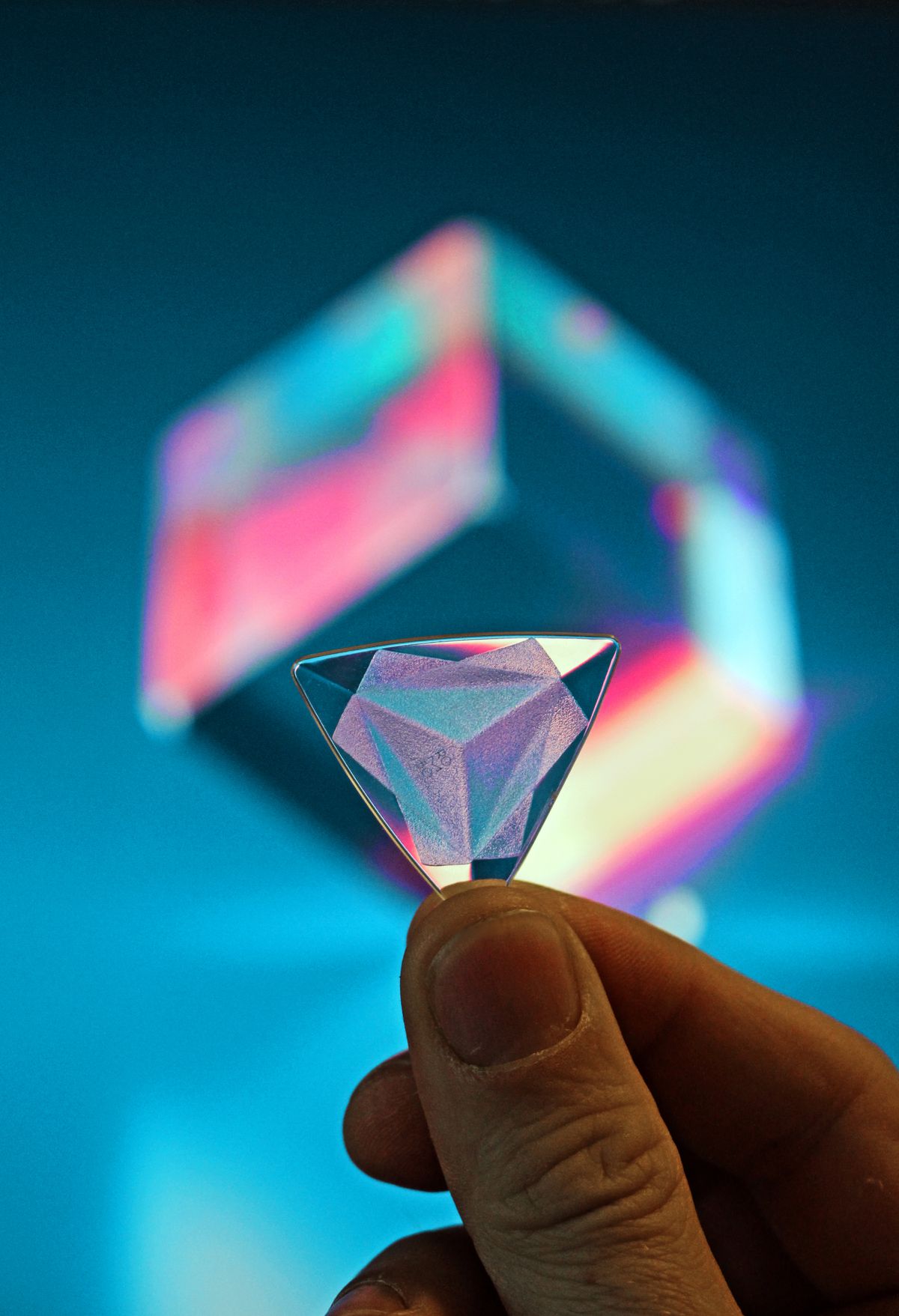
What does a lens do?
The short answer to what does a lens do: it redirects incoming light to form an image.
A convex lens can produce both real and virtual images. When the object sits beyond the focal point, the lens forms a real, inverted image on the opposite side — this is how a camera works. When the object sits inside the focal point, the lens forms a virtual, upright, magnified image on the same side — this is a magnifying glass.
A concave lens always produces a virtual, upright, and diminished image, regardless of the object's position. This is why security peepholes use them to shrink a wide corridor into a viewable size.
For a detailed comparison of convex and concave lenses, see our guide on converging vs diverging lenses. The broader principle of how light bends through lenses is covered in our article on how lenses use refraction.
The lensmaker's equation
The lensmaker's equation connects the physical properties of a lens to its focal length. It is the formula you use when you need to design a lens — to grind a specific curve into a specific piece of glass to achieve a desired power.
1/f = (n − 1)(1/R₁ − 1/R₂)
Where:
- f is the focal length (positive for convex, negative for concave)
- n is the refractive index of the lens material (e.g., 1.52 for crown glass)
- R₁ is the radius of curvature of the first surface (positive if convex toward the incoming light)
- R₂ is the radius of curvature of the second surface (negative if concave toward the incoming light — the sign convention matters)
Here is the idea in plain terms. The flatter the surface (larger radius), the less it bends light. A steep surface (small radius) bends it more. The material matters too — diamond (n = 2.42) bends light more sharply than crown glass (n = 1.52) for the same curvature. The equation tells you exactly how these factors combine.
Worked example: designing a simple biconvex lens
Suppose you need a biconvex lens with a focal length of 20 cm, made from crown glass (n = 1.52). Both surfaces have the same curvature, so R₁ = +R and R₂ = −R (opposite signs because the surfaces curve in opposite directions).
1/f = (n − 1)(1/R − 1/(−R)) 1/20 = (0.52)(2/R) 1/20 = 1.04/R R = 20.8 cm
Each surface should be ground to a radius of curvature of about 20.8 cm. That is your design. The HyperPhysics page on the lensmaker's equation has an interactive calculator to explore how changing the radii and index affects the focal length.
Image distance vs object distance
Once you have a lens, the position of the image depends on where you put the object. The thin lens equation gives the relationship:
1/f = 1/v − 1/u
Where:
- f is the focal length (positive for convex, negative for concave)
- v is the image distance (positive if the image forms on the opposite side)
- u is the object distance (always taken as negative in the standard Cartesian sign convention)
For a convex lens:
- When the object is beyond 2F (u is large), the image forms between F and 2F on the opposite side — real, inverted, diminished. This is a camera.
- When the object is between F and 2F, the image forms beyond 2F — real, inverted, magnified. This is a projector.
- When the object is inside F, v becomes negative — the image forms on the same side as the object, virtual, upright, magnified. This is a magnifying glass.
Worked example: finding the image position
Take a convex lens with focal length f = 15 cm. Place an object 30 cm from the lens (u = −30 cm in the sign convention, but many calculations use the magnitude for simplicity).
Using 1/v = 1/f + 1/u: 1/v = 1/15 + 1/30 1/v = 2/30 + 1/30 = 3/30 v = 10 cm
The image forms 10 cm on the opposite side of the lens. Since v is positive and less than f, the image is real, inverted, and diminished — the object was beyond 2F.
Now move the object to 20 cm: 1/v = 1/15 + 1/20 1/v = 4/60 + 3/60 = 7/60 v ≈ 8.57 cm
The image is still real and inverted, but this time it lies between F (15 cm) and 2F (30 cm), and the magnification M = v/u ≈ 0.43 — the image is about 43% the size of the object.
Worked example: magnifying glass
Use the same lens (f = 15 cm). Place an object 10 cm from the lens — inside the focal point.
1/v = 1/15 + 1/10 = 2/30 + 3/30 = 5/30 v = 6 cm but with a negative sign (inside F gives a virtual image) v = −6 cm
The image is virtual, upright, and on the same side as the object. Magnification M = |v|/u = 6/10 = 0.6. Wait — that is less than 1. That cannot be right for a magnifying glass.
The catch is that the simple formula M = |v|/u is for a specific image distance convention. For a magnifying glass held at the near point of the eye, the angular magnification is M = 25 cm / f, where 25 cm is the standard near-point distance. With f = 15 cm, M ≈ 1.67×.
The subtlety here is that a lens does not simply magnify — it produces a virtual image that the eye then interprets as larger. The OpenStax textbook on geometric optics walks through the correct angular magnification formula for magnifying glasses, microscopes, and telescopes.
Common misconception: "a convex lens always magnifies"
A common mistake is thinking a convex lens always makes things bigger. It does not. A convex lens can produce diminished, same-size, or magnified images depending on where you put the object. When the object is beyond 2F, the image is smaller than the object — a camera uses a convex lens to shrink a mountain onto a tiny sensor. That is the opposite of magnification, yet the same lens and the same physics. The magnification depends on the distances, not on the lens type.
For a broader look at how different materials bend light, see our refraction examples guide covering over 20 real-world cases.
Frequently Asked Questions
How does a lens work?
A lens works by refraction. Light slows when it enters the transparent material and bends toward the normal. When it exits, it speeds up and bends away from the normal. The curved surfaces ensure all incoming parallel rays either converge to a focal point (convex) or diverge as if from a virtual focal point (concave).
What does the lens do?
A lens bends incoming light in a controlled way. A convex lens converges light to a point, while a concave lens spreads light apart. Lenses are used to form images — real or virtual — depending on the object's distance from the lens.
What is the lensmaker's equation?
The lensmaker's equation is 1/f = (n − 1)(1/R₁ − 1/R₂), where f is the focal length, n is the refractive index of the material, and R₁ and R₂ are the radii of curvature of the two lens surfaces. It tells you how to design a lens to achieve a specific focal length.
What is a lens?
A lens is a piece of transparent material — glass, plastic, or crystal — with at least one curved surface. It uses refraction to bend light in a controlled way. The word comes from the Latin for lentil, because the double-convex shape resembles the seed.
What is the thin lens equation?
The thin lens equation is 1/f = 1/v − 1/u, where f is the focal length, v is the image distance, and u is the object distance. It predicts where an image forms for a given object position. For a convex lens, a positive v means a real image on the opposite side; negative v means a virtual image on the same side as the object.
How do you calculate image distance from object distance?
Use the thin lens equation 1/f = 1/v − 1/u. Rearranging gives 1/v = 1/f + 1/u. For a convex lens with f = 10 cm and an object at u = 30 cm, the image distance is v = 15 cm — a real image between F and 2F on the opposite side.

About Umar Farooq
Umar Farooq writes in-depth guides on the physics of light and optics — from reflection, refraction, and lenses to diffraction, lasers, and fiber optics, explained from first principles.
Read more about Umar Farooq →