Types of light are the different bands of the electromagnetic spectrum, and there are seven worth knowing: radio waves, microwaves, infrared, visible light, ultraviolet, X-rays, and gamma rays. Only one of them — visible light — your eyes can actually see. All seven are the same thing underneath, electromagnetic waves, separated only by wavelength. Here's where we're going: a quick tour of each type, what makes it different, and where you've already met it.
What are the types of light? One family across the spectrum
Here's the key idea: the different types of light aren't separate phenomena. They're one thing — electromagnetic radiation — sorted by wavelength, the distance between one wave crest and the next.
Think of it like a single long piano keyboard. Press a key on the far left and you get a deep, slow note; walk to the far right for a high, fast one. Every key is the same instrument; only the pitch changes. The electromagnetic spectrum works the same way. Long wavelengths (radio) sit at one end, short wavelengths (gamma rays) at the other, and visible light is a handful of keys in the middle. The "type" is just where you are on the keyboard.
Here's a misconception worth fixing: people often picture radio waves, light, and X-rays as unrelated things. They're not. Gamma rays and visible light are both electromagnetic waves — so are radio waves and microwaves. James Clerk Maxwell showed in 1865 that light is an electromagnetic wave, and radio, X-rays, and the rest are the same wave at different wavelengths. What changes across the spectrum is the energy each photon carries: shorter wavelength means higher frequency, and by E = hf, more energy per photon. That single rule explains why X-rays can see through skin and radio waves pass harmlessly through your body. (For the deeper "is it a wave or a particle?" question, see our guide on whether light is a wave or a particle.)
Visible light — the only type you can see
Visible light is the narrow band the human eye can detect, running from about 380 nanometres (violet) to 700 nanometres (red). That's a sliver — roughly 100–200 times thinner than a human hair at any single wavelength — yet it's the only stretch of the whole spectrum we experience as colour and sight.
Within that band, wavelength is colour. Long wavelengths near 700 nm look red; short ones near 380 nm look violet, with orange, yellow, green, and blue in between. White light, like sunlight, is all of these mixed together — which is why a prism or a raindrop can fan it back out into a rainbow. For the behaviours this light shows — bending, bouncing, splitting — see our guide to the properties of light.
Infrared light — the type you feel as heat

Just past red, at wavelengths longer than 700 nm, sits infrared — the first type of light beyond the visible. You can't see it, but you can feel it: the warmth radiating off glowing embers or a patio heater reaches you as infrared.
We know it's there thanks to a beautifully simple experiment. In 1800, William Herschel split sunlight with a prism and held a thermometer to each colour to read its warmth. When he slid the bulb past the red end, where the eye sees nothing, the temperature climbed higher than in any visible colour. He'd found invisible rays beyond red — the first proof that the spectrum runs past what we can see. Today infrared runs your TV remote, thermal cameras, and the night-vision that turns body heat into a picture. (NASA's infrared overview shows what the warm universe looks like in this band.)
Ultraviolet light — the type that causes sunburn

On the other side of violet, at wavelengths shorter than 380 nm, is ultraviolet (UV) — invisible, but far from harmless. Each UV photon carries more energy than a visible one, enough to damage the DNA in your skin cells. That's sunburn, and over years, the main driver of skin cancer.
UV is also useful. It makes white shirts glow under a club's "blacklight," sterilises water and surfaces by wrecking microbes' DNA, and lets banknotes hide security marks that only show under a UV lamp. The Sun floods us with it, which is exactly why sunscreen exists. (NASA's ultraviolet page covers how astronomers use it too.)
X-rays and gamma rays — the high-energy types

Push to even shorter wavelengths and the photons get powerful enough to pass straight through soft tissue. X-rays do exactly that: bone and metal absorb them, flesh mostly doesn't, so a detector behind you records a shadow map of your skeleton. That's the chest X-ray and the airport scanner.
Shorter still — and more energetic — are gamma rays, produced by nuclear reactions, radioactive atoms, and the most violent events in the universe. A single gamma photon can carry millions of times the energy of a visible one. That power is dangerous to living cells, which is also why a tightly focused gamma beam is used to kill tumours in radiotherapy. These two types of light are the spectrum's heavy hitters.
Radio waves and microwaves — the longest types
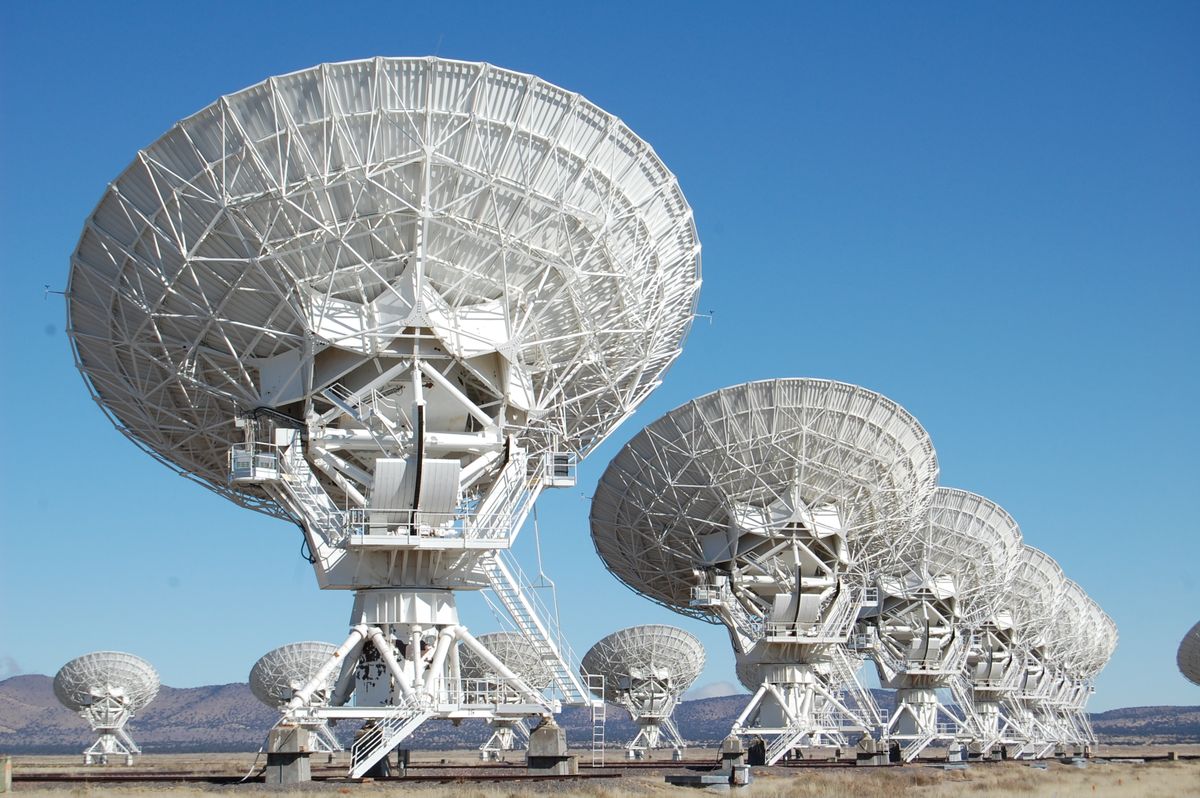
Go the other way — to the longest wavelengths and lowest energies — and you reach microwaves and radio waves. These are still light, just with crests spaced centimetres to kilometres apart instead of billionths of a metre.
Microwaves heat the water in your food and carry Wi-Fi, Bluetooth, and radar. Radio waves, longer still, carry broadcast radio, television, and mobile-phone signals, and let giant dish antennas listen to distant galaxies. Their photons are far too weak to harm DNA, which is why these types of light pass through you all day with no effect — your body is bathed in radio signals right now.
How does an element emit light?

So where does light come from in the first place? At the atomic level, an element emits light when one of its electrons drops from a higher energy level to a lower one. The energy it loses leaves as a single photon, and the size of that drop sets the photon's wavelength — its colour.
Here's the elegant part. Every element has its own unique ladder of energy levels, so each emits its own fixed set of wavelengths — a barcode of colours. Heat sodium and it glows the orange of a street lamp; neon gives the red-orange of a sign; mercury, a cold blue-white. Astronomers read these barcodes in starlight to tell what distant stars are made of, without ever leaving Earth. (NASA's introduction to the spectrum ties emission to the bands above.)
One original diagram for this article: a single spectrum ladder, radio at the bottom (long wavelength, low energy) climbing to gamma at the top (short wavelength, high energy). Each rung labelled with its type of light, a typical wavelength, and a familiar source — radio mast, microwave oven, TV remote, the visible rainbow, the Sun (UV), a hospital X-ray, a star (gamma). One image that shows all the types as steps on the same staircase.
Want the bigger picture of what light is and the energy it carries? Start with our light energy guide, or browse all our optics guides.
Frequently Asked Questions
What are the main types of light?
The main types of light, in order of increasing energy, are: radio waves, microwaves, infrared, visible light, ultraviolet, X-rays, and gamma rays. They are all the same thing — electromagnetic waves — and differ only in wavelength. Visible light is the narrow band our eyes can detect, from about 380 to 700 nanometres.
What are the different types of light we can and cannot see?
We can see only visible light, the band from roughly 380 to 700 nanometres. Every other type is invisible to us: radio, microwaves, and infrared have longer wavelengths, while ultraviolet, X-rays, and gamma rays have shorter wavelengths and more energy. We detect them with instruments rather than our eyes.
Does every light source emit only one type of light?
No. Most sources emit a mix. The Sun pours out infrared, visible, and ultraviolet together; a hot filament gives off infrared and visible light. A laser is the rare exception — it emits essentially one single wavelength. So a 'white' bulb is really sending you several types of light at once.
How does an element emit light?
An atom emits light when one of its electrons drops from a higher energy level to a lower one. The lost energy leaves as a photon, and the gap's size sets the photon's wavelength — its colour. Because every element has a unique set of energy levels, each emits its own signature set of wavelengths, which is how we identify elements in stars.
Are gamma rays and visible light the same thing?
Yes and no. Gamma rays and visible light are both electromagnetic waves — the same phenomenon — so in that sense they are the same kind of thing. But a gamma ray has a far shorter wavelength and carries millions of times more energy per photon, which is why one is harmless to look at and the other is dangerous.

About Umar Farooq
Umar Farooq writes in-depth guides on the physics of light and optics — from reflection, refraction, and lenses to diffraction, lasers, and fiber optics, explained from first principles.
Read more about Umar Farooq →