
A plane mirror is a flat reflective surface that produces a virtual, upright image the same size as the object. Stand in front of any bathroom mirror and you see yourself at your actual height, the right way up, at the same distance behind the glass as you are in front of it. Unlike concave mirrors that magnify or convex mirrors that shrink, a plane mirror gives you a faithful 1:1 copy — no distortion, no focus, just the reflection. Here are the 5 key properties of plane mirror images, how ray diagrams work, and where plane mirrors show up in everyday life.
Picture a perfectly still lake reflecting a mountain on its bank. The reflection is exact — same size, same distance, just flipped. That is what a plane mirror does: it holds up a flat, smooth surface and returns light in a way that preserves every detail, no magnification, no compression, no bending.
What is a plane mirror?
A plane mirror is a mirror with a flat (planar) reflective surface. Most household mirrors are plane mirrors: a sheet of glass with a thin layer of silver or aluminium on the back, protected by paint. The glass itself is transparent — the actual reflection happens at the metal coating behind it.
The defining feature of a plane mirror is that the surface is perfectly flat. This means the normal (the line perpendicular to the surface) points in the same direction at every point on the mirror. Unlike curved mirrors where the normal changes direction across the surface, a plane mirror's uniform geometry produces an undistorted image.
How does a plane mirror form an image? (Ray diagram explained)
Image formation in a plane mirror follows the law of reflection: the angle of incidence equals the angle of reflection. Here is how to draw the ray diagram step by step.
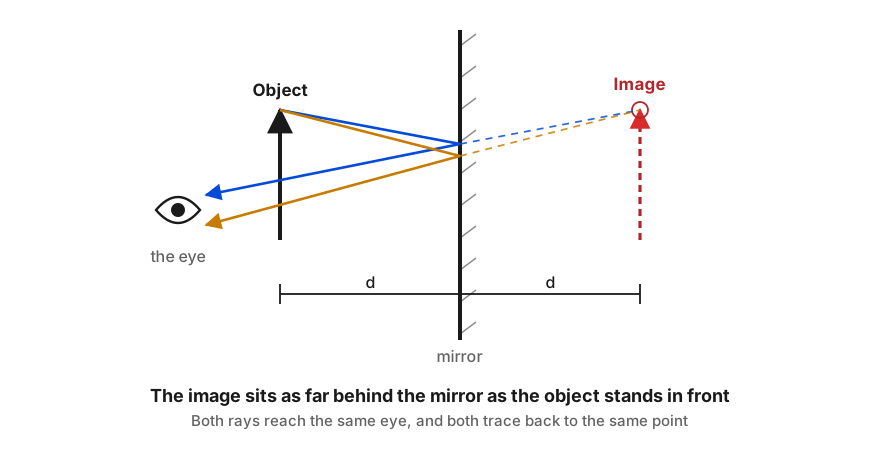
- Place the object (an arrow, for example) in front of the mirror at a known distance.
- Draw at least two rays from a point on the object to the mirror.
- For each ray, reflect it so that the angle of reflection equals the angle of incidence.
- Extend the reflected rays backward behind the mirror using dashed lines.
- Where the dashed lines intersect is where the image forms.
The image is always the same distance behind the mirror as the object is in front. If you stand 1 metre from a plane mirror, your image appears 1 metre behind it. This is the simplest image formation in all of optics — no focal points, no sign conventions to juggle.
The Physics Classroom tutorial on plane mirror images provides detailed ray diagrams showing exactly how the law of reflection determines image location. The Doc Brown revision notes on plane mirrors cover the same diagrams with a GCSE exam focus, including common mistakes to avoid.
5 key properties of plane mirror images
Every image formed by a plane mirror has these five characteristics. No exceptions, regardless of the object's distance or size.
1. The image is virtual
The image cannot be projected onto a screen. The reflected rays do not actually meet in front of the mirror — they only appear to meet when traced backward behind it. Your brain does the tracing automatically, which is why you "see" the image behind the glass.
2. The image is upright (erect)
The image has the same vertical orientation as the object. If the object is right side up, the image is right side up. Plane mirrors never produce inverted images — that is a property only of concave mirrors (and only when the object is beyond the focal point).
3. The image is the same size as the object
Magnification is exactly 1. The image is neither magnified nor diminished. This is why a plane mirror is the standard for "true" reflection — what you see is what you get, at the exact same scale.
4. The image is laterally inverted
Left and right appear swapped. Raise your right hand in front of a plane mirror and the image appears to raise its left hand. What is actually happening is a front-back reversal: the mirror flips the image along the direction perpendicular to its surface, and our brains interpret that as left-right swapping.
5. The image distance equals the object distance
The image appears as far behind the mirror as the object is in front. If a cat sits 50 cm from a mirror, its reflection appears 50 cm behind it. The total distance from the cat to its image is 100 cm.
Multiple reflections: what happens with two plane mirrors
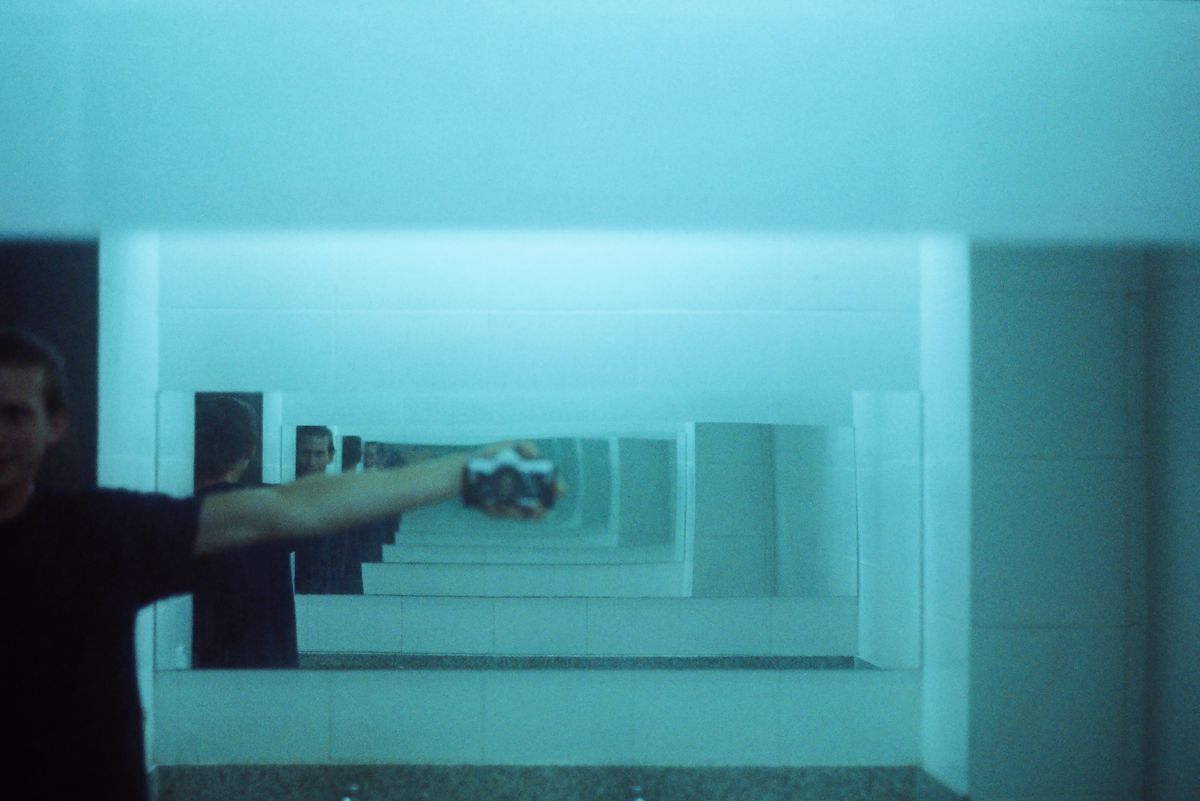
When two plane mirrors face each other at an angle, something interesting happens: the image in one mirror gets reflected in the other, producing multiple images. You have seen this in dressing rooms with mirrors on opposite walls, creating an infinite tunnel of reflections.
The number of images formed by two plane mirrors at an angle θ is given by:
Number of images = (360° ÷ θ) − 1 (when 360°/θ is an integer)
For example:
- Mirrors at 90° (perpendicular): (360 ÷ 90) − 1 = 3 images
- Mirrors at 60°: (360 ÷ 60) − 1 = 5 images
- Mirrors at 0° (parallel, facing each other): infinitely many images — the dressing room effect
This is the principle behind kaleidoscopes, which use three mirrors at 60° to create symmetrical patterns. Periscopes, on the other hand, use two mirrors at 45° to let you see around corners or above crowds — a classic application from submarine warfare.
Real-world uses of plane mirrors
Plane mirrors are everywhere, often in places where their undistorted 1:1 reflection is critical:
Personal grooming. Bathroom and dressing mirrors let you see your exact appearance — no magnification, no widening, just the true image. This is the most familiar use.
Periscopes. Two plane mirrors at 45° redirect light so you can see over obstacles or around corners. Submarines use periscopes to observe the surface while submerged. At a smaller scale, periscopes are common in science classrooms.
Kaleidoscopes. Three plane mirrors arranged in a triangle at 60° create infinite symmetrical patterns. Each reflection reflects another reflection, producing the intricate designs kaleidoscopes are known for.
Rear projection systems. Some projector setups use plane mirrors to fold the light path, making the overall device more compact without distorting the image.
Safety and observation. Convex mirrors are preferred for wide-angle security, but plane mirrors are used where an accurate, undistorted view is needed — for example, in dance studios to check posture and alignment.
Optical instruments. Spectrophotometers, interferometers, and other precision instruments use plane mirrors to redirect light beams without introducing distortion or focal shifts.
The BYJU'S guide on plane mirrors covers additional applications and worked examples for measuring image distances. For the differences between plane mirrors and their curved counterparts, see our guide on concave vs convex mirrors. The physics of how all mirrors reflect light from first principles is in our guide on what happens when light hits a mirror.
Common misconception: "Plane mirrors reverse left and right"
This is the most persistent myth about plane mirrors, and it is almost right — but not for the reason you think.
A plane mirror does not actually swap left and right. It reverses front and back along the direction perpendicular to the mirror. Imagine facing north in front of a mirror. Your image faces south. Your left hand (west) is on the west side of the image. There is no left-right swap — the mirror simply turns you around to face the opposite direction.
The confusion arises because when a person facing you raises their right hand, you raise your left to mirror them. A mirror does the same thing, so we say the image is "laterally inverted." But the mechanism is front-back reversal, not a deliberate left-right swap. Wear a shirt with text and look in a mirror — the text reads backward, which we interpret as left-right reversal, but it is actually depth reversal.
Plane mirror vs curved mirrors at a glance
| Property | Plane mirror | Concave mirror | Convex mirror |
|---|---|---|---|
| Surface | Flat | Curves inward | Curves outward |
| Image type | Virtual only | Real or virtual | Virtual only |
| Image size | Same as object | Varies (magnified to diminished) | Always diminished |
| Field of view | Normal | Narrow | Wide |
| Light behaviour | Reflects without focusing | Converges | Diverges |
| Focal length | Infinite | Negative | Positive |
| Typical use | Grooming, periscopes | Telescopes, headlights | Rearview, security mirrors |
For the complete details on the other two types, see our guides on concave mirrors and convex mirrors. The comparison between all mirror types — including which ones can produce real images — is covered in our concave vs convex mirror comparison.
Frequently Asked Questions
What is a plane mirror?
A plane mirror is a flat, smooth reflective surface, usually made of a sheet of glass with a thin metal coating (silver or aluminium) on the back. It reflects light according to the law of reflection and produces a virtual image that is upright, the same size as the object, and laterally inverted.
What are the 5 properties of an image formed by a plane mirror?
The five properties are: (1) the image is virtual — it cannot be projected onto a screen; (2) the image is upright (erect); (3) the image is the same size as the object; (4) the image is laterally inverted — left and right are swapped; (5) the image appears as far behind the mirror as the object is in front.
What is reflection in a mirror?
Reflection in a mirror is the bouncing back of light rays from a reflective surface. For a plane mirror, the angle of incidence equals the angle of reflection (the law of reflection), and the reflected rays produce a virtual image that appears behind the mirror surface.
What is the mirror illustration or ray diagram for a plane mirror?
A mirror illustration (ray diagram) for a plane mirror shows at least two rays from a point on the object reflecting off the mirror and appearing to diverge from a point behind the mirror. The image is located where the extended reflected rays intersect. The image distance behind the mirror equals the object distance in front.
Why does a plane mirror reverse left and right but not up and down?
A plane mirror does not actually reverse left and right — it reverses front to back along the direction perpendicular to the mirror surface. What we perceive as left-right reversal is a result of the image facing toward us while we face the mirror. If you face north in front of a mirror, your image faces south. The mirror flips depth, not horizontal orientation.
Can a plane mirror form a real image?
A plane mirror normally forms a virtual image of a real object. However, it can form a real image if the object is virtual — for example, when a converging beam of light is directed at the mirror. The real image would form in front of the mirror where the reflected beam converges.
What is the focal length of a plane mirror?
The focal length of a plane mirror is infinite. Since the mirror is flat, parallel rays remain parallel after reflection — they neither converge nor diverge. The power of a plane mirror is zero.
What is the magnification of a plane mirror?
The magnification of a plane mirror is +1. The image is the same size as the object (magnitude of 1) and upright (positive sign by the Cartesian sign convention).

About Umar Farooq
Umar Farooq writes in-depth guides on the physics of light and optics — from reflection, refraction, and lenses to diffraction, lasers, and fiber optics, explained from first principles.
Read more about Umar Farooq →