
A real image forms where light rays actually converge — you can project it onto a screen. A virtual image forms where rays only appear to diverge — you cannot capture it on a screen. That is the real vs virtual image difference in a nutshell. Picture a cinema projector: it throws a real, inverted image onto the screen that you can see from anywhere in the theatre. Now picture your reflection in a bathroom mirror: you see a virtual, upright image that appears behind the glass but vanishes the moment you remove the mirror. Here are the 7 key differences between real vs virtual images, with examples from every common optical device.
Think of a real image as light physically landing on a surface — like sunlight focused through a magnifying glass burning a hole in a leaf. The light actually goes there. A virtual image is the opposite: the light never reaches that point. Your brain just traces the diverging rays backward and constructs the image from where they seem to come.
What is a real image?
A real image is formed when light rays from an object converge at an actual point after reflection or refraction. The rays physically meet there. If you place a screen at that exact location, you will see the image projected on it.
Key properties of real images:
- The image is inverted (upside down relative to the object)
- It can be projected onto a screen
- It forms on the same side as the object for mirrors, and on the opposite side for lenses
- The image distance v is negative by the Cartesian sign convention (for mirrors)
Real images are produced by:
- Concave mirrors — when the object is beyond the focal point (F)
- Converging (convex) lenses — when the object is beyond the focal point
- Pinhole cameras — the image on the back wall
- The human eye — the image on your retina
Every image you see on a cinema screen, a camera sensor, or a projector is a real image. The light physically converges at those surfaces and forms an upside-down picture that your brain (or the camera processor) later flips.
What is a virtual image?
A virtual image is formed where light rays only appear to diverge from a point. The rays never actually meet there. If you trace the reflected or refracted rays backward with dashed lines, they seem to come from a location where no light truly exists.
Key properties of virtual images:
- The image is upright (right side up)
- It cannot be projected onto a screen
- It forms behind the mirror (for mirrors) or on the same side as the object (for lenses)
- The image distance v is positive by the Cartesian sign convention (for mirrors)

Virtual images are produced by:
- Plane mirrors — the classic bathroom mirror reflection
- Convex mirrors — always, regardless of object position
- Concave mirrors — when the object is between F and the pole
- Converging lenses — when the object is inside the focal point (magnifying glass)
- Diverging lenses — always, regardless of object position
Your reflection in a mirror, the image in a car's side mirror, and the magnified view through a magnifying glass are all virtual images. The light is real, but it only appears to come from behind the mirror or lens surface.
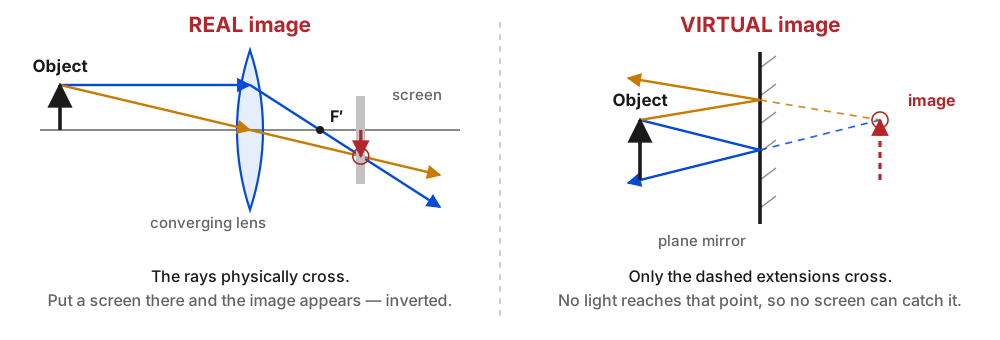
7 key differences between real vs virtual images
1. How the rays behave
Real image: rays actually converge at the image point after reflection or refraction. Virtual image: rays diverge after reflection or refraction; they only appear to come from the image point.
2. Can it be projected?
Real image: Yes. Place a screen at the image location and the image appears on it. Virtual image: No. The light never converges there, so a screen shows nothing.
3. Orientation
Real image: always inverted (upside down) relative to the object. Virtual image: always upright (right side up).
4. Image distance sign (Cartesian convention, mirrors)
Real image: v is negative (image in front of the mirror). Virtual image: v is positive (image behind the mirror).
5. Image distance sign (Cartesian convention, lenses)
Real image: v is positive (image on the opposite side of the lens from the object). Virtual image: v is negative (image on the same side as the object).
6. Which devices produce them
| Device | Real image | Virtual image |
|---|---|---|
| Plane mirror | No | Always |
| Concave mirror | Object beyond F | Object between F and P |
| Convex mirror | No | Always |
| Converging lens | Object beyond F | Object inside F |
| Diverging lens | No | Always |
| Pinhole camera | Always | No |
| Human eye | On retina (always) | No |
7. Examples in everyday life
Real images: cinema screen, camera sensor, projector, your retinal image, a pinhole camera, a concave mirror focusing sunlight to burn paper.
Virtual images: your reflection in any flat mirror, the car behind you in a convex side mirror, the magnified text through a magnifying glass, the view through a peephole, the "objects are closer than they appear" warning in car mirrors.
Which one are you looking at?
You do not need a formula. Hold a piece of paper where you think the image is.
If a picture lands on the paper, it is real. The light genuinely arrives at that point — which is what a cinema screen, a camera sensor and your own retina all depend on. A real image from a single mirror or lens is always inverted.
If nothing lands on the paper, it is virtual. No light ever reaches there; your eye traces the diverging rays backwards and places the image where they appear to start. Your bathroom reflection is the everyday case, and virtual images are always upright.
The shortcut for exam questions: with one mirror or one lens, upright means virtual and inverted means real. Plane mirrors, convex mirrors and diverging lenses can only ever give you the virtual kind.
Diminished vs enlarged images
A diminished image is smaller than the object (magnification |m| < 1). An enlarged image is larger than the object (|m| > 1). These properties are independent of whether the image is real or virtual:
- Concave mirror real images: can be diminished (object beyond C), same-size (object at C), or enlarged (object between C and F)
- Concave mirror virtual images: always enlarged (object between F and P)
- Convex mirror virtual images: always diminished (|m| < 1)
- Converging lens real images: can be diminished, same-size, or enlarged
- Converging lens virtual images: always enlarged
- Diverging lens virtual images: always diminished
- Plane mirror virtual images: always same-size (|m| = 1)
The distinction between diminished and enlarged matters in applications. A diminished real image is how a camera fits a mountain onto a tiny sensor. An enlarged virtual image is how a makeup mirror lets you see pores. Both are useful, but the optical setup determines which you get.
The BYJU'S guide on the difference between real and virtual images covers the core comparison with ray diagrams and a video explanation. The GeeksforGeeks comparison of real and virtual images provides additional examples and a detailed table of properties. For a deeper mathematical treatment of how the sign convention determines image type, the BBC Bitesize guide on real and virtual images covers the lens and mirror cases side by side.
Common misconception: "Virtual images are not real light"
This is the most widespread misunderstanding. A virtual image is not imaginary — the light reaching your eyes from a virtual image is perfectly real light. It has energy, it travels at the speed of light, and it carries information about the object. The "virtual" part is that the light appears to come from a place where it never actually converged.
When you look at yourself in a mirror, light really does leave your face, reflect off the mirror, and enter your eyes. The image you see is not a hallucination — it is a physical consequence of your brain tracing the reflected rays backward. The light is real; the apparent location behind the mirror is the virtual part.
A related mistake: thinking that because you can see a virtual image, it must be real. In fact, your eye always forms a real image on its retina — but the thing you are looking at might be a virtual image produced by the mirror or lens in front of your eye.
For a detailed look at each device that produces real and virtual images, see our guides on concave mirrors, convex mirrors, and plane mirrors. How the image type relates to converging and diverging behaviour is covered in our converging vs diverging mirror guide. For the lens equivalents, see our converging vs diverging lens comparison.
Frequently Asked Questions
What is the difference between a real image and a virtual image?
A real image is formed when light rays actually converge at a point — it can be projected onto a screen and is always inverted. A virtual image is formed where light rays only appear to diverge from a point — it cannot be projected and is always upright. Real images are produced when the object is beyond the focal point of a concave mirror or converging lens. Virtual images are produced by plane mirrors, convex mirrors, diverging lenses, and by concave mirrors or converging lenses when the object is inside the focal point.
Which mirrors and lenses produce real images?
Concave mirrors produce real images when the object is beyond the focal point. Converging (convex) lenses produce real images when the object is beyond the focal point. Plane mirrors, convex mirrors, and diverging (concave) lenses produce only virtual images — they can never produce a real image of a real object.
Can a convex mirror produce a real image?
No. A convex mirror always diverges reflected rays, so the rays never converge in front of the mirror. The image is always virtual, upright, and diminished regardless of the object's position. Only concave mirrors can produce real images.
Is the image on your retina real or virtual?
The image formed on your retina is a real image. The convex lens in your eye converges light rays to form a real, inverted image on the light-sensitive retina. Your brain then flips the image right side up so you perceive the world correctly.
What is the difference between diminished image and enlarged image?
A diminished image is smaller than the object (magnification less than 1). An enlarged image is larger than the object (magnification greater than 1). Real images can be diminished, same-size, or enlarged depending on the object's distance. Virtual images formed by convex mirrors are always diminished; virtual images formed by concave mirrors (object inside focal point) are always enlarged.
How can you tell if an image is real or virtual from a ray diagram?
In a ray diagram, real images are shown where solid reflected rays actually intersect in front of the mirror or behind the lens. Virtual images are shown where dashed extensions of reflected or refracted rays intersect behind a mirror or in front of a lens. A real image can be caught on a screen placed at that point; a virtual image cannot.

About Umar Farooq
Umar Farooq writes in-depth guides on the physics of light and optics — from reflection, refraction, and lenses to diffraction, lasers, and fiber optics, explained from first principles.
Read more about Umar Farooq →