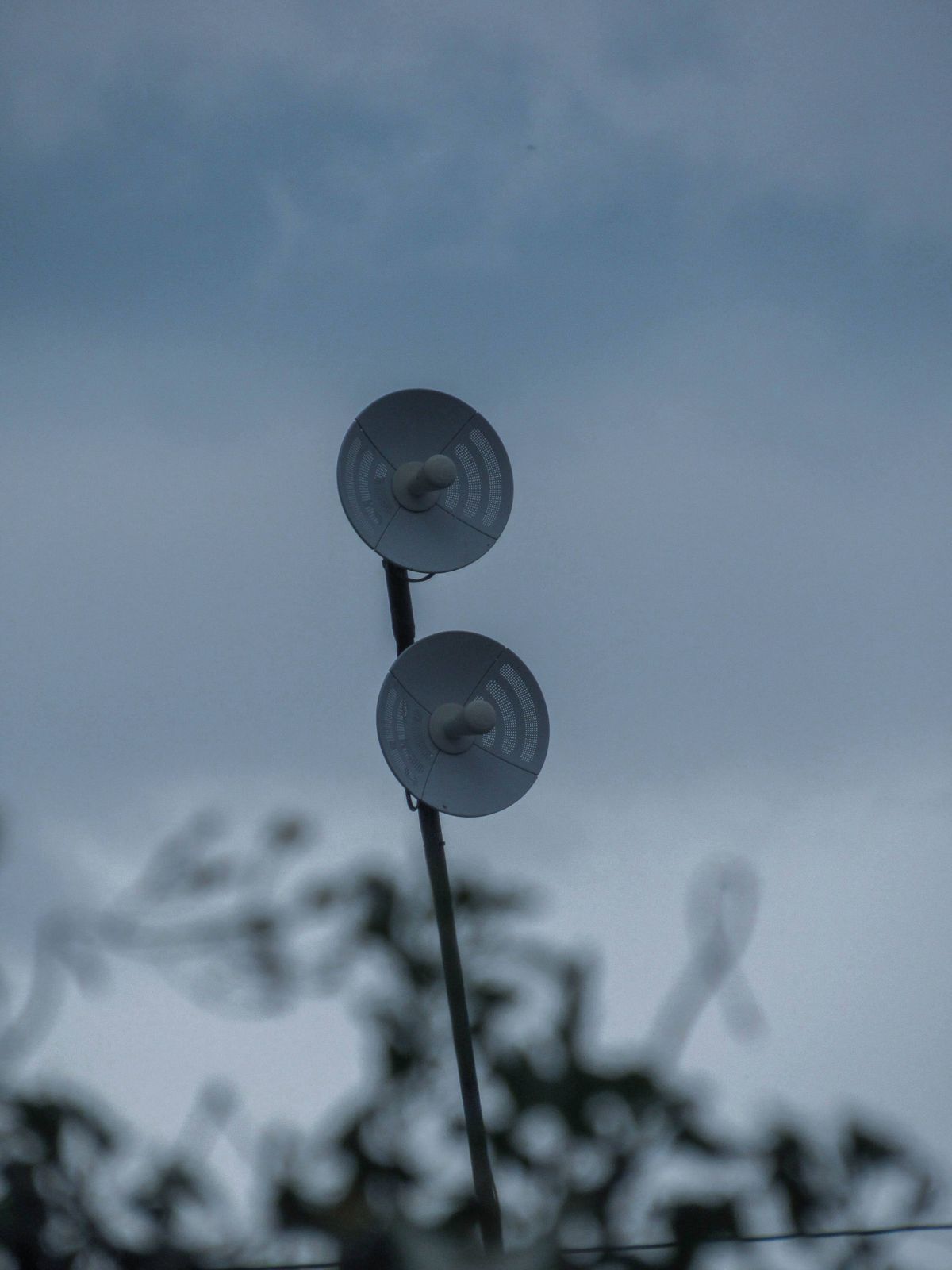
Polarization of electromagnetic waves describes the direction in which the electric field oscillates as the wave travels. For radio waves, microwaves, and light — all forms of electromagnetic radiation — the three types are linear, circular, and elliptical. Antenna polarisation must match between transmitter and receiver for efficient signal transfer. A mismatch of 90° (crossed polarisations) can reduce the signal by 30 dB or more — a thousandfold loss in power.
Here is what we cover: how EM wave polarisation works across the spectrum, the three polarisation types in radio and antenna contexts, horizontal vs vertical polarisation, antenna polarisation matching, circular polarisation in satellite links, and real-world applications in communications and radar.
How EM wave polarisation works across the spectrum
All electromagnetic waves — from radio to gamma rays — are transverse waves. The electric field oscillates perpendicular to the direction of travel. The direction of this oscillation is the polarisation.
For visible light, polarisation is typically discussed in terms of filters and optics. For radio waves, polarisation is determined by the antenna that radiates the wave. The antenna's physical orientation sets the polarisation of the wave it transmits, and a receiving antenna must match that polarisation for maximum signal.
The same physics applies at every frequency. A vertically polarised light wave and a vertically polarised radio wave are the same phenomenon — just at vastly different wavelengths. A 100 MHz FM radio wave has a wavelength of about 3 metres. A 500 nm green light wave has a wavelength 6 million times shorter. But both follow the same polarisation rules.
Picture a skipping rope held by two people. If you shake it up and down, the wave is vertically polarised. If you shake it side to side, it is horizontally polarised. The rope is the electric field; the direction you shake is the polarisation. This picture works the same whether the rope is 3 metres long or 500 nanometres long — the principle is identical.
The three polarisation types in radio and antenna contexts
Radio waves, like light, can be linearly, circularly, or elliptically polarised.
Linear polarisation is the most common in terrestrial radio. The electric field oscillates in a single fixed plane. A vertical whip antenna radiates vertically polarised waves. A horizontal dipole antenna radiates horizontally polarised waves. Most FM broadcast, television, and two-way radio use linear polarisation.
Circular polarisation has the electric field rotating as the wave travels. One full rotation per wavelength means the field traces a helix through space. Circular polarisation is left-handed (LHCP) or right-handed (RHCP), depending on the rotation direction. Satellite communications often use circular polarisation because the signal's polarisation can rotate as the satellite moves, and circular polarisation eliminates the need for precise antenna alignment.
Elliptical polarisation is the general case, where the electric field traces an ellipse. Any antenna that is not perfectly designed for pure linear or circular polarisation will produce elliptically polarised waves. In practice, most real antennas produce slightly elliptical polarisation.
| Type | Electric field behaviour | Common antenna type |
|---|---|---|
| Linear | Oscillates in one plane | Dipole, whip, Yagi |
| Circular | Rotates in a circle | Helical, crossed dipoles |
| Elliptical | Traces an ellipse | Most real antennas (slight ellipticity) |
For a complete guide to the three types in optics, see our article on types of polarisation.
Horizontal vs vertical polarisation
In terrestrial radio, the two most common linear polarisations are horizontal and vertical — defined relative to the ground.
Vertical polarisation has the electric field perpendicular to the ground. It is produced by a vertical monopole or whip antenna. Advantages:
- Less affected by ground reflections (the ground plane acts as a reflector).
- Omnidirectional in the horizontal plane — ideal for mobile communications.
- Less susceptible to man-made noise, which tends to be vertically polarised.
Common uses: AM broadcasting, mobile two-way radio, marine communications, cellular base stations, FM radio reception on vehicles.
Horizontal polarisation has the electric field parallel to the ground. It is produced by a horizontal dipole or Yagi antenna. Advantages:
- Lower ground wave attenuation over long distances.
- Less interference from vertically polarised man-made noise.
- Better performance for point-to-point links with directional antennas.
Common uses: TV broadcasting, FM broadcast (transmitters often use horizontal or circular), point-to-point microwave links, amateur radio DX communications.
Cross-polarisation occurs when a vertically polarised wave encounters a horizontally polarised antenna (or vice versa). The theoretical signal loss is complete — but in practice, real antennas and propagation effects mean the loss is typically 20–30 dB. This is sometimes used deliberately to reduce interference between adjacent channels.
Antenna polarisation matching
For maximum signal transfer, the polarisation of the transmitting and receiving antennas must match.
The power transfer between mismatched antennas follows the same cos²θ relationship as Malus's law for light. For linear polarisations at an angle θ:
- θ = 0° (aligned): maximum signal (0 dB loss)
- θ = 45°: 3 dB loss (half power)
- θ = 90° (crossed): theoretical infinite loss; practical loss 20–30 dB
For circular polarisation, a left-handed antenna cannot receive a right-handed signal — the mismatch loss is similarly large. However, a circularly polarised antenna can receive a linearly polarised signal with only 3 dB loss, which is why satellite broadcasts often use circular polarisation: it works with any orientation of a linear receiving antenna.
Applications of polarisation matching:
- FM radio: Some stations use circular polarisation so that car antennas (vertical) and home antennas (horizontal) both receive adequate signal.
- Satellite TV: Circular polarisation doubles channel capacity by transmitting two different signals on the same frequency using opposite hands.
- Radar: Weather radar uses specific polarisations to distinguish between different types of precipitation.
- Wi-Fi: Modern Wi-Fi uses multiple antennas with different polarisations (MIMO) to improve data rates.
Circular polarisation in satellite and space communications
Satellite communications rely heavily on circular polarisation for two key reasons.
No polarisation alignment needed. A satellite in orbit rotates and changes orientation relative to the ground. If it used linear polarisation, the ground antenna would need continuous polarisation tracking. Circular polarisation eliminates this requirement: the signal is the same regardless of rotation.
Faraday rotation compensation. When a linearly polarised radio wave passes through the ionosphere, the plane of polarisation rotates — an effect called Faraday rotation. The amount of rotation varies with frequency, time of day, and solar activity. At satellite frequencies, the rotation can be tens of degrees, causing significant signal loss if linear polarisation is used. Circular polarisation is immune to this effect because a rotating circle is still a circle.
Frequency reuse. Satellite transponders can transmit two independent signals on the same frequency using opposite circular polarisations (RHCP and LHCP). The receiving dish separates them by polarisation, effectively doubling the satellite's capacity. This is called polarisation diversity.
The International Telecommunication Union (ITU) allocates specific polarisation assignments for different satellite services to minimise interference between neighbouring satellites.
Common misconception: polarisation only matters for light
Many people assume polarisation is a concern only for optics and photography. In reality, polarisation is just as important — arguably more so — for radio communications.
Every radio link depends on polarisation matching. A mobile phone tower uses vertical polarisation. A car radio antenna is vertical. A Wi-Fi router may use multiple polarisations simultaneously. A satellite dish is designed for a specific circular polarisation. Getting it wrong means a weak or unusable signal.
Polarisation is also critical in radar. Weather radars transmit and receive in specific polarisations to distinguish rain from hail, measure rainfall rate, and identify tornado debris signatures. Polarimetric radar — which measures both horizontal and vertical polarisation — is now standard in modern weather forecasting.
For a deeper look at how polarisers work at the material level, see our guide on how polarisation works.
Key takeaways
- Polarisation of electromagnetic waves describes the orientation of the electric field — it applies to all EM radiation from radio to gamma rays.
- The three types are linear, circular, and elliptical — the same as for light.
- Antenna polarisation must match between transmitter and receiver for efficient signal transfer.
- Vertical polarisation is common for mobile communications; horizontal polarisation is common for broadcasting.
- Circular polarisation is standard for satellite communications because it eliminates alignment and Faraday rotation issues.
- Polarisation diversity (using opposite polarisations on the same frequency) doubles channel capacity.
- Cross-polarisation causes 20–30 dB signal loss, which is sometimes used deliberately to reduce interference.
- Polarisation is critical in radar, Wi-Fi (MIMO), and modern communications systems — not just optics.
External resources
- Wikipedia: Polarization (Waves) — comprehensive reference on EM wave polarisation including mathematical description and antenna applications
- Wikipedia: Antenna (Radio) — Polarization — detailed section on antenna polarisation types, matching, and practical considerations
- RP Photonics: Polarization of Light — technical reference on polarisation across the electromagnetic spectrum, including radio and optical
Frequently Asked Questions
What is polarization of electromagnetic waves?
Polarization of electromagnetic waves describes the orientation of the electric field as the wave propagates. For radio waves and light, the three types are linear polarization (electric field in one plane), circular polarization (rotating electric field), and elliptical polarization (the general case). Antenna polarization must match between transmitter and receiver for maximum signal transfer.
What is antenna polarization?
Antenna polarization is the polarization of the radio wave that an antenna radiates or responds to most efficiently. A vertical antenna produces vertically polarized waves; a horizontal antenna produces horizontally polarized waves. Circularly polarized antennas are used in satellite communications where the signal orientation may rotate during transmission.
What is the difference between horizontal polarization and vertical polarization?
Horizontal polarization has the electric field parallel to the ground; vertical polarization has it perpendicular to the ground. Horizontal polarization is less affected by ground reflections and is commonly used for TV broadcasting. Vertical polarization is less susceptible to interference from man-made noise and is common for mobile radio and AM broadcasting.
What is a vertically polarized antenna?
A vertically polarized antenna radiates radio waves with the electric field oriented perpendicular to the ground. A vertical whip antenna (as on a car) is the most common example. These antennas are omnidirectional in the horizontal plane and are widely used for mobile communications, FM radio, and marine communications.
What is a polarized wave?
A polarized wave is a transverse wave in which the oscillation occurs in a well-defined direction or pattern. For electromagnetic waves, this means the electric field has a fixed orientation (linear), rotates (circular), or traces an ellipse (elliptical). Polarized waves are the basis for radio communications, radar, and optical technologies.
What is electromagnetic polarization?
Electromagnetic polarization is the property of an electromagnetic wave that describes the direction and behaviour of its electric field. It is fundamental to antenna design, radio propagation, radar, satellite communications, and optical systems. The polarization state affects signal strength, reflection, and interference patterns.
What is coherent optical polarization?
Coherent optical polarization refers to the well-defined polarization state of laser light, where all photons oscillate in the same direction or rotation. Unlike incoherent sources like LEDs or sunlight, lasers produce coherent polarized light essential for interferometry, fibre optic communications, and quantum optics experiments.

About Umar Farooq
Umar Farooq writes in-depth guides on the physics of light and optics — from reflection, refraction, and lenses to diffraction, lasers, and fiber optics, explained from first principles.
Read more about Umar Farooq →