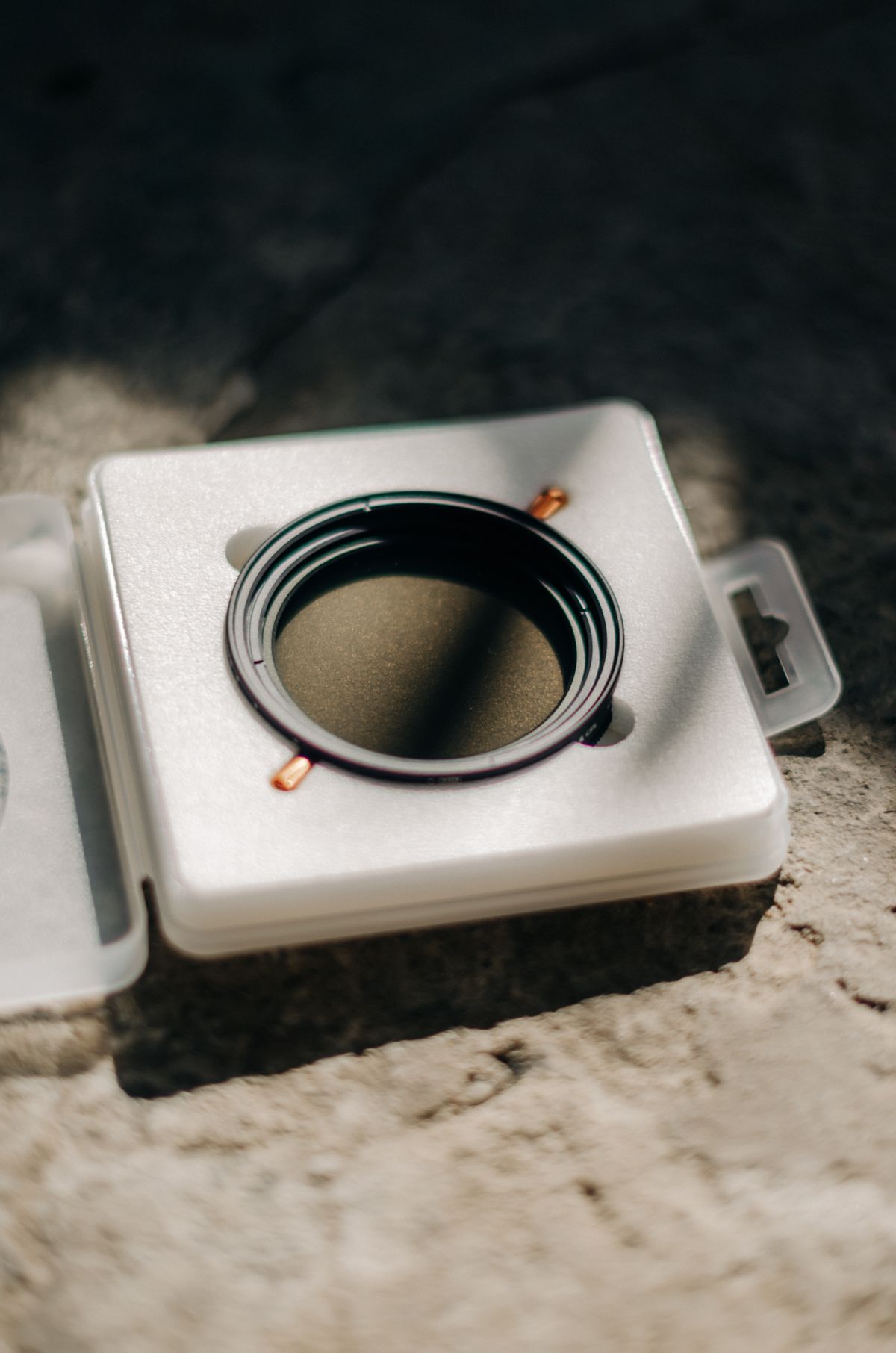
How does polarization work? A polariser restricts the direction in which the electric field of a light wave can vibrate. It acts like a gate: it allows light waves vibrating in one orientation to pass through while blocking those vibrating in the perpendicular orientation. The exact mechanism depends on the type of polariser, but the result is the same — unpolarised light becomes polarised.
Here is what we will cover: how dichroic (absorptive) polarisers work at the electron level, how wire-grid polarisers work for longer wavelengths, how circular polarisers combine a linear polariser with a quarter-wave plate, how polarisers are manufactured, and where you see them every day.
How polarisation works in dichroic absorptive filters
Dichroic polarisers are the most common type. They work by absorbing one polarisation component while transmitting the other. The key is the material's molecular structure.
Picture a crowd of people pushing through a narrow corridor. People facing the corridor can walk straight through. People facing sideways get stopped by the walls. The corridor selects one orientation and blocks the other. A dichroic polariser does the same to light waves — but at the molecular level.
The filter contains long-chain molecules, all aligned in the same direction. These molecules conduct electricity along their length: electrons can move freely along the chain but not across it. When light hits the filter, the electric field of the wave pushes and pulls on the electrons. If the field is parallel to the molecules, the electrons oscillate freely along the chains, absorbing energy from the wave. If the field is perpendicular to the molecules, the electrons cannot move far, so the wave passes through with little absorption.
This preferential absorption is why the molecules must be aligned. If they were randomly oriented, every polarisation would be partially absorbed and no clean polarised beam would emerge.
What about different wavelengths? Dichroic polarisers work across a broad wavelength range, typically the entire visible spectrum. The absorption mechanism is broadband because it depends on electron motion in conductive polymer chains, not on a resonant wavelength. This is why a standard Polaroid filter works for all colours of visible light.
For a side-by-side comparison of polarised vs unpolarised light, see our guide on unpolarised light.
Wire-grid polarisers — how the original design works
Wire-grid polarisers use a completely different mechanism. Instead of absorbing light, they reflect it.
Picture a fence of parallel metal wires. If you try to push a stick through the fence, the stick gets through easily if it is parallel to the wires — it slides between them. If the stick is perpendicular to the wires, it hits the metal and bounces back. A wire-grid polariser works the same way.
A wire-grid polariser consists of an array of parallel, closely spaced conducting wires. The spacing between wires must be smaller than the wavelength of the light. When the electric field is parallel to the wires, it drives electrons along the wires, which re-radiate a reflected wave that cancels the transmitted wave. When the electric field is perpendicular to the wires, the electrons cannot move along the wires, so the wave passes through.
Wire-grid polarisers were the first type ever demonstrated. In 1888, Heinrich Hertz used a wire-grid polariser to show that radio waves — which he had just discovered — behaved like light waves and could be polarised.
Today, wire-grid polarisers are used for:
- Microwaves and radio waves, where making dichroic materials is impractical.
- Infrared polarisers, where metal grids on substrates like germanium are effective.
- Polarising beamsplitters, where both the reflected and transmitted beams are used.
For visible light, wire-grid polarisers are less common because the wire spacing must be less than about 400 nm — difficult and expensive to manufacture. But advances in nanofabrication have made visible-wavelength wire-grid polarisers commercially available.
How polarising filters are manufactured
Most commercial polarising filters — including those in sunglasses and camera filters — are made from a material developed by Edwin Land in the 1920s and 1930s.
The process:
- A sheet of polyvinyl alcohol (PVA) is stretched in one direction. The stretching aligns the long PVA polymer chains in the direction of the pull.
- The stretched sheet is soaked in iodine. The iodine atoms attach to the PVA chains and form conducting chains that run along the polymer direction.
- The iodine-doped PVA sheet is laminated between two layers of cellulose acetate or glass for protection.
- The resulting film is a dichroic polariser: it absorbs light polarised parallel to the stretched direction and transmits light polarised perpendicular to it.
The stretching ratio determines the quality of the polariser. More stretching produces better alignment and higher extinction ratios. Typical Polaroid sheets have extinction ratios of several hundred to one across the visible spectrum.
For camera filters and high-end applications, the polarising film is often sandwiched between optical glass with anti-reflection coatings. These coatings reduce surface reflections that would otherwise degrade performance and create unwanted glare.

Circular polarisers — linear plus a waveplate
A circular polariser is not a fundamentally different type of polariser. It is a linear polariser followed by a quarter-wave plate, bonded together in a single assembly.
Here is how it works:
- Unpolarised light enters the linear polariser first. The linear polariser transmits only one polarisation direction.
- The linearly polarised light then passes through the quarter-wave plate. The waveplate introduces a 90° phase shift between the horizontal and vertical components.
- If the quarter-wave plate is oriented at 45° to the linear polariser's axis, the emerging light is circularly polarised.
Circular polarisers are used in photography because they do not interfere with a camera's autofocus and metering systems. Early DSLR cameras used beamsplitters that were sensitive to linear polarisation — a linear polariser would cause exposure errors and autofocus failure. Circular polarisers solved this by converting the linear polarisation to circular before it reached the camera's internal optics.
Modern mirrorless cameras are less sensitive to this issue, but circular polarisers remain the standard for photography because they also work correctly with the reflective mirrors in DSLRs.
For a complete overview of the different polarisation states, see our guide on types of polarisation.
Malus's law and extinction ratio
When polarised light passes through a second polariser — called an analyser — the transmitted intensity depends on the angle between the two polarisation axes. Malus's law is:
I = I₀ cos²θ
Where I is the transmitted intensity, I₀ is the incident polarised intensity, and θ is the angle between the polarisation direction and the analyser's axis.
At 0°, the axes are aligned and all the light passes. At 90°, the axes are crossed and ideally no light passes. At 45°, half the intensity passes.
Real polarisers are not perfect. Even with crossed polarisers, a tiny amount of light leaks through. This is quantified by the extinction ratio — the ratio of transmitted intensity when the axes are parallel to the transmitted intensity when they are crossed. A good polarising filter might have an extinction ratio of 500:1, meaning 500 times more light passes when aligned than when crossed.
For the full Malus's law formula with worked examples, see the what is polarised light guide.
Common misconception: all polarisers are the same
Many people think all polarising filters work the same way — they just "block some light." In reality, there are multiple types with different mechanisms: dichroic (absorptive), wire-grid (reflective), and circular (linear plus waveplate). Each has different strengths and best-use cases.
Dichroic polarisers are inexpensive and work well for visible light. Wire-grid polarisers operate across a broader wavelength range and can handle higher power levels. Circular polarisers are essential for photography but unnecessary for simple glare reduction.
The choice matters. A wire-grid polariser designed for infrared will not work for visible light. A circular polariser used as a simple sunglass lens introduces unnecessary optical elements. Knowing how each type works helps you pick the right polariser for the job.
Key takeaways
- How does polarization work? A polariser restricts the electric field direction of light waves by selective absorption or reflection.
- Dichroic polarisers absorb one polarisation using aligned long-chain molecules — electrons oscillate along the chains and dissipate the wave energy.
- Wire-grid polarisers reflect one polarisation using parallel conducting wires spaced closer than the wavelength.
- Circular polarisers combine a linear polariser with a quarter-wave plate to produce circularly polarised light.
- Polarising filters are manufactured by stretching iodine-doped PVA film to align the molecular chains.
- Real polarisers have an extinction ratio that quantifies how well they block the unwanted polarisation.
- Applications include polarised sunglasses, camera filters, LCD displays, 3D cinema, and scientific instrumentation.
External resources
- Britannica: Polarization — encyclopedia entry covering the physics of polarisation and types of polarisers
- Wikipedia: Polarizer — comprehensive reference on polariser types, design, and applications
- Edmund Optics: Introduction to Polarization — technical guide covering polariser selection, waveplates, and imaging applications
Frequently Asked Questions
How does polarization work?
Polarization works by restricting the direction in which the electric field of a light wave can vibrate. A polariser contains aligned long-chain molecules (in dichroic filters) or parallel conducting wires (in wire-grid polarisers) that absorb or reflect light with electric fields in one orientation while transmitting the perpendicular orientation.
How does a polarizer work?
A polariser works by selectively absorbing or reflecting one polarisation component of light. In dichroic polarisers, long-chain molecules are aligned in one direction. Electrons oscillate freely along these molecules and absorb light vibrating parallel to them. Light vibrating perpendicular to the molecules passes through with little absorption.
What is a polarizer?
A polariser is an optical filter that lets light waves of a specific polarisation pass through while blocking light waves of other polarisations. Common types include linear polarisers (used in sunglasses and LCDs) and circular polarisers (used in photography and 3D glasses).
Is the polarising power directly proportional to something?
The polarising power of a polariser follows Malus's law: I = I₀ cos²θ. The transmitted intensity is proportional to the square of the cosine of the angle between the light's polarisation direction and the polariser's axis. At 0 degrees all aligned light passes; at 90 degrees none passes.
What is the difference between a linear and circular polarizer?
A linear polariser transmits only light with electric fields aligned to its axis. A circular polariser consists of a linear polariser followed by a quarter-wave plate that converts linearly polarised light to circularly polarised light. Circular polarisers are used in photography to avoid autofocus and metering issues with DSLR cameras.
How are polarizing filters made?
Most polarising filters are made by embedding long-chain molecules like iodine-doped polyvinyl alcohol in a transparent plastic sheet. The sheet is heated and stretched in one direction to align the molecules. This stretched film is then laminated between glass or plastic sheets for protection.

About Umar Farooq
Umar Farooq writes in-depth guides on the physics of light and optics — from reflection, refraction, and lenses to diffraction, lasers, and fiber optics, explained from first principles.
Read more about Umar Farooq →