The colors of the rainbow in order, from the outer edge to the inner edge, are red, orange, yellow, green, blue, indigo, and violet. That's seven colours, remembered by the acronym ROYGBIV (or the name Roy G. Biv). The sequence never changes — and the physics behind it explains why red always sits on top and violet at the bottom. Here is everything you need to know about the rainbow colour order, from Newton's experiments to the indigo debate.
The colors of the rainbow in order: a full breakdown
Every rainbow you see follows the same sequence. From the outermost arc to the innermost:
| Colour | Wavelength (approx.) | Why it sits where it does |
|---|---|---|
| Red | ~700–620 nm | Longest wavelength — bends the least |
| Orange | ~620–590 nm | Bends slightly more than red |
| Yellow | ~590–565 nm | In the middle of the visible range |
| Green | ~565–495 nm | Bends more than yellow |
| Blue | ~495–450 nm | Shorter wavelength — more bending |
| Indigo | ~450–420 nm | Between blue and violet — hard to distinguish |
| Violet | ~420–380 nm | Shortest wavelength — bends the most |
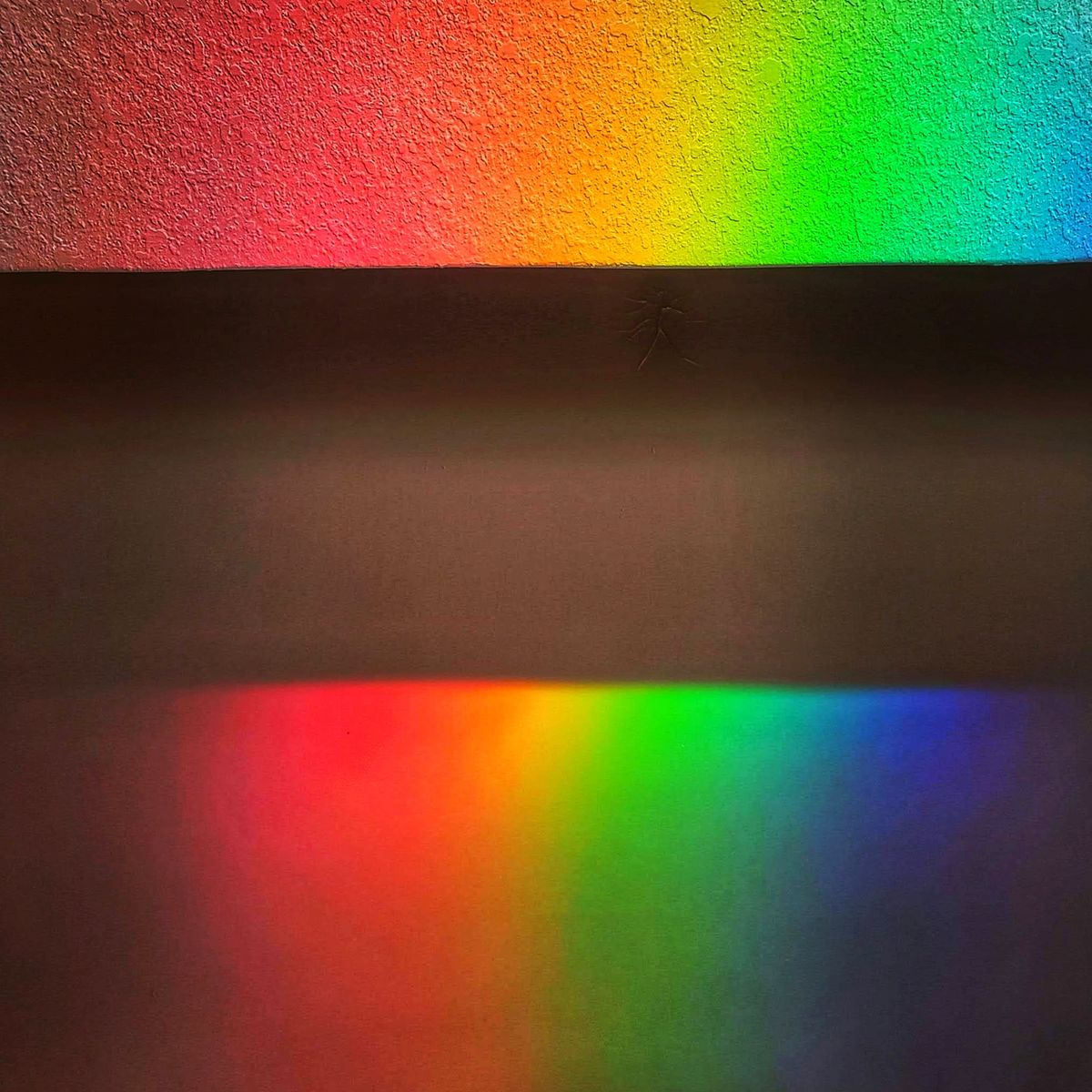
Red always appears on the outer edge because its wave is the longest and the droplet bends it the least. Violet, with the shortest wavelength, gets bent most sharply and lands on the inner edge. The other five fan out between them in that exact order.
What is ROYGBIV? The rainbow acronym explained
ROYGBIV stands for Red, Orange, Yellow, Green, Blue, Indigo, Violet. It is a mnemonic — a memory trick — that strings the first letter of each colour into a pronounceable word. Most people say it as three syllables: Roy Gee Biv, as though it were a person's name.
The name Roy G. Biv has become so embedded in pop culture that it appears in songs by Boards of Canada, books like Artemis Fowl and the Eternity Code, and even a comic book character called Rainbow Raider (Wikipedia on ROYGBIV).
VIBGYOR: the reverse rainbow order
In Indian and British school systems, children learn the sequence backwards: VIBGYOR (violet, indigo, blue, green, yellow, orange, red). Same seven colours, reversed direction. VIBGYOR lists the colours from the inner edge (violet) to the outer edge (red). Both acronyms are correct — they just start at opposite ends of the arc.
Why are there 7 colours in the rainbow? The Newton story
The short answer: Isaac Newton decided there should be seven. And it was a somewhat arbitrary choice.
In the mid-1660s, Newton let a beam of sunlight through a glass prism and watched it fan out into a band of colours. He originally identified only five — red, yellow, green, blue, and purple. But he later added orange and indigo so the count would match the seven notes of the Western musical scale, a symmetry he believed reflected a deeper harmony in nature. (For more on how prisms split light, see refraction through a prism.)
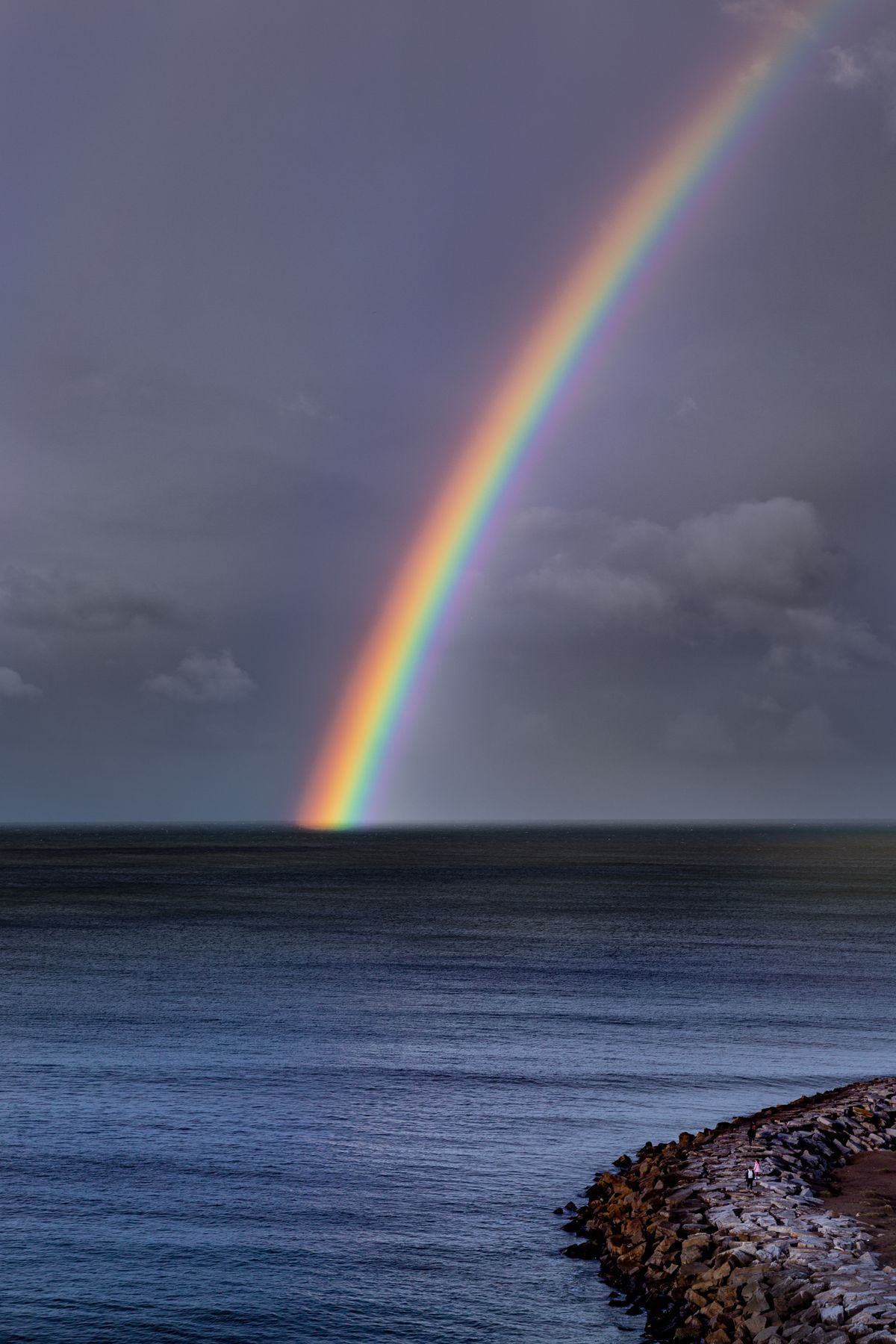
The accepted idea at the time was that the prism added colour to white light. Newton proved otherwise with a clever experiment: he passed the spread-out colours through a second prism and recombined them back into white light. The colours were inside the white light all along. The prism only separated them. He published this in Opticks in 1704 — one of the most important works in the history of physics.
But here is the catch: a rainbow is a continuous spectrum, not seven neat stripes. Every wavelength blends smoothly into the next. The number seven is a human convention, not a physical boundary.
The physics: why the sequence never changes
Picture a crowd leaving a stadium through the same exit. The people in blue shirts are slightly slower through the gate than those in red shirts, so they fan out into separate streams by the time they reach the street outside. This is what happens when white light enters a raindrop.
Each colour of light has a different wavelength, and water has a slightly different refractive index for each one. Red light (longest wavelength) has the smallest index — it slows the least and bends the least. Violet (shortest wavelength) has the highest index — it slows the most and bends the most. The difference is tiny but consistent, which is why the order never varies. For the full picture of how light bends at boundaries, see the guide to what light is.
The indigo debate: 6 vs 7 colours
Many people — including a fair number of scientists — argue that indigo does not belong in the list. The problem is that the human eye struggles to distinguish indigo from either blue or violet. Most people cannot reliably point to indigo in a rainbow and say "that one, right there." Modern colour models in physics and digital design typically list six spectral colours: red, orange, yellow, green, blue, violet. The LGBT Pride flag uses six stripes, dropping indigo entirely.
So why does indigo survive? Tradition. Newton's seven-colour model is deeply embedded in education, popular culture, and the very acronyms — ROYGBIV, VIBGYOR — that children everywhere still learn. But if a future curriculum drops it, the rainbow will still look the same. Indigo will still be there, somewhere between blue and violet. We will just stop giving it a separate name.
Why pink, brown, black, and white are missing from the rainbow
A common question is whether pink, brown, black, or white appear in the rainbow. The answer is no — and the reason tells you something interesting about how colour vision works.
These are non-spectral colours: they cannot be produced by a single wavelength of light. Pink is created by the brain when it receives a mix of red, green, and blue wavelengths simultaneously. Brown is a dark shade of orange. White is the combination of all visible wavelengths together. Black is the absence of light.
In a rainbow, each raindrop sends out a single, pure wavelength per angle. There is no mixing of different colours from the same droplet, so non-spectral colours never appear.
Double rainbow: the order flips
If you are lucky enough to see a double rainbow, look at the fainter arc above the main one. Its colours run backwards — violet on the outer edge, red on the inner. Here is why.
In a primary rainbow, light inside each raindrop reflects once before exiting. In a secondary rainbow, the light reflects twice inside the droplet before exiting. That extra reflection flips the colour order. The secondary bow also forms at a wider angle — about 51° from the antisolar point, compared to 42° for the primary bow — and is significantly dimmer because some light escapes with each bounce. The dark strip between them is called Alexander's dark band. (For more detail on the angles, see light refraction and rainbows or the page on the visible spectrum.)
How to remember the colors of the rainbow
Beyond ROY G. Biv, several mnemonics help lock in the sequence:
- Richard Of York Gave Battle In Vain — a traditional British sentence recalling the 1460 Battle of Wakefield
- Read Out Your Good Book In Verse — an alternative attributed to Isaac Asimov
- Roy G. Biv — treat the acronym as a person; it is the simplest and most common
For hands-on learning, especially with children, try lining up crayons, blocks, or coloured paper in ROYGBIV order. Drawing a rainbow with chalk or painting coloured handprints in sequence builds memory through repetition. Several children's songs set the seven colours to familiar melodies — the same trick that makes advertising jingles stick in your head for decades.
Summary: why the rainbow order is always the same
The colours of the rainbow in order — red, orange, yellow, green, blue, indigo, violet — are fixed by the physics of how light bends inside water droplets. Red bends the least and appears at the top; violet bends the most and appears at the bottom. Whether you use ROYGBIV or VIBGYOR, whether you count six or seven colours, the sequence itself is one of the most reliable patterns in nature.
External resources
- NASA Science — Visible Light (verified, the spectrum behind the rainbow's colours)
- Wikipedia — Rainbow (verified, the full physics of how the colours separate)
Frequently Asked Questions
What are the 7 colors of the rainbow in order?
The 7 colors of the rainbow in order from top to bottom (outer to inner edge) are: red, orange, yellow, green, blue, indigo, and violet. The acronym ROYGBIV (often pronounced as the name Roy G. Biv) helps remember this sequence.
What is ROYGBIV and what does it stand for?
ROYGBIV is an acronym where each letter stands for a colour: R = red, O = orange, Y = yellow, G = green, B = blue, I = indigo, V = violet. It's the most common way to remember the sequence of rainbow colours from longest wavelength (red) to shortest (violet).
How many colours are in the rainbow?
Traditionally, there are seven colours in the rainbow: red, orange, yellow, green, blue, indigo, and violet. However, the rainbow is actually a continuous spectrum containing an infinite number of hues. The seven-colour model comes from Isaac Newton in the 1660s, who chose that number to match the seven notes of the musical scale.
What is VIBGYOR?
VIBGYOR is ROYGBIV written in reverse — violet, indigo, blue, green, yellow, orange, red. It's commonly used in Indian and British educational contexts. The order starts from the inner edge (violet) and works outward to red, which is the opposite of the ROYGBIV convention.
Is pink a colour of the rainbow?
No, pink is not a colour of the rainbow. It is a non-spectral colour, which means it doesn't have its own wavelength. Pink is created by the brain when it simultaneously receives red, green, and blue light — a combination that doesn't occur naturally in a rainbow's pure spectral bands.
Are there 6 or 7 colours in the rainbow?
Both answers are correct in different contexts. The scientific answer is that the rainbow is a continuous spectrum with infinitely many colours — any count is a human choice. The traditional answer is 7 (Newton's ROYGBIV). Many modern lists use 6 colours by dropping indigo, since most people can't reliably distinguish it from blue or violet.
What is the first colour of a rainbow?
The first (topmost/outermost) colour of a rainbow is red. It appears at the top because red light has the longest wavelength (around 700 nm) and bends the least when passing through water droplets. Violet, with the shortest wavelength, appears at the bottom.
How to remember the colors of the rainbow?
The most popular method is ROY G. BIV — treat the acronym as a person's name. Sentence mnemonics also work well: 'Richard Of York Gave Battle In Vain' or 'Read Out Your Good Book In Verse.' For children, singing a rainbow song or arranging coloured objects in ROYGBIV order builds memory through repetition.

About Umar Farooq
Umar Farooq writes in-depth guides on the physics of light and optics — from reflection, refraction, and lenses to diffraction, lasers, and fiber optics, explained from first principles.
Read more about Umar Farooq →