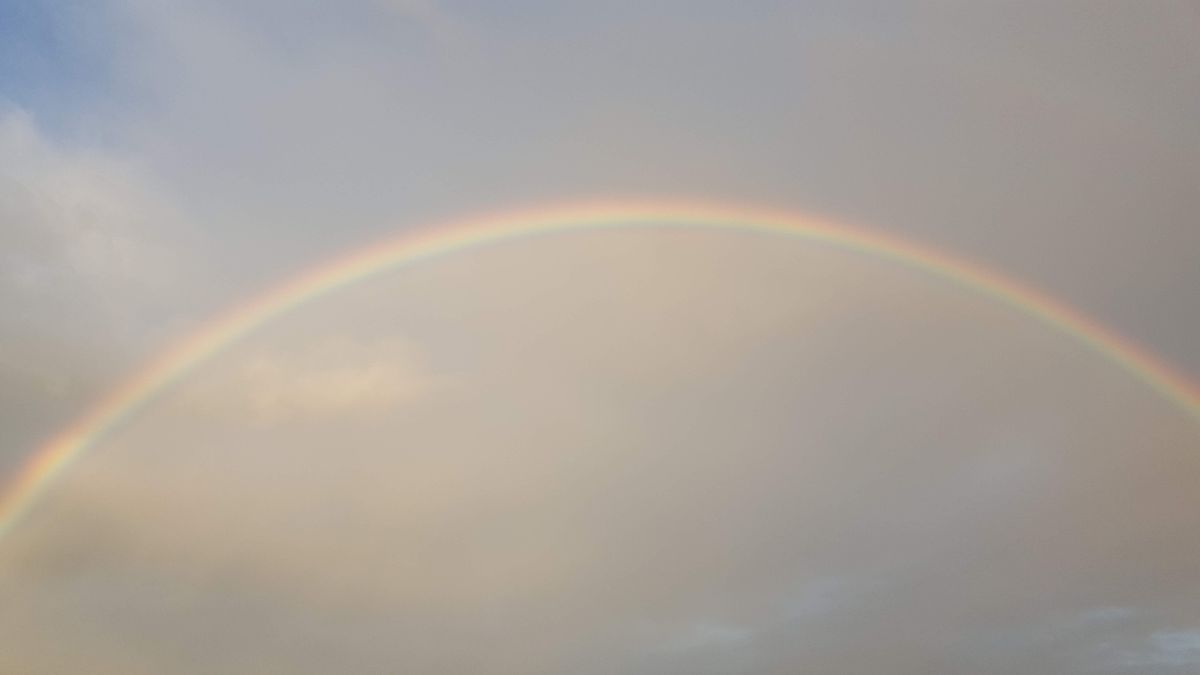
Every rainbow is a full circle rainbow, not a half-circle or arch. You see only an arc because the horizon blocks the lower half. From an airplane window — or your own garden with a hose — the complete 360° ring is waiting to be seen. Here's where we're going: why a full circle rainbow is always curved, the fixed angle that makes it circular, and how to spot the full circle yourself.
What makes a rainbow curved?
Sunlight enters a spherical raindrop, bends (refracts), reflects off the back, then bends again as it exits. This three-step path sends coloured light back toward you at a fixed angle: about 42° for red light and 40° for violet, with every other colour in between. The first to work this out geometrically was René Descartes in 1637, using a glass sphere filled with water.
Here's the picture that makes it click. Picture a crowd leaving a stadium where the blue-shirted fans are slightly slower through the gate than the red-shirted ones — they fan out into separate streams. Each colour in white light has a slightly different refractive index in water, so each bends by a slightly different amount. The red fans head one way at 42°, the violet fans another at 40°.
The catch: that angle is measured from the antisolar point — the spot opposite the sun where your shadow's head lands. Every raindrop that sends colour to your eye does so at this exact angle from that point. All those droplets, at that same angle all around, form a full circle rainbow.
The cone of light: your eye at the tip
Think of it in three dimensions. For any fixed angle (say 42°) from a fixed point (the antisolar point), every droplet that sends light to your eye lies on the surface of a cone — with your eye at the tip, the antisolar point at the centre of the cone's base, and the rainbow forming the circular rim.
This is why a full circle rainbow is always curved and never straight. A straight rainbow would require the same angle to exist in a line, but a fixed angle from a point in 3D space traces a circle every time. This is also why two people never see the same rainbow. Move a step to your left and your antisolar point shifts, meaning different droplets are at the right angle for your new position. The rainbow you see is yours alone.
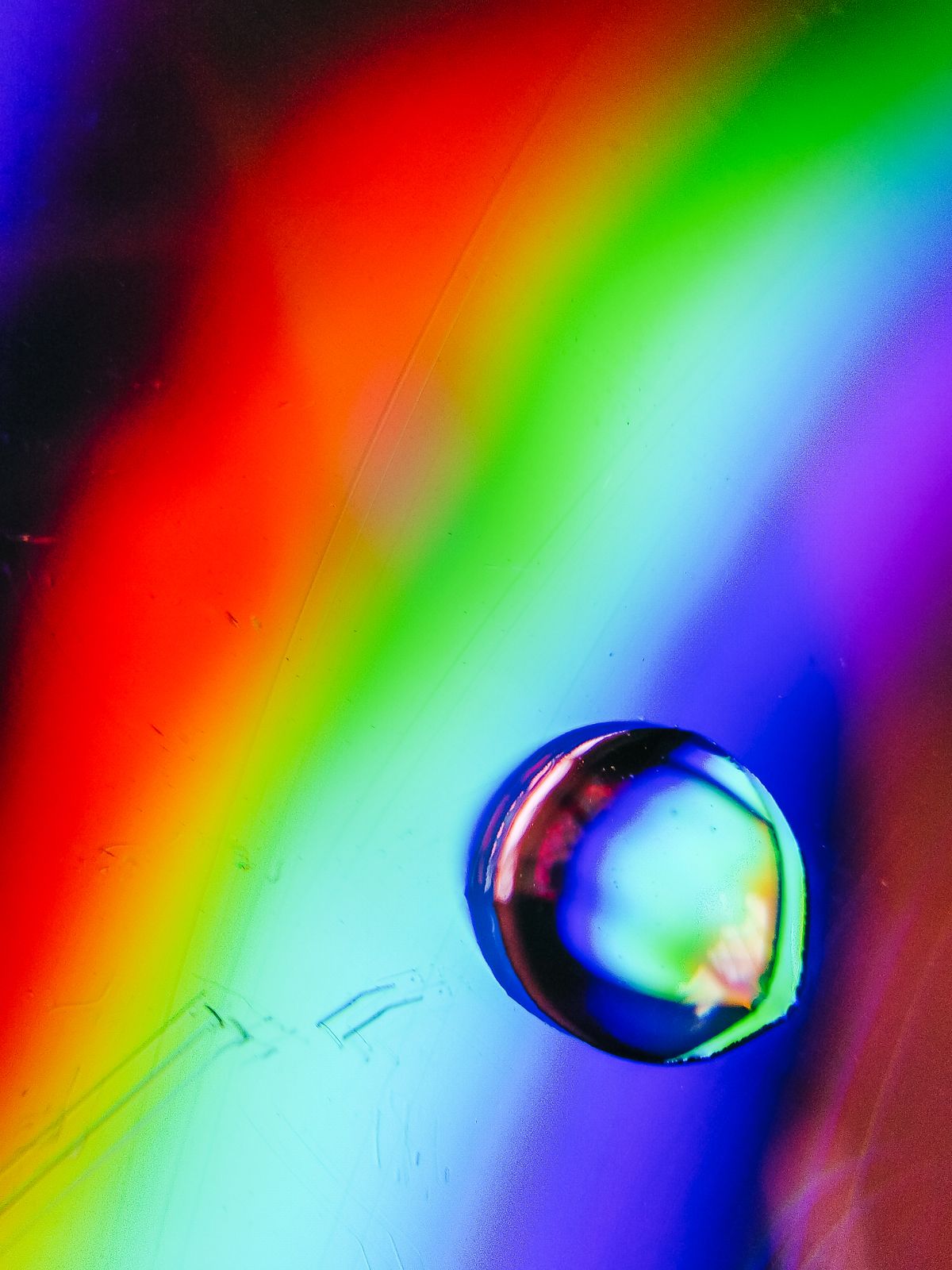
The dispersion of white light into its component colours was proved by Isaac Newton in the 1660s, when he passed sunlight through a prism and then recombined the colours with a second prism, proving the colours were inside white light all along. The same mechanism — dispersion by refraction — happens inside every raindrop.
Why the ground hides the bottom half
If a full circle rainbow is always present, why have you never seen one? The answer is the ground.
The centre of a rainbow — the antisolar point — sits below the horizon whenever the sun is above it. The lower half of the circle extends beneath your feet, where there are no raindrops and no line of sight. The horizon literally cuts the circle in half.
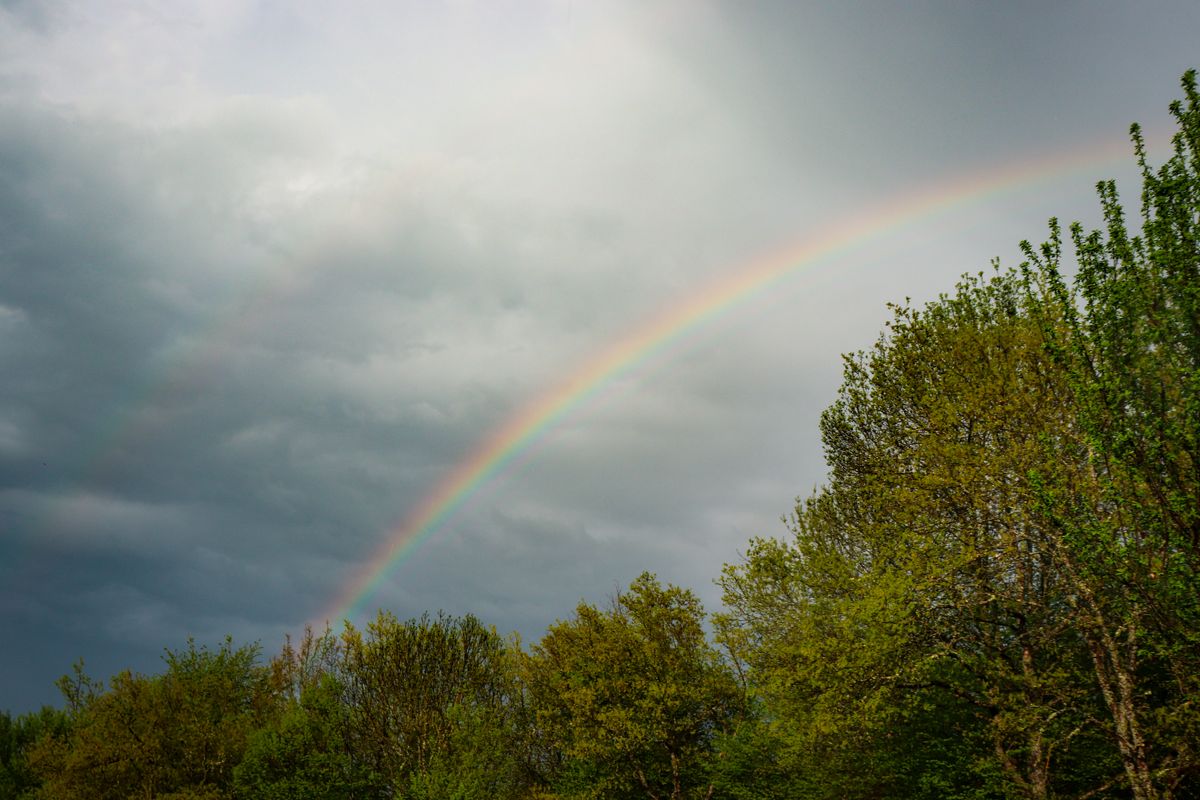
How much of the circle you see depends on the sun's height:
- Sun low near the horizon: you see a tall arch approaching a full semicircle (about 50% of the full circle).
- Sun at about 42° above the horizon: you see a tiny arc hugging the horizon.
- Sun higher than 42°: no rainbow at all — the entire circle sits below the horizon.
This is why the best rainbows appear near sunrise or sunset, when the sun is low and the arc rises high overhead.
The Sun must be below about 42° above the horizon for a primary bow to be visible at all. This is a hard physical limit set by the refractive index of water — not a rule of thumb, but geometry.
How to see a full circle rainbow
You do not need a pilot's licence to see a full circle rainbow. Here are three ways:
From an airplane. Book a window seat on the side opposite the sun during rainy weather. When the plane flies above a cloud deck with sunlight behind you, the full circle may appear below — a perfect ring of colour around the plane's shadow. Pilots and passengers report this more often than you might think.

From a garden hose. Stand with your back to the sun on a bright morning or late afternoon. Set your hose nozzle to a fine mist. Spray the water in front of you at about arm's length, aiming where your shadow's head falls. Look into the mist. If the spray is wide enough and the sun angle is right, you will see a complete circle of colour.
Near a waterfall. Large waterfalls produce constant mist. On sunny days, stand with the sun behind you and look into the spray. The bottom of the circle may be visible if you are high enough or the mist extends far enough below your viewpoint.
A note on nomenclature: a rainbow seen in fine mist at close range is sometimes called a glory, but a glory is much smaller (5–20°) and centred on the antisolar point itself. A true full circle rainbow is larger (40–42°) and follows the same physics as any other rainbow.
Double rainbows and Alexander's dark band
Sometimes a second arc appears above the primary bow. This is the secondary rainbow, caused by light that reflects twice inside the raindrop instead of once. It appears at about 51° from the antisolar point — roughly 10° outside the primary bow — and its colours are reversed, with red on the inside and violet on the outside.
The secondary bow is always fainter because each reflection loses light. The sky between the primary and secondary bows looks noticeably darker than the rest — this is Alexander's dark band, named after Alexander of Aphrodisias who first described it in around 200 AD.
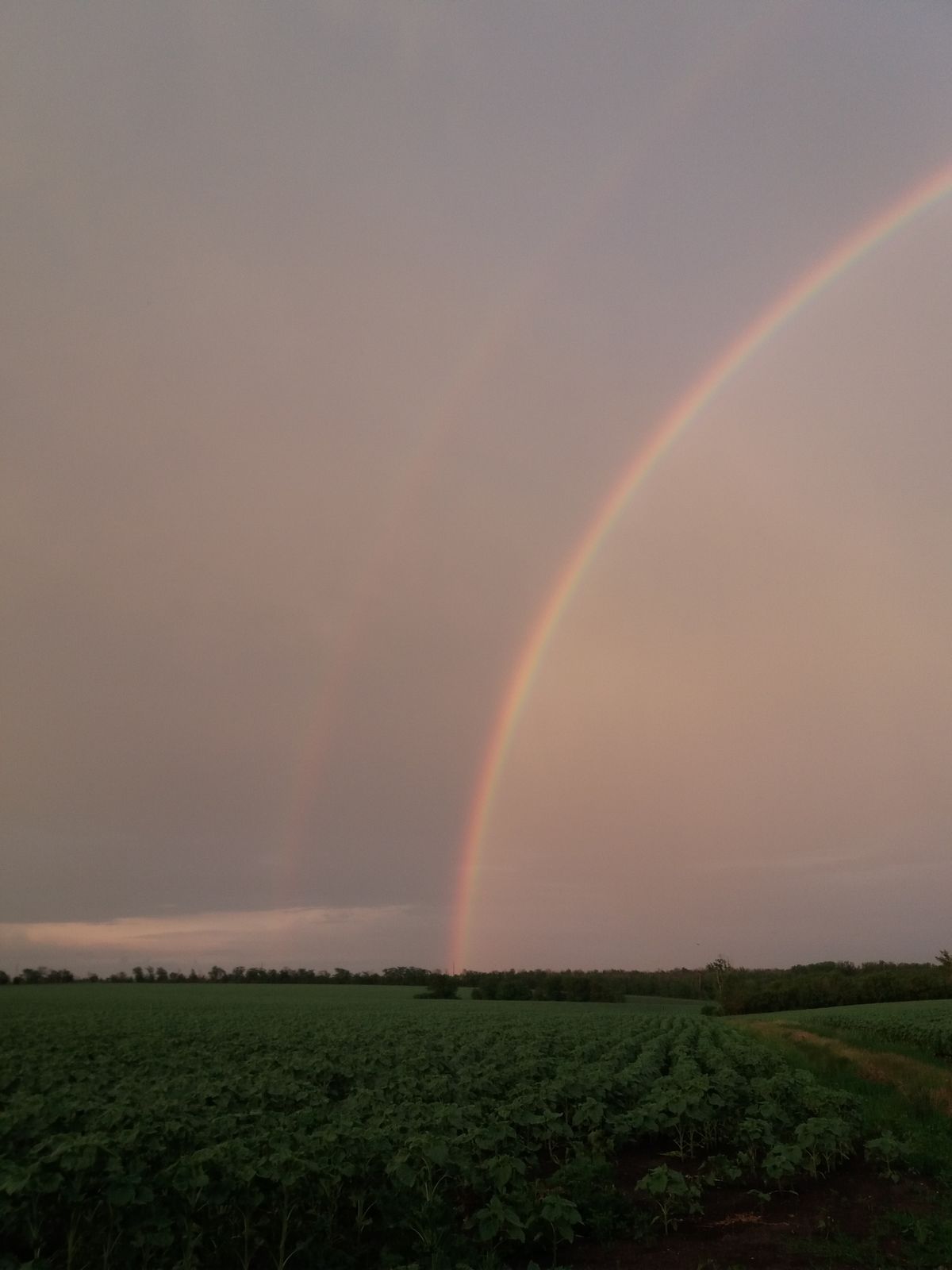
A common misconception to clear up: people picture a rainbow as a flat arch that sits somewhere in the distance, like a painted band across the sky. It is not. A rainbow is a 42° cone of directions with your eye at the apex. There is no physical location where it "lands." You cannot reach the end of a rainbow — every step you take shifts the entire optical setup. The leprechaun's pot of gold was never in danger.
For the adventurous, the tertiary (three-reflection) and quaternary (four-reflection) rainbows exist but point toward the sun, drowning in its glare. The quinary (five-reflection) rainbow was photographed for the first time only in 2014.
How big is a full circle rainbow?
The angular size of a full circle rainbow is fixed: the primary bow spans from about 40° (violet) to 42° (red). But the actual physical size depends on how far away the raindrops are. A full circle rainbow formed by mist from a garden hose might be a metre across. One formed by a distant rain shower could be kilometres wide.
The theoretical maximum visible arc from ground level occurs at sunrise or sunset, when about 50% of the full circle is above the horizon. To see more than 50%, you need altitude. From a commercial aircraft cruising at 35,000 feet, nearly the entire circle can be visible on the right day.

The largest section of a rainbow typically seen from ground level is about 50% of the full circle — during sunset or sunrise when the sun is on the horizon.
Summary
Yes — every rainbow is a full circle rainbow. The arc you see from your backyard is just the top half of a complete ring. The lower half is hidden by the ground, not absent. See a full circle rainbow for yourself from an airplane, a hilltop, or your own garden hose. The physics that makes a full circle rainbow curved is the same physics that makes it circular: a fixed angle of 40–42° from the antisolar point, through spherical raindrops, to your eye. That geometry never changes, whether you see a sliver of colour on the horizon or a full 360° ring from 35,000 feet.
For more on the optics of rainbows, see our guide to how rainbows form or the colours of the rainbow in order. For the physics of light bending through transparent materials, start with what is refraction.
External resources
- Descartes' original 1637 rainbow diagram and the physics of the 42° angle — Physics Van, University of Illinois
- Full-circle rainbow photographed via misting sprinklers — Atmospheric Phenomena
- The complete physics of rainbows — Wikipedia: Rainbow
Frequently Asked Questions
Is a rainbow a full circle or just an arc?
A rainbow is a full circle, not just an arc. Every rainbow forms a complete 360° circle of light, but the horizon blocks the lower half. From an airplane or a high vantage point, the full circle becomes visible.
Why do we only see a rainbow as an arc or arch?
We see only an arc because the ground and horizon block the lower half of the circular rainbow. The centre of a rainbow is the antisolar point, which sits below the horizon when the sun is above it. The higher the sun, the smaller the visible arc.
How can I see a full circle rainbow?
The easiest way is from an airplane with the sun behind you and rain below. You can also create one at home: stand with your back to the sun on a bright day, and spray a garden hose on a fine mist setting. Look into the mist and you may see a complete circle of colour.
Can rainbows appear at night?
Yes, rainbows can appear at night. These are called moonbows or lunar rainbows, formed by moonlight refracting through water droplets. They are much fainter than daytime rainbows and often appear white to the naked eye.
How rare is a double rainbow?
Double rainbows are not exceedingly rare. They occur when sunlight reflects twice inside raindrops instead of once. The secondary bow appears about 10° outside the primary bow with its colours reversed. The sky between them, called Alexander's dark band, is noticeably darker.
What is the shape of a rainbow really?
The true shape of a rainbow is a cone with your eye at the tip. All raindrops that send coloured light to your eye lie on the surface of that cone. The circular base of that cone is why rainbows are always curved and never straight.
Can a rainbow be straight or vertical?
No, a rainbow cannot be straight or vertical. Because raindrops are spherical and the angle of light exit is fixed at 40-42°, the set of droplets that can send light to your eye always forms a circle or arc. A straight or vertical rainbow is physically impossible.

About Umar Farooq
Umar Farooq writes in-depth guides on the physics of light and optics — from reflection, refraction, and lenses to diffraction, lasers, and fiber optics, explained from first principles.
Read more about Umar Farooq →