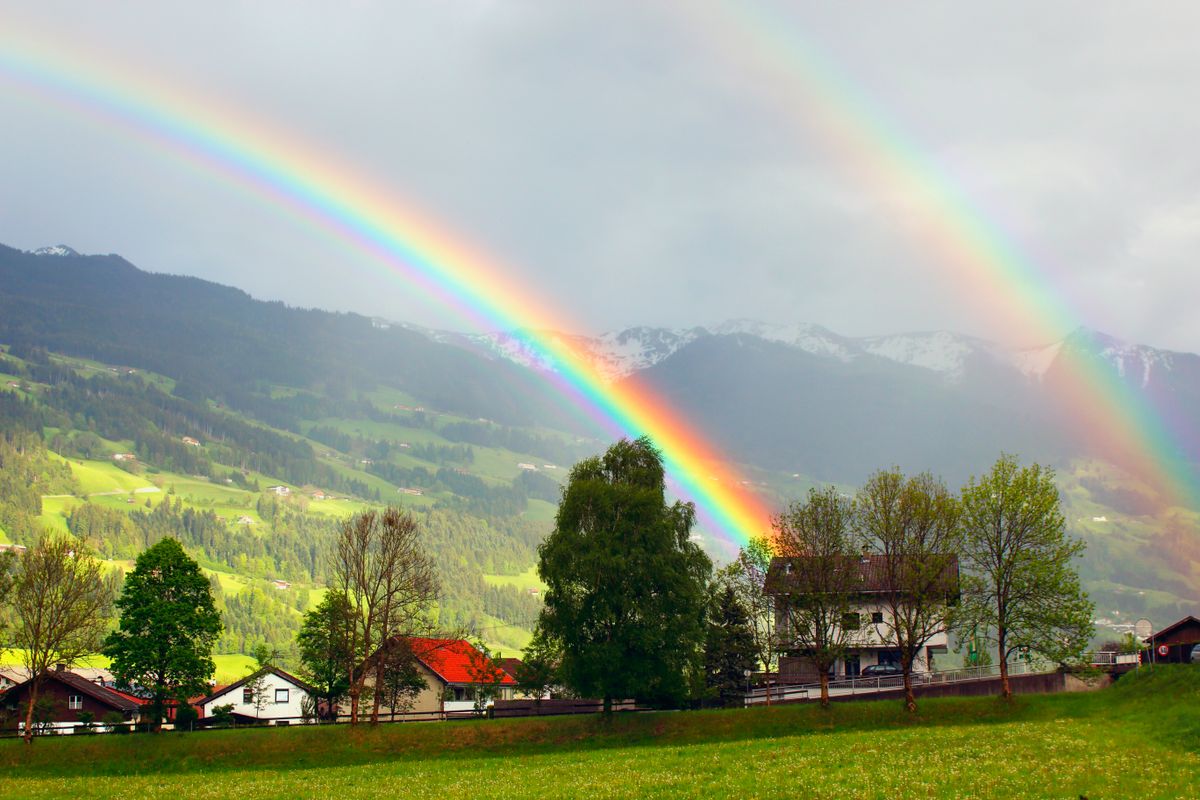
Rainbows are not objects you can touch — they are optical illusions made of sunlight and water, and the rules they follow are stranger than most people realise. Here is the short version: rainbows are full circles, each one is personal to you, and the longest on record lasted nearly 9 hours. Below are 25 fun facts about rainbows grouped by theme so you can find what surprises you most.
How rainbows form: the science
-
A rainbow is sunlight split by raindrops. Sunlight looks white, but it contains every colour mixed together. When it enters a raindrop, it bends (refracts), reflects off the back of the drop, and bends again as it exits — fanning the colours out like a tiny prism. Isaac Newton settled this in the 1660s: the colours are already inside white light, and the raindrop just separates them. This is one of the core fun facts about rainbows: every rainbow you see is a physics demonstration happening in real time. For more on the full spectrum, see our guide to types of light.
-
The primary rainbow sits at exactly 42°. From the antisolar point (the spot directly opposite the sun), the red band appears at about 42°, and the violet band at about 40°. This angle is fixed by the physics of refraction in water. The sun must be lower than about 42° above the horizon, which is why rainbows never appear at midday.
-
Light is reflected once inside the primary bow — one refraction in, one reflection, one refraction out. The secondary bow (the fainter one above) involves two internal reflections, which is why its colours are reversed and it sits at about 51°.
-
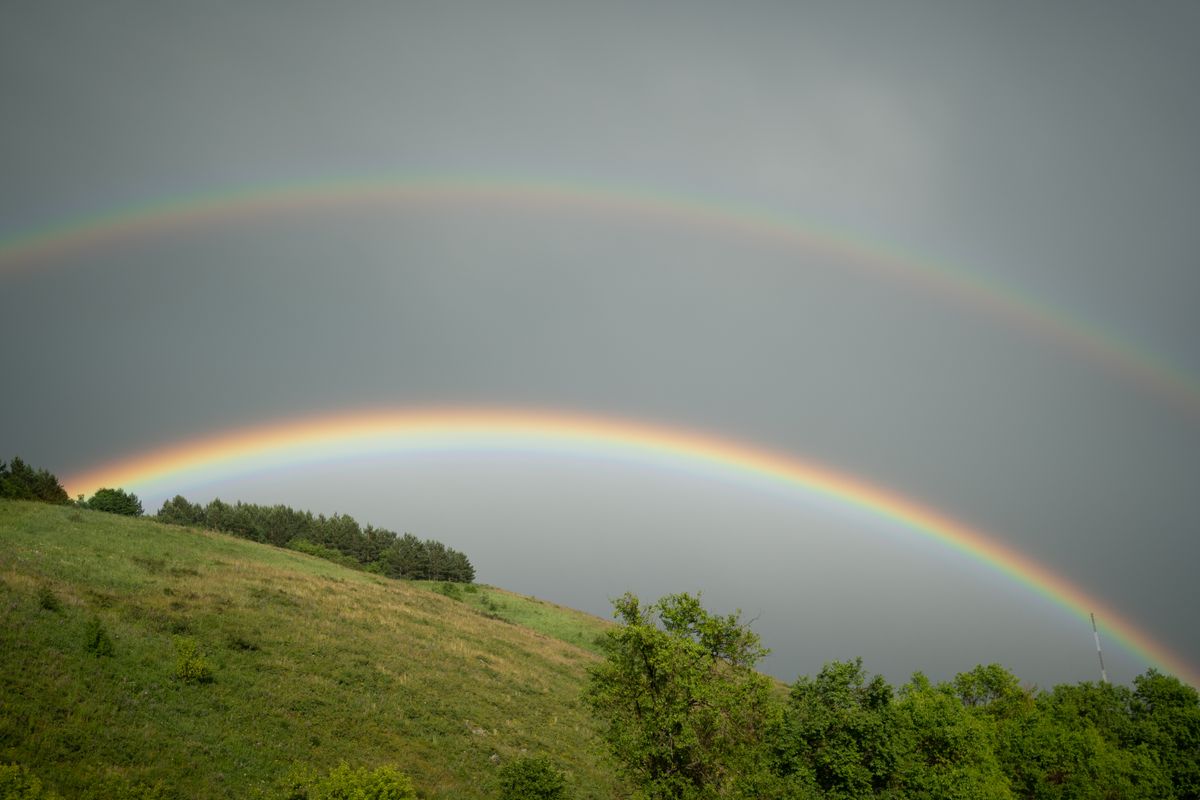
The dark band between the two rainbows has a name. It is called Alexander's dark band, named after Alexander of Aphrodisias, who first described it over 2,000 years ago. The sky between 42° and 51° is noticeably darker because neither the primary nor secondary bow sends light to that angular region.
-
Every raindrop makes its own rainbow. A single raindrop sends coloured light in all directions. You see the combined effect of millions of drops, each contributing a tiny slice of the arc. That is why a rainbow appears continuous.
Rainbow colours: what you see and why
-
ROYGBIV is the traditional seven-colour order. Red, orange, yellow, green, blue, indigo, violet — always in that order from the outer edge. In the secondary bow, the order flips: red on the inside, violet on the outside. Another of the fun facts about rainbows worth remembering: the colours are always in the same sequence, every time.
-
The colours are not a hard line, they blur into one another. The visible spectrum runs continuously from about 380 nm (violet) to 700 nm (red). The seven named colours are a cultural convention, not a physical division.
-
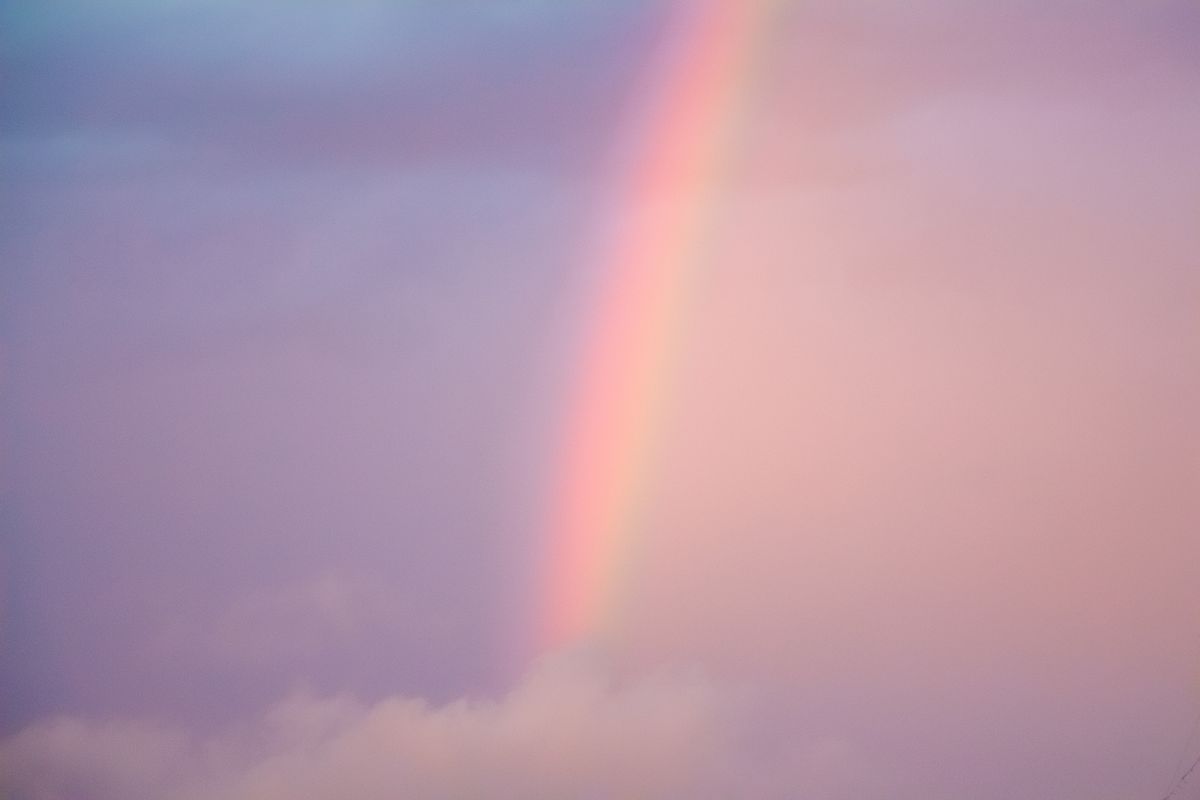
No two people see the same rainbow. A rainbow is a cone of light centred on the line from the sun through your eye. Move one step sideways and the cone shifts. The person beside you sees their own rainbow — slightly different in position, width, and brightness.
-
Your left and right eyes see slightly different rainbows. They are about 6–7 cm apart, so each eye looks through a slightly different set of raindrops. Your brain stitches the two views together and you perceive a single, stable arc.
Rare and unusual rainbows
-
Double rainbows are not that rare. If conditions are right — sun behind you, rain ahead, and raindrops large enough — a secondary bow forms. It is always fainter because some light is lost at each reflection. The colours are reversed, and the sky between the two bows is Alexander's dark band.
-
Moonbows are night-time rainbows. They form when bright moonlight (reflected sunlight) refracts through raindrops. They are rare because moonlight is roughly 400,000 times fainter than sunlight, so they usually appear white to the naked eye.
-
Supernumerary rainbows are the faint pastel bands inside the primary arc. They are caused by interference between light waves taking slightly different paths inside the drop — the same phenomenon that creates the colours in a soap bubble.
-
Fogbows are rainbows made of fog droplets. Because fog droplets are far smaller than raindrops, they produce a broad white arc with very faint colours — sometimes called a "white rainbow."
-
A twinned rainbow has two primary arcs splitting from a single base. It is rare and caused by a mix of differently sized raindrops that distort the usual 42° cone into two overlapping arcs.
Rainbow records and geography
-
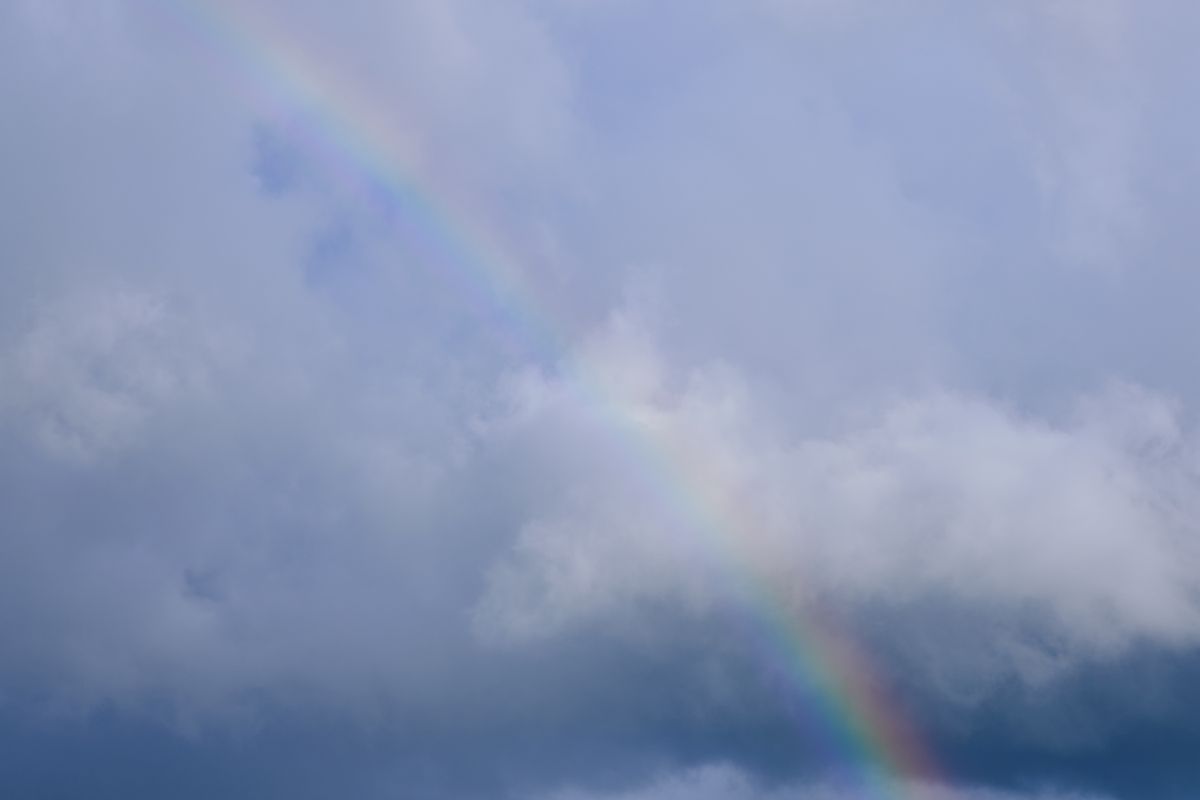
The longest-lasting rainbow on record lasted 8 hours 58 minutes. It was observed on 30 November 2017 over the Yangmingshan area of Taipei, Taiwan — a Guinness World Record. The previous record was about 6 hours over Sheffield, England in 1994. (Guinness World Records confirms the details.)
-
Hawaii has more rainbows than anywhere else. The state's mix of frequent rain showers, bright sunshine, and clean air creates ideal conditions. Some locations in Hawaii see rainbows on over 200 days per year.
-
Earth may be the only planet in the solar system with rainbows. The ingredients — liquid water droplets and sunlight — only exist together on Earth. Some astronomers think Saturn's moon Titan could produce rainbows in its methane rain.
-
You can see a full-circle rainbow from an aeroplane. From high above, the horizon no longer blocks the bottom half, and the full 360° circle becomes visible. Aerial photographers have captured this effect above rain showers.
Rainbow myths and history
-
The word "rainbow" comes from the Latin arcus pluvius — "rainy arch." It entered English through Old English reġnboga.
-
In Greek mythology, the rainbow was a path created by Iris, the goddess-messenger who linked the mortal world to the heavens. The word "iris" still names the coloured part of the eye and a family of flowers.
-
The pot of gold at the end of the rainbow is an Irish legend — supposedly guarded by a leprechaun. Since a rainbow has no physical end, the treasure stays mythical.
-
Newton chose seven rainbow colours to match the seven notes of a musical scale. He was fascinated by the idea that nature might follow musical harmonies. The colour indigo was included largely to make the count seven.
-
Rainbows have long been a symbol of hope. The story in Genesis uses the rainbow as a divine promise after the flood. In modern times, the rainbow flag has represented LGBTQ+ pride since 1978.
Fun facts about rainbows you can test yourself
-
You can make your own rainbow with a garden hose. Stand with your back to the sun on a clear day. Turn the nozzle to a fine mist and spray into the air. The mist of droplets will produce a mini-rainbow — the same physics, just smaller.
-
Rainbows appear opposite the sun, not above it. When you spot a rainbow, the sun is always directly behind you. That is why morning rainbows appear in the west and evening rainbows in the east. For a deeper look at the optics, see our guide to refraction.
For more on the physics that makes rainbows possible — refraction, reflection, and the visible spectrum — browse our optics guides or read about the properties of light.
External resources
Frequently Asked Questions
How long does a rainbow last?
Most rainbows last less than an hour. The longest-observed rainbow was seen over Taipei, Taiwan in 2017 and lasted 8 hours and 58 minutes — a Guinness World Record.
Do rainbows touch the ground?
No. Rainbows only appear to touch the ground. They are actually full circles of light centred on the antisolar point. From the ground we see only the top half because the horizon cuts off the rest.
Do rainbows have an end?
A rainbow has no physical end. It is an optical illusion whose position depends on your viewpoint and the sun behind you. Move toward where it seems to land and it shifts away — you can never reach it.
What is at the end of a rainbow?
Nothing physical. The Irish legend promises a pot of gold guarded by a leprechaun, but since a rainbow has no fixed location, the pot of gold stays a myth.
Can rainbows form at night?
Yes. Moonbows — or lunar rainbows — form when bright moonlight refracts through raindrops. They are rare and usually appear white to the human eye because moonlight is much fainter than sunlight.
Why is a rainbow curved and not straight?
A rainbow is curved because it is part of a circle. Each raindrop sends coloured light toward your eye at a fixed angle — about 42° for the primary bow. All drops at that angle form a cone centred on the antisolar point, and your eye sees the edge of that cone as an arc.
How many colours are in a rainbow?
The visible spectrum runs continuously, but it is traditionally described as seven colours: red, orange, yellow, green, blue, indigo, and violet (ROYGBIV). Isaac Newton settled on seven in the 1660s, matching the seven notes of a musical scale.

About Umar Farooq
Umar Farooq writes in-depth guides on the physics of light and optics — from reflection, refraction, and lenses to diffraction, lasers, and fiber optics, explained from first principles.
Read more about Umar Farooq →