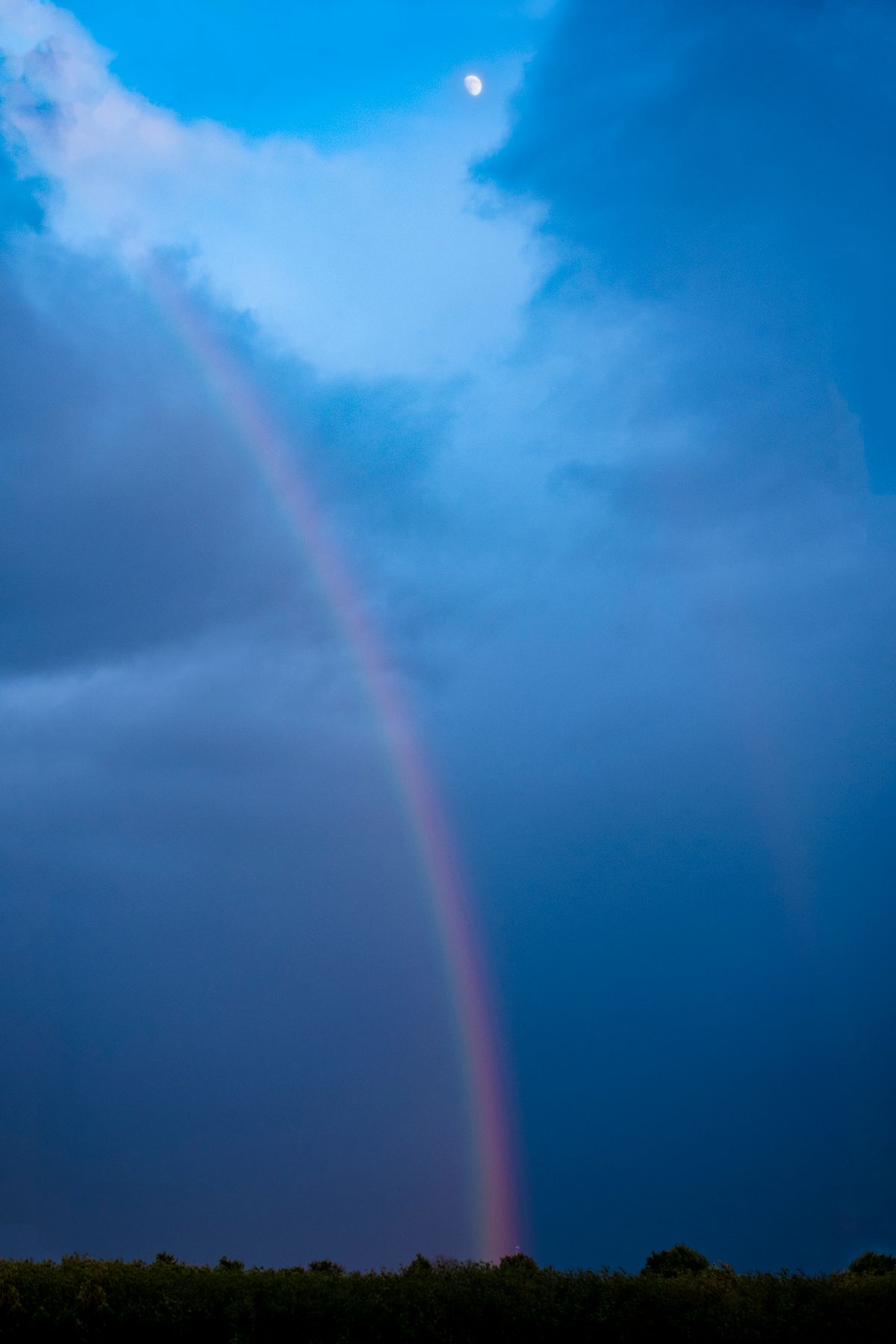
A moonbow is a rainbow produced by moonlight instead of sunlight — the same physics, the same arc, but ghostly fainter and usually white to the naked eye. It forms when moonlight refracts and reflects through water droplets in exactly the same three-step process as a daytime rainbow. The catch is that moonlight is about 400,000 times dimmer than sunlight, so several rare conditions must align for a moonbow to appear. Here is what we cover: how moonbows form, why they look white, the ghostly fogbow, whether snow can make a rainbow, where to see them, and how they compare.
How Does a Moonbow Form?
Here is the key idea. A moonbow forms the same way a daytime rainbow does. Think of it like swapping the bulb in a projector — swap the Sun for the Moon and you get the same picture, just much dimmer.
Sunlight entering a raindrop refracts (bends), reflects once off the inside back surface, then refracts again as it exits. That three-step process separates white light into its component colours because each colour bends by a slightly different amount. Red (longest wavelength, about 700 nm) bends the least. Violet (shortest, about 380 nm) bends the most. The result is the familiar 42-degree arc.
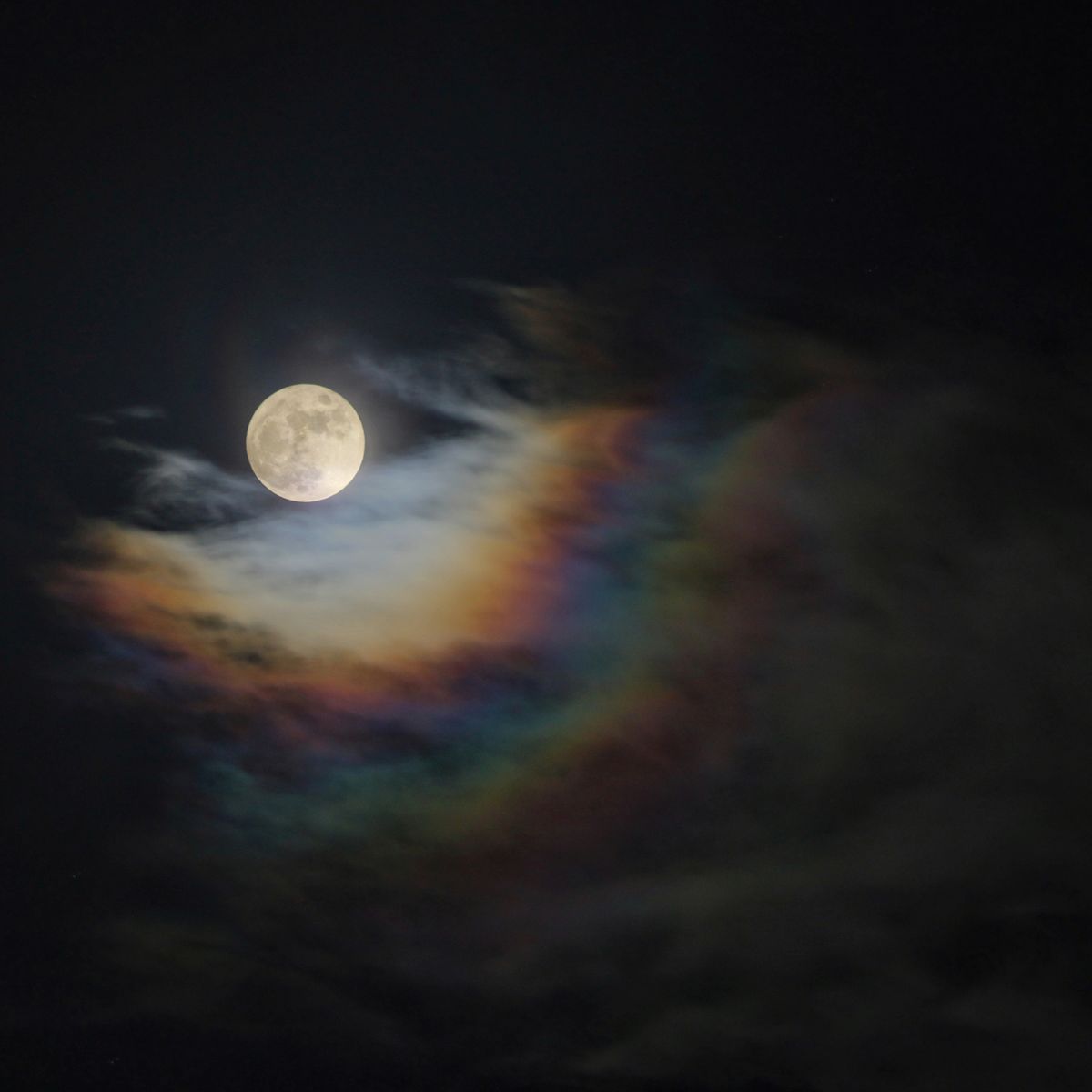
A moonbow uses moonlight instead. Moonlight is simply sunlight reflected off the Moon's surface — the same white light, just dramatically weaker. When that reflected moonlight hits raindrops, the identical refraction-reflection-refraction sequence unfolds. The primary moonbow appears at about 42 degrees from the antilunar point, exactly as a solar rainbow sits 42 degrees from the antisolar point. A secondary moonbow at about 51 degrees — fainter still — is possible but extremely rare.
The conditions are strict. You need four things simultaneously:
- A near-full Moon — at least 80-90% illuminated, ideally full
- Rain or mist opposite the Moon — water droplets in the right spot
- A dark sky — no light pollution, no cloud cover near the Moon
- The Moon below 42 degrees above the horizon — low enough for the arc to clear the ground
This combination makes moonbows far rarer than solar rainbows. Even at famous moonbow sites like Cumberland Falls in Kentucky, the bow appears only 2-4 nights per month during the right season.
Why Do Moonbows Look White?
This is the question that puzzles most people. The colours are there — a camera with a long exposure or a sensitive sensor will capture the full ROYGBIV spectrum of a moonbow. So why does the naked eye see only a pale white or grey arc?
The answer lies in how human vision works in dim light. Your retina has two types of photoreceptors: cones (which detect colour and need bright light) and rods (which detect brightness only and work in low light). In bright daylight, cones are active and you see rainbow colours. In the dim light of a moonbow — about 400,000 times dimmer than sunlight — the cones cannot respond. Your visual system switches to rod-only (scotopic) vision, which is colour-blind.
Picture it like switching your phone camera to night mode: the image goes monochrome because the sensor cannot gather enough colour information. Your eyes do the same thing automatically. The colours in a moonbow are physically present, but the biological hardware to see them is dormant.
This is also why reports of colourful moonbows are so rare. Only under an exceptionally bright full moon, with large raindrops and perfectly dark skies, do some people glimpse faint colour — typically a hint of red on the outer edge.
What Is a Fogbow? The White Rainbow in Mist
A fogbow (also called a white rainbow, ghost rainbow, or cloudbow) is the pale, nearly colourless cousin of the ordinary rainbow. It forms when sunlight (or moonlight) passes through the tiny water droplets in fog or mist rather than through raindrops.
Here is what makes fogbows different. Ordinary raindrops are about 0.25 to 3 mm in diameter — large enough to cleanly refract and separate colours. Fog droplets are typically under 0.05 mm, about 100 times smaller. At that scale, a second effect kicks in: diffraction. Light bends around the edges of these tiny droplets, spreading in multiple directions. That diffraction smears the separated colours back together, producing a wide, white arc.
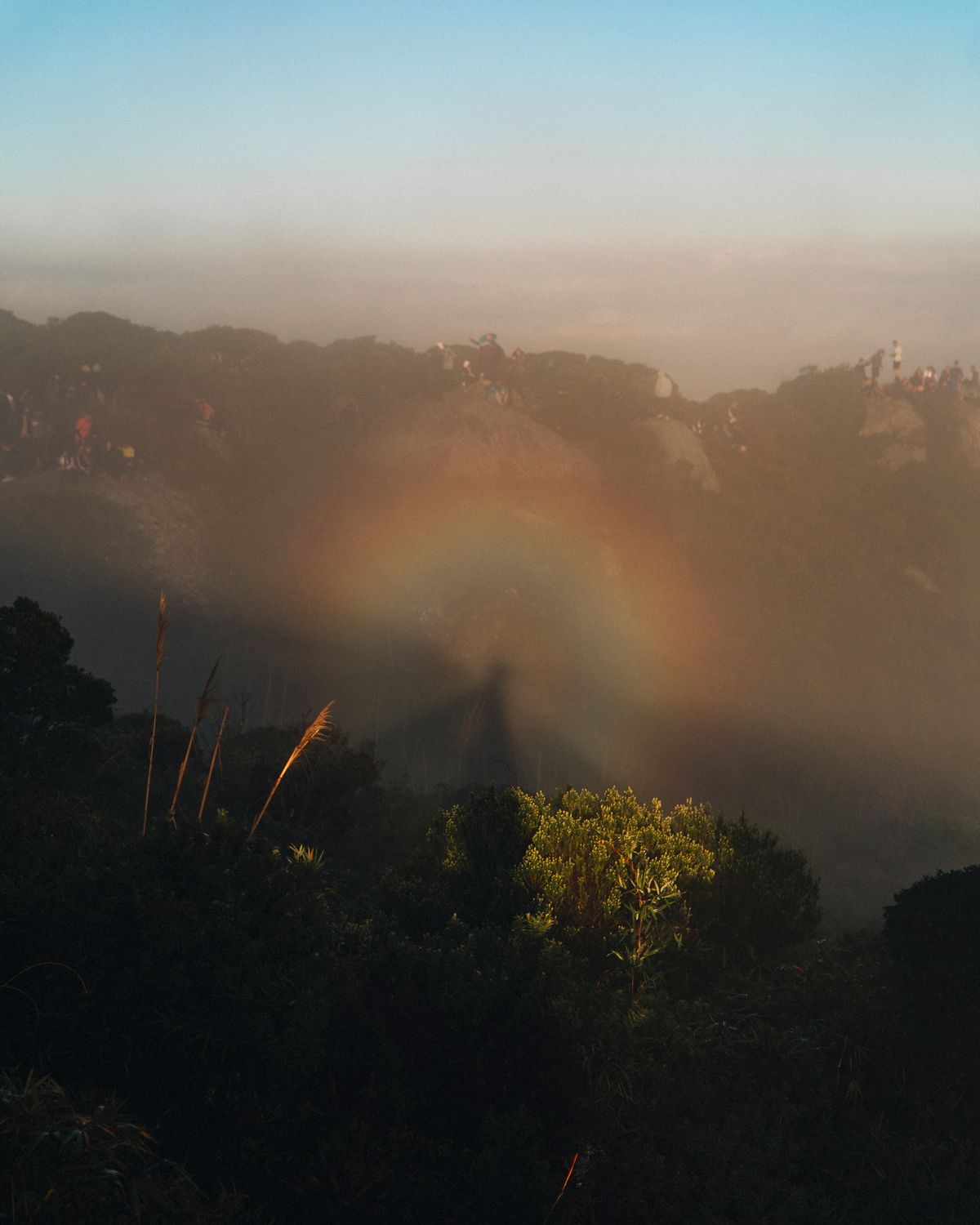
Think of it like drawing seven coloured lines side by side and then smudging them with a wet thumb. The individual colours blur into a washed-out white. That is exactly what diffraction does to the colours inside a fogbow.
Fogbows have several distinctive features:
- They are wider than ordinary rainbows — the arc can span a noticeably larger angle
- They are fainter — often hard to spot against a bright fog bank
- They appear white — with faint red on the outer edge and faint blue on the inner edge
- Supernumerary arcs — faint pastel bands inside the main bow — are common when fog droplets are uniformly sized
To spot a fogbow, stand with your back to the Sun (or Moon) and look into a bank of fog or mist. The Sun should be low, no more than 30-40 degrees high. Fogbows are most common in coastal areas, over mountain valleys, and around waterfall spray.
When a fogbow forms at night by moonlight, it is called a lunar fogbow — the rarest of the rare, requiring both a bright moon and a fog bank.
Can Snow Produce a Rainbow?
This is a common question, and the short answer is no — there is no true snowbow equivalent of a rainbow. Here is the physics behind why.
Rainbows need spherical water droplets. The spherical shape allows light to enter, refract at a clean angle, reflect off the inside back surface at the correct geometry, and refract out again at a predictable angle. Each colour emerges at a slightly different angle, producing the separated spectrum.

Snowflakes are not spherical. They are complex, six-sided branched crystals — each one different, each one with flat faces and sharp angles. When sunlight hits a snowflake, it does not undergo the clean refraction-reflection-refraction path. Instead, it scatters in every direction. That scattering is exactly why snow appears white: all the colours of sunlight are mixed together and bounced around randomly.
However, people do sometimes see rainbow-like colours in snowy conditions. These are usually ice halos or sun dogs — caused by sunlight refracting through simple hexagonal ice crystals (not snowflakes) in high cirrus clouds. A 22-degree halo, for example, forms a colourful ring around the Sun. But that is a different phenomenon from a rainbow. True rainbows need liquid water droplets.
The term snowbow does appear in some sources, but it typically refers to a rare halo-like arc produced by light reflecting off oriented ice crystals near the ground in bright sunlight. It is extremely uncommon and technically not a rainbow.
Where to See Moonbows and Fogbows
Several locations around the world are famous for reliable moonbow and fogbow sightings:
| Location | Best for | When to go |
|---|---|---|
| Cumberland Falls, Kentucky, USA | Moonbows | 2-4 nights around full moon, 2-3 hours after sunset |
| Victoria Falls, Zambia/Zimbabwe | Spray moonbows | Full moon nights, especially December-February |
| Yosemite National Park, California | Moonbows over waterfall spray | April-June (snowmelt), around full moon |
| Niagara Falls, New York/Ontario | Moonbows and fogbows | Full moon winter nights (less tourist crowds) |
| Scottish Highlands | Fogbows | Misty mornings with low sun, year-round |
| Coastal California (Golden Gate) | Fogbows | Summer fog season with bright sun |
The secret to seeing any of these is patience. Moonbows are not guaranteed even at the best sites — cloud cover, Moon phase, and rain timing must all cooperate. Photographers often use long exposures (10-30 seconds) on a tripod to capture the colour that the naked eye misses.
Moonbow vs Fogbow vs Rainbow: Quick Comparison
| Feature | Rainbow | Moonbow | Fogbow |
|---|---|---|---|
| Light source | Sun | Moon | Sun or Moon |
| Droplet size | 0.25-3 mm | 0.25-3 mm | Under 0.05 mm |
| Colour visible? | Yes, full ROYGBIV | No (white to eye) | No (white/pale) |
| Main angle | ~42 degrees | ~42 degrees | ~35-40 degrees |
| Typical width | Narrow band | Narrow band | Much wider arc |
| Rarity | Common | Rare | Uncommon |
| Best viewed | Day, sun behind | Night, full moon | Morning fog, sun behind |
The Myth: Rainbows Only Happen During the Day
This is one of the most persistent misconceptions in atmospheric optics. The myth is reasonable — almost everyone has only ever seen rainbows in daylight. But light itself has no preference for day or night. The physics of refraction, reflection, and dispersion works identically regardless of whether the source is the Sun or the Moon.
The reason we think of rainbows as daytime-only is simple: moonlight is too dim for most people to notice the colour, and the conditions for moonbows are so specific that most people never encounter one. Aristotle himself knew about lunar rainbows nearly 2,400 years ago, describing them in his Meteorology. The phenomenon has been documented for centuries — it is merely rare, not impossible.
Moonbows are not supernatural or separate from ordinary rainbows. They are the same physical phenomenon, playing out under a different light source. If more people lived near a dark-sky waterfall site with a reliable full moon, the "daytime-only" myth would vanish quickly.
For a deeper dive into the refraction physics that makes all rainbows possible, see our guide on how rainbows form. For the full range of rare atmospheric bows, check out rare types of rainbows. The connection between prism dispersion and rainbow colour separation is covered in refraction through a prism.
External resources: The Atmospheric Optics page on moonbows is the definitive reference for lunar rainbow photography and physics. NASA's Visible Light page covers the visible spectrum that both rainbows and moonbows display. For fogbows specifically, Atmospheric Optics' fogbow article has detailed simulations and images.
Frequently Asked Questions
What is a moonbow?
A moonbow (also called a lunar rainbow or night rainbow) is a rainbow produced by moonlight rather than direct sunlight. It forms by the same physics — refraction, reflection, and dispersion in water droplets — but appears much fainter because moonlight is roughly 400,000 times dimmer than sunlight.
How rare are moonbows?
Moonbows are rare because several conditions must align: a near-full moon, rain or mist falling opposite the moon, a dark sky free from light pollution, and the moon below 42 degrees above the horizon. Meeting all these at once is uncommon, which is why many people never see one in their lifetime.
Why do moonbows look white?
Moonbows look white or grey because moonlight is too dim to activate the cone cells in your retina that detect colour. Your eyes switch to rod cells (scotopic vision) in low light, which perceive brightness only. The colours are there — a camera with a long exposure will capture them — but your eyes cannot see them.
What is a fogbow?
A fogbow (or white rainbow) is a pale, nearly colourless arc that forms when sunlight or moonlight passes through tiny fog droplets rather than raindrops. Because fog droplets are under 0.05 mm, diffraction smears the colours together, producing a wide white bow with faint red on the outside and faint blue on the inside.
Can snow produce a rainbow?
No. Snowflakes are complex, six-sided crystals — not spherical like raindrops. Rainbows require spherical drops for the precise refraction and reflection geometry that separates colours. Snowflakes scatter light in all directions instead, which is why snow appears white and cannot form a true snowbow. Some ice halos are sometimes mistaken for snowbows, but they are different phenomena.
Where can you see a moonbow?
The best-known moonbow locations are Cumberland Falls (Kentucky, USA), Victoria Falls (Zambia/Zimbabwe), Yosemite National Park (California, USA), and Niagara Falls (New York/Ontario). These sites combine waterfall spray with dark skies and reliable moon positions. The optimal viewing window is 2–3 hours after sunset or before sunrise during a full moon.
What is the difference between a moonbow and a rainbow?
The physics is identical — both involve refraction, reflection, and dispersion in water droplets. The key differences are brightness (moonbows are far fainter), colour perception (moonbows appear white to the naked eye), and rarity (moonbows need a full moon, dark sky, rain opposite the moon, and the moon below 42 degrees).
Are fogbows real rainbows?
Yes, fogbows are real rainbows — but with a twist. They form by the same refraction and reflection process as ordinary rainbows. The difference is droplet size: fog droplets are so tiny (under 0.05 mm) that diffraction dominates, smearing the colours into a white bow. They are sometimes called ghost rainbows or white rainbows.

About Umar Farooq
Umar Farooq writes in-depth guides on the physics of light and optics — from reflection, refraction, and lenses to diffraction, lasers, and fiber optics, explained from first principles.
Read more about Umar Farooq →