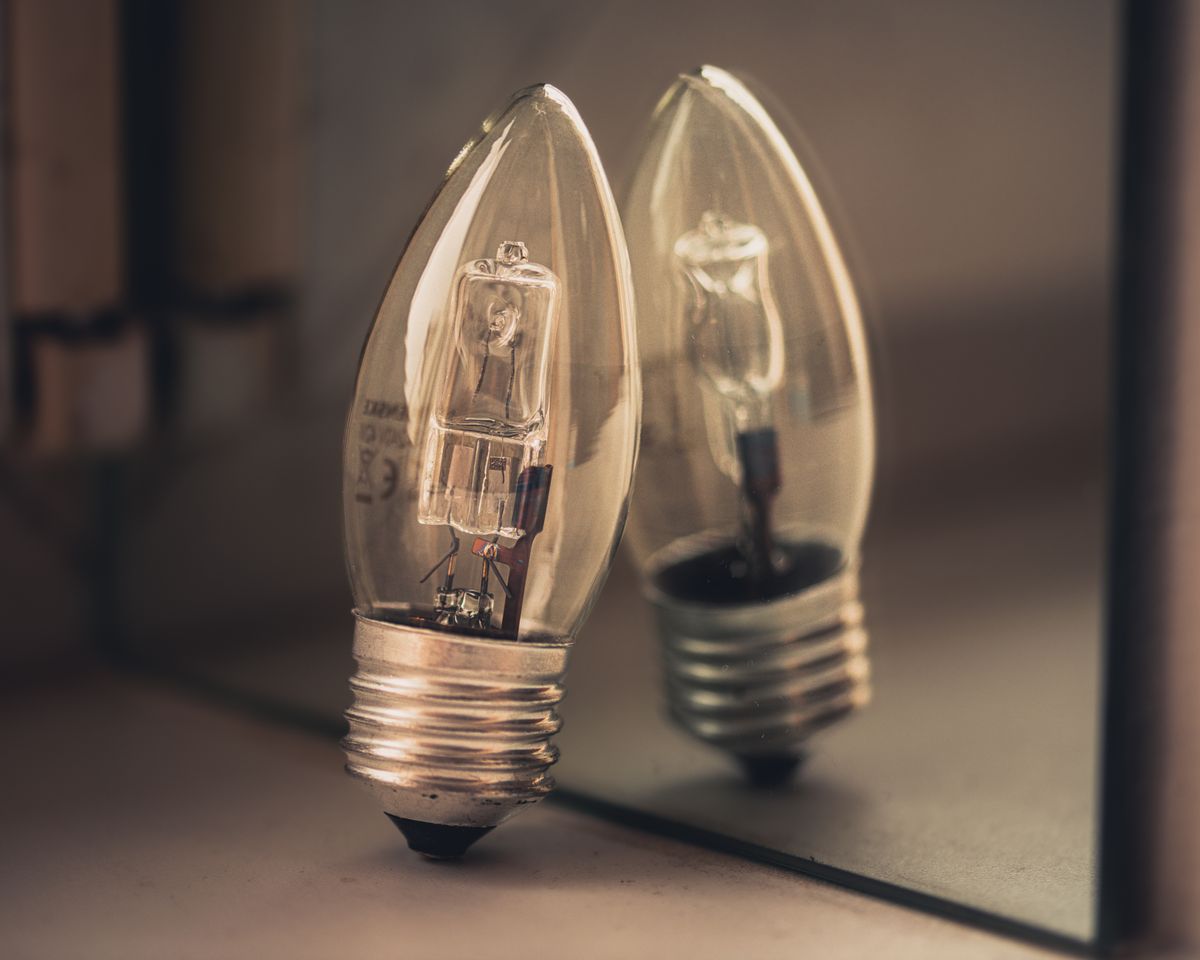
When light hits a mirror, it reflects off the surface at the same angle it arrived. That is the law of reflection in one sentence. But understanding what happens when light hits a mirror means going deeper — to the atomic level, where photons interact with free electrons in the metal coating on the back of the glass. The electrons absorb the incoming energy and re-emit it almost instantly, sending the light back into the room. The whole process takes less than a femtosecond. Here is exactly what happens when light hits a mirror, broken down into 5 steps.
Think of a ball thrown at a wall. The ball hits, compresses slightly, and springs back. Light hitting a mirror does something similar, but at the atomic level: the electromagnetic field of the light wave pushes and pulls on the free electrons in the metal, and those electrons respond by radiating their own wave. The result is a perfect bounce.
Step 1: Light travels from the object to the mirror
The process begins before the light reaches the mirror. Light from a source (the sun, a lamp, or your face) travels in straight lines until it hits something. Some of these rays travel toward the mirror. These are called incident rays.
Each incident ray carries a specific direction and intensity. When you stand in front of a mirror, light reflects off your face in all directions. Some of those rays travel toward the mirror — those are the ones that will make your reflection visible. To understand what happens when light hits a mirror, you need to follow these rays from start to finish.
Step 2: Light passes through the glass to the metal coating
A mirror is not just a piece of glass. Modern mirrors are a sandwich: a sheet of glass with a thin layer of metal (silver or aluminium) on the back, protected by a layer of paint. The glass itself is transparent. When the incident ray reaches the front surface, about 8% reflects off the glass — this produces a faint secondary reflection (ghost image). The remaining 92% passes through the glass and reaches the metal coating. Almost every explanation of what happens when light hits a mirror skips this detail — but the glass is just a window to the real reflective surface underneath.
This is why mirrors have their reflective coating on the back — the glass protects the delicate metal surface from scratches and tarnish while letting most of the light through.
Step 3: Free electrons in the metal absorb the photon energy
This is the key step. Metals are special because they contain free electrons — electrons that are not bound to individual atoms but can move freely through the material. When the light wave reaches the metal, its oscillating electric field pushes and pulls on these free electrons.
The electrons begin oscillating at the same frequency as the incoming light wave. They absorb the energy of the incident photons. But unlike in a dark surface where this energy becomes heat, in a metal the electrons re-radiate the energy almost immediately. The Britannica explanation of how mirrors work notes that this re-radiation is what makes metal surfaces reflective — the free electrons act like tiny antennas, broadcasting the light back out.
Step 4: The electrons re-emit the light as a reflected ray
The oscillating electrons emit their own electromagnetic wave. This emitted wave travels away from the metal surface back through the glass. Because the metal surface is smooth at the microscopic level, all the re-emitted waves leave in a coordinated direction — the same angle as the incident ray but on the opposite side of the normal line.
This is the reflected ray. The angle of reflection equals the angle of incidence because the geometry of the re-emission is determined by the direction of the incident wavefront. Every wavelength reflects at the same angle — which is why mirrors do not separate white light into colours. This is the most important part of what happens when light hits a mirror: the coordinated re-emission from free electrons produces the neat, organised bounce that gives you a clear reflection.
Step 5: The reflected light reaches your eyes
The reflected ray travels from the mirror back to your eyes. Your brain, assuming light travels in straight lines, traces the reflected ray backward in a straight line behind the mirror. It concludes that the light came from a point behind the mirror surface. This is why you see a virtual image — the object appears to be behind the mirror at the same distance you are standing in front of it.
The image, called a reflected image, has these properties:
- Virtual (cannot be projected on a screen)
- Upright (not upside down)
- Same size as the object
- Laterally inverted (left and right swapped)
- The same distance behind the mirror as the object is in front
This is why mirrors and light reflection work together to create the illusion of depth behind the mirror surface. The reflected image you see is a faithful reproduction because the reflection of light in mirrors preserves spatial geometry.
What happens with different mirror shapes
The 5 steps above describe a plane mirror — a flat mirror. Curved mirrors change the image because the direction of the normal varies across the surface:
Concave mirrors (curved inward like a bowl) make the reflected rays converge. If you are close to the mirror, the image is magnified — this is why makeup mirrors and shaving mirrors are concave. If you are far away, the image flips upside down. What happens when light hits a mirror that is concave is the same atomic process — free electrons absorbing and re-emitting — but the curved surface redirects the rays toward a focal point. Concave mirrors are used in reflecting telescopes to gather and focus light from distant stars.
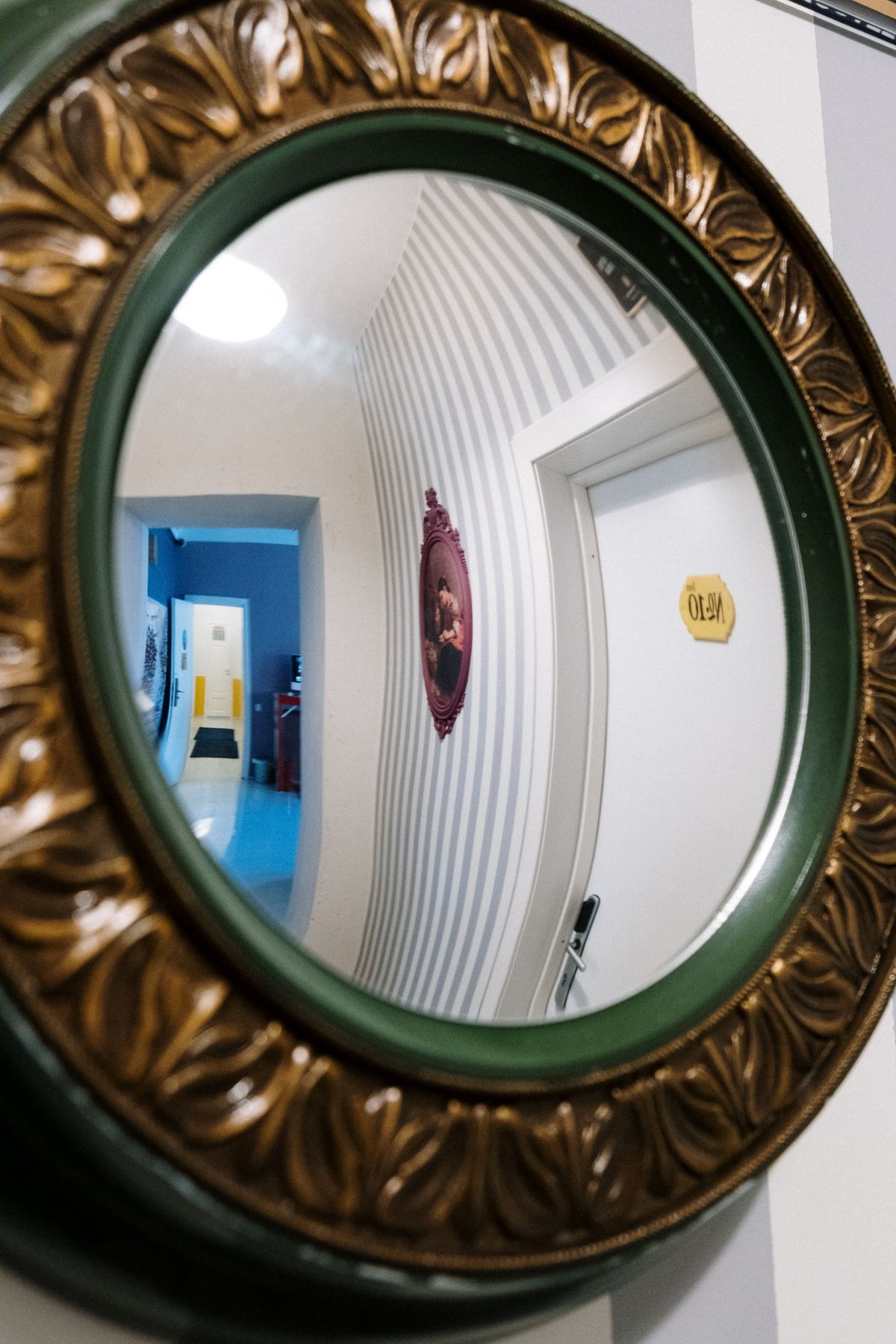
Convex mirrors (curved outward like a dome) make the reflected rays diverge. The image is smaller and shows a wider field of view. This is why car side mirrors and security mirrors are convex — you see more of the area even though objects look smaller. The BBC Bitesize guide on mirror reflection includes practical experiments for measuring how these different mirror shapes affect the reflected image. For an AP-level treatment of the same physics, the OpenStax textbook on the law of reflection covers the principle in greater mathematical detail.
What happens to the light that is not reflected
Even the best mirror does not reflect all the light that hits it. A standard household mirror reflects about 90–95% of incident light. About 5–10% is absorbed by the metal coating and turned into heat. Another fraction (roughly 4–8%) reflects off the front glass surface, producing a faint secondary image. Over time, mirrors degrade as the metal coating oxidises or tarnishes, reducing reflectivity further. While 90–95% sounds high, when you compare what happens when light hits a mirror with what happens at other surfaces, it is the best you will get — most rough surfaces reflect less than 30%.
This absorption is why mirrors in bright sunlight feel slightly warm. It is also why a mirror's reflective coating is sealed behind paint — to protect it from air and moisture that would accelerate the tarnishing process.
Common misconception: "light bounces off the glass surface of a mirror"
Most people think light reflects off the front of the mirror — the glass surface. What happens when light hits a mirror in reality is different: light travels through the glass and reflects off the metal coating on the back. The glass is just a transparent protective layer. If you scrape off the back coating of a mirror, the glass becomes transparent and the reflection disappears. Understanding this is key to understanding mirrors and light reflection — the metal coating does the work, not the glass.
A second common misconception: "mirrors reflect because the surface is smooth." Smoothness is necessary for a clear image, but it is not sufficient. You need the smooth metal surface. A smooth piece of glass without metal reflects only about 8% of light — not enough to form a bright reflection. For more on why metals reflect specifically, see our reflection physics waves pillar guide. To compare mirror reflection with other wave behaviours, read the guide on reflection refraction and diffraction.
Summary
When light hits a mirror, it passes through the glass, interacts with free electrons in the metal coating, and is re-emitted as a reflected ray at the same angle it arrived. The entire process — from photon absorption to re-emission — happens in less than a femtosecond. The result is a clear, virtual image that appears behind the mirror. Different mirror shapes (plane, concave, convex) change how the reflected light behaves, but the underlying mechanism of electron re-radiation is the same for all of them. If you have ever wondered "when light hits a mirror what happens," the short answer is: it bounces back at the same angle, driven by free electrons in the metal coating. For more everyday examples of reflection in action, see our collection of reflection of light examples.
Frequently Asked Questions
What happens when light hits a mirror?
When light hits a mirror, it reflects off the surface following the law of reflection: the angle of incidence equals the angle of reflection. At the atomic level, photons interact with free electrons in the metal coating on the back of the glass. These electrons absorb the incoming light energy and re-emit it almost instantly, sending the light back into the room at the same angle it arrived.
Why does a mirror reflect better than other surfaces?
A mirror reflects better because it has a smooth metal coating (usually silver or aluminium) applied to the back of a glass sheet. Metals contain free electrons that are not bound to individual atoms. These free electrons can oscillate with the incoming light wave and re-radiate the energy efficiently. Rough surfaces scatter light because their surface angles vary microscopically. A mirror's microscopic smoothness keeps all the reflected rays parallel, forming a clear image.
What are the 5 steps of reflection in a mirror?
Step 1: Light travels from the object to the mirror as incident rays. Step 2: The light passes through the glass and reaches the metal coating. Step 3: Free electrons in the metal absorb the photon energy and oscillate. Step 4: The electrons re-emit the light as a reflected ray at the same angle. Step 5: The reflected rays travel to your eyes, where your brain reconstructs the image behind the mirror.
Why does the image appear behind the mirror?
The image appears behind the mirror because your brain assumes light travels in straight lines. When reflected rays enter your eyes, your brain traces them back in straight lines behind the mirror surface, creating the illusion of an object at that location. This is called a virtual image — it exists only in your perception, not on the mirror surface.
Do mirrors reflect all the light that hits them?
No. A standard mirror reflects about 90–95% of incident light. The remaining 5–10% is absorbed by the glass and metal coating as heat. No surface reflects 100% of incoming light — even the best mirrors lose a small fraction. This is why a mirror feels slightly warm after prolonged exposure to bright light.
What is the difference between a plane mirror and a curved mirror?
A plane mirror (flat) reflects light without changing the image size — you see yourself at actual size. A concave mirror (curved inward) converges light and magnifies the image — used in makeup mirrors and telescopes. A convex mirror (curved outward) diverges light and reduces the image — used in car side mirrors to give a wider field of view.

About Umar Farooq
Umar Farooq writes in-depth guides on the physics of light and optics — from reflection, refraction, and lenses to diffraction, lasers, and fiber optics, explained from first principles.
Read more about Umar Farooq →