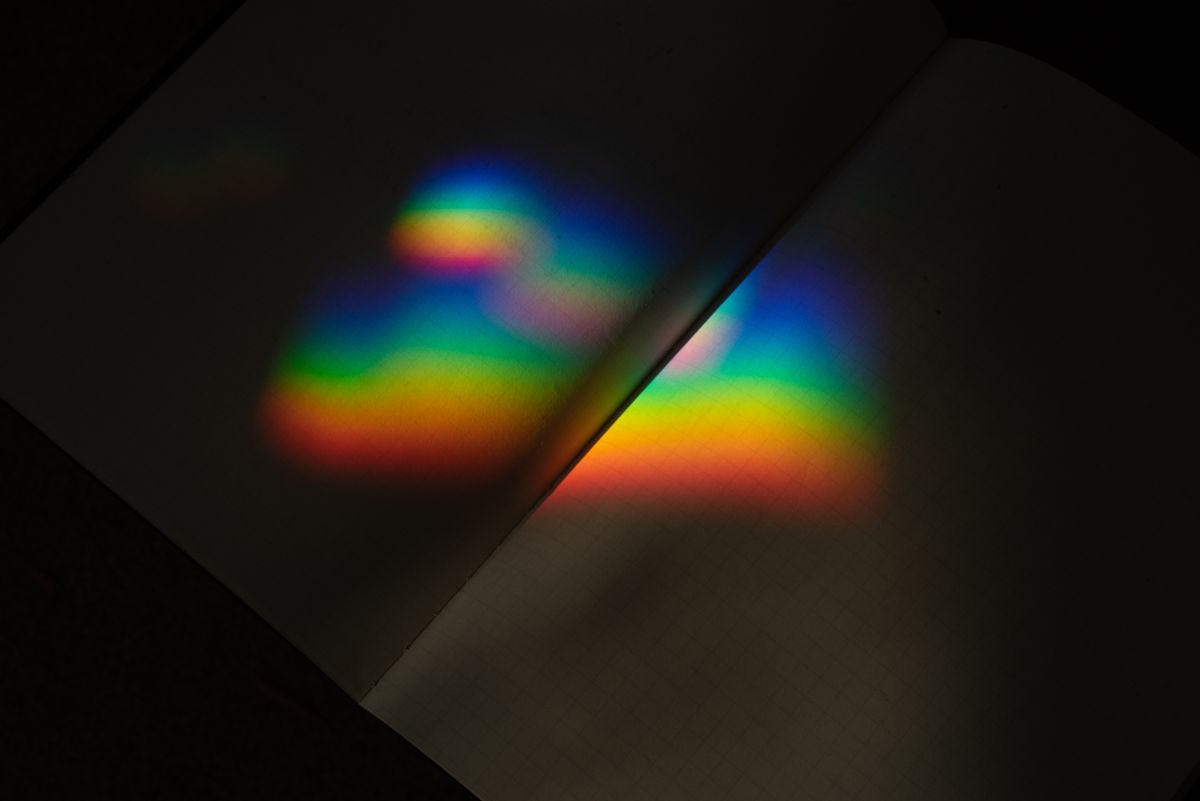
The angle of refraction is the angle between the refracted ray and the normal line at the point where light crosses from one material into another. It tells you exactly which direction the light travels after it bends, and you calculate it using Snell's law: n₁ sin θ₁ = n₂ sin θ₂. Here's the full breakdown — from the formula to three step-by-step examples you can work through yourself.
What is the angle of refraction?
When a ray of light hits the boundary between two transparent materials — say, air and water — part of it passes through and changes direction. Draw an imaginary normal line perpendicular to the surface at the point of impact. The angle of refraction (written θ₂ or θ_r) is the angle between that normal and the ray inside the new medium.
The angle you start with, measured between the incoming ray and the normal, is the angle of incidence (θ₁). The relationship between the two is not a simple proportion. It follows a precise mathematical rule discovered in the 10th century by the Persian scientist Ibn Sahl and later formalised by the Dutch mathematician Willebrord Snell in 1621.
Here's the key point: if the light is slowing down (entering a denser medium like water or glass), the angle of refraction is smaller than the angle of incidence — the ray bends toward the normal. If it's speeding up (exiting into a less dense medium like air), the angle of refraction is larger — it bends away. The OpenStax College Physics chapter on refraction covers this rule in detail with clear diagrams.
Snell's law: the formula behind the angle of refraction
The equation that links both angles and both materials is Snell's law:
n₁ sin θ₁ = n₂ sin θ₂
Where:
- n₁ = refractive index of the first medium (where the light starts)
- θ₁ = angle of incidence (in the first medium, from the normal)
- n₂ = refractive index of the second medium (where the light enters)
- θ₂ = angle of refraction (in the second medium, from the normal)
The refractive index of a material tells you how much it slows light. In a vacuum it's exactly 1. In air it's about 1.0003 (close enough to 1 for most calculations). In water it's 1.333 — light drops from 299,792,458 m/s to about 225,000 km/s. In crown glass it's 1.52 — down to about 197,000 km/s.
Think of it like a car rolling from smooth tarmac onto sand at an angle. The wheel that reaches the sand first slows first, so the whole car pivots toward that side. That's exactly what light does: the part of the wavefront entering the slower medium first slows first, and the beam turns. The equation above is the precise mathematical version of that picture. (The car analogy is great for the geometry, but it breaks down if you think light is "dragged" — it's actually the wave re-radiating inside the material.)
How to calculate the angle of refraction: 3 simple steps
To find the angle of refraction, rearrange Snell's law to solve for θ₂:
sin θ₂ = (n₁ / n₂) × sin θ₁
Then take the inverse sine (sin⁻¹ or arcsin) of both sides.
Step 1: Identify n₁ and n₂. Look up the refractive indices of both media.
Step 2: Identify θ₁ — the angle of incidence, measured from the normal.
Step 3: Plug into the formula: θ₂ = sin⁻¹( (n₁/n₂) × sin θ₁ ).
That's it. Let's run it with real numbers.
Three worked examples
Example 1: Air to Water (30° incidence)
Light hits a still pool at 30° from the normal. Air n₁ ≈ 1.0003, water n₂ = 1.333.
sin θ₂ = (1.0003 / 1.333) × sin(30°) = 0.750 × 0.500 = 0.375
θ₂ = sin⁻¹(0.375) = 22.0°
The ray bends from 30° down to 22° — a noticeable 8° shift toward the normal. This is why a straw looks bent in a glass of water. (The Wikipedia page on Snell's law traces this same calculation back to the 1621 derivation.)
Example 2: Air to Crown Glass (45° incidence)
Light enters a glass window pane at 45°. Air n₁ ≈ 1.0003, crown glass n₂ = 1.52.
sin θ₂ = (1.0003 / 1.52) × sin(45°) = 0.658 × 0.707 = 0.465
θ₂ = sin⁻¹(0.465) = 27.7°
The bend is larger here — 17.3° — because glass slows light more than water. This is why thick glass bends light enough to distort the view behind it.
Example 3: Water to Crown Glass (35° incidence)
Light travels from water into a glass aquarium wall at 35°. Water n₁ = 1.333, crown glass n₂ = 1.52.
sin θ₂ = (1.333 / 1.52) × sin(35°) = 0.877 × 0.574 = 0.503
θ₂ = sin⁻¹(0.503) = 30.2°
The bend is modest — only 4.8° — because the speed change from water to glass is smaller. This shows that the angle of refraction depends on the ratio of the two indices, not just the second material alone.
Here's a quick reference table for common combinations at a 30° angle of incidence:
| From medium | To medium | n₁ → n₂ | Angle of refraction |
|---|---|---|---|
| Air (1.0003) | Water (1.333) | 1.00 → 1.33 | 22.0° |
| Air (1.0003) | Crown glass (1.52) | 1.00 → 1.52 | 19.2° |
| Air (1.0003) | Diamond (2.417) | 1.00 → 2.42 | 12.0° |
| Water (1.333) | Crown glass (1.52) | 1.33 → 1.52 | 26.1° |
| Crown glass (1.52) | Air (1.0003) | 1.52 → 1.00 | 49.5° (bends away) |
The last row shows a case where the angle of refraction is larger than the angle of incidence — light speeds up exiting glass into air.
What affects the angle of refraction?
Two factors determine how much light bends.
The material pair. The bigger the ratio n₁/n₂, the larger the bend. Going from air into diamond (ratio 1:2.42) bends light far more than from water into glass (ratio 1.33:1.52). Every material pair has its own signature.
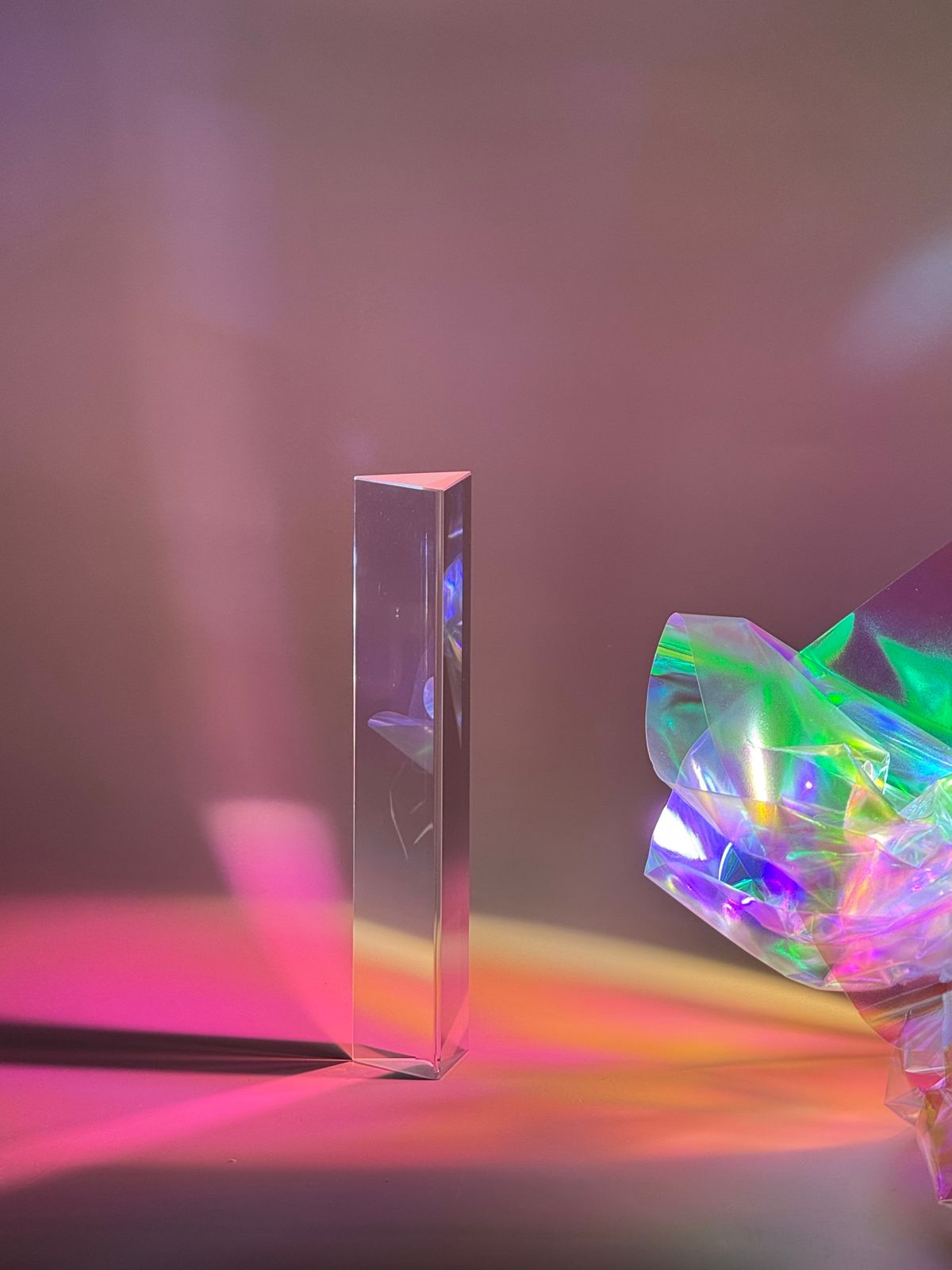
The wavelength of light. This is where it gets interesting. Blue light (shorter wavelength, around 450 nm) has a slightly higher refractive index in glass than red light (longer wavelength, around 650 nm). For crown glass, the difference is small — roughly 1.530 for violet versus 1.512 for red — but it's enough that a prism can separate white light into a full spectrum. This is called dispersion, and it's the reason refraction through a prism produces rainbows.
The frequency of the light does not change when it crosses a boundary — what changes is the wavelength. Shorter wavelengths interact more strongly with the electrons in the material, which is why they slow more and bend more.
Where you see this in real life
Every time you put on glasses, take a photo, or look through a microscope, you're relying on someone having calculated the angle of refraction correctly.
Eyeglasses and contact lenses use curved surfaces to bend light by specific amounts, focusing it onto your retina. The lensmaker's equation starts with Snell's law at each surface.
Camera lenses are assemblies of up to 20 glass elements, each one carefully chosen and shaped so that the combined angle of refraction at every surface produces a sharp image on the sensor. The what causes refraction page walks through the physics behind each of those bends.
Fibre optics use the angle of refraction in reverse — past a certain steep angle, light can't exit the glass core at all and reflects internally instead. That's total internal reflection, and it's the principle that carries internet data across oceans.
Rainbows are just sunlight hitting millions of water droplets, with each droplet acting like a tiny prism. The different angles of refraction for red and blue create the arc. The deeper physics behind refraction of light in water explains exactly why the red band sits at 42° and the violet at 40°.
A common misconception is that the light slows because it bumps into atoms like billiard balls. That's not right — bouncing would scatter the light randomly. What actually happens is the light wave drives the electrons in the material, those electrons re-radiate their own waves, and the combined wave propagates more slowly. It's cleaner, and it explains why the beam stays coherent instead of spraying everywhere.
Frequently Asked Questions
What is Snell's law in simple terms?
Snell's law says that when light passes from one material into another, the ratio of the sines of the angles equals the inverse ratio of the speeds. In simpler terms, n1 sin θ1 = n2 sin θ2, where n is the refractive index and θ is the angle from the normal. It tells you exactly how much light will bend.
How do you calculate the angle of refraction?
Use Snell's law: n1 sin θ1 = n2 sin θ2. Rearrange to get sin θ2 = (n1/n2) × sin θ1, then take the inverse sine. For example, light entering water from air at 30°: sin θ2 = (1.0003/1.333) × sin(30°) = 0.375, so θ2 = sin⁻¹(0.375) = 22.0°.
What is the angle of refraction?
The angle of refraction is the angle between the refracted ray (the light after it crosses the boundary) and the normal line (an imaginary line perpendicular to the surface). It tells you the direction the light travels inside the new material.
What happens to the angle of refraction when the angle of incidence increases?
The angle of refraction increases too, but not by the same amount. The relationship is nonlinear because it follows Snell's law with sines. For example, doubling the incident angle from 30° to 60° in air-to-water changes the refraction angle from 22.0° to 40.5°, less than double.
How does wavelength affect the angle of refraction?
Shorter wavelengths (blue/violet) have a slightly higher refractive index in most materials than longer wavelengths (red). So blue light bends more, which is why a prism splits white light — each colour has a different angle of refraction. This is called dispersion.
What is the difference between angle of incidence and angle of refraction?
The angle of incidence is measured in the first medium before the light crosses the boundary. The angle of refraction is measured in the second medium after it crosses. They are related by Snell's law: n1 sin θ1 = n2 sin θ2. If the new medium is slower, the angle of refraction is smaller.

About Umar Farooq
Umar Farooq writes in-depth guides on the physics of light and optics — from reflection, refraction, and lenses to diffraction, lasers, and fiber optics, explained from first principles.
Read more about Umar Farooq →