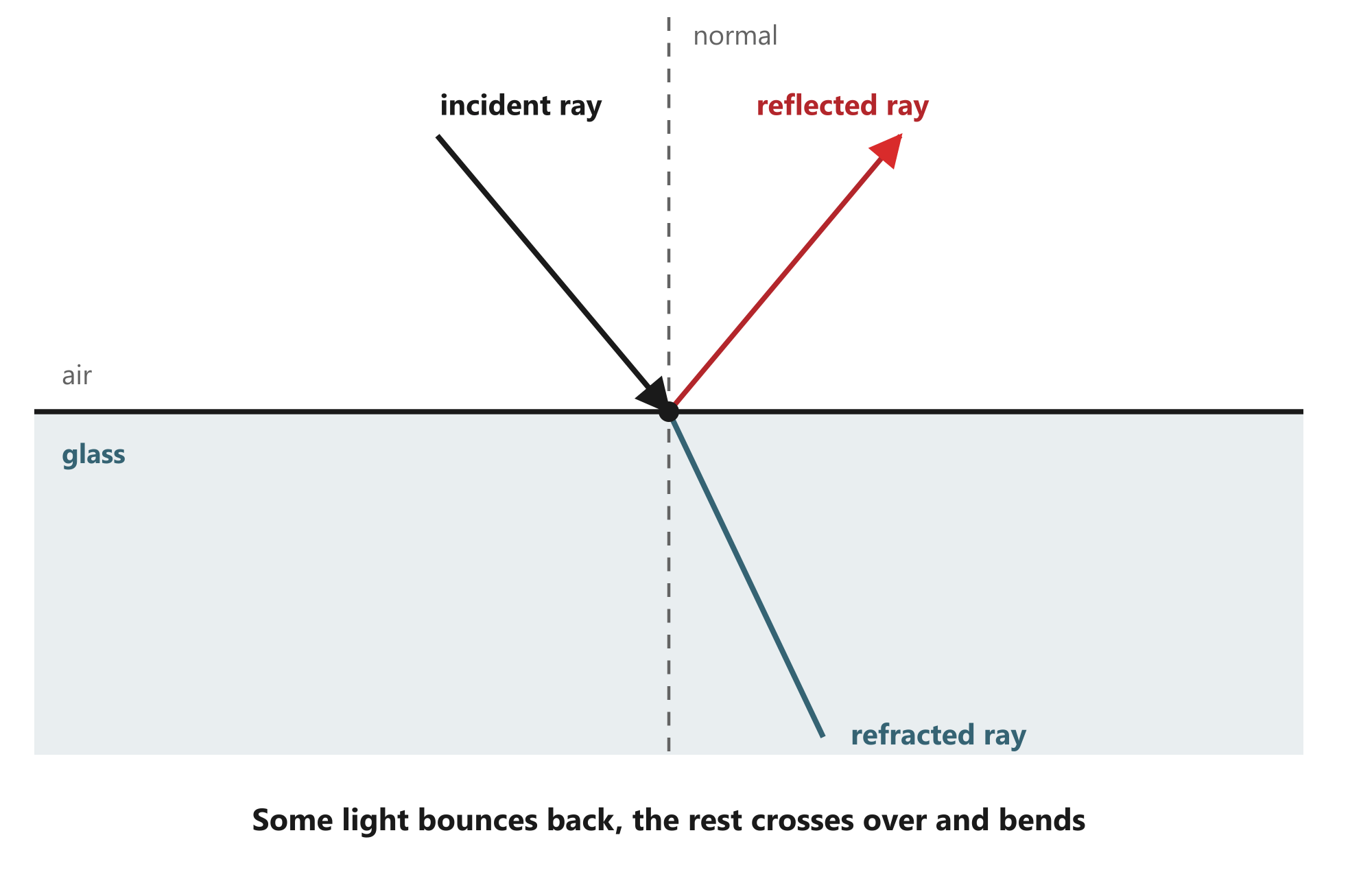
A refracted ray is the bent path light takes after crossing from one medium into another. Every time light moves from, say, air into water or glass into air, the ray changes direction at the boundary. That redirected ray is called the refracted ray. It is one of three key rays you need to label in any refraction diagram — the other two being the incident ray (arriving) and the reflected ray (bouncing off). Here is the difference between them, plus how to draw one in 4 simple steps.
What is a refracted ray?
A refracted ray is the ray of light on the far side of a boundary between two different media. It has changed direction because the light changed speed when crossing the boundary.
Picture a car rolling off smooth tarmac onto sand at an angle. The wheel that reaches the sand first slows first, so the whole car pivots toward the sand side. Light does the same thing. The part of the wavefront that enters the new medium first changes speed first, and the beam bends. The ray on the other side — the bent one — is the refracted ray.
The exact amount of bending follows Snell's law: n₁ sin θ₁ = n₂ sin θ₂, where n is the refractive index of each medium.
The three rays in a refraction diagram
Every refraction diagram has three rays, and knowing which is which is half the battle.
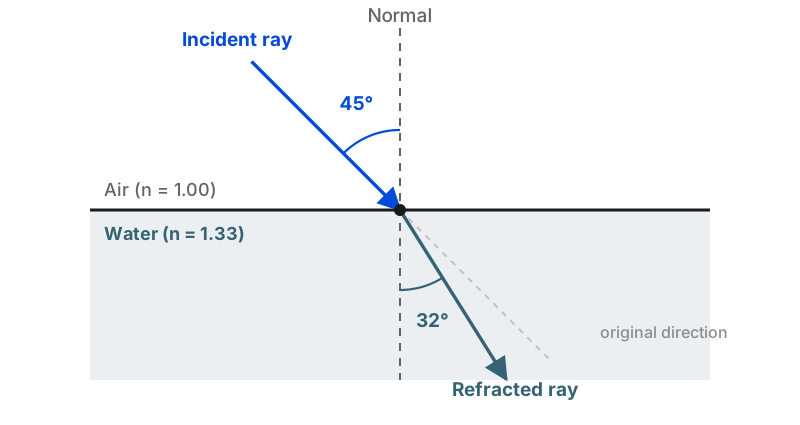
The incident ray approaches the boundary from the first medium. It travels in a straight line until it reaches the surface. The angle between the incident ray and the normal (the dashed line perpendicular to the surface) is the angle of incidence, θ₁.
The reflected ray bounces off the boundary and stays in the first medium. It obeys the law of reflection: the angle of reflection equals the angle of incidence. Some light always reflects, even from transparent surfaces.
The refracted ray passes through the boundary into the second medium. It is the ray that changes direction — the one that bends. The angle between it and the normal is the angle of refraction, θ₂.
If the second medium is denser (higher refractive index), the ray bends toward the normal, so θ₂ < θ₁. If the second medium is rarer (lower refractive index), it bends away from the normal, so θ₂ > θ₁.

How to draw a refracted ray: 4 simple steps
Drawing the ray on a diagram is straightforward once you know the rules. Here is the step-by-step method.
Step 1: Draw the boundary and the normal
Start with a straight horizontal or angled line representing the surface between the two media. Label each side with the medium name — "Air" on top, "Water" below, for example. Draw a dashed line perpendicular to the boundary at the point where the light hits. This is the normal.
Step 2: Draw the incident ray
Draw a straight arrow approaching the boundary at an angle. Label it "incident ray" and mark the angle between it and the normal as θ₁ (angle of incidence).
Step 3: Decide which way the ray bends
This depends on the media. For light going from air (index 1.0003) into water (1.333), the second medium is denser, so the ray bends toward the normal. For light going from water into air, it bends away from the normal.
Step 4: Draw it
On the far side of the boundary, draw a straight arrow continuing from the point of impact. If the light entered a denser medium, angle the arrow closer to the normal than the incident ray. If it entered a rarer medium, angle it farther away. Label this arrow "refracted ray" and mark the angle between it and the normal as θ₂ (angle of refraction).
Don't forget the reflected ray — draw a third arrow on the same side as the incident ray, at the same angle to the normal. The Physics Classroom refraction tutorial shows worked examples of these diagrams.
What is wave refraction?
Wave refraction is the same phenomenon applied to waves other than light. Any wave — sound, water, seismic — bends when its speed changes across a boundary or gradient.
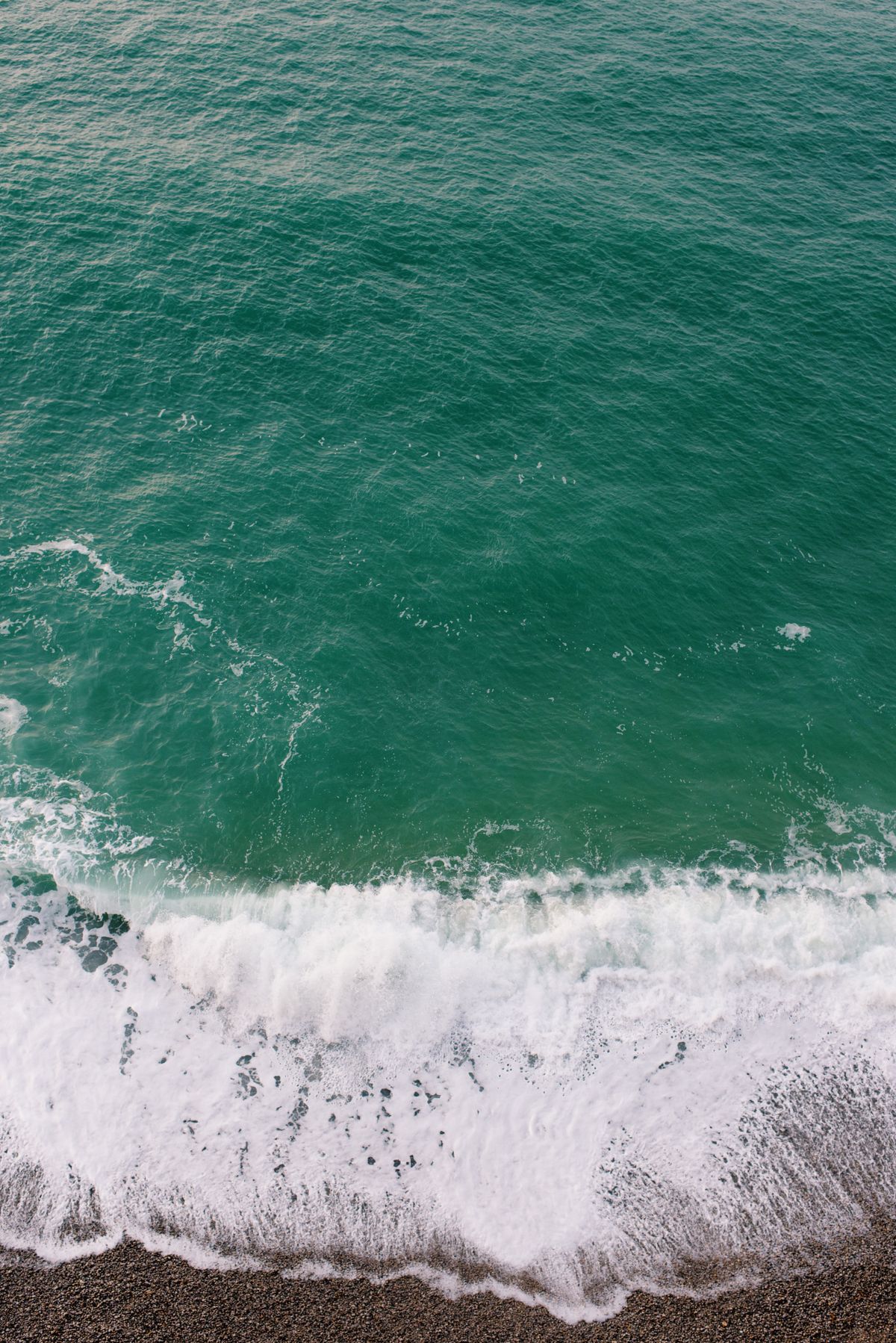
Ocean waves approaching a beach at an angle slow down in the shallower water first. The part of the wavefront nearest the shore slows before the part farther out, so the wave swings around to become more parallel to the beach. The same physics as light, just with water instead of glass.
Sound waves refract through layers of air at different temperatures. On a cool night over a lake, sound travels upward into warmer air and bends back down, which is why voices carry farther across water after dark. Britannica's entry on refraction has more on how these different wave types behave.
For light, refraction occurs when the wave crosses a boundary between two media with different refractive indices. If the ray hits at an angle, the ray bends — that bend is refraction. If it hits straight on (along the normal), no bending occurs and the ray passes straight through.
What happens to the refracted ray in different media?
The behaviour of the ray depends on how the two media compare. Here are the three main cases.
Light from air to a denser medium (glass, water, diamond)
The light slows down. The ray bends toward the normal. For example, from air to water (index 1.333), an incident angle of 30° produces a refracted angle of about 22°.
Light from a denser medium to air
The light speeds up. The refracted ray bends away from the normal. From water to air at 30° incidence, the refracted angle is about 42°. Beyond a certain angle — the critical angle — no refraction occurs at all. The light reflects entirely back into the water. This is total internal reflection, and it happens because the refracted ray cannot bend away from the normal past 90°.
Light between media with the same refractive index
No bending occurs. The ray passes straight through as if the boundary did not exist. Identical media mean identical wave speeds, so there is no speed change and therefore no refraction.
Common misconception about refracted rays
A widespread mistake is thinking that the refracted ray "curves" gradually through the medium, like a bending hose. It does not. The light travels in straight lines within each medium. The direction change happens only at the exact point where the ray meets the boundary — nothing else.
Another confusion is calling any bent-looking object underwater a ray. The bent straw in a glass of water is not itself a ray; it is an object viewed through one. The light leaving the submerged straw refracts at the water surface before reaching your eye, tricking your brain into seeing the straw in the wrong position. The ray is the invisible path the light follows; the apparent bend of the straw is the result.
For a deeper look at the calculations that predict exactly where a refracted ray will go, our guide to Snell's law and the angle of refraction has step-by-step worked examples. If you want to understand the mechanism behind why it bends at all, start with what causes refraction. And for the broader context of how this fits with other wave behaviours, see reflection vs refraction.
Summary
| Ray | Location | Direction |
|---|---|---|
| Incident ray | Approaches the boundary in the first medium | Straight until the surface |
| Reflected ray | Leaves the boundary in the first medium | Bounces off at the same angle |
| Refracted ray | Leaves the boundary in the second medium | Bends toward or away from the normal |
Wave refraction describes the same bending for any wave type — light, sound, or water — whenever a speed change across a boundary redirects the wavefront. The ray that results — bent toward or away from the normal — is the refracted ray.
Frequently Asked Questions
What is a refracted ray?
A refracted ray is the ray of light that has passed from one transparent medium into another and changed direction due to the change in speed. It appears on the opposite side of the boundary from the incident ray. If the second medium is denser, the refracted ray bends toward the normal; if rarer, it bends away.
How does a refracted ray differ from an incident ray?
An incident ray approaches the boundary before refraction occurs. A refracted ray is the same light after it has crossed the boundary and changed direction. The incident ray is in the first medium; the refracted ray is in the second medium. The angle between each ray and the normal is related by Snell's law.
What is wave refraction?
Wave refraction is the bending of any wave — not just light — when it enters a different medium or zone where its speed changes. Ocean waves refract as they approach shore because the shallower water slows them. Sound waves refract through temperature layers in the air. The principle is the same: a speed change at an angle causes the wave to turn.
What happens to a refracted ray when light enters a denser medium?
When light passes from a less dense to a denser medium (like air to water), the refracted ray bends toward the normal line. The angle of refraction is smaller than the angle of incidence. The light also slows down and its wavelength shortens, but its frequency stays the same.
When does refraction occur?
Refraction occurs whenever a wave passes from one medium into another and the wave speed differs between the two media. If the wave hits the boundary straight on (perpendicular), it passes through without bending — the speed still changes but the direction does not. Refraction requires both a speed change and an angled approach.
What is the difference between a refracted ray and a reflected ray?
A reflected ray bounces off the boundary and stays in the original medium. A refracted ray passes through the boundary and enters the second medium. The reflected ray obeys the law of reflection (angle of incidence equals angle of reflection). The refracted ray obeys Snell's law.
Can a refracted ray and a reflected ray exist at the same time?
Yes. When light hits a boundary, some of it is reflected and some is transmitted (refracted). At any transparent boundary, there is both a reflected ray and a refracted ray. The relative amounts depend on the angle of incidence and the refractive indices of the two media.

About Umar Farooq
Umar Farooq writes in-depth guides on the physics of light and optics — from reflection, refraction, and lenses to diffraction, lasers, and fiber optics, explained from first principles.
Read more about Umar Farooq →