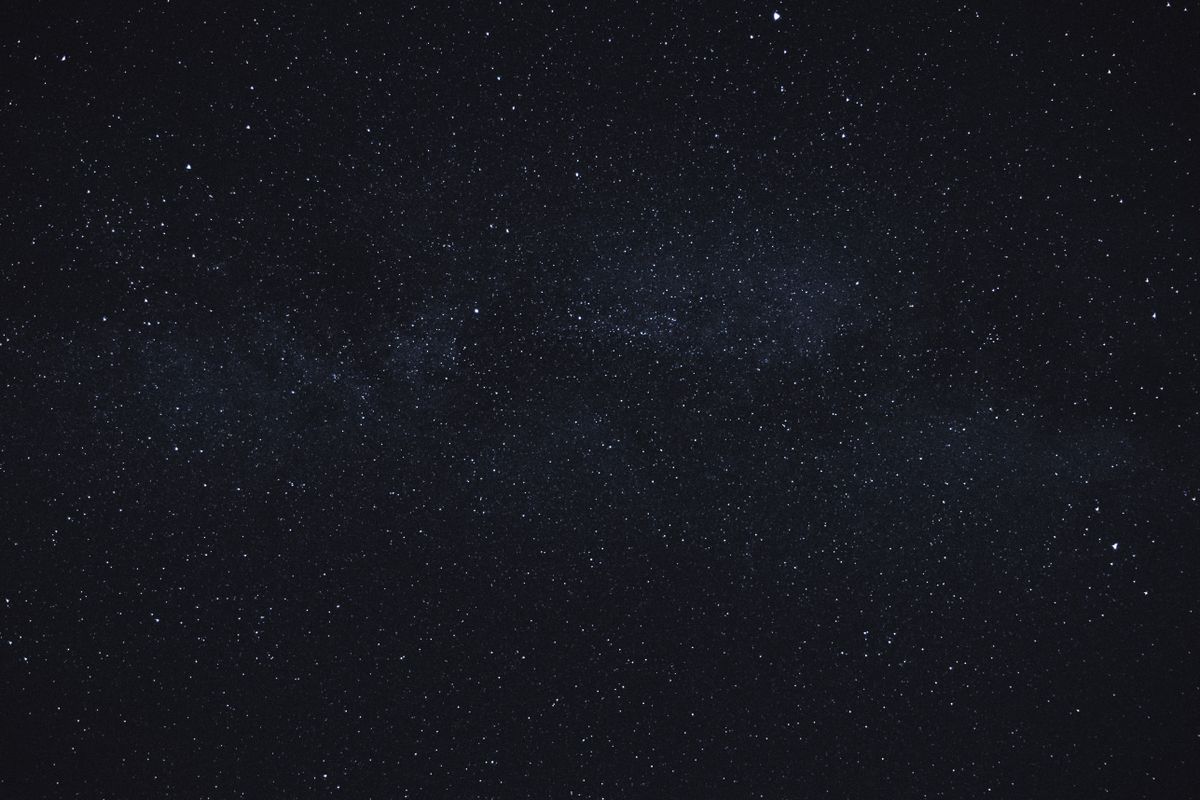
Refraction at night is the bending of starlight as it passes through Earth's atmosphere. The air is not a uniform blanket — pockets of hot and cold air with different densities each bend the light by a tiny amount. Above your head on a clear night, hundreds of these shifting layers are at work, each redirecting starlight like an invisible lens. The result is the shimmering, twinkling, ever-changing night sky you see with your own eyes.
Here are the 5 easy ways the atmosphere tricks your eyes after dark.
What is refraction at night?
Refraction at night is the same physics as a straw looking bent in a glass of water: light changes direction when it crosses a boundary between two different materials. Here, the "materials" are layers of air at different temperatures and densities.
Think of it like this. Picture a car rolling from smooth tarmac onto sand at an angle. The wheel that hits the sand first slows first, so the car pivots toward the sand side. Starlight does the same thing as it enters the atmosphere: the part of the wavefront that reaches denser air first slows first, so the beam bends. The denser the air, the more the light bends toward the perpendicular — and since the atmosphere gets denser all the way down to sea level, the light curves gradually, not in a single snap. Our guide to what causes refraction covers the mechanism from first principles.
The name for this is atmospheric refraction (or astronomical refraction when the light comes from space). It is why the sky does not look the same to an astronaut as it does to you — and why the stars you see are never quite where they truly are.
1. Why stars twinkle
The most familiar effect of refraction at night is the twinkling of stars. Astronomers call it stellar scintillation, and it is the direct result of light passing through restless air.
Here is what happens. A star is so far away that it acts as a point source — effectively a single dot of light. That single beam enters the atmosphere and passes through dozens of turbulent layers, each with its own temperature and density. Each layer bends the light by a slightly different amount. Because the air is never still (wind, convection, and temperature fluctuations keep it churning), the bending changes from millisecond to millisecond. Your eye sees this as a rapid fluctuation in brightness and position — a twinkle.
Stars near the horizon twinkle more than stars overhead. The reason is simple: light from a low star travels through much more atmosphere — roughly 40 times more air mass than a star at the zenith. More air means more turbulence, so the twinkling is stronger.
2. Why planets do not twinkle
If stars twinkle, why does Venus or Jupiter shine steadily? The answer is the size of the source.
A planet is close enough that it appears as a tiny disc, not a point. Light from different parts of that disc travels through slightly different paths in the atmosphere. The random fluctuations from each part average out, so the overall brightness stays steady. Jupiter's disc, for example, is about 40 arcseconds across — small to the naked eye, but still hundreds of times wider than the atmospheric turbulence cells that cause twinkling.
Think of it like a coin and a dinner plate at the bottom of a rippling pool. The coin shimmers and dances because the ripples cover its whole surface. The dinner plate barely seems to move — the ripples affecting one edge cancel those affecting the other. A star is the coin, and a planet is the plate. This point-versus-extended-source difference is why planets make good targets for steady telescopic observation, while stars are best studied with adaptive optics or from space.
3. The flattened Sun and the stretched Moon
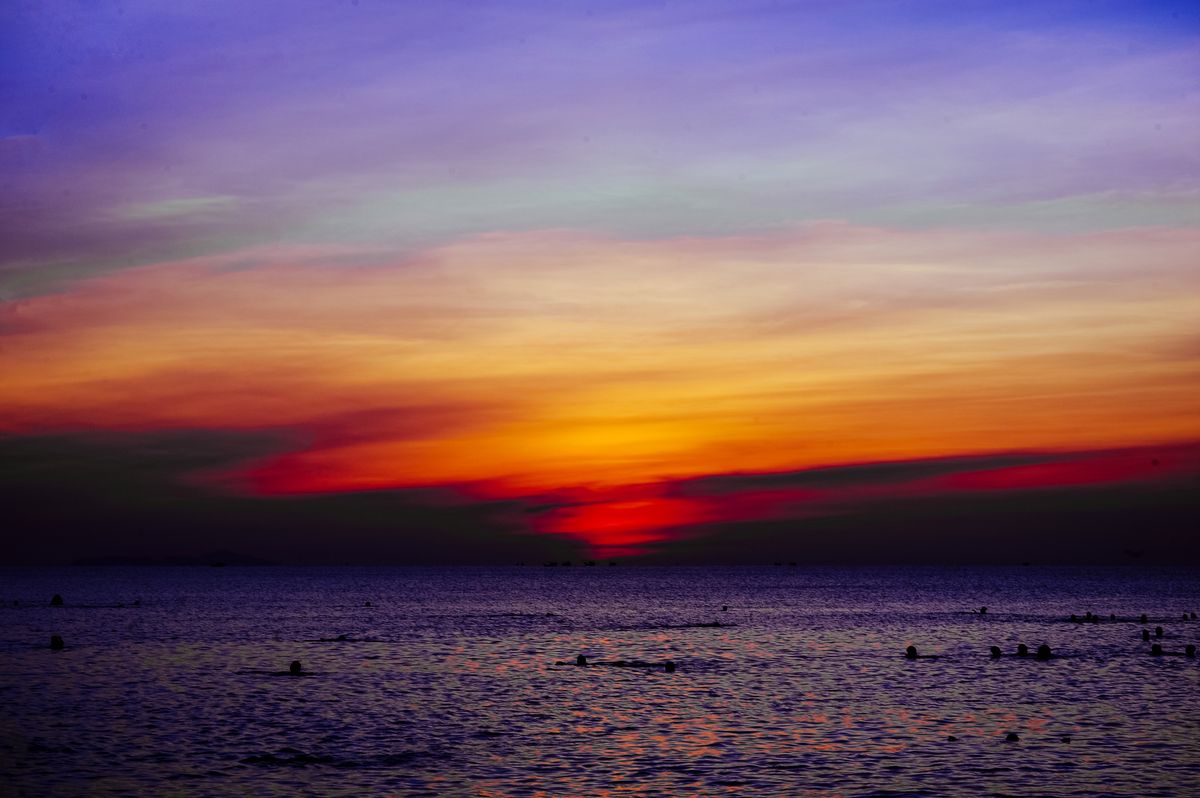
At sunrise and sunset, refraction at night (or, more precisely, atmospheric refraction) does something dramatic: it squashes the Sun into an oval.
The Sun's bottom edge, sitting right at the horizon, is refracted by about 34 arcminutes upward. The top edge, just above the horizon, is refracted by only about 29 arcminutes. That 5-arcminute difference — roughly one-sixth of the Sun's diameter — compresses the vertical axis. The result is the familiar flattened oval shape you see just before sunset.
The same effect happens with the Moon. When the full Moon rises over the horizon, it too looks stretched horizontally and squashed vertically. The effect is strongest when the Moon is nearest the horizon and fades as it climbs higher.
Sometimes, just as the Sun's last sliver disappears below the horizon, a brief flash of green appears. This is the green flash — a consequence of atmospheric refraction splitting the Sun's light by colour, just like a prism. Blue and green light bend more than red, so for a split second the green rim of the Sun is visible after the red has set.
4. Why the day is longer than you think
Here is a surprising consequence of refraction at night: sunrise happens earlier than it should, and sunset later. Refraction at night bends the Sun's light over the horizon even when the Sun itself is below it, extending the visible day.
At the horizon, atmospheric refraction lifts the Sun's image by about 34 arcminutes — more than the Sun's own diameter of 32 arcminutes. This means the Sun becomes visible several minutes before it has geometrically risen and stays visible several minutes after it has geometrically set. The exact extra time depends on your latitude and the season, but the practical upshot is that daytime is a few minutes longer than night at the equinoxes, contrary to what many people believe.
The same effect lets you see the Sun when it is technically below the horizon. Ernest Shackleton, stranded in Antarctica during his Endurance expedition, recorded the Sun appearing when it should have been 2°37′ below the horizon — an extreme case of refraction caused by the very cold, very dense air near the ice.
Temperature and pressure affect how much refraction happens. Lower temperature and higher pressure both increase the density of the air, and therefore increase the bending. Humid air also refracts slightly more than dry air. On a warm, humid summer evening, sunrise and sunset can drift by seconds compared with a crisp winter morning. The timeanddate.com guide to atmospheric refraction has worked examples of how this shifts the day length.
5. Practical tips for stargazers
Understanding refraction at night helps you get better views of the sky. The same atmospheric layers that create beautiful twinkling also degrade telescopic images, so knowing how refraction at night works lets you pick the best observing conditions.
Observe when objects are high. Refraction at night is weakest at the zenith and strongest near the horizon. A star at 45° altitude is shifted by less than 1 arcminute; one at 10° altitude is shifted by over 5 arcminutes. The lower the object, the more its light is distorted. Telescopic observers call this "bad seeing" — the image shimmers and blurs. Professional observatories schedule their most important observations when targets are highest in the sky, and sailors traditionally avoid shooting stars below 20° above the horizon for navigation.
Mountaintops help. Observatories are built on high, dry mountains for a reason. The thinner air above a mountain top means less atmosphere for starlight to travel through, which means less turbulence and sharper images. Mauna Kea in Hawaii (4,200 m) and the Atacama desert in Chile (5,000 m) are among the best observing sites on Earth precisely because the air above them is thin and stable. The reduction in refraction at night is one of the key advantages of high-altitude astronomy.
Use the steady planets. On nights when the stars are twinkling strongly (poor seeing), switch your telescope to a planet. Planets do not twinkle, and their extended discs are less affected by atmospheric turbulence. Venus, Jupiter, and Saturn can look crisp even when the stars around them are dancing.
Wikipedia's atmospheric refraction entry has the full mathematical treatment, including the formulas used to calculate refraction at any altitude.
Summary
| Effect | Cause | When it matters most |
|---|---|---|
| Stars twinkle | Point-source light through turbulent air layers | Nights with strong wind shear or temperature gradients |
| Planets stay steady | Extended disc averages out fluctuations | Always — planets are reliable targets |
| Sun/Moon flatten at horizon | Differential refraction across the disc | Sunrise and sunset |
| Day is longer than 12h at equinox | Refraction lifts the Sun above its true position | March and September equinoxes |
| Bad seeing for telescopes | Rapid refraction fluctuations blur the image | When objects are low in the sky |
Refraction at night is not an abstract physics idea — it is something you can see every clear evening. The twinkling star, the flattened sunset, the extra minutes of daylight — all of them are the same mechanism at work: light bending through a restless atmosphere. Our refraction examples page has more everyday situations where this effect shows up, and the Snell's law calculator lets you work out the exact angles yourself.
Frequently Asked Questions
What is refraction at night?
Refraction at night is the bending of starlight as it passes through Earth's atmosphere. The air has layers of different temperature and density, and each layer bends the light by a slightly different amount. This causes stars to appear to twinkle, shifts the apparent position of celestial objects, and flattens the Sun at sunrise and sunset.
Why do stars twinkle?
Stars twinkle because of atmospheric refraction. As starlight passes through turbulent air layers of different density, each layer bends the light slightly. Since a star is a point source (effectively a single point of light), these small shifts translate directly into visible changes in brightness and position. The effect is called stellar scintillation.
Why do planets not twinkle?
Planets do not twinkle because they appear as extended discs, not point sources. Light from different parts of a planet's disc travels through separate atmospheric paths, and the random fluctuations average out. The result is a steady, non-twinkling image. This is the same reason a coin at the bottom of a pool shimmers while a dinner plate stays still.
Does atmospheric refraction affect sunrise and sunset times?
Yes. Atmospheric refraction lifts the Sun's image by about 34 arcminutes at the horizon — more than the Sun's own apparent diameter (about 32 arcminutes). This means the Sun appears above the horizon several minutes before it geometrically rises and stays visible several minutes after it geometrically sets. Daytime is therefore a few minutes longer than night at the equinoxes.
Why does the Sun look flattened at sunset?
The Sun looks flattened at sunset because the lower edge of the Sun is refracted more than the upper edge. At the horizon, the bottom of the Sun is lifted by about 34 arcminutes while the top is lifted by about 29 arcminutes. This difference of 5 arcminutes (about one-sixth of the Sun's diameter) squashes the disc into an oval shape.
What is the difference between astronomical and terrestrial refraction?
Astronomical refraction (also called atmospheric refraction) bends light from celestial objects like stars, the Sun and the Moon as it enters Earth's atmosphere from space. Terrestrial refraction bends light from objects on Earth, such as distant mountains, and depends heavily on the temperature gradient near the ground. Both follow the same physics but apply to different sources.
How much does atmospheric refraction bend starlight?
Atmospheric refraction is zero at the zenith (directly overhead), less than 1 arcminute at 45° altitude, about 5.3 arcminutes at 10° altitude, and about 35.4 arcminutes right at the horizon. The exact amount depends on air temperature, pressure, and humidity. Lower temperatures and higher pressure increase refraction.

About Umar Farooq
Umar Farooq writes in-depth guides on the physics of light and optics — from reflection, refraction, and lenses to diffraction, lasers, and fiber optics, explained from first principles.
Read more about Umar Farooq →