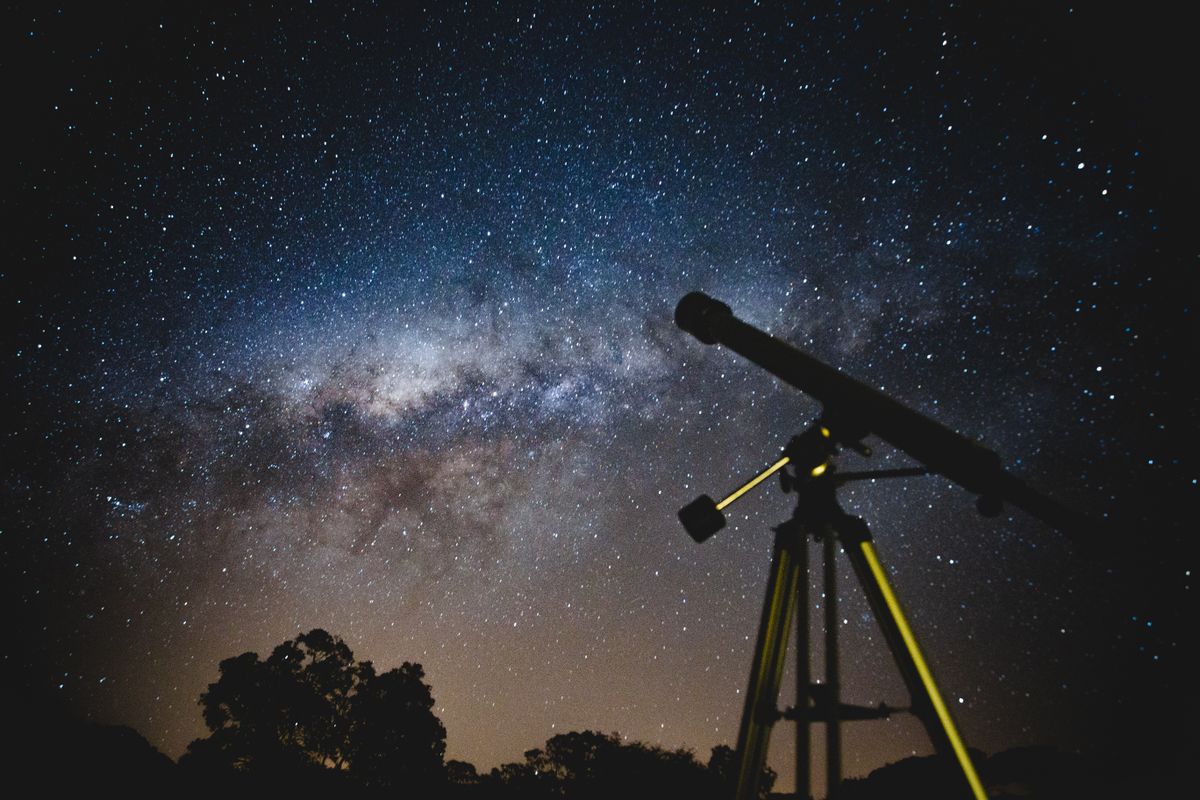
The opposite of a telescope depends on which meaning you use. As an optical instrument, the opposite of a telescope is a microscope — one zooms in on the cosmos, the other zooms in on the microscopic world. As a verb meaning to compress or condense, the opposite is expand, extend, or unfold. The word "telescope" has two distinct lives, and each has its own opposite.
Here is what we cover: the two meanings of telescope, why a microscope is its optical opposite, the verb opposites, other optical opposites in physics, and the fascinating history that connects them all.
The Opposite of a Telescope as an Instrument: The Microscope
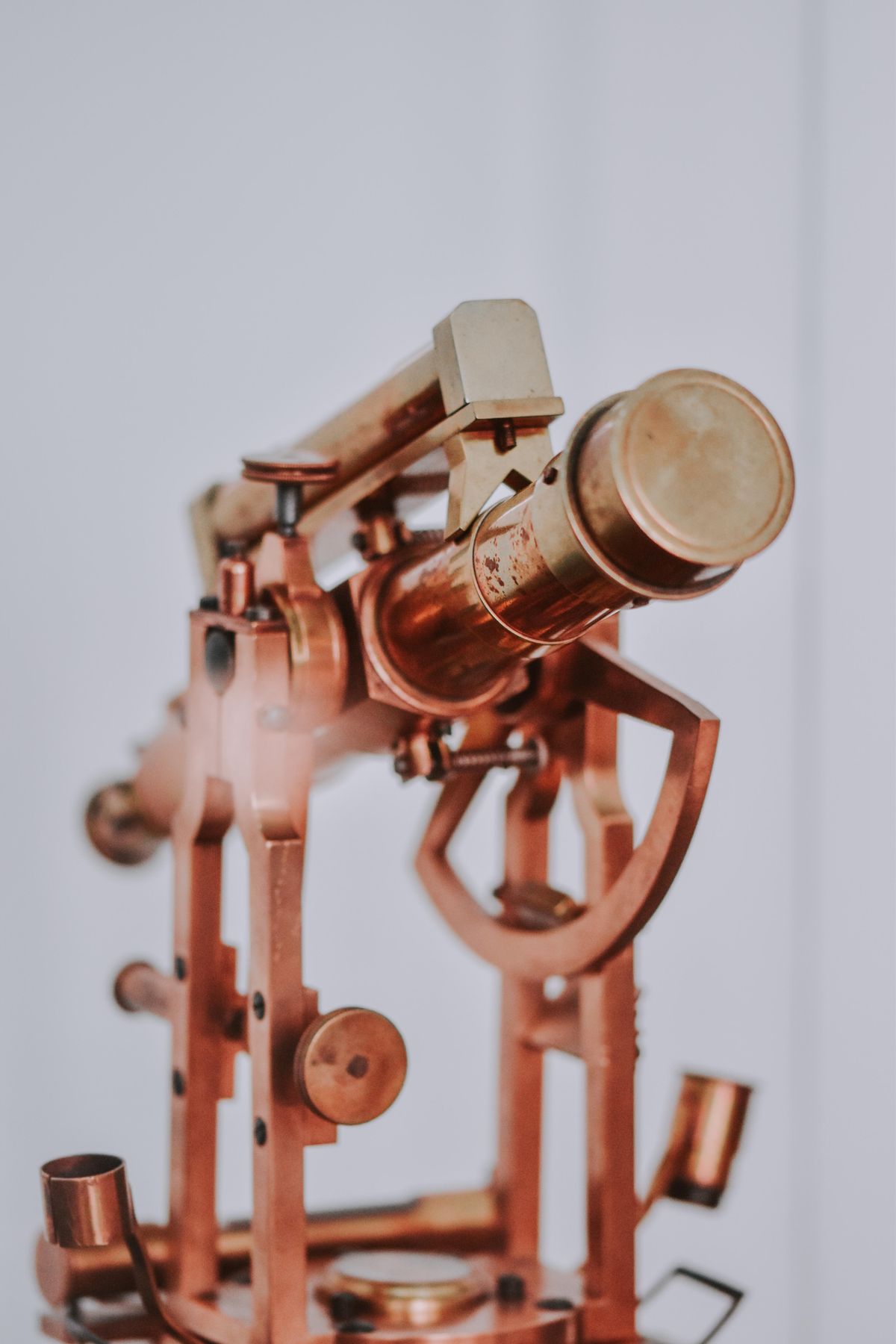
A telescope and a microscope are like looking through the same door from opposite sides. One brings the far-away world close; the other brings the tiny world large. Both use lenses to bend light, but they are engineered for opposite ends of the size spectrum.
| Feature | Telescope | Microscope |
|---|---|---|
| What it sees | Distant objects (stars, planets) | Tiny objects (cells, bacteria) |
| Focal length | Long (often 500–2000 mm) | Short (typically 4–45 mm) |
| Aperture | Large (gathers light) | Small (focuses light) |
| Light source | External (sun, stars) | Built-in (LED, halogen) |
| Magnification | 20× to 300× typical | 40× to 1500× typical |
| Image orientation | Inverted (no problem in space) | Upright (prisms correct it) |
The physics is the same — Snell's law of refraction through lenses — but the design goals are opposite. A telescope uses a large objective to catch as many photons as possible from a faint, distant source. A microscope uses a high-power objective with short focal length to resolve the finest details of a tiny, close-up specimen.
This is why you cannot swap one for the other. A telescope cannot focus on something centimetres away, and a microscope lacks the aperture to gather light from a star.
The Opposite of Telescope as a Verb: Expand, Extend, Unfold
The word "telescope" has a second life as a verb. When something telescopes, it compresses or condenses — like a collapsible telescope sliding into itself. The meaning comes directly from the instrument: a telescope's tube sections slide together to make it shorter.
As a verb, telescope means to:
- Compress — "The film telescopes years into minutes"
- Condense — "The report telescopes the findings into a few paragraphs"
- Collapse — "The car telescoped on impact, crumpling the front end"
The antonyms are every word about making things larger or longer:
- Expand, extend, unfold, lengthen, elongate
- Open, spread, decompress, dilate, outspread
The Merriam-Webster Thesaurus lists open, expand, and outspread as the primary antonyms for the verb form of telescope. This is the most common use of the word in everyday language — and the one most people confuse when asking about the "opposite of a telescope."
Other Optical Opposites in Physics
The instrument opposite (telescope vs microscope) is not the only pair in optics. Physics is full of complementary opposites:
- Refracting vs reflecting telescope — A refractor uses a glass lens to gather light; a reflector uses a curved mirror. Each has strengths and weaknesses, and the choice between them is one of the first decisions a telescope buyer makes.
- Convex vs concave lens — Convex lenses converge light rays to a focus; concave lenses diverge them. A telescope uses a convex objective; early Galilean telescopes used a concave eyepiece.
- Converging vs diverging mirror — A concave mirror gathers light (like a telescope's primary); a convex mirror spreads it (like a security mirror).
- Long focal length vs short focal length — The focal length determines whether an instrument is a telescope (long) or a microscope (short). This single parameter is the physical reason they are optical opposites.
Understanding these pairs helps make sense of how optics works. For a deeper look at how lenses bend light, see our guide on convex lenses. For mirrors in optics, the concave mirror article covers the reflecting side of the story.
The History: One Invention, Two Directions
In 1608, the German-Dutch spectacle maker Hans Lippershey applied for a patent on a device "for seeing things far away as if they were nearby." His telescope used a convex objective lens and a concave eyepiece, magnifying about three times. The patent was denied because other makers claimed similar devices, but the Dutch government paid him generously for copies.
Within a year, Galileo heard of the design, built his own, and turned it to the stars — discovering Jupiter's moons, the phases of Venus, and the craters of the Moon. The telescope had found its purpose.
The microscope emerged around the same time and place — the Netherlands, 1590s to 1610s — from the same lens-grinding workshops. Where the telescope looked outward, the microscope looked inward. Both were born from the same optical principles, but they pointed in opposite directions.
This dual birth is why the opposite of a telescope is a microscope. They are siblings that went their separate ways — one to explore the cosmos, the other to explore the cell.
For more on how the microscope side works, see how does a microscope work.
Common Misconception: Magnification Is the Point
A common mistake is to think magnification is the purpose of both instruments. It is not. Resolution — the ability to distinguish fine detail — matters far more. A telescope magnifying 300× is useless if the optics cannot resolve the detail. A microscope at 1000× is no good if the lens cannot separate two points 200 nm apart.
Telescope magnification is limited by aperture and atmospheric stability. Microscope magnification is limited by the wavelength of light (Abbe's diffraction limit, about 0.2 µm). In both cases, empty magnification — making the image bigger without revealing more detail — is the enemy. The best instrument is the one that resolves the most, not the one that magnifies the most.
The Wikipedia history of the telescope covers the technical evolution from Lippershey's crude spyglass to modern observatories. The FSU optics timeline has a thorough account of Lippershey's role and the disputed claims of early telescope invention. The Galileo Project at Rice University provides an authoritative look at the earliest documentary evidence.
Understanding the opposite of a telescope requires seeing the word from both sides: the instrument that makes far things near, and the verb that compresses. Once you see both, the question answers itself.
Frequently Asked Questions
What is the opposite of a telescope?
The opposite of a telescope depends on the context. As an optical instrument for viewing distant objects, the opposite is a microscope (for viewing tiny nearby objects). As a verb meaning to compress or condense, the opposite is expand, extend, or unfold. The word has two distinct meanings, and each has its own opposite.
Is a microscope the opposite of a telescope?
Yes, a microscope is considered the optical opposite of a telescope. Both use lenses to magnify, but they work in opposite directions: telescopes make distant objects appear nearer, while microscopes make tiny objects appear larger. Telescopes have long focal lengths and large apertures; microscopes have short focal lengths and small apertures.
What is the opposite of telescope as a verb?
As a verb, telescope means to compress, condense, or shorten. The opposite verb is expand, extend, unfold, lengthen, or elongate. For example, if a film telescopes events into minutes, the opposite would be to expand the timeline. Merriam-Webster lists open, expand, and outspread as the primary antonyms.
What is an antonym of telescope?
Common antonyms for telescope include microscope (as a noun) and expand, extend, or open (as a verb). Power Thesaurus lists 47 opposites including arise, expand, extend, amplify, enlarge, grow, and unfold. The right antonym depends on whether you mean the instrument or the action of compressing.
Can you use a telescope as a microscope?
Not practically. Telescopes are designed to focus on objects at infinity — they cannot focus on objects just centimetres away. A microscope needs a short focal length to magnify tiny nearby objects. The optical designs are opposites, which is why you cannot swap one for the other without major modifications.
Which optical instrument is the opposite of a telescope?
A microscope is the optical opposite of a telescope. Telescopes are optimised to gather light from distant objects using large apertures and long focal lengths. Microscopes are optimised to magnify tiny nearby objects using high-power objectives and short focal lengths. They use the same physics (refraction through lenses) but solve opposite problems.

About Umar Farooq
Umar Farooq writes in-depth guides on the physics of light and optics — from reflection, refraction, and lenses to diffraction, lasers, and fiber optics, explained from first principles.
Read more about Umar Farooq →