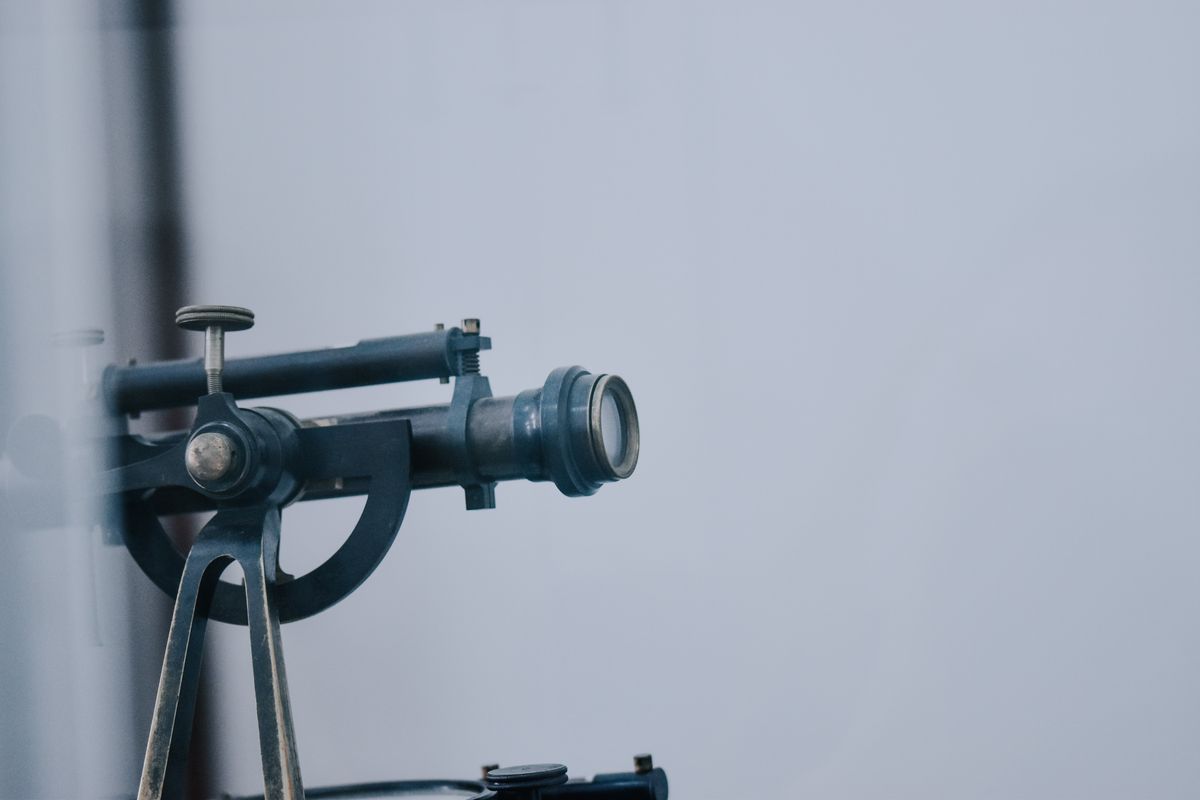
Optical instruments are devices that process light waves to either improve how we see things or measure light's properties. They work by manipulating light through lenses, mirrors, prisms, and filters. If it bends, reflects, or analyses light to do something useful, it is an optical instrument.
Picture a magnifying glass concentrating sunlight to a smouldering dot on a leaf. That single convex lens is the simplest optical instrument — one curved piece of glass bending parallel rays to a focus. Now picture a research-grade microscope with a dozen lenses, filters, and a camera sensor. Same physics, vastly more capability. Every optical instrument, from the cheapest reading glasses to the most expensive space telescope, rests on the same foundation: controlling how light travels.
This guide covers the full range of optical instruments — what they are, how they are classified, how the most common ones work, and where you encounter them.
What are optical instruments?
An optical instrument is any device that processes light waves (or photons) to serve one of two purposes:
- Enhance an image for viewing — making distant objects appear closer, tiny objects appear larger, or capturing a scene as a photograph.
- Analyse light to determine characteristic properties — measuring intensity, wavelength, polarisation, refractive index, or interference patterns.
All optical instruments exploit the fundamental behaviours of light: reflection, refraction, diffraction, interference, and polarisation. The specific combination of lenses, mirrors, prisms, and detectors determines what the instrument does and how well it does it.
The two broad categories — image enhancement and analysis — cover everything from a child's magnifying glass to an interferometer measuring gravitational waves.
For the foundational physics of how lenses bend light, see our guide on how a lens works. The principles of refraction described there underpin almost every optical instrument.
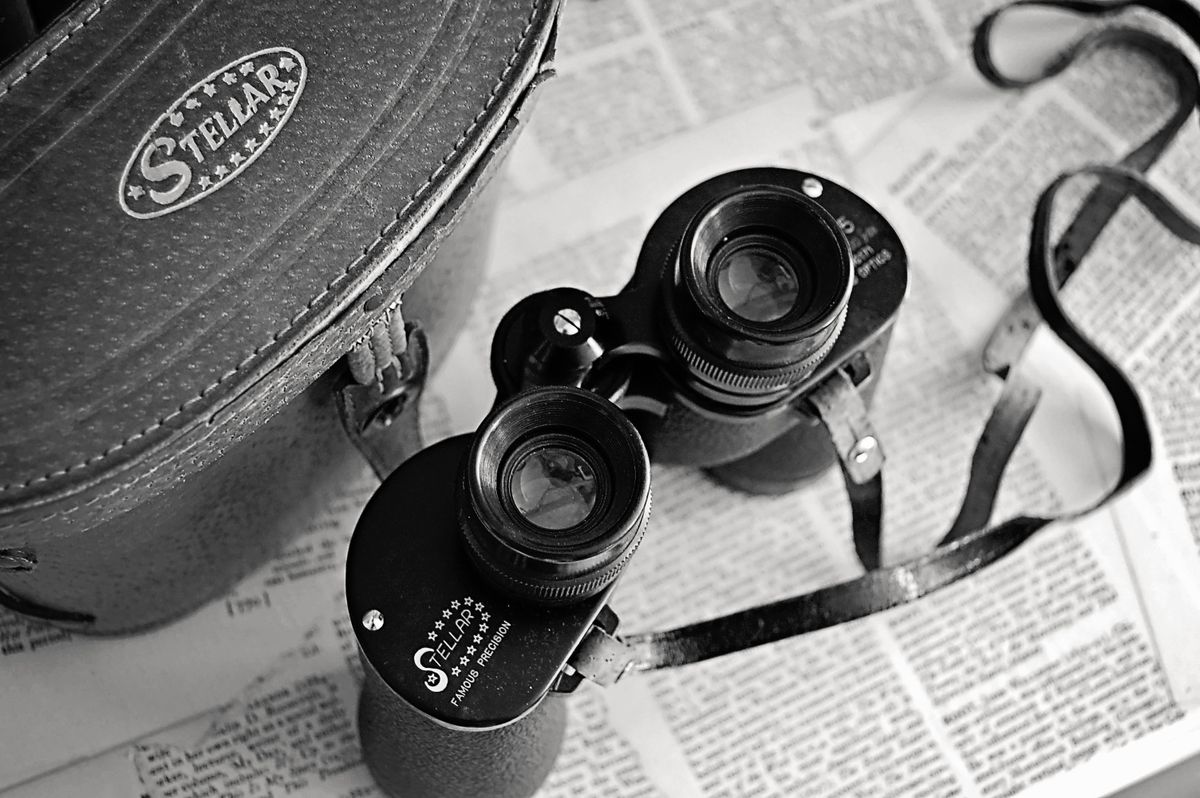
Image enhancement optical instruments
These instruments are designed to help us see things we otherwise could not — because they are too far, too small, too faint, or simply around a corner.
Telescopes
The telescope is the oldest purpose-built optical instrument for astronomy. It gathers light from distant objects and magnifies the image so details become visible. The larger the objective lens or mirror, the more light it collects and the fainter the objects it can reveal.
There are three main designs:
- Refracting telescopes use a large convex objective lens to bend light to a focus. Galileo's original design from 1609 was a refractor.
- Reflecting telescopes use a concave mirror instead of a lens. Newton built the first practical reflector in 1668, solving the colour-fringing problem that plagued early refractors.
- Catadioptric telescopes combine lenses and mirrors, using a corrector plate to eliminate aberrations. The Schmidt-Cassegrain design is the most popular type among amateur astronomers today.
The refracting vs reflecting telescope comparison on Wikipedia provides a detailed breakdown of how each design works and their relative advantages.
Microscopes
Microscopes magnify tiny objects that the naked eye cannot resolve. A simple microscope uses a single convex lens (a magnifying glass). A compound microscope uses two lens systems: an objective lens that forms a real, magnified image of the specimen, and an eyepiece lens that magnifies that image further.
Compound microscopes are essential tools in biology, medicine, materials science, and forensics. Modern optical microscopes can resolve details down to about 200 nanometres, limited by the diffraction of light. For how the basic optics work, see our pillar guide on how a microscope works.
Binoculars
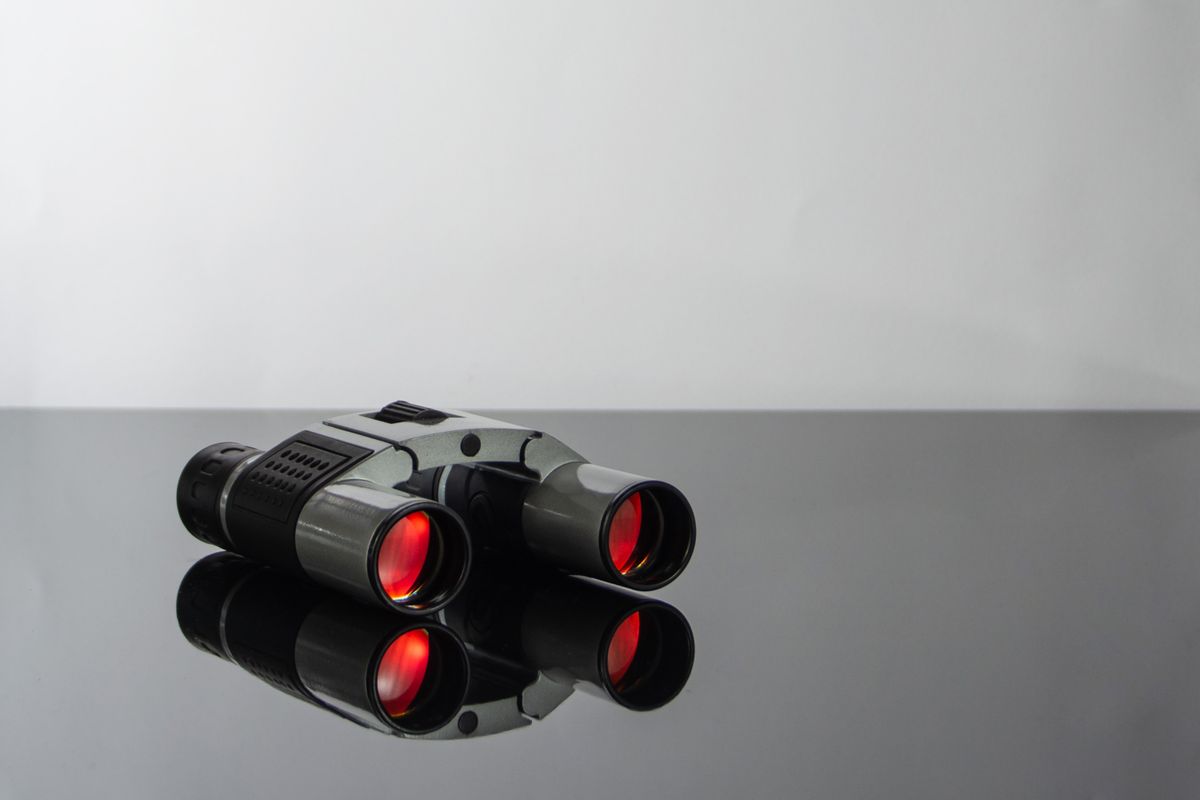
Binoculars are essentially two small refracting telescopes mounted side by side, aligned to point in the same direction. This gives stereoscopic vision — each eye sees the scene from a slightly different angle, producing a three-dimensional impression. Inside, prisms (usually Porro or roof prisms) fold the light path to keep the instrument compact while delivering an upright image.
Cameras
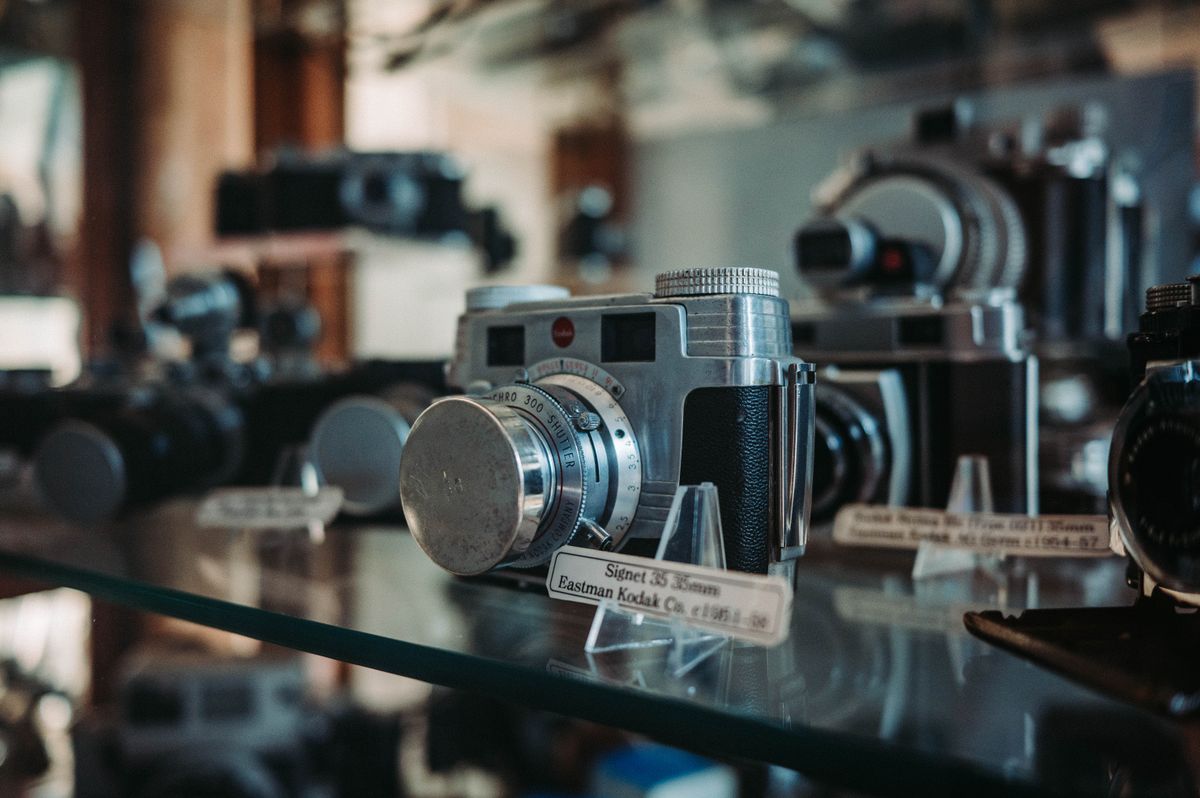
A camera is an optical instrument that records an image. Light from the scene passes through a lens system that focuses it onto a light-sensitive surface — historically photographic film, now an electronic sensor (CCD or CMOS). The lens aperture controls how much light enters, and the shutter controls exposure time. Modern smartphone cameras pack multiple miniature lenses, each specialised for different focal lengths, into a device thinner than a finger.
Periscopes
A periscope uses mirrors or prisms at 45° angles at each end of a tube to redirect light, allowing the user to see over or around obstacles. Simple periscopes are used in classrooms and as toys; complex ones with magnification optics are standard equipment in submarines and armoured vehicles.
Magnifying glasses and kaleidoscopes
A magnifying glass is the simplest optical instrument — a single convex lens that produces a magnified virtual image when held close to an object. A kaleidoscope uses angled mirrors (typically two or three) inside a tube to create symmetrical patterns from loose coloured objects by repeated reflection.
Optical measuring instruments
The second major class of optical instrument does not produce an image for viewing. Instead, it analyses light to measure physical quantities. These instruments are fundamental to chemistry, physics, materials science, and manufacturing.
Spectrometer
A spectrometer splits light into its component wavelengths using a prism or diffraction grating. By measuring which wavelengths are present and at what intensity, it identifies chemical elements and compounds. Every atom and molecule has a unique spectral fingerprint. Spectrometers are used in astronomy to determine the composition of stars, in chemistry for substance identification, and in environmental monitoring for pollution detection.
The HyperPhysics guide on spectrometry explains the principles of dispersion and spectral analysis in detail.
Photometer
A photometer measures the intensity of light. Simple photometers use a photodiode or photomultiplier tube. More sophisticated instruments measure intensity at specific wavelengths for applications in colour science, lighting design, and photography.
Refractometer
A refractometer measures the refractive index of a liquid or solid. Since refractive index changes with concentration, refractometers are widely used in food and beverage production (measuring sugar content in wine or fruit juice), chemical manufacturing, and quality control.
Polarimeter
A polarimeter measures the rotation of polarised light as it passes through an optically active substance. This is how sugar content is measured in the confectionery industry and how concentrations of chiral molecules are determined in pharmaceutical laboratories.
Interferometer
An interferometer splits a light beam into two paths, then recombines them. The resulting interference pattern reveals tiny differences in path length with extraordinary precision. The Laser Interferometer Gravitational-Wave Observatory (LIGO) uses a 4-kilometre-long interferometer to detect gravitational waves — ripples in spacetime caused by colliding black holes.
Autocollimator and vertometer
An autocollimator measures small angular deflections with high precision, used for aligning optical systems and machine tools. A vertometer (or lensmeter) measures the refractive power of lenses, which is how opticians verify prescription glasses.
For more on how interference patterns reveal information about light, see our guide on interference patterns.
The human eye as a natural optical instrument
The human eye is often described as the original optical instrument. Light enters through the cornea (which does about two-thirds of the focusing), passes through the pupil (controlled by the iris), then through the crystalline lens (which fine-tunes focus), and lands on the retina, where photoreceptor cells convert it into neural signals.
The eye's adjustable lens — a process called accommodation — changes shape to focus objects at different distances, just as a camera lens autofocuses. The iris acts as an aperture, expanding in dim light and contracting in bright light.
The eye is remarkable, but it has limitations. The blind spot where the optic nerve meets the retina, chromatic aberration in the lens, and the diffraction limit of the pupil all mean that optical instruments often outperform natural vision. That is precisely why we build them.
For how different materials bend light to correct vision, see the guide on reflection vs refraction, which covers how lenses in eyeglasses use refraction to compensate for eye defects.
Simple vs compound optical instruments
Optical instruments are often classified by complexity:
| Type | Definition | Examples |
|---|---|---|
| Simple | Uses a single lens or mirror | Magnifying glass, simple microscope, hand lens |
| Compound | Uses multiple lenses or mirrors | Compound microscope, telescope, camera, binoculars |
A simple instrument is limited in magnification and image quality. Compound instruments can achieve much higher magnifications and correct for optical aberrations by combining elements with complementary properties. A high-end camera lens might contain 15–20 individual lens elements arranged in multiple groups.
Common misconception: "Magnification is the point of an optical instrument"
Many people think the sole purpose of any optical instrument is to magnify. This is wrong.
Resolution matters more than magnification. Empty magnification — blowing up a blurry image — reveals no new detail. The interesting physics is the diffraction limit, not the eyepiece number. A telescope that magnifies 500× is useless if its optics cannot resolve fine details; you are just looking at a big blur.
The true measure of an optical instrument's power is its ability to resolve fine detail — to separate two closely spaced points as distinct. This resolving power is determined by the diameter of the objective (for telescopes and cameras) or the numerical aperture (for microscopes), following the Rayleigh criterion. Without adequate resolution, magnification adds nothing.
This is why a quality 80 mm telescope outperforms a cheap 200 mm telescope despite lower magnification. Resolution, not magnification, is what reveals the universe.
For more on the physics behind resolution limits, see our guide on what is diffraction, which explains how wave behaviour sets fundamental limits on image sharpness.
Key takeaways
- Optical instruments process light to enhance images or analyse light properties.
- The two main categories are image enhancement (telescopes, microscopes, cameras, binoculars, periscopes) and optical measuring (spectrometers, photometers, refractometers, polarimeters, interferometers).
- Simple instruments use one lens or mirror; compound instruments use multiple elements for better performance.
- The human eye is a natural optical instrument with an adjustable lens and variable aperture.
- Resolution, not magnification, is the true measure of an optical instrument's capability.
- Optical instruments are used across astronomy, biology, medicine, chemistry, manufacturing, telecommunications, and everyday life.
Frequently Asked Questions
What are optical instruments?
Optical instruments are devices that process light waves to either enhance an image for viewing (like telescopes and microscopes) or analyse light to determine its properties (like spectrometers and photometers). Common examples include microscopes, telescopes, cameras, binoculars, periscopes, and measuring instruments such as refractometers and polarimeters.
What are the types of optical instruments?
Optical instruments fall into two main categories: image enhancement instruments (telescopes, microscopes, cameras, binoculars, periscopes, magnifying glasses) and optical measuring instruments (spectrometers, photometers, refractometers, polarimeters, interferometers, reflectometers). The human eye is also considered a natural optical instrument.
What is the difference between a simple and compound optical instrument?
A simple optical instrument uses a single lens or mirror, such as a magnifying glass. A compound optical instrument uses multiple lenses or mirrors to achieve greater magnification or more precise measurements, such as a compound microscope, telescope, or camera.
What are optical measuring instruments used for?
Optical measuring instruments analyse properties of light or materials. A spectrometer measures the optical spectrum for chemical analysis. A refractometer measures refractive index. A photometer measures light intensity. A polarimeter measures rotation of polarised light. An interferometer measures interference patterns for precise distance and wavelength measurements.
Is the human eye an optical instrument?
Yes, the human eye is a natural optical instrument. It uses a cornea and crystalline lens to focus light onto the retina, which converts light into neural signals sent to the brain. The eye's adjustable lens (accommodation) allows focusing at different distances, similar to how a camera lens autofocuses.
What is the first optical instrument ever invented?
The first optical instruments were telescopes used for magnification of distant images and microscopes used for magnifying tiny images, developed in the early 17th century by figures like Galileo Galilei and Antonie van Leeuwenhoek. The camera obscura, a precursor to the camera, was known even earlier.
What are examples of optical instruments used in daily life?
Common daily-life optical instruments include eyeglasses and contact lenses (vision correction), cameras and smartphone lenses (photography), binoculars (birdwatching and sports), magnifying glasses (reading), projectors (presentations), and DVD/Blu-ray players (laser optics for reading discs).
How does a telescope work as an optical instrument?
A telescope uses an objective lens or mirror to gather light from a distant object and form a real, inverted image at its focal point. An eyepiece lens then magnifies this image for viewing. Refracting telescopes use lenses; reflecting telescopes use mirrors; catadioptric telescopes use both.

About Umar Farooq
Umar Farooq writes in-depth guides on the physics of light and optics — from reflection, refraction, and lenses to diffraction, lasers, and fiber optics, explained from first principles.
Read more about Umar Farooq →