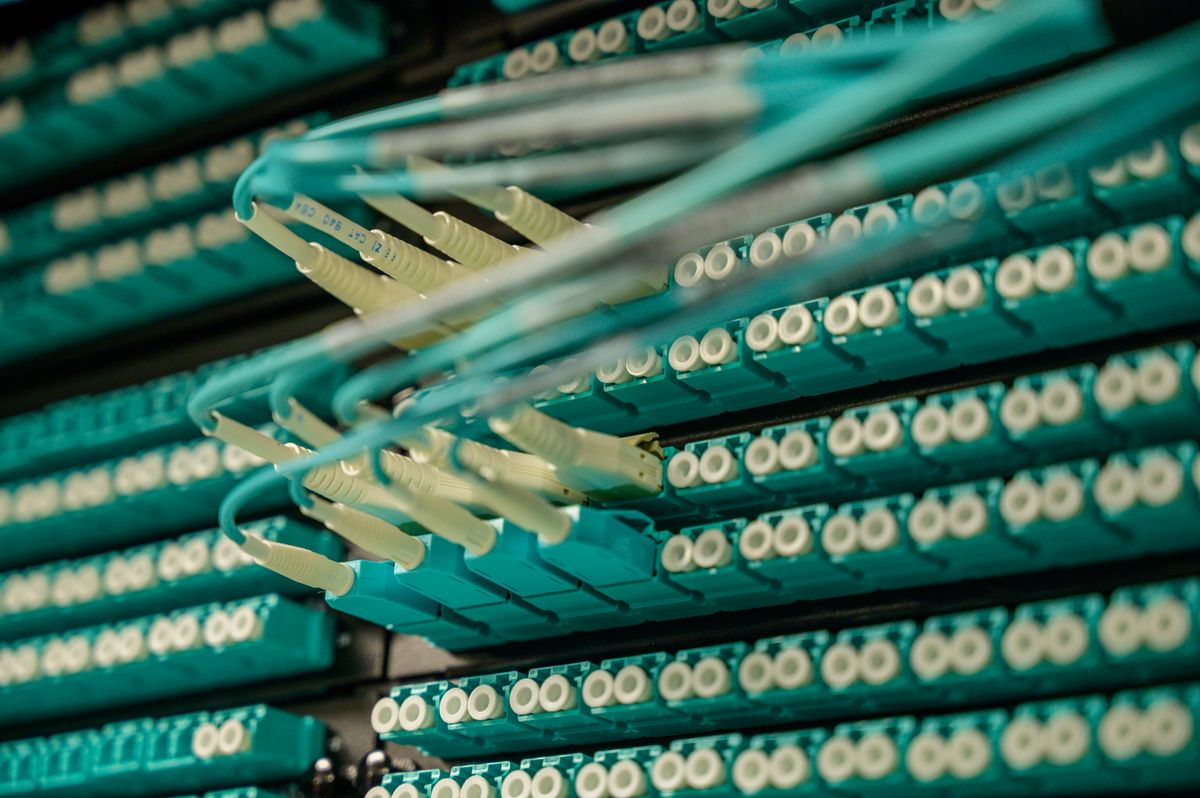
What does fiber optic cable look like? From the outside, a fibre optic cable looks like a slim plastic cord — similar to an HDMI or coaxial cable but noticeably thinner and more flexible. From the inside, it is a single hair-thin strand of solid silica glass wrapped in several protective layers. The colour of the outer jacket tells you at a glance what type it is: yellow for single-mode, orange or aqua for multimode.
Picture a high-end charging cable for a phone, but slimmer and with a smoother, glossier finish. Now imagine that inside that cable is a thread of ultra-pure glass about the thickness of a human hair. That is what a fibre optic cable looks like. The glass does the work. The plastic layers just keep it safe.
If you have ever wondered what does fiber optic cable look like, this visual guide covers everything: the outside and inside appearance, the glass core, connector types, how to identify cable type by sight, and the difference between indoor and outdoor cables.
What Does Fiber Optic Cable Look Like from the Outside?
From the outside, a fibre optic patch cable looks a lot like other slim data cables. It has a smooth, glossy plastic outer jacket and flexible strain-relief boots at each end where the connectors attach.
The key visual difference from copper cables is thickness and flexibility. A typical fibre patch cable is about 2–3 mm in diameter — roughly half the thickness of a standard Cat6 Ethernet cable. It is also lighter and bends more easily, though you should not kink it sharply.
The jacket colour follows a strict industry standard:
| Jacket Colour | Fibre Type | Typical Use |
|---|---|---|
| Yellow | Single-mode (OS1/OS2) | Long-distance telecom, FTTH |
| Orange | Multimode OM1/OM2 | Legacy networks, short runs |
| Aqua (cyan) | Multimode OM3/OM4 | Data centres, high-speed LAN |
| Violet | Multimode OM5 | Wideband data centres |
| Blue | Polarisation-maintaining | Sensors, research |
| Black | Outdoor cable | Direct burial, aerial |
This is the simplest way to answer what does fiber optic cable look like at a glance: check the jacket colour. If you see a yellow cable running along a ceiling or into a junction box, it is single-mode fibre. If you see orange or aqua in a data centre rack, it is multimode. The standard is so widely followed that technicians identify cable type by colour from across the room.
What Does a Fiber Optic Cable Look Like Inside?
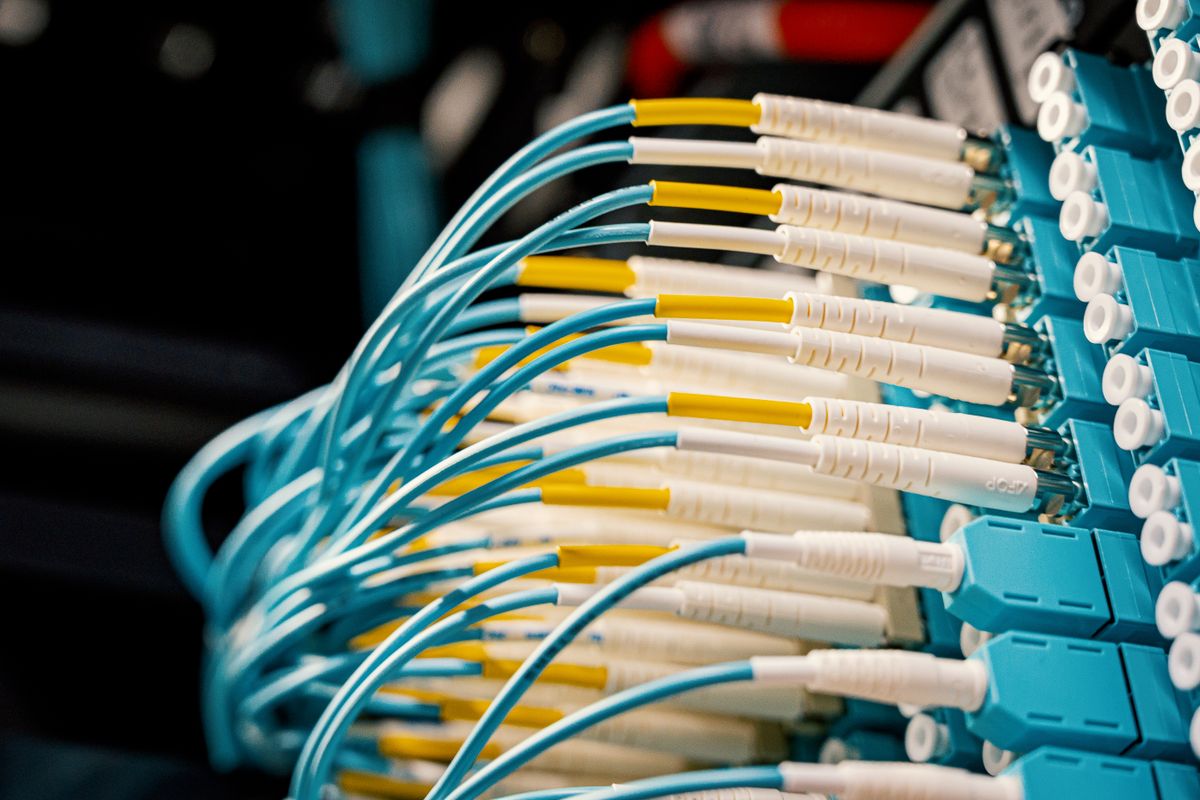
Strip the outer jacket off a fibre optic cable and you find a surprisingly simple internal structure. This is what does fiber optic cable look like on the inside — five layers, each with a distinct appearance:
- Outer jacket — coloured plastic tube, 1–3 mm diameter
- Strength members — yellow or white aramid yarn (Kevlar) strands wrapped around the inner layers
- Buffer coating — a thin, transparent or coloured plastic layer, 250–900 µm thick
- Cladding — transparent glass, 125 µm total diameter (including core)
- Core — the innermost glass, invisible to the naked eye at 8–62.5 µm
When you cut a cable and look at the end, you see a tiny glass dot in the centre surrounded by the cladding layer. That dot is the core. You cannot see it clearly without a microscope — it is too small. The cladding and coating give the fibre its visible thickness.
The aramid yarn strength members are the most visually distinctive part inside the cable. They are bright yellow or white threads that run the length of the cable, visible as soon as you pull back the jacket. Do not cut them off — they are structural.
What Does the Glass Core Look Like?
The glass core is the part of the cable that actually carries light. It is made of ultra-pure silica glass — the same base material as window glass but thousands of times clearer.
Here is the surprising visual fact: you cannot see the core with the naked eye. In a single-mode fibre, the core is 9 µm in diameter. That is one-ninth the width of a human hair. Even in a multimode fibre, the core is only 50 or 62.5 µm — still thinner than a hair.
What you do see when you look at a bare fibre is the 125 µm cladding. The core is completely invisible inside it. The whole assembly looks like a transparent glass thread — thinner than a sewing needle and completely clear.
If you shine a red laser pointer into one end of a bare fibre, you see a bright red dot at the other end. The glass itself stays dark. The light travels through the core without illuminating the material around it — like water flowing through a clear pipe without wetting the outside.
What Do Fiber Optic Connectors Look Like?
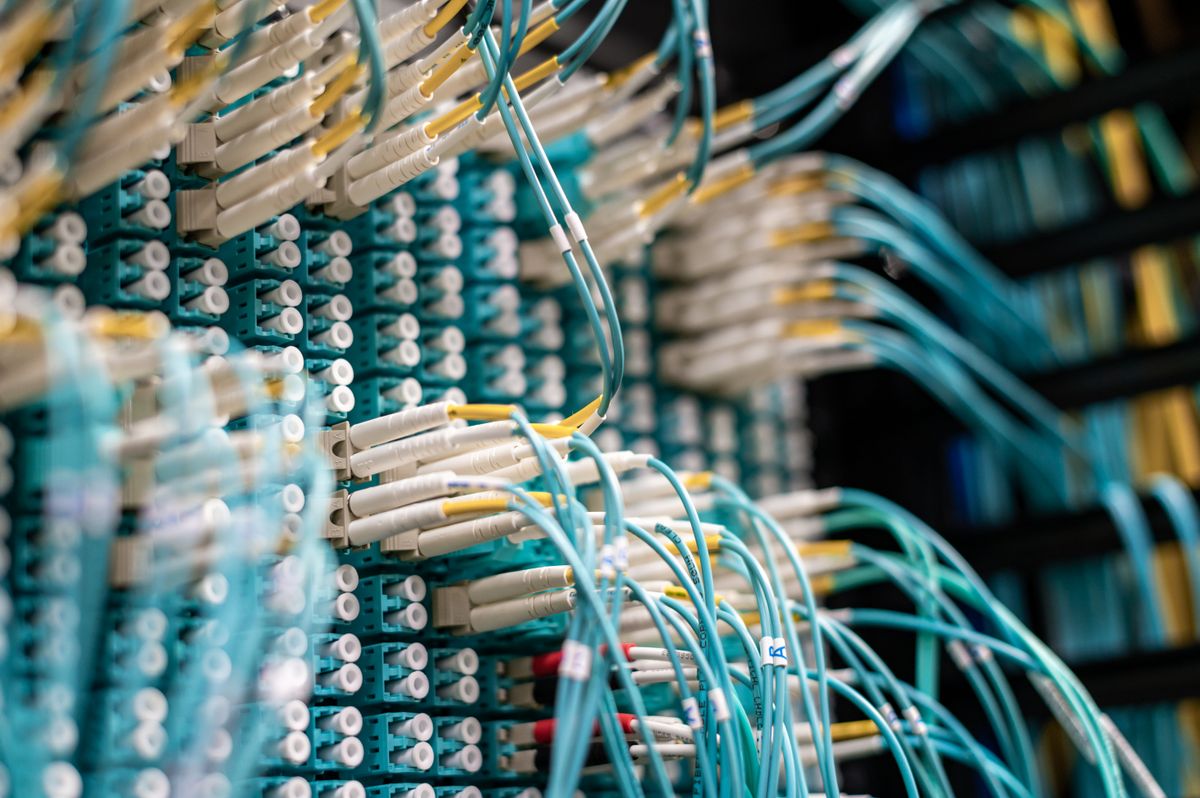
Connectors are a key part of what does fiber optic cable look like at the ends. Each type has a distinct visual appearance:
LC connector — the most common type. Small and square, about the size of a fingernail, with a 1.25 mm ceramic ferrule (the tip that holds the fibre). LC connectors often come in duplex pairs held together by a clip. The latch is a small lever on top, similar to an RJ45 Ethernet plug but much smaller.
SC connector — larger than LC, about twice the size. Square with a 2.5 mm ferrule. It uses a push-pull mechanism — you push it in until it clicks and pull it out by gripping the body. SC connectors are common on patch panels and optical network terminals.
ST connector — round with a twist-lock bayonet mechanism. You push it in and twist a quarter-turn to lock it. ST connectors have a 2.5 mm ferrule and are common in older networks and industrial settings.
FC connector — round with a screw-on collar. It provides the most secure connection and is used in high-vibration environments like broadcast and military applications. The ferrule is 2.5 mm.
The ferrule is the crucial visual detail. It is usually a bright white or translucent ceramic (zirconia) tip. If you look at the end of a connector under a magnifying glass, you see a tiny dot of glass in the centre of the ferrule — that is the fibre end-face.
How to Identify Fiber Cable Type by Sight
You can identify a fibre optic cable type without any tools. Here is what to look for:
Check the jacket colour. Yellow means single-mode. Orange or aqua means multimode. This alone tells you the fibre type in 90% of cases.
Read the printing on the jacket. Every cable has text printed along its length. It will say something like "OS2 Single Mode" or "OM3 Multimode 50/125." The two numbers after OM or OS are the core and cladding diameters in micrometres — "50/125" means a 50 µm core and 125 µm cladding.
Look at the connector. LC connectors are small and square and almost always indicate a modern patch cable. SC connectors are larger. ST connectors are round. The ferrule size (1.25 mm for LC, 2.5 mm for SC and ST) is a dead giveaway.
Feel the cable. Indoor patch cables are soft and flexible. Outdoor cables are stiff and tough, often with a metallic armour layer beneath the jacket that you can feel when you squeeze the cable.
Count the fibres. A simplex cable has one fibre and one connector at each end. A duplex cable has two fibres side by side — often a zipcord design where two cables are joined by a thin web of plastic. Ribbon cables have 12 or more fibres in a flat row.
What Does an Outdoor Fiber Cable Look Like vs Indoor?
The difference between indoor and outdoor fibre cables is immediately visible.
Indoor patch cables are thin (2–3 mm), flexible, and have a smooth plastic jacket. They come in bright colours (yellow, orange, aqua) and have pre-terminated connectors. You see these between racks in a data centre or from your ONT to your router.
Outdoor cables are thick (5–15 mm), stiff, and almost always black. The jacket is polyethylene (PE) — a tough, slightly waxy plastic that resists UV and moisture. Outdoor cables often have a corrugated steel or aluminium armour layer beneath the jacket. You can see the metallic edge where the cable is cut.
Armoured cables have a visible spiral wrap of steel tape or interlocking metal armour. They look like a heavy-duty electrical cable and are used for direct burial. The armour adds significant weight and rigidity.
Loose-tube cables (used outdoors) have a distinctive appearance: the fibres are loosely held inside semi-rigid plastic tubes, often filled with water-blocking gel. If you cut a loose-tube cable, gel may ooze out. Indoor cables use tight-buffer construction where the coating is bonded directly to the fibre.
A Common Misconception: Fiber Cables Are Hollow Mirrored Tubes
Many people picture a fibre optic cable as a hollow tube with a mirrored inner surface, like a miniature periscope. When asked what does fiber optic cable look like inside, they imagine a shiny tunnel. This is the most persistent visual myth in fibre optics — and it is completely wrong.
A fibre optic cable is solid glass all the way through. There is no hollow centre. There is no mirror coating. The light travels through the solid silica core and reflects off the core-cladding boundary not because of a reflective coating but because of total internal reflection — a purely optical phenomenon.
The mirror idea is tempting because it is intuitive. You shine light into a pipe with mirrors, and the light bounces along. But fibre optics work differently. The "mirror" is a transparent boundary between two types of glass with slightly different refractive indices. The light reflects because the angle is too shallow for it to escape.
You can see this effect yourself. Look up at the surface of a swimming pool from underwater. The surface looks like a mirror, but it is just water and air — no silver involved. That same physics traps light inside a fibre.
For the history behind fibre optics and the 1840s experiment that first demonstrated this, see total internal reflection. For the full breakdown of what each layer is made of, read what is fiber optic cable made of. And for an introduction to how fibre works from first principles, start with what is optical fiber.
External resources
- Cable Matters: Fiber Optic Cable Types — Complete Guide — comprehensive guide to cable types, jacket colours, and connector identification with visual descriptions
- ElectronicsHacks: What Does a Fiber Optic Cable Look Like? — detailed visual description of fiber cable appearance, structure, and types
- Wikipedia: Optical Fiber — reference on fiber types, dimensions, and construction with cross-section diagrams
Frequently Asked Questions
What does a fiber optic cable look like in simple terms?
A fiber optic cable looks like a thin plastic cord, similar to an HDMI or coaxial cable but slimmer. Inside, it contains a strand of ultra-pure glass as thin as a human hair, surrounded by protective layers. The outer jacket is often yellow, orange, or aqua, indicating the cable type.
How can you tell single-mode from multimode fiber by looking?
Single-mode fiber has a yellow outer jacket and a core diameter of about 9 micrometres. Multimode fiber has an orange (OM1/OM2), aqua (OM3/OM4), or violet (OM5) jacket and a larger core of 50 or 62.5 micrometres. The cable printing also often states OS1/OS2 for single-mode or OM1–OM5 for multimode.
What do fiber optic connectors look like?
LC connectors are small and square, about the size of a fingernail, with a 1.25 mm ceramic ferrule. SC connectors are larger, about twice the size, with a 2.5 mm ferrule and a push-pull design. ST connectors are round with a twist-lock bayonet mechanism. FC connectors are round with a screw-on collar.
Is fiber optic cable hollow inside?
No. Fiber optic cable is solid glass all the way through. There is no hollow tube. The light travels through the solid silica core and reflects off the core-cladding boundary by total internal reflection — not off a mirror or through an empty pipe.
What color is a fiber optic cable?
The jacket colour follows an industry standard: yellow for single-mode fiber (OS1/OS2), orange for OM1 and OM2 multimode, aqua for OM3 and OM4 multimode, violet for OM5 multimode, and blue for polarisation-maintaining fiber. Indoor patch cables are often coloured; outdoor cables are typically black.

About Umar Farooq
Umar Farooq writes in-depth guides on the physics of light and optics — from reflection, refraction, and lenses to diffraction, lasers, and fiber optics, explained from first principles.
Read more about Umar Farooq →