Optical fiber is a hair-thin strand of glass that carries information as pulses of light. It is the backbone of the modern internet, connecting continents, streaming video, and enabling instant communication across the globe. What is optical fiber? In simple terms, it is a flexible light pipe made of ultra-pure glass that traps light inside and guides it over long distances with almost no loss.
Here is what we cover: what optical fiber is, how it works using total internal reflection, its structure, the difference between single-mode and multi-mode, how it is made, and why it matters.
What Is Optical Fiber? A Simple Definition
An optical fiber is a flexible, transparent strand of glass or plastic that acts as a waveguide for light. Imagine a long, perfectly clear pipe with a mirror finish on the inside. Shine a torch into one end, and the light bounces along the interior, following the pipe around corners and emerging at the far end. That is what an optical fiber does — except the "pipe" is thinner than a human hair and the "torch" is a laser flashing billions of times per second.
Optical fibers are bundled together into cables and used primarily for telecommunications. A single fiber pair can carry hundreds of terabits of data per second — enough for millions of simultaneous HD video streams.
The key to understanding what is optical fiber is knowing that it is not a single thing. It is a system: a core, a cladding, a light source, and a detector. The fiber itself is just the path. The magic is in how the light moves along it.
How Does Optical Fiber Work? Total Internal Reflection
An optical fibre works because of a phenomenon called total internal reflection. Here is the principle in plain terms.
Picture a light ray travelling down the centre of a glass fibre. When it hits the boundary between the glass core and the surrounding cladding at a shallow angle, it does not escape. It reflects back into the core — completely. Every bounce keeps the light trapped inside, and this happens thousands of times per metre along the length of the fibre.
Fiber optic cable diagram: light bouncing along the core
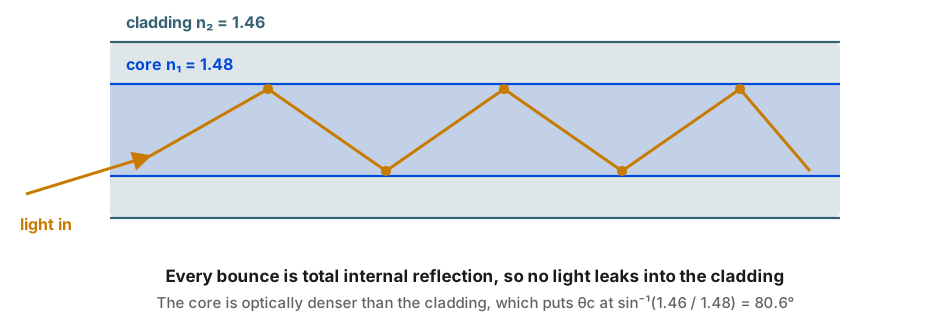
Think of it like a bobsleigh running down an ice track. The walls of the track are high and slick. If the sleigh hits the wall at a shallow angle, it bounces off and keeps going. If it hit head-on, it would crash through. The same is true for light in a fibre: as long as the light hits the core-cladding boundary at an angle shallower than the critical angle (about 42° for a typical glass fibre), it reflects perfectly and stays inside.
This is possible because the core and cladding are made of different types of glass. The core has a slightly higher refractive index (about 1.447) than the cladding (about 1.444). This tiny difference — less than 0.5% — is enough to keep the light confined. The critical angle for total internal reflection is determined by this index difference.
The Structure of an Optical Fibre: Core, Cladding, Coating
Every optical fibre has four layers, each with a specific job:
| Layer | Material | Thickness | Purpose |
|---|---|---|---|
| Core | Ultra-pure silica glass | 8–62.5 µm | Carries the light signal |
| Cladding | Silica glass (lower index) | 125 µm total (core + cladding) | Keeps light in the core via TIR |
| Buffer coating | Acrylate polymer | 250 µm | Protects from moisture and damage |
| Outer jacket | PVC or similar | 400–900 µm | Mechanical protection |
The core is where the light travels. It is made of extremely pure silica glass doped with germanium or other materials to raise its refractive index slightly above the cladding.
The cladding surrounds the core and has a lower refractive index. It does not carry light — it provides the optical boundary that makes total internal reflection possible. Without cladding, the core would leak light into the surrounding air.
The buffer coating is a soft plastic layer applied directly after the glass is drawn. It protects the pristine glass surface from scratches and moisture, which would otherwise cause microcracks and fibre failure.
The outer jacket provides strength and strain relief. Cables designed for outdoor or submarine use also include strength members like Kevlar and water-blocking gels.
Single-Mode vs Multi-Mode Fibre
There are two main types of optical fibre, and the difference is the size of the core.
Single-mode fibre (SMF) has a very narrow core — about 9 micrometres (millionths of a metre) in diameter. Light travels straight down the centre in a single path, with virtually no bouncing. This eliminates signal distortion from multiple paths and lets single-mode fibre carry signals over 100 km or more without amplification. It is the standard for long-haul telecommunications, submarine cables, and high-speed internet backbones. Single-mode fibre uses laser diodes operating at 1310 nm or 1550 nm — wavelengths where glass has the lowest loss.
Multi-mode fibre (MMF) has a wider core — typically 50 or 62.5 micrometres. Light enters the fibre at multiple angles and follows multiple paths (modes). This makes multi-mode fibre easier to couple with inexpensive LED sources, but the different path lengths cause a timing spread called modal dispersion, which limits the useful distance to about 2 km. Multi-mode fibre is used in data centres, local area networks, and building backbones.
| Property | Single-Mode | Multi-Mode |
|---|---|---|
| Core diameter | 9 µm | 50 or 62.5 µm |
| Light source | Laser diode | LED or laser |
| Distance | Up to 100 km | Up to 2 km |
| Bandwidth | 100,000+ MHz·km | 200–1000 MHz·km |
| Cost per metre | Lower fibre, higher electronics | Higher fibre, lower electronics |
| Typical use | Telecom, submarine, FTTH | Data centers, LAN |
The term mode in this context simply means a path the light can take down the fibre. Single-mode = one path. Multi-mode = many paths.
A Common Misconception: Fibre Optic Cables Are Hollow Tubes
Many people picture a fibre optic cable as a hollow tube with a mirrored inner surface, like a pipe lined with mirror glass. That is wrong.
A fibre optic cable is solid glass. There is no hollow space and no mirror lining. The light is trapped not by a reflective coating but by total internal reflection at the boundary between two types of glass with different refractive indices. The cladding is not a mirror — it is transparent glass. The reflection happens because of the way light behaves when crossing from a higher-index medium to a lower-index one at a shallow angle.
This is the same reason a swimming pool looks like a mirror when you view the surface from underwater at a shallow angle. The water is not coated with silver. The reflection is intrinsic to the physics.
Why Optical Fibre Matters
Optical fibre has three decisive advantages over copper wire:
Bandwidth. A single fibre pair can carry over 100 terabits per second using wavelength-division multiplexing — sending many colours of light down the same fibre simultaneously. Copper tops out at about 10 Gbps over short distances.
Distance. Fibre signals travel 40–100 km before needing amplification. Copper signals degrade after 1–2 km. This is why submarine cables crossing the Atlantic use fibre exclusively.
Immunity. Fibre is immune to electromagnetic interference, radio frequency interference, and lightning. It does not conduct electricity, so it creates no ground loops and produces no sparks. This makes it ideal for industrial environments, military applications, and data centres.
Security. Tapping a fibre cable requires physically accessing the glass, which causes a detectable signal loss. Copper cables can be tapped inductively without physical contact.
The world's 600+ submarine fibre cables carry approximately 99% of all intercontinental data traffic. Without optical fibre, streaming, cloud computing, and instant global communication would be impossible.
External resources
- Wikipedia: Optical fiber — comprehensive encyclopedia article covering history, operating principles, manufacturing, and applications
- Explain That Stuff: How fiber optics work — clear educational guide with diagrams, history, and hands-on experiments
- Corning: Optical Fiber Basics — manufacturer's introduction to fibre types, performance, and applications
See our guide on total internal reflection for the physics that makes fibre optics possible, and read about how laser light works for the type of light source used in fibre communication. For the many ways fibre is used, see what are fiber optic cables used for.
Frequently Asked Questions
What is optical fiber in simple terms?
Optical fiber is a thin, flexible strand of glass or plastic that carries light from one end to the other. Think of it as a pipe for light. The light bounces off the inner walls of the fiber, staying trapped inside, and emerges at the far end. This lets information travel as light pulses over long distances at incredible speeds.
How does fiber optics work for the internet?
Fiber internet works by converting data into pulses of laser light and sending them through glass fibers. A laser diode at the transmitting end flashes on and off billions of times per second. The light travels through the fiber by total internal reflection — bouncing off the core-cladding boundary. At the receiving end, a photodetector converts the light pulses back into data. This happens at near light speed.
Is fiber optic better than cable?
Fiber optic is significantly better than copper cable for speed, distance, and reliability. Fiber offers symmetrical gigabit speeds (1000 Mbps upload and download), is immune to electromagnetic interference, and can transmit data over 40 km without signal amplification. Copper cable (coaxial or DSL) typically maxes out at lower speeds, is affected by interference, and requires signal boosting every 1-2 km.
What is the difference between single-mode and multi-mode fiber?
Single-mode fiber has a very thin core (about 9 microns) and uses a laser to send light straight down the middle with a single path. It supports higher bandwidth over longer distances (up to 100 km). Multi-mode fiber has a larger core (50 or 62.5 microns) and uses LEDs or lasers that send light along multiple paths. It is used for shorter distances (up to 2 km) in data centers and local networks.
Can fiber optics transmit electricity?
No. Fiber optics transmit light, not electricity. The glass or plastic core is a non-conductor. This is actually an advantage: fiber cables do not spark, are immune to electromagnetic interference, and can safely be used in explosive environments or near high-voltage equipment.
How is optical fiber made?
Optical fiber starts as a thick glass preform — a rod of ultra-pure silica glass about the diameter of a walking stick. The preform is heated to over 2000°C and drawn into a thin strand like pulling taffy. The resulting fiber is about 125 microns in diameter — roughly the thickness of a human hair. A protective coating is applied immediately after drawing to prevent microcracks.

About Umar Farooq
Umar Farooq writes in-depth guides on the physics of light and optics — from reflection, refraction, and lenses to diffraction, lasers, and fiber optics, explained from first principles.
Read more about Umar Farooq →