
Two waves meet. What happens next decides whether you hear a thundering bass note or silence, whether a microscope image snaps into focus or blurs, and whether a radio signal reaches across a continent or fades into noise.
Constructive interference makes waves larger. Destructive interference makes them smaller (or wipes them out entirely). The difference comes down to one thing: whether the waves arrive in step or out of step.
[Diagram description: visual comparison of constructive vs destructive interference — crests aligned producing a taller combined wave on the left, crest aligned with trough producing a flat line on the right. Label with path difference Δr = nλ and Δr = (n + ½)λ respectively.]
Comparison table: constructive vs destructive interference
| Property | Constructive | Destructive |
|---|---|---|
| Wave alignment | Crest meets crest; trough meets trough | Crest meets trough |
| Resulting amplitude | Bigger — amplitudes add (A₁ + A₂) | Smaller — amplitudes subtract (or cancel to zero) |
| Phase difference | 0°, 360°, 720°… (0, 2π, 4π… rad) | 180°, 540°, 900°… (π, 3π, 5π… rad) |
| Path difference | Δr = nλ (whole wavelengths) | Δr = (n + ½)λ (half-integer wavelengths) |
| What you perceive | Louder, brighter, taller | Quieter, dimmer, flatter |
| Everyday analogy | Two trampoline jumpers bouncing in sync | Two trampoline jumpers bouncing exactly out of sync |
Think of two people on a trampoline. Jumping in sync — both pushing down together — they launch higher than either can alone. Jumping out of sync — one pushing down while the other rises — they nearly cancel each other's bounce. That is the essence of constructive vs destructive interference.
How to tell if interference is constructive or destructive
You can identify which type of interference you are looking at using either the phase difference or the path difference. They are two ways of saying the same thing.
Method 1: phase difference
Compare where each wave is in its cycle when they meet.
- Same point in the cycle (both at a crest, both at a trough, both crossing zero upward) → the waves are in phase → constructive interference.
- Opposite points in the cycle (one at a crest while the other is at a trough) → the waves are out of phase → destructive interference.
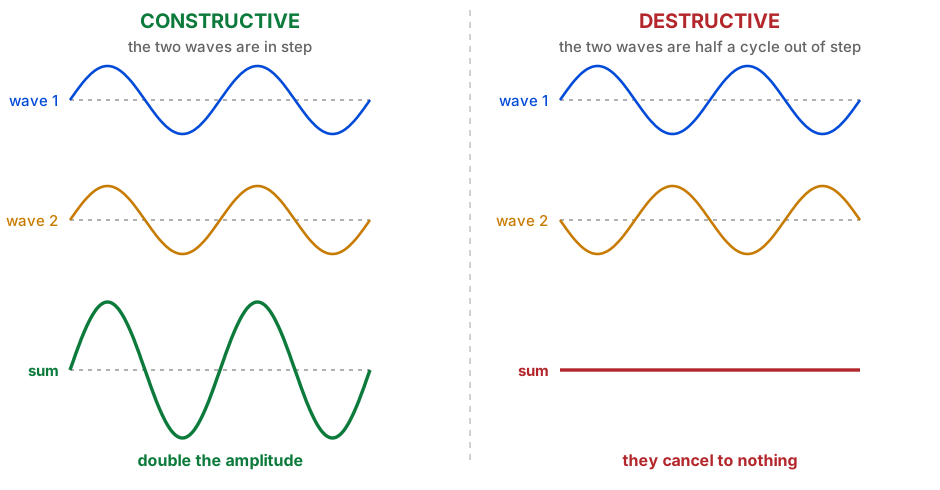
In degrees: a phase difference of 0°, 360°, 720°… (any whole multiple of 360°) gives constructive interference. A phase difference of 180°, 540°, 900°… (any odd multiple of 180°) gives destructive interference.
Method 2: path difference
If you know the wavelengths and how far each wave has travelled, use the path difference formula.
- If the path difference Δr equals a whole number of wavelengths (Δr = nλ), the waves arrive in phase → constructive.
- If Δr equals a half-integer number of wavelengths (Δr = (n + ½)λ), the waves arrive exactly out of phase → destructive.
For example, a path difference of exactly one wavelength (Δr = λ, 2λ, 3λ…) means constructive interference. A path difference of half a wavelength (Δr = λ/2, 3λ/2, 5λ/2…) means destructive interference.
Constructive interference in detail
Here is the full picture of what happens when waves add up.
Imagine a 440 Hz tuning fork (the A above middle C) and a second identical fork sounding at the same moment. When the sound waves from both reach your ear with their crests aligned, the air pressure peaks add together. The combined wave has twice the amplitude of either fork alone. You hear a noticeably louder note.
The condition in symbols:
- Path difference: Δr = nλ (n = 0, 1, 2, 3, …)
- Phase difference: Δφ = 2πn
Because intensity is proportional to amplitude squared, doubling the amplitude quadruples the intensity. Four times the energy arrives at that point — not because new energy appears, but because wave energy from elsewhere in the pattern is concentrated there.
Where you see constructive interference
- Concert speaker arrays. Sound engineers stack speakers and time the signals so that the waves combine constructively toward the audience. The sound projects farther and more efficiently than a single speaker could manage.
- Radio telescope arrays. Multiple dish antennas (like the Very Large Array in New Mexico) combine their signals constructively to act as a single telescope as wide as the array — far sharper than any individual dish.
- Bright fringes in interference patterns. Every bright band in a double-slit pattern is a location of constructive interference.
Destructive interference in detail
Now here is what happens when waves cancel.
Take the same two tuning forks, but shift one fork's sound by half a wavelength before it reaches your ear. The crest of the first wave arrives at the same moment as the trough of the second. The air pushed forward by one wave is pulled back by the other. The result: silence.
The condition in symbols:
- Path difference: Δr = (n + ½)λ (n = 0, 1, 2, 3, …)
- Phase difference: Δφ = (2n + 1)π
Complete cancellation only happens when the two waves have equal amplitude. If one wave is weaker, the cancellation is partial — the combined wave is smaller, but not zero.

Where you see destructive interference
- Noise-cancelling headphones. A tiny microphone captures ambient noise. A digital processor creates an inverted copy — shifted by exactly half a wavelength. The original noise and the anti-noise meet at your eardrum and cancel. The effect works best for low-frequency, continuous sounds like engine rumble because the phase relationship stays stable.
- Anti-reflective coatings. Camera lenses and glasses have a thin film coating. Its thickness is chosen so that light reflecting off the top surface and light reflecting off the bottom surface undergo destructive interference. The reflection cancels, and more light passes through the lens.
- Dark fringes in interference patterns. Every dark band between the bright fringes of a double-slit pattern is a location of destructive interference.
Worked example: two speakers
Let us put the formulas to work.
Two speakers are separated by 3.0 metres and both emit a 500 Hz tone. The speed of sound in air is 343 m/s. A listener stands at various positions in front of the speakers.
Step 1 — find the wavelength.
λ = v ÷ f = 343 ÷ 500 = 0.686 metres (about 69 cm).
Step 2 — pick a position and calculate the path difference.
The listener stands 2.0 metres from speaker A and 2.686 metres from speaker B.
Δr = |rB − rA| = |2.686 − 2.0| = 0.686 m
Step 3 — compare with the wavelength.
Δr = 0.686 m = exactly 1 × λ
This is a whole-number multiple of the wavelength. The waves arrive in phase. The listener hears constructive interference — a loud tone.
Step 4 — move to a different position.
Now the listener is 2.0 metres from speaker A and 2.343 metres from speaker B.
Δr = |2.343 − 2.0| = 0.343 m
Compare: 0.343 ÷ 0.686 = 0.5 → Δr = ½λ
This is a half-integer multiple of the wavelength. The waves arrive exactly out of phase. The listener hears destructive interference — the tone drops to near silence.
Walk slowly between these two positions and you hear the volume rise and fall as you pass through alternating zones of constructive and destructive interference.
Common misconception: interference destroys energy
When two identical waves cancel to silence, it seems like the energy has vanished. It has not.
Destructive interference does not destroy energy — it redistributes it. In the two-speaker example above, the energy that would have reached the quiet spot is redirected to the loud spots nearby. In Young's double-slit experiment, the dark fringes are dark because light energy has been moved from those positions to the bright fringes. When you add up the energy across the entire pattern, it exactly equals the sum of the energies of the two original waves.
The same principle applies to noise-cancelling headphones. The anti-noise wave cancels the ambient sound at your ear, but the combined wave energy radiates outward in other directions. Total energy is always conserved.
Key takeaways
- Interference is the result of wave superposition — waves either add (constructive) or subtract (destructive).
- The deciding factor is the phase difference (or equivalently, the path difference) between the waves.
- Constructive: Δr = nλ or Δφ = 2πn — waves in step, amplitude increases.
- Destructive: Δr = (n + ½)λ or Δφ = (2n + 1)π — waves out of step, amplitude decreases.
- Destructive interference does not destroy energy; it moves it elsewhere.
- Real-world applications range from concert acoustics and noise cancellation to anti-reflective coatings and radio astronomy.
For a broader introduction to interference including the history and conditions required, see our pillar guide on what is wave interference. To understand how interference compares to related wave phenomena, read diffraction of a wave.
External resources
- The Physics Classroom: Interference of Waves — clear diagrams and step-by-step explanations of constructive and destructive interference for sound and light waves
- Encyclopaedia Britannica: Destructive Interference — authoritative reference with mathematical treatment and historical context
- Explain that Stuff: Noise-Cancelling Headphones — how destructive interference makes silence possible in consumer headphones
Frequently Asked Questions
What is the difference between constructive and destructive interference?
Constructive interference occurs when waves are in phase (crest meets crest or trough meets trough), so their amplitudes add and the resulting wave is larger. Destructive interference occurs when waves are exactly out of phase (crest meets trough), so they cancel and the resulting wave is smaller or zero. The condition depends on the path difference: constructive when Δr = nλ, destructive when Δr = (n + 1/2)λ.
How can you tell if interference is constructive or destructive?
You can check the phase difference: if Δφ = 0°, 360°, 720°… (or 0, 2π, 4π… in radians), the interference is constructive. If Δφ = 180°, 540°, 900°… (or π, 3π, 5π…), it is destructive. Alternatively, use the path difference: a whole-number multiple of the wavelength (Δr = nλ) gives constructive interference; a half-integer multiple (Δr = (n + 1/2)λ) gives destructive interference.
What is constructive interference in simple terms?
Constructive interference is when two waves line up perfectly — crest on crest, trough on trough — and combine to make a bigger wave. Think of two people pushing a swing at exactly the same moment: the swing goes higher than either person could manage alone.
What is destructive interference in simple terms?
Destructive interference is when two waves line up opposite — crest on trough — and cancel each other out. The result can be a smaller wave or no wave at all. This is how noise-cancelling headphones work: they create a sound wave that is the exact opposite of the ambient noise, and the two cancel out.
Does destructive interference destroy energy?
No. Destructive interference does not destroy energy — it redistributes it. When waves cancel at one point in space, the energy appears somewhere else. In Young's double-slit experiment, for example, the dark fringes are dark because light that would have gone there is redirected into the bright fringes. Total energy is conserved.
What are examples of constructive and destructive interference?
Examples of constructive interference: speaker arrays at concerts (waves combine to project sound further), radio telescope arrays (signals combined for higher resolution), and bright fringes in interference patterns. Examples of destructive interference: noise-cancelling headphones, anti-reflective coatings on glasses, and dark fringes in interference patterns.
What is the formula for constructive and destructive interference?
Constructive interference formula: Δr = nλ (path difference equals a whole number of wavelengths). Destructive interference formula: Δr = (n + 1/2)λ (path difference equals a half-integer number of wavelengths). In terms of phase difference: constructive when Δφ = 2πn, destructive when Δφ = (2n + 1)π.
What does constructive vs destructive interference sound like?
Constructive interference sounds louder — the wave amplitudes add, increasing the volume. Destructive interference sounds quieter or produces silence — the waves cancel. A practical example is walking past two speakers playing the same tone: you hear the volume rise and fall as you pass through zones of constructive and destructive interference.

About Umar Farooq
Umar Farooq writes in-depth guides on the physics of light and optics — from reflection, refraction, and lenses to diffraction, lasers, and fiber optics, explained from first principles.
Read more about Umar Farooq →