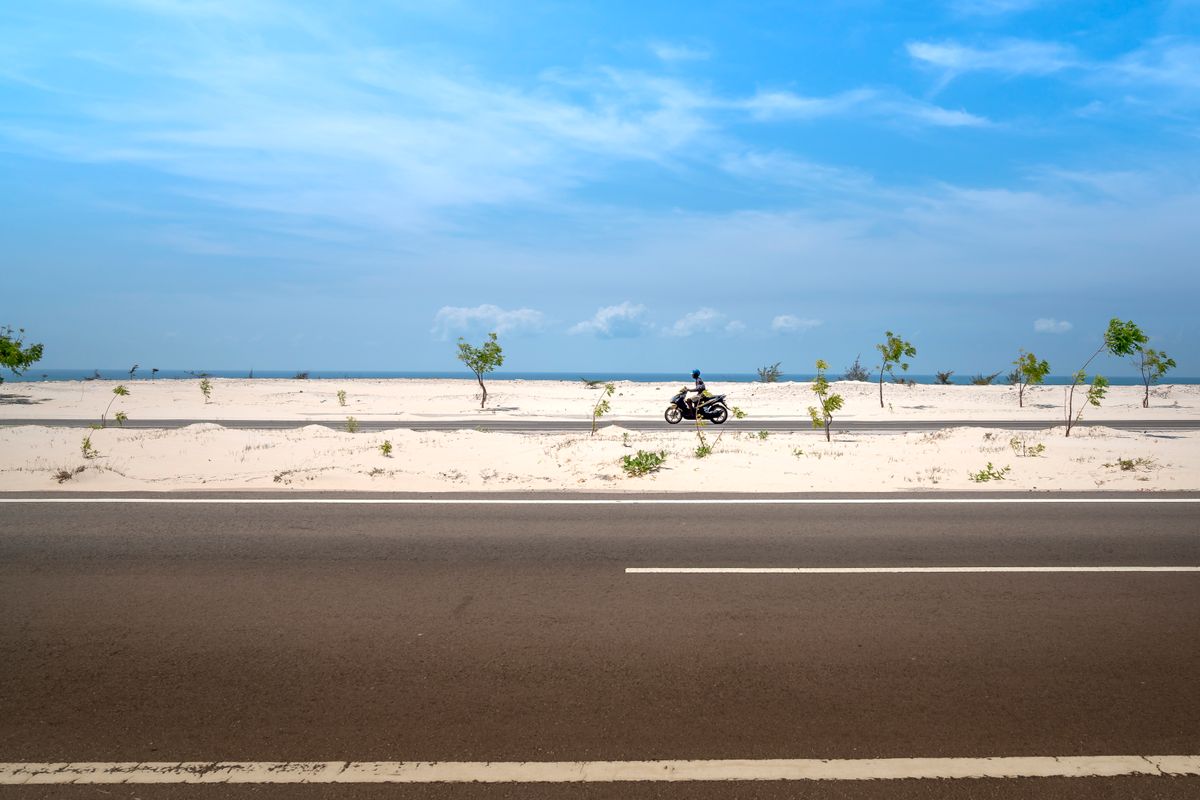
A mirage on road is not a trick of your mind — it is real atmospheric refraction. On a hot summer day, the air just above the road surface becomes much hotter than the air a few feet higher. Since hot air is less dense, its refractive index drops slightly. Light from the sky bends as it crosses this boundary, and your brain interprets the bent light as a reflection — making the road ahead look wet.
Here is what we cover: what causes a mirage on road, why the "puddle" vanishes as you approach, what heat shimmer is and how it differs from a mirage, and 3 physics facts that explain the phenomenon.
What Causes a Mirage on Road?
Think of it like a car driving from smooth tarmac onto sand at an angle. The wheel that hits the sand first slows first, and the car swings toward that side. Light does the same thing when it passes from cool air into hot air — it bends because it changes speed.
Here is the key idea. The refractive index of air at standard temperature and pressure is 1.0003. When the sun heats the road surface, the air in the first few centimetres above it becomes much hotter — often 20–30 °C hotter than the air a metre higher. This hot air expands, becomes less dense, and its refractive index drops to about 1.00026 or lower.
When light from the sky comes down toward the road at a shallow angle and enters this hot layer, the part of the wavefront that reaches the hot air first speeds up first. The whole beam bends upward — away from the road surface. Your eye traces the bent light back along a straight line and projects it onto the road. That bright patch is an image of the sky, mistaken by your brain for water.
Why the "Water" Vanishes as You Approach
A common and deeply satisfying experience: you drive toward the puddle, and it keeps moving away or disappears just before you reach it. This is not a glitch — it is geometry.
The angle at which light enters the hot air layer determines how much it bends. As you drive closer, that angle changes. A position that produced the perfect bending for a convincing puddle a hundred metres ahead now sends the light past your eye or above it. The mirage shifts or vanishes entirely.
The effect also depends on the temperature gradient being just right. If a cloud covers the sun for a moment, the road cools, the gradient weakens, and the mirage disappears. When the sun returns, so does the puddle. This on-off behaviour is another clue that the phenomenon is driven entirely by temperature, not imagination.
What Is Heat Shimmer and How Is It Different?
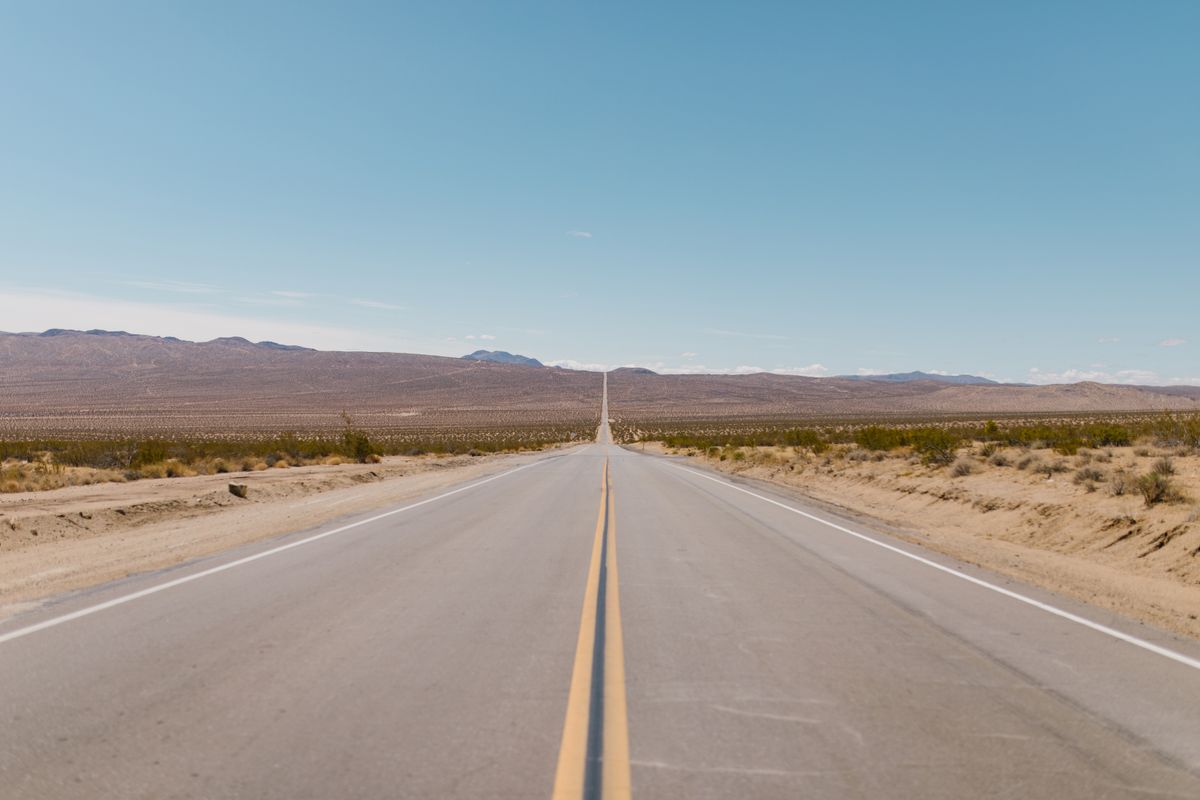
Heat shimmer (also called heat haze) is closely related to a road mirage but not the same thing. Both are caused by light refracting through layers of air at different temperatures. The difference is organisation.
A mirage forms when there is a clean, well-defined temperature gradient — a smooth transition from hot air near the surface to cooler air above. Light follows a consistent curved path, producing a stable image.
Heat shimmer forms when the temperature gradient is turbulent. Pockets of hot and cool air mix chaotically above the hot surface. Each pocket has a slightly different refractive index, so light bends by a different amount through each one, moment by moment. The result is the wavy, dancing, rippling appearance you see rising from hot asphalt on a summer afternoon.
The same road can produce both at once — a stable puddle mirage on the road surface with shimmering air dancing above it. The keyword cluster "air looking wavy in the sun" describes the heat shimmer component specifically.
3 Surprising Physics Facts About Road Mirages
1. A Mirage on Road Is Refraction, Not Reflection
It is easy to think the hot air acts like a mirror, reflecting the sky downward. It does not. Reflection bounces light off a surface. Mirage light bends continuously as it passes through a gradient of changing refractive index — that is refraction, obeying Snell's law, not the law of reflection.
The distinction matters because refraction depends on the angle of entry and the refractive indices of the air layers. If it were reflection, the "puddle" would behave like a true mirror. Instead, it shifts with your position and disappears at close range — classic refraction behaviour.
2. Hot Air Has a Measurably Lower Refractive Index
The change is tiny but reliable. At 0 °C, the refractive index of air is about 1.00029. At 30 °C, it drops to about 1.00026. That is a difference of just 0.003%. But over the long, shallow path that light travels through the hot layer near the road, this tiny difference accumulates into a noticeable bend.
The greater the temperature difference between the road surface and the air above it, the stronger the refraction and the more convincing the mirage. On a 40 °C day with asphalt reaching 60–70 °C, the effect can be dramatic — producing large, vivid puddles spanning hundreds of metres of road.
3. The "Water" Is Actually the Sky
This is the fact that surprises most people. The bright, shimmering patch you see on the road is not reflected light from anything on the ground — it is an image of the blue sky, bent downward by refraction.
Light from the sky travels toward the road. As it enters the hot air layer, it bends upward. Your brain, assuming light travels straight, extrapolates the bent ray backward to where it would have come from if straight — and that place is on the road surface. You are literally seeing the sky projected onto the road.
This upward bending is the defining characteristic of an inferior mirage — the image appears below the real object. It is called inferior from the Latin for "lower," not because the quality is poor.
Common Misconception: Mirages Are Not Heat-Induced Hallucinations
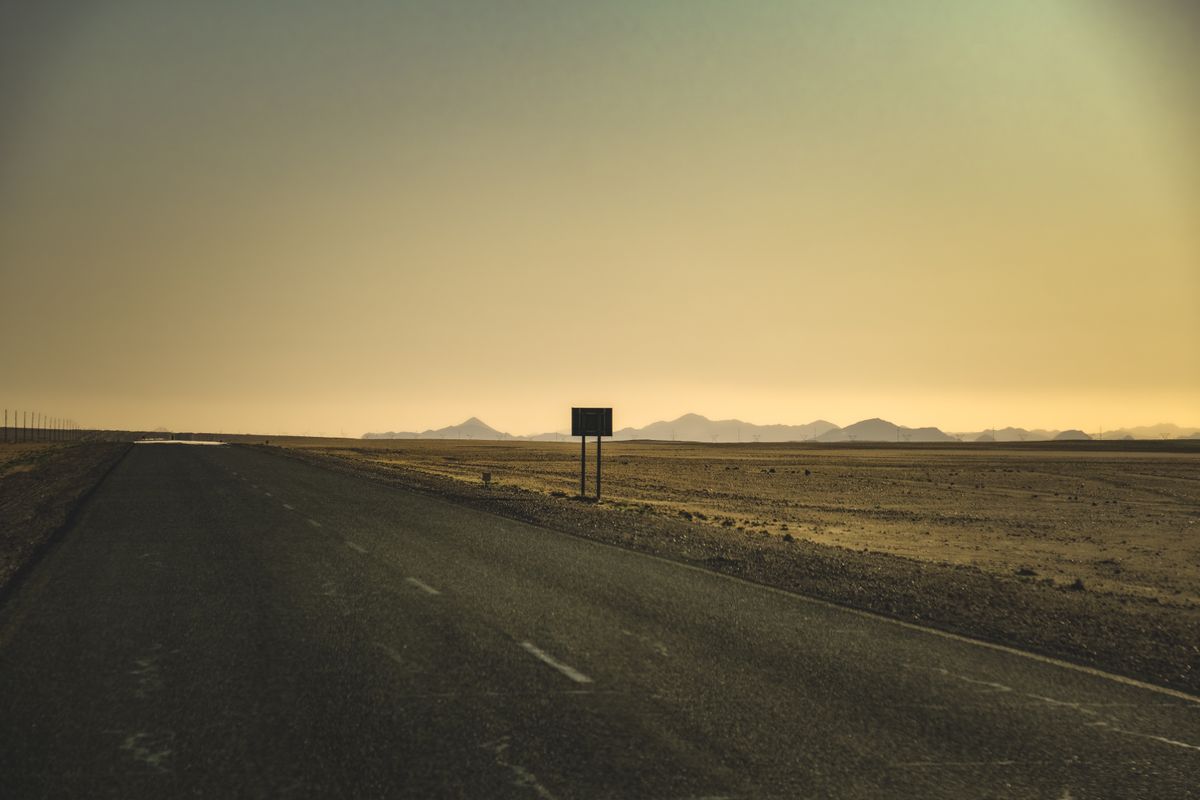
A persistent belief, repeated in popular culture, is that a mirage on road is a hallucination caused by heat stroke or dehydration. This is not true.
A mirage is a real, measurable optical phenomenon. You can photograph it with any camera. You can measure the temperature gradient that causes it. The light follows a real curved path through real air layers and enters your eye as real photons.
What is subjective is your brain's classification of the image. Your visual system sees a bright, reflective-looking patch on a horizontal surface and labels it "water." It is a reasonable inference — just incorrect in this case. The image is real; the interpretation is wrong.
External Resources
- HowStuffWorks: What Causes a Mirage? — clear explanation of the refraction mechanism with diagrams
- HyperPhysics: Atmospheric Refraction — detailed physics reference with worked ray diagrams
- Wikipedia: Mirage — comprehensive guide covering types, causes, and historical observations
For more everyday examples of light bending, see our guide on refraction examples. The relationship between refractive index and temperature also plays a role in refraction at night, where atmospheric layers distort starlight. And the same physics of total internal reflection that contributes to diamond sparkle is covered in total internal reflection.
Frequently Asked Questions
Why do roads look wet in summer?
Roads look wet in summer because of a mirage — a real atmospheric refraction phenomenon. The sun heats the road surface, which warms the air directly above it. This hot air has a lower refractive index than the cooler air above. Light from the sky bends upward as it passes through the boundary between these air layers. Your brain interprets the bent light as a reflection, creating the illusion of a puddle on the road ahead.
What is heat shimmer?
Heat shimmer (also called heat haze) is the wavy, rippling appearance of air above hot surfaces. It happens when pockets of hot and cool air mix turbulently above a hot road or surface. Because each pocket has a slightly different refractive index, light passing through them bends by constantly varying amounts, creating a dancing or shimmering effect. Heat shimmer and road mirages share the same cause: refraction through a temperature gradient.
Why does air look wavy on hot days?
Air looks wavy on hot days because sunlight heats the ground, which then heats the air directly above it. This creates chaotic mixing of rising hot air and sinking cooler air. Each air layer has a slightly different density and refractive index. As light passes through these constantly shifting layers, it bends by varying amounts from moment to moment, producing a wavy, rippling appearance above the hot surface.
Is a mirage the same as a hallucination?
No. A mirage is a real optical phenomenon caused by the refraction of light through layers of air at different temperatures. It can be photographed and measured. What is subjective is your brain's interpretation — seeing a bright patch on the road and identifying it as water. The light itself is real; the 'puddle' is an image of the sky redirected by refraction. A hallucination, by contrast, has no external physical source.
What is the difference between a mirage and heat shimmer?
A mirage produces a stable, organised image (like a puddle or false sky), while heat shimmer produces a chaotic, dancing distortion. A mirage requires a sharp, well-defined temperature gradient so light follows a consistent curved path. Heat shimmer occurs when the gradient is turbulent and mixing, causing the light to bend by randomly varying amounts. Both are the same physical phenomenon — refraction through air of different temperatures — just at different levels of organisation.
Can you photograph a mirage on road?
Yes. A road mirage is easily photographed with any camera or smartphone. The image will show the same 'water' effect visible to the eye. This is definitive proof that a mirage is a real optical phenomenon, not a psychological trick. The photograph captures real light that followed a curved path through the hot air layer near the road surface.

About Umar Farooq
Umar Farooq writes in-depth guides on the physics of light and optics — from reflection, refraction, and lenses to diffraction, lasers, and fiber optics, explained from first principles.
Read more about Umar Farooq →