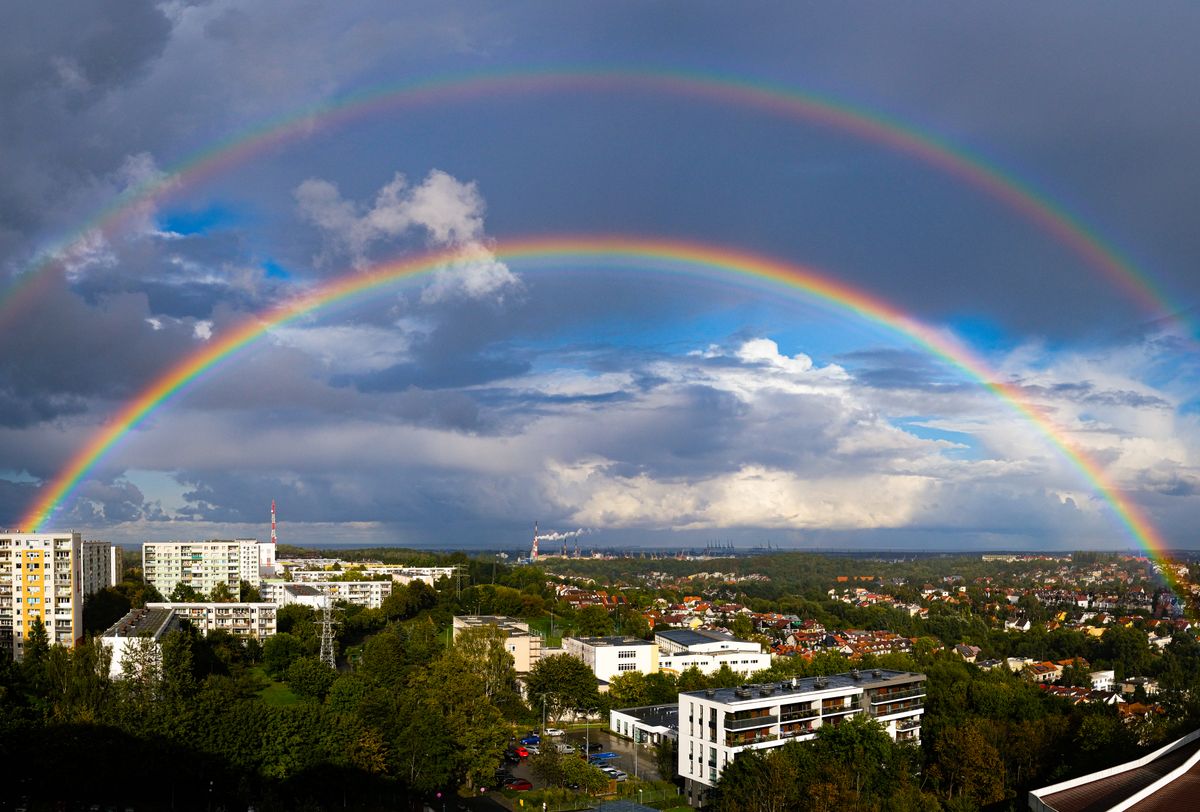
Rainbows form when sunlight enters a raindrop, bends, reflects off the inside back surface, and bends again as it exits — separating white light into its component colours. This three-step process — refraction, reflection, refraction — happens simultaneously in millions of raindrops, each acting like a tiny prism. The combined effect is the multicoloured arc we call a rainbow.
Here is what we cover: the step-by-step physics of rainbow formation, why the colours always appear in a specific order, the surprising 42° angle that determines a rainbow's position, why rainbows are curved, what causes double rainbows, and a common misconception corrected.
How Do Rainbows Form? The Simple 3-Step Process
Picture a single raindrop falling through the air. Sunlight — which looks white but actually contains every colour — hits the droplet. Here is exactly what happens, step by step.
Step 1: Refraction on entry. When sunlight enters the raindrop, it slows down because water is denser than air. The refractive index of water is about 1.333, meaning light travels at roughly 225,000 km/s inside the drop — about three-quarters of its speed in a vacuum. This slowing causes the light to bend. Different colours bend by different amounts: violet bends most, red bends least. This is called dispersion.
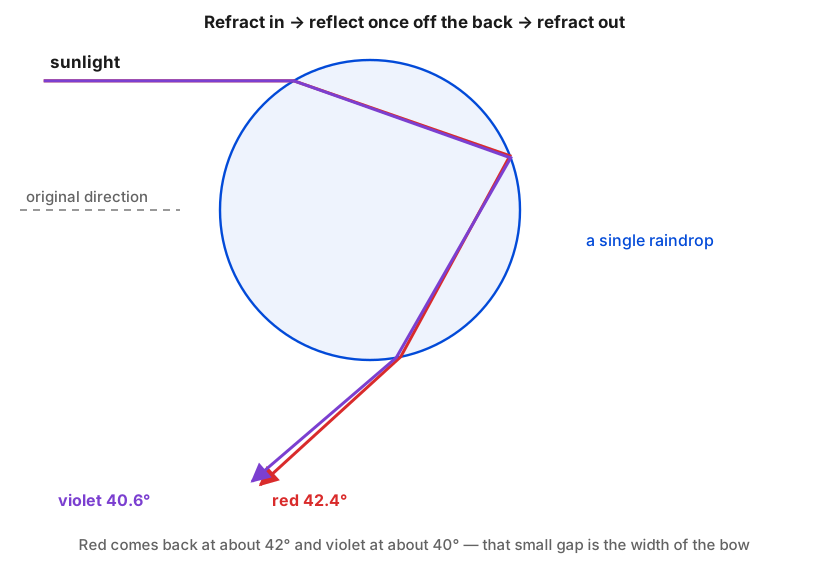
Step 2: Internal reflection. The light travels through the droplet and hits the back inner surface. Some of it reflects off the back and heads back toward the front of the droplet. This is not total internal reflection — the angle is too steep — but a partial reflection that sends the light back the way it came.
Step 3: Refraction on exit. The reflected light reaches the front surface of the droplet again and exits back into the air. As it speeds up leaving the water, it bends a second time. The combination of both refractions and the internal reflection spreads the colours into a fan. The light that reaches your eye is the separated spectrum.
Think of it like a crowd leaving a stadium through a narrow gate. The blue-shirted fans move slightly slower through the gate than the red-shirted ones, so they fan out into separate streams. Each colour "stream" emerges from the droplet at a slightly different angle, and your eye sees them as distinct bands.
Why the Colours Appear in Order: ROYGBIV Explained
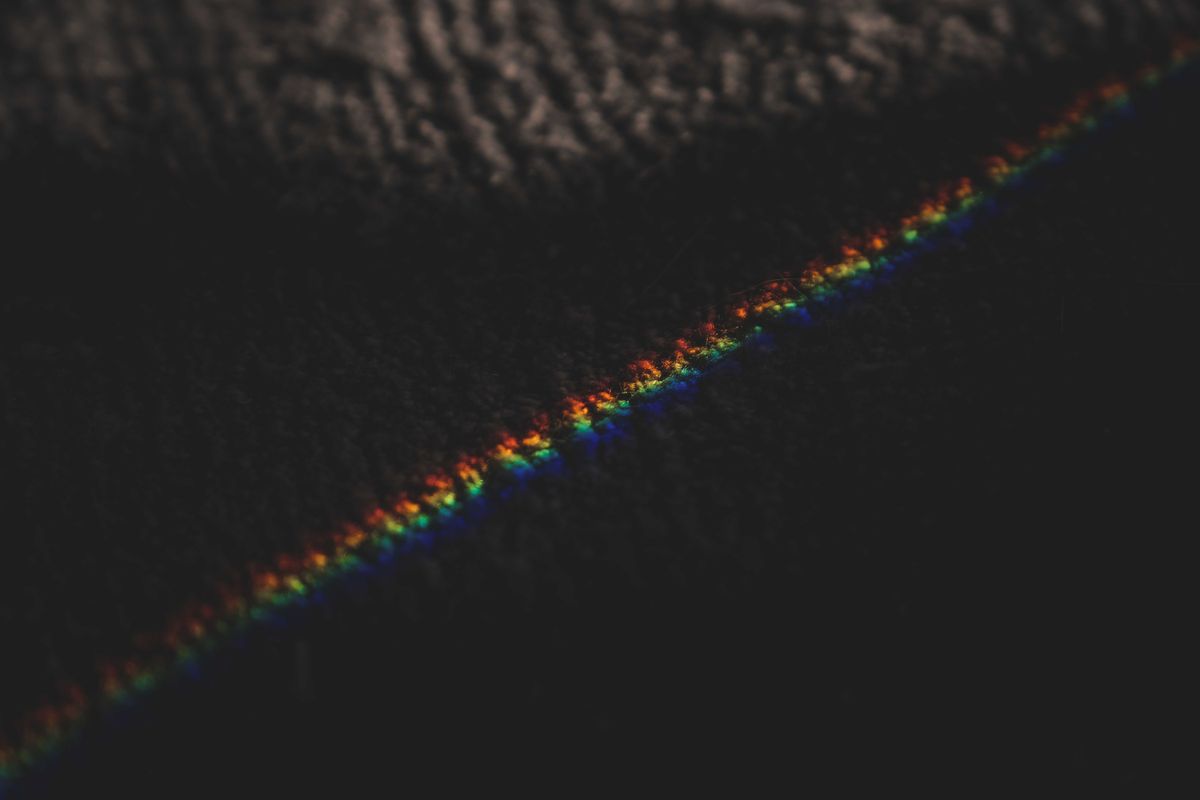
The colours of the rainbow always appear in the same order: red, orange, yellow, green, blue, indigo, violet. The mnemonic ROYGBIV (or Richard Of York Gave Battle In Vain) helps you remember the sequence.
Here is why this order never changes. When white light enters a raindrop, each wavelength bends by a different amount. Red light, with its longer wavelength (around 625–700 nm), is refracted least. Violet light, with its shorter wavelength (around 380–450 nm), is refracted most. This difference is tiny — only about 2° across the whole spectrum — but it is enough to separate the colours.
In the primary rainbow, red appears on the outer edge (top) and violet on the inner edge (bottom). This is because of the internal reflection inside the droplet. The light is bent, reflected, and bent again, and the geometry of this path means that the red light emerges at a steeper angle (about 42°) than the violet light (about 40°). So when you look at the top of a rainbow, you see red; when you look at the bottom, you see violet.
Newton demonstrated this in the 1660s. He passed sunlight through a glass prism and saw it fan into colours. Then he passed the colours through a second prism and recombined them into white light — proving the colours were already inside white light, not added by the prism. The Newton story is from his work during the plague years of 1665–66, when he left Cambridge and experimented at home in Lincolnshire.
The 42° Angle: Why Rainbows Appear Where They Do
A rainbow always appears at a specific angle in the sky: about 42° from the direction opposite the sun. This is not random. It is a consequence of the physics.
Here is the key. As light passes through a raindrop, the angle between the incoming sunlight and the outgoing coloured light depends on where on the droplet the light enters. For most entry points, the light scatters in many directions. But there is one specific entry point — a ring around the droplet — where the outgoing light is concentrated. This is called the minimum deviation angle, and for water it is 42° for red light and about 40° for violet.
This 42° angle is why you must have the sun behind you to see a rainbow. The line from the sun through your head to the rainbow forms an angle of 42°. If the sun is higher than 42° above the horizon, the rainbow would be below the ground — invisible. This is why rainbows appear most often in the morning or late afternoon, when the sun is low.
The same angle explains why you see a rainbow as an arc rather than a straight line. The set of all raindrops that send light to your eye at exactly 42° forms a cone. Where that cone meets the sky, you see a circle. The ground cuts off the bottom half, leaving the familiar arc.
Why Rainbows Are Curved
A common question is why rainbows are curved. The answer: a rainbow is a circle — you just see the top half.
Imagine a cone with its tip at your eye and its centre line pointing toward your shadow (the antisolar point). Every raindrop on the surface of this cone, 42° from the centre line, reflects light to your eye. The base of this cone is a circle. From the ground, the circle extends below the horizon where there are no raindrops, so you only see the arc.
From an aeroplane, you can sometimes see the full circle. Pilots and passengers have reported circular rainbows when flying above rain clouds with the sun behind them. You can also create a full-circle rainbow yourself on a sunny day by spraying a garden hose with your back to the sun — if the mist is fine enough.
Here is a subtle but important point: every person sees their own personal rainbow. The rainbow you see is formed by a different set of raindrops than the one the person next to you sees. Two people never see exactly the same rainbow. This is because the 42° cone is fixed relative to each observer's eye, not to a location in space.
What About Double Rainbows?
A double rainbow happens when sunlight reflects twice inside the raindrop instead of once. The primary rainbow comes from one internal reflection. The secondary rainbow comes from a second internal reflection.
The secondary bow appears about 10° outside the primary bow — at roughly 50–53° from the antisolar point. Its colours are reversed: red is on the inside edge, violet on the outside. It is also fainter — about one-tenth the brightness of the primary bow — because each reflection loses some light.
The dark band between the primary and secondary rainbows is called Alexander's dark band. It appears darker than the surrounding sky because the raindrops in that region send less light toward the observer.
Theoretically, every rainbow is a double rainbow, but the secondary bow is often too faint to see. When conditions are right — bright sunlight, large raindrops, and a dark background — both bows become visible.
Common Misconception: A Rainbow Is Not a Physical Object You Can Reach
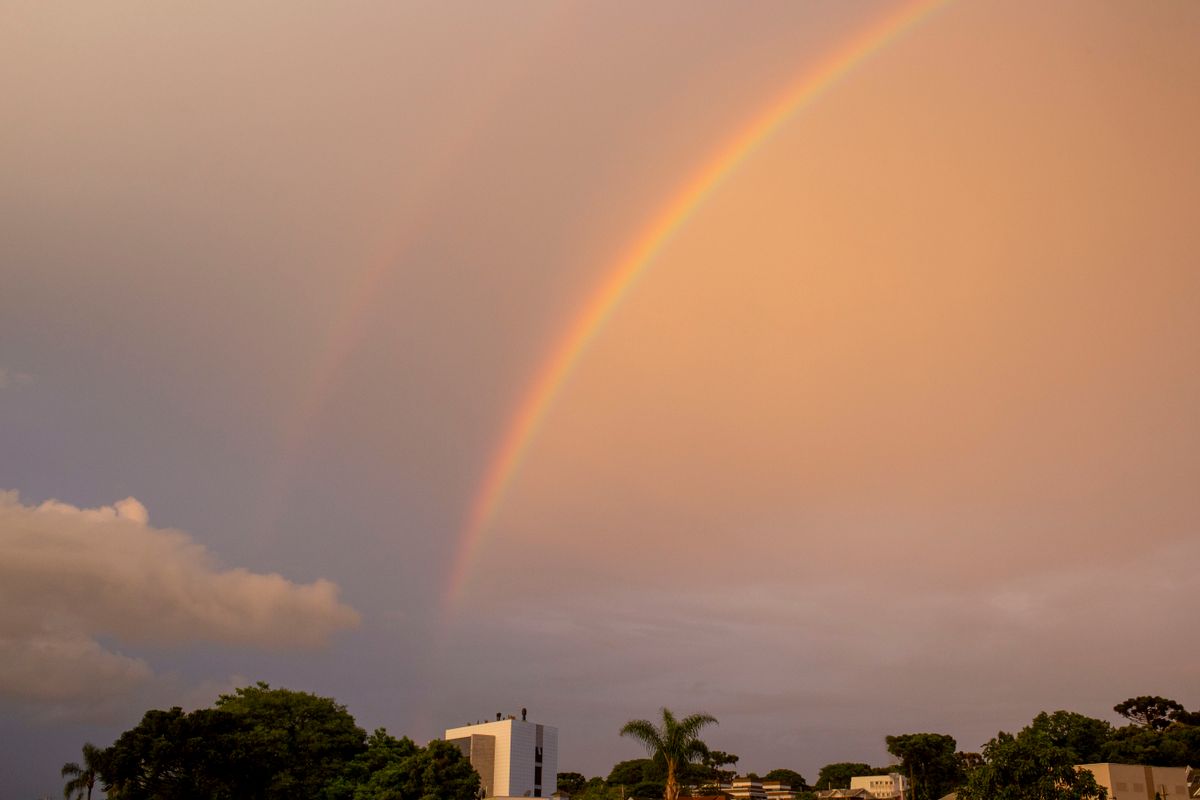
Many people believe a rainbow is a flat arc that touches the ground somewhere in the distance. This is wrong.
A rainbow is not an object. It has no physical location. It is an optical phenomenon — a pattern of light created by millions of water droplets, each sending a specific colour to your eye at a specific angle. As you walk toward where the rainbow appears to touch the ground, the droplets that create it change. The rainbow moves with you. You can never reach it.
This is the physics behind the old legend of the pot of gold at the end of the rainbow. The legend persists precisely because the rainbow always stays out of reach — not because of magic, but because of geometry. The 42° angle that defines the rainbow is fixed relative to your eye, not to the landscape.
External resources
- Wikipedia: Rainbow — comprehensive article covering the physics, history, and variations of rainbows
- Encyclopaedia Britannica: Rainbow — reliable reference with diagrams and historical context
- The Physics Classroom: Rainbow Formation — clear educational tutorial on the refraction and reflection processes inside raindrops
See our guide on reflection vs refraction for the fundamental physics behind rainbow formation, and explore what is light for a beginner's introduction to the nature of light. For the full visible spectrum that makes rainbow colours possible, read about types of light.
Frequently Asked Questions
Why do rainbows appear after rain?
Rainbows appear after rain because the air is filled with millions of suspended water droplets. These droplets act as tiny prisms. When sunlight breaks through the clouds and hits these droplets, each droplet refracts, reflects, and disperses the light. The result is a collective arc of colour that we see as a rainbow. The rain has to stop (or at least thin out) so the sun can shine through, but the droplets need to remain suspended in the air.
What causes a rainbow to have colours?
The colours in a rainbow come from a process called dispersion. Sunlight looks white but actually contains all colours of the visible spectrum. When light enters a water droplet, each colour bends by a slightly different amount because each wavelength travels at a slightly different speed in water. Violet light (shortest wavelength, around 380 nm) bends the most. Red light (longest wavelength, around 700 nm) bends the least. This separation of colours is what produces the familiar spectrum.
Why is a rainbow curved and not straight?
A rainbow is curved because it is actually a cone of light with your eye at the tip. All the raindrops that reflect light toward your eye at exactly the right angle (42° for the primary bow) lie on the surface of an imaginary cone. The intersection of that cone with the sky appears as a circle. From the ground, the ground blocks the bottom half, so we only see a semicircular arc. From an aeroplane, you can sometimes see the full circle.
Can you ever reach the end of a rainbow?
No. A rainbow is not a physical object at a fixed location. It is an optical illusion created by millions of water droplets reflecting and refracting light. As you move, the droplets that form the rainbow change. The rainbow moves with you because the angle between you, the sun, and the droplets must stay at 42°. Two people standing next to each other see different rainbows formed by different droplets. There is no pot of gold at the end — because there is no 'end' to reach.
What is a double rainbow?
A double rainbow occurs when sunlight reflects twice inside a raindrop instead of once. The first internal reflection produces the primary rainbow (brighter, with red on the outside). A second reflection produces the secondary rainbow (fainter, about 10° outside the primary, with colours reversed — red on the inside). The dark band between the two bows is called Alexander's band, named after Alexander of Aphrodisias who first described it around 200 AD.
How many colours are in a rainbow?
The human eye typically distinguishes seven colours in a rainbow: red, orange, yellow, green, blue, indigo, and violet (remembered by the mnemonic ROYGBIV or Richard Of York Gave Battle In Vain). Newton originally chose seven by analogy to the seven notes in a musical scale. However, a rainbow is actually a continuous spectrum — the colours blend into each other without sharp boundaries. Some cultures traditionally recognise fewer colours.

About Umar Farooq
Umar Farooq writes in-depth guides on the physics of light and optics — from reflection, refraction, and lenses to diffraction, lasers, and fiber optics, explained from first principles.
Read more about Umar Farooq →