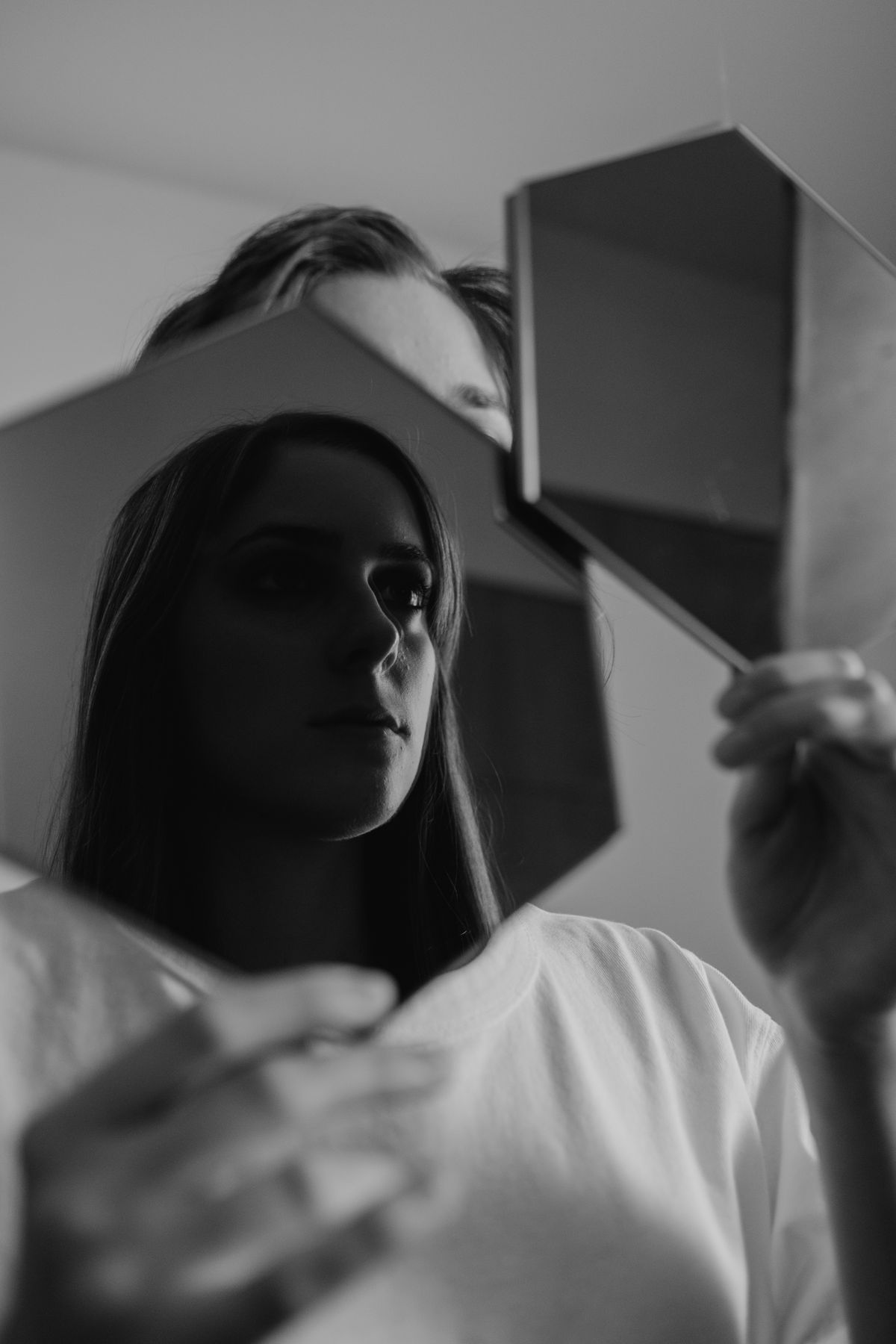
Reflection vs refraction — reflection is light bouncing back into the same medium, like a ball off a wall. Refraction is light bending as it passes into a different medium and changes speed, like a car turning when it drives from tarmac onto sand. Both describe what light does at a boundary, but they are fundamentally different processes governed by their own precise laws. Here are the 7 critical differences, with a full comparison table and examples you can see every day.
What is reflection?
Reflection happens when light hits a surface and bounces back into the material it came from. The rule could not be simpler: the angle at which the light arrives equals the angle at which it leaves, both measured from the line perpendicular to the surface — the normal.
Picture throwing a ball at a wall. Throw it straight on and it bounces straight back. Throw it at an angle and it leaves at the mirror-image angle on the other side. Light does exactly the same thing, and the law of reflection captures it in two tidy statements: the angle of incidence equals the angle of reflection, and the incident, reflected, and normal rays all sit in the same plane.

A smooth surface like a mirror or a calm lake produces a clear image because the reflected rays stay parallel — this is specular reflection. A rough surface like a brick wall reflects light in every direction because the microscopic surface angles are random — this is diffuse reflection, and it is why you can see a wall from any angle but cannot see your face in it. (The Britannica entry on reflection covers the full classification.)
What is refraction?
Refraction happens when light passes through a boundary into a different transparent material and bends because its speed changes. Unlike reflection, the light does not bounce back — it enters the new medium and changes direction along the way.
Here is the picture that makes it click. Imagine a car driving off smooth tarmac onto soft sand at an angle. The wheel that reaches the sand first slows first, so the whole car pivots toward that side. Light does the same at the surface of a pond: the part of the wavefront that reaches the water first slows first, and the beam swings toward the perpendicular.
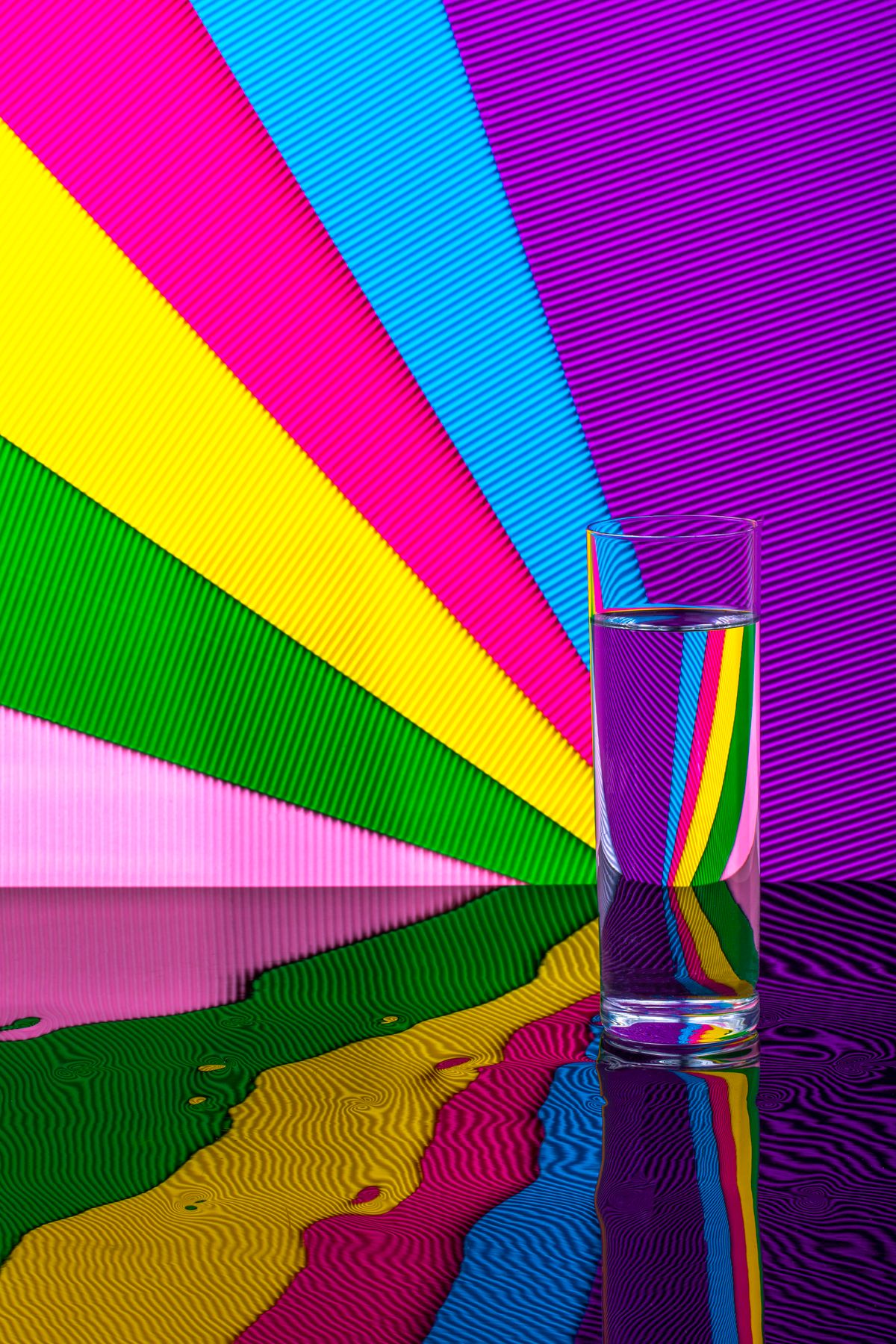
The amount of bending depends on the refractive index of each material. Light travels at 299,792,458 m/s in a vacuum. In water (index 1.333) it drops to about 225,000 km/s. In crown glass (1.52) to about 197,000 km/s. In diamond (2.417) to roughly 124,000 km/s. The larger the speed change, the more the light bends.
The exact relationship follows Snell's law: n₁ sin θ₁ = n₂ sin θ₂. If the light enters a slower medium, it bends toward the normal. If it enters a faster medium, it bends away. The frequency stays the same — only the wavelength and direction change. (Britannica's refraction article has the full mathematical detail.)
Reflection vs refraction: 7 key differences
Here is the full comparison across every dimension that matters:
| Aspect | Reflection | Refraction |
|---|---|---|
| What light does | Bounces back into the same medium | Passes through into a new medium and bends |
| What causes it | Light hits a surface it cannot pass through | Light changes speed crossing a transparent boundary |
| Speed of light | Unchanged — stays in the original medium | Changes — slows or speeds up in the new medium |
| Angle rule | θᵢ = θᵣ (angle in equals angle out) | n₁ sin θ₁ = n₂ sin θ₂ (Snell's law — angles are not equal) |
| Wavelength | Stays the same | Changes (frequency stays the same) |
| Surface type | Opaque or reflective surface (mirror, metal, water) | Transparent interface (air–water, air–glass, water–glass) |
| Common uses | Mirrors, periscopes, solar reflectors, safety vests | Lenses, glasses, microscopes, cameras, prisms, rainbows |

The single most important difference to remember is this: in reflection, light stays in the original medium; in refraction, it enters a new medium and changes speed. Everything else flows from that one fact.
Which one is it, and what tells you
The wave came back into the medium it started in — reflection. Your face in a mirror, a mountain on still water, sound bouncing off a wall. Angle in equals angle out, and the speed never changes.
The wave carried on into a different medium — refraction. The straw that looks bent, the pool that looks shallow, everything a lens does. The speed changes at the boundary, and that speed change is what turns the direction.
What most explanations skip: you rarely get one without the other. Look at a window at night and you see both at once — your reflection in the glass, and the street through it. The same boundary reflects part of the light and refracts the rest. The only question is which part dominates, and that comes down to the angle.
Where you see both every day
Reflection is everywhere you see a mirror-like bounce: checking your appearance, the rear-view mirror in a car, reflective strips on a cyclist's jacket, the Moon shining by reflected sunlight, and a calm lake mirroring the trees.
Refraction is everywhere light passes through a transparent material: every pair of glasses, a camera lens, the bent-looking straw in your drink, the rainbow after rain, a diamond that sparkles with coloured fire, and the heat haze shimmering above a hot road.
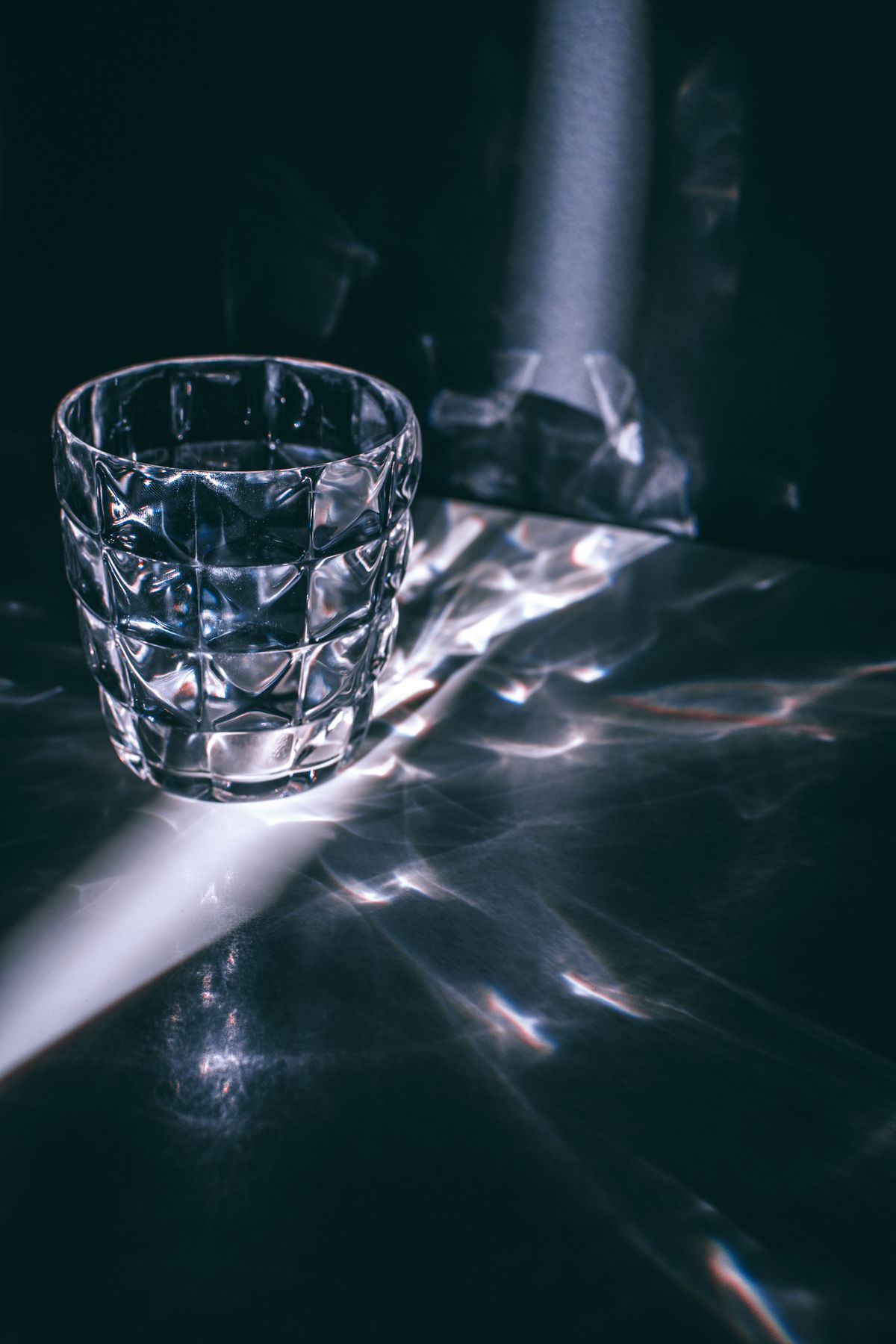
Some effects use both at once. A rainbow refracts sunlight as it enters each raindrop, reflects off the inside surface, and refracts again on the way out. A prism refracts light at both faces while some light reflects internally off the base. The two phenomena often work as a team in nature and in optical instruments.
For more everyday examples of refraction in particular, our guide to refraction examples covers over 20 cases from the natural world and technology. The broader picture of all the wave behaviours — including how reflection and refraction fit alongside diffraction, interference, and polarisation — is in the properties of light.
Common misconception about reflection vs refraction
A persistent wrong idea is that refraction happens because light "bumps into atoms and gets tired." This sounds like a sensible picture — if you bump into things you slow down — but it predicts something that does not happen. Bumping into atoms would scatter light in random directions, not send it cleanly in a new direction at a precisely predictable angle.
The real mechanism is a wave-interference effect. The light wave drives the electric charges in the material, those charges re-radiate their own tiny waves, and the combination of the original and re-radiated waves propagates more slowly. The beam stays organised because the interference is coherent. In plain terms: the medium responds to the wave, and the combined wave moves slower — so it bends.
Reflection, by contrast, really is a bounce — but only off a smooth surface. If the surface is rough at the scale of the wavelength, the organised bounce becomes diffuse scattering. Both phenomena are governed by the same wave nature of light; they just play out differently depending on what the light meets at the boundary.
Worked example: the same ray, reflected versus refracted
Let us compare what happens when a single ray meets two different surfaces at the same 30° angle.
Reflection at a mirror. A ray strikes a flat mirror at 30° from the normal. It leaves at exactly 30° on the other side. No calculation needed — the law of reflection gives the answer instantly.
Refraction at a water surface. The same ray hits a still pool at 30° from the normal. Using Snell's law:
sin θ₂ = (n₁ / n₂) × sin θ₁ = (1.0003 / 1.333) × sin 30° = 0.750 × 0.500 = 0.375
θ₂ = sin⁻¹(0.375) = 22°
The ray bends toward the normal by about 8° as it enters the water. That 8° shift is why a straw looks displaced at the surface — your eye traces the light back in a straight line and reaches the wrong conclusion about where the underwater part sits.
For more step-by-step refraction calculations with different material pairs, see our guide to Snell's law and the angle of refraction. To understand what causes the speed change in the first place, read what causes refraction.
Frequently Asked Questions
What is the main difference between reflection and refraction?
The main difference is what happens to the light. In reflection, light bounces back into the same medium it came from, like a ball off a wall. In refraction, light passes through the boundary into a new medium and bends because its speed changes, like a car turning when it drives from tarmac onto sand at an angle.
Do mirrors use reflection or refraction?
Mirrors use reflection. A mirror has a smooth, polished surface that bounces light rays back into the same medium, forming an image. The angle at which the light hits equals the angle at which it bounces away — this is the law of reflection.
Do glasses use reflection or refraction?
Eyeglasses and contact lenses use refraction. They are curved pieces of glass or plastic that bend (refract) incoming light to focus it correctly on the retina. This compensates when the eye's natural lens focuses light slightly in front of or behind the retina.
What are some examples of reflection and refraction?
Everyday examples of reflection include seeing yourself in a mirror, a still lake reflecting mountains, and a shiny car bonnet reflecting sunlight. Examples of refraction include a straw looking bent in a glass of water, a swimming pool appearing shallower than it is, rainbows, and the way a magnifying glass focuses sunlight to a point.
How are reflection and refraction similar?
Both reflection and refraction involve light changing direction when it meets a boundary between two different media. Both follow precise mathematical laws — the law of reflection for reflection and Snell's law for refraction. Both are wave behaviours and are fundamental to how we see and interact with the world.
What is the law of reflection?
The law of reflection says the angle of incidence equals the angle of reflection. Both angles are measured from the normal — an imaginary line perpendicular to the surface. The incident ray, the reflected ray, and the normal all lie in the same plane.
What is Snell's law of refraction?
Snell's law gives the exact relationship between the incident and refracted angles: n1 sin θ1 = n2 sin θ2, where n is the refractive index of each medium. It predicts exactly how much the light will bend when it crosses a boundary, based on the speed change between the two materials.

About Umar Farooq
Umar Farooq writes in-depth guides on the physics of light and optics — from reflection, refraction, and lenses to diffraction, lasers, and fiber optics, explained from first principles.
Read more about Umar Farooq →