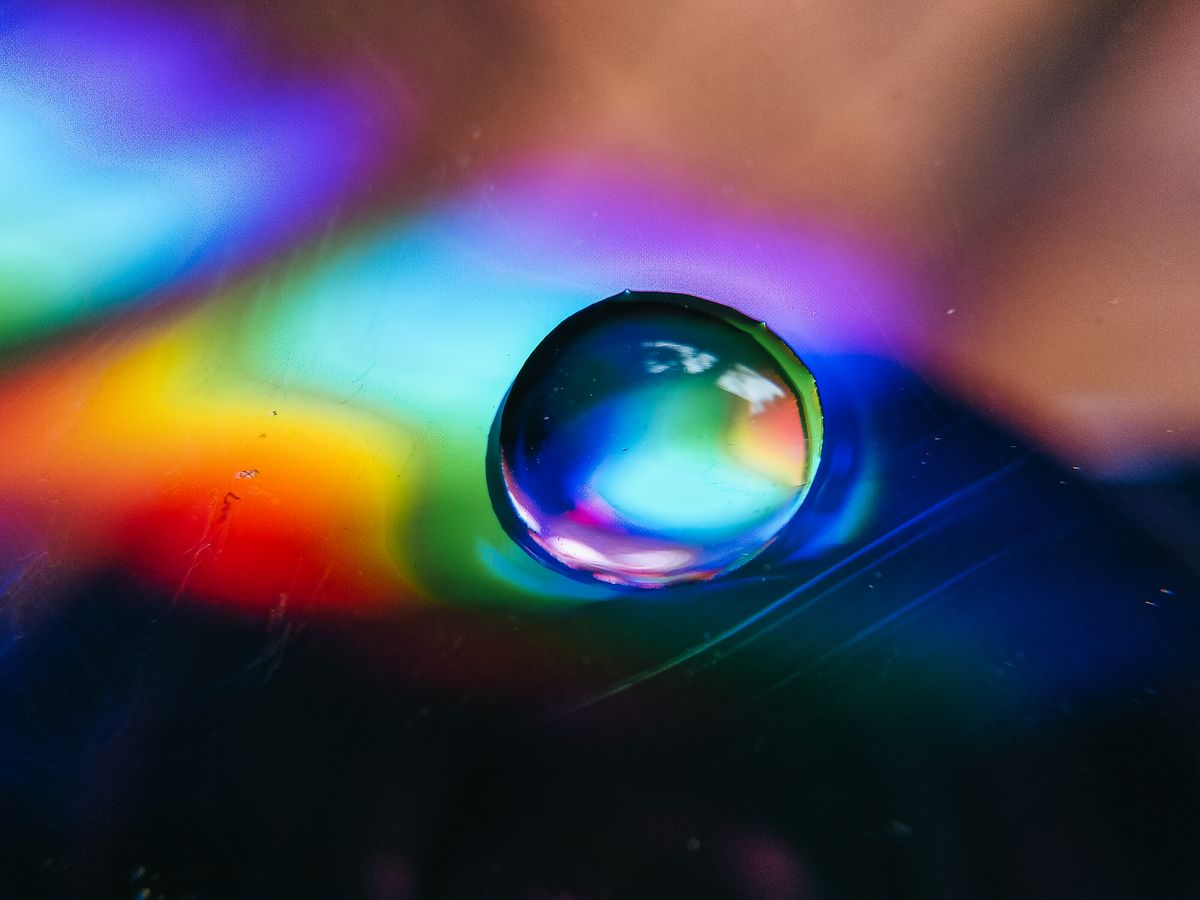
Refraction of light in water is the bending of light as it crosses between air and water. Light travels at about 299,700 km/s in air but slows to roughly 225,000 km/s in water (refractive index 1.333), and this speed change at the surface is what bends the beam. It's why a straw looks broken in a glass, why a swimming pool appears shallower than it is, and why rainbows form. Here's the full physics — from the everyday effects to the numbers that predict them.
What is refraction of light in water?
Refraction of light in water is simply what happens when a light ray crosses the boundary between air and water at an angle and changes direction because its speed changes. Entering water from air, the ray slows and pivots toward the perpendicular (the normal line). Leaving water for air, it speeds up and pivots away.
Here's the picture that makes it click. Imagine a car rolling off a paved road onto a soft gravel shoulder at an angle. The wheel that meets the gravel first slows first, and the whole car swings toward that side. Light entering water does the same: the part of the wavefront that reaches the water first slows first, so the beam turns.
The key number that governs all of this is water's refractive index, 1.333 at 20 °C. Compared to air at roughly 1.0003, this is a significant jump — meaning light slows by about 25%. That's a large enough change to produce the dramatic bending you see in everyday life. (The Science Learning Hub's refraction guide shows a good refractive index table for water alongside other common materials.)
5 everyday examples of refraction of light in water
1. A straw or pencil looks bent in a glass
The classic example. Fill a glass halfway with water, drop in a straw, and look from the side. The straw appears to snap at the waterline. The underwater section looks shifted and slightly magnified. Light from that section exits the water, speeding up and bending away from the normal, so your eye traces it to the wrong place.
2. A swimming pool looks shallower than it really is
Stand at the edge of a pool and the bottom looks closer than it is. Light from the pool floor bends away from the normal as it exits the water, raising the apparent image. The effect is strongest when you look from a low angle. For a pool that's 2 m deep, the apparent depth is only about 1.5 m — the ratio is set by the refractive indices (actual depth ÷ apparent depth = n_water / n_air ≈ 1.33).
3. Fish appear to be somewhere they aren't
This is the same physics as the straw, but with real stakes. Light from a fish bends away from the normal as it exits the water, so the fish appears higher and closer to the surface than it really is. Experienced spearfishers learn to aim below the apparent fish. The archer fish, which shoots down insects by spitting water, instinctively makes the opposite correction — it aims above the apparent insect because it sees from below.
4. Rainbows: sunlight refracting through millions of water drops
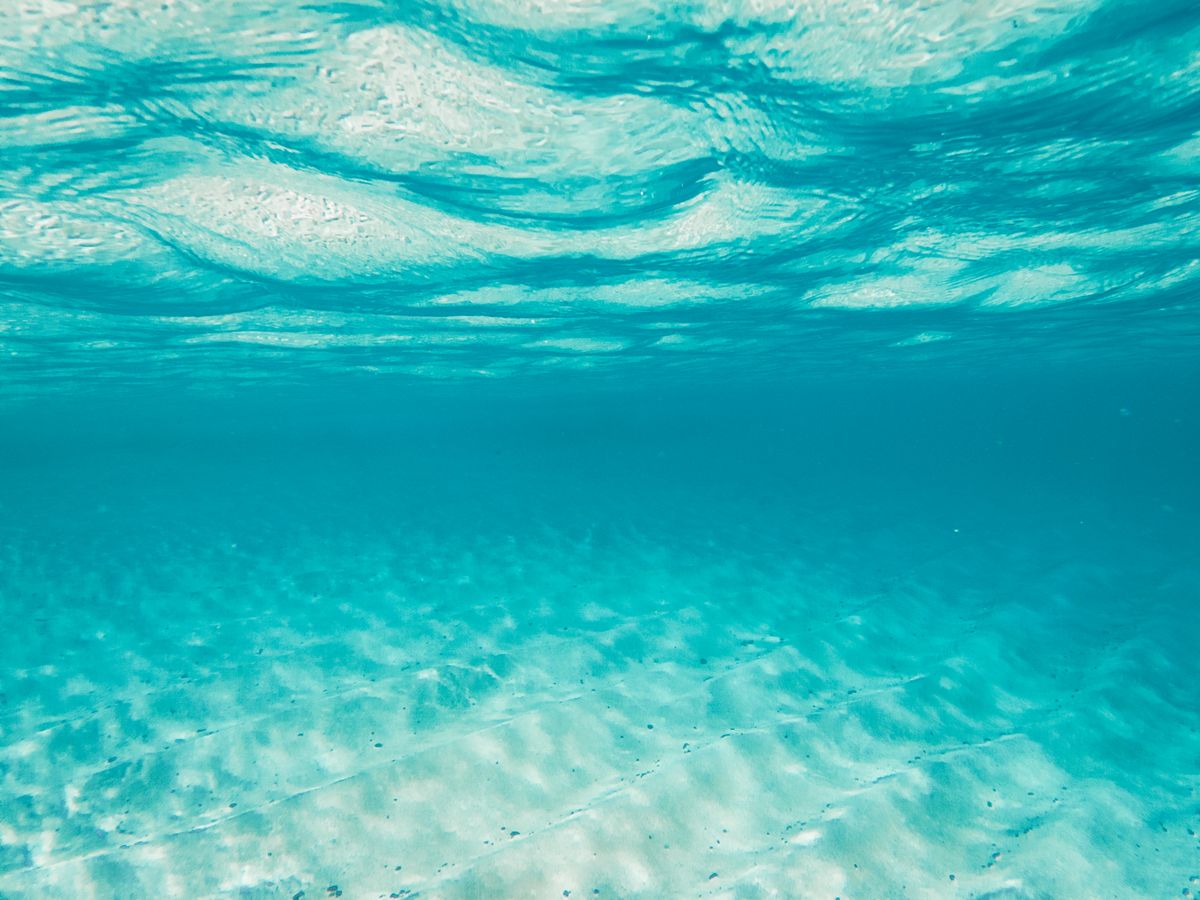
A rainbow is a spectacular case of refraction of light in water. Sunlight enters a raindrop, refracts (bends), reflects off the inside, and refracts again as it exits. Because each colour has a slightly different refractive index in water — blue marginally higher than red — the white light fans out into a spectrum. The primary bow sits at about 42° from the antisolar point, red on the outer edge at 42° and violet on the inner at about 40°.
5. The setting Sun looks flattened
On a clear evening, the Sun appears squashed into an oval just before it dips below the horizon. That's atmospheric refraction: light from the Sun's lower edge bends more as it passes through denser air near the horizon, lifting that edge more than the top. The same effect lets you see the Sun for a few extra minutes after it has geometrically set.
Why water bends light: the speed factor
Refraction of light in water comes down to one number: the speed of light in water is about 225,000 km/s, compared to 299,792,458 m/s in a vacuum and essentially the same in air.
When a wavefront hits the water surface at an angle:
- The part that reaches the water first slows to 225,000 km/s first
- The rest of the wavefront continues at full speed for a fraction of a second longer
- The wavefront pivots
The direction of the pivot is consistent: into water, the ray bends toward the normal; back into air, it bends away. And here's a subtle point worth fixing: people sometimes picture light getting "tired" or "dragged" in water. That's not it. Light isn't slowed by friction. The wave drives electrons in the water, which re-radiate their own waves, and the combined wave travels slower. The light hasn't lost energy — it's still the same frequency — it's just propagating through a medium that responds to it. (The OpenStax refraction chapter walks through the full wave explanation and the index-of-refraction definition with real values.)
Snell's law: predicting the bend in water
The exact relationship that predicts refraction of light in water is Snell's law:
n₁ sin θ₁ = n₂ sin θ₂
For air → water: n₁ = 1.0003 (air), n₂ = 1.333 (water) For water → air: n₁ = 1.333 (water), n₂ = 1.0003 (air)
Worked example 1 — light entering water. A ray hits the water surface at 30° to the normal. What's the angle inside?
sin θ₂ = (1.0003 × sin 30°) ÷ 1.333 = 0.500 ÷ 1.333 = 0.375 θ₂ ≈ 22°
The ray bends toward the normal by about 8°.
Worked example 2 — light leaving water. A ray from underwater hits the surface at 30° to the normal. What's the angle in air?
sin θ₂ = (1.333 × sin 30°) ÷ 1.0003 = 0.667 ÷ 1.0003 = 0.666 θ₂ ≈ 42°
The ray bends away from the normal by about 12° — a noticeably larger bend, which is why the straw-in-water illusion is so striking.
Critical angle for water: when refraction stops
There's a limit. As the angle inside water gets larger, the exiting ray bends more and more until it reaches 90° — skimming the surface. That happens at about 48.6° for a water-to-air boundary. Beyond that angle, the light can't escape at all. It reflects back into the water instead — total internal reflection.
This is why a submerged object viewed from above disappears if you look from a steep enough angle. It's also the principle behind fibre optics, where light is trapped inside a glass core and bounces along for kilometres with almost no loss. For water, the critical angle of 48.6° means that any ray hitting the surface steeper than that from below stays inside. (For comparison, the critical angle from crown glass to air is about 41.8°, and from diamond to air just 24.4°.)
Common misconception about refraction of light in water
The most persistent wrong idea is that refraction of light in water happens because "light bounces off water molecules like bumper cars." That picture sounds plausible but it predicts scattered, randomised light paths — not the clean, predictable bend that Snell's law describes.
What actually happens is a wave-interference effect. Light's oscillating electric field drives the water molecules' electrons, which re-radiate their own electromagnetic waves. The original wave and all these re-radiated waves combine through interference. The resulting composite wave propagates more slowly — hence the lower speed and the bend. It's not individual photons bouncing; it's the whole wavefront adjusting to its new environment.
Temperature matters: how warm water changes refraction
Water's refractive index isn't fixed. It varies with temperature — warmer water has a slightly lower index because the molecules are farther apart and respond differently to the light wave. At 20 °C the index is 1.333; at 80 °C it drops to about 1.329. The change is small per degree, but over large bodies of water or in thermal gradients, it produces visible effects — like the shimmering heat haze above a sun-warmed lake, where layers of water at different temperatures refract light by slightly different amounts.
This is also why refraction of light in water matters in oceanography: sound speed in water changes with temperature too, bending sonar signals in ways that must be accounted for.
For more everyday examples of light bending at boundaries, see our full guide to refraction examples. To understand the deeper mechanism of why speed changes cause bending, read what causes refraction. And for the broader picture of how refraction fits among the other wave behaviours, check the properties of light.
Frequently Asked Questions
What is refraction of light in water?
Refraction of light in water is the bending of light as it crosses from air into water or from water back into air. It happens because light travels at different speeds in the two media — about 299,700 km/s in air and 225,000 km/s in water. When the light hits the surface at an angle, the change in speed causes it to change direction.
Why does light refract in water?
Light refracts in water because it slows down when entering water (n = 1.333) from air (n ≈ 1.0003). The part of the wavefront that reaches the water first slows first, which pivots the whole beam toward the normal. Leaving water and returning to air does the opposite — the light speeds up and bends away from the normal.
What is the refractive index of water?
The refractive index of water at 20 °C is 1.333. This means light travels at about 225,000 km/s in water, compared to 299,792,458 m/s in a vacuum. The index varies slightly with wavelength (blue light has a marginally higher index than red) and with temperature (warmer water has a slightly lower index).
How much does light bend in water?
The amount depends on the angle and follows Snell's law: n1 sin θ1 = n2 sin θ2. For example, light entering water from air at 30° to the normal bends to about 22°. Leaving water at 30° from inside, the ray bends to about 41° in air — a much larger change because the speed increase is more dramatic coming out.
Does water refract light more than glass?
No — glass has a higher refractive index (crown glass ≈ 1.52) than water (1.333), so glass bends light more. That said, water still produces a very noticeable bend because the speed change from air (≈ 299,700 km/s) to water (≈ 225,000 km/s) is a significant 25% drop. Glass drops to about 197,000 km/s, a 34% decrease.
Why does a straw look bent in water?
The straw itself isn't bent. Light from the underwater part of the straw travels from water to air, speeding up and bending away from the normal as it exits. Your brain traces that light back in a straight line, so the underwater section appears at a different, shallower position. The apparent shift is exactly what Snell's law predicts.

About Umar Farooq
Umar Farooq writes in-depth guides on the physics of light and optics — from reflection, refraction, and lenses to diffraction, lasers, and fiber optics, explained from first principles.
Read more about Umar Farooq →