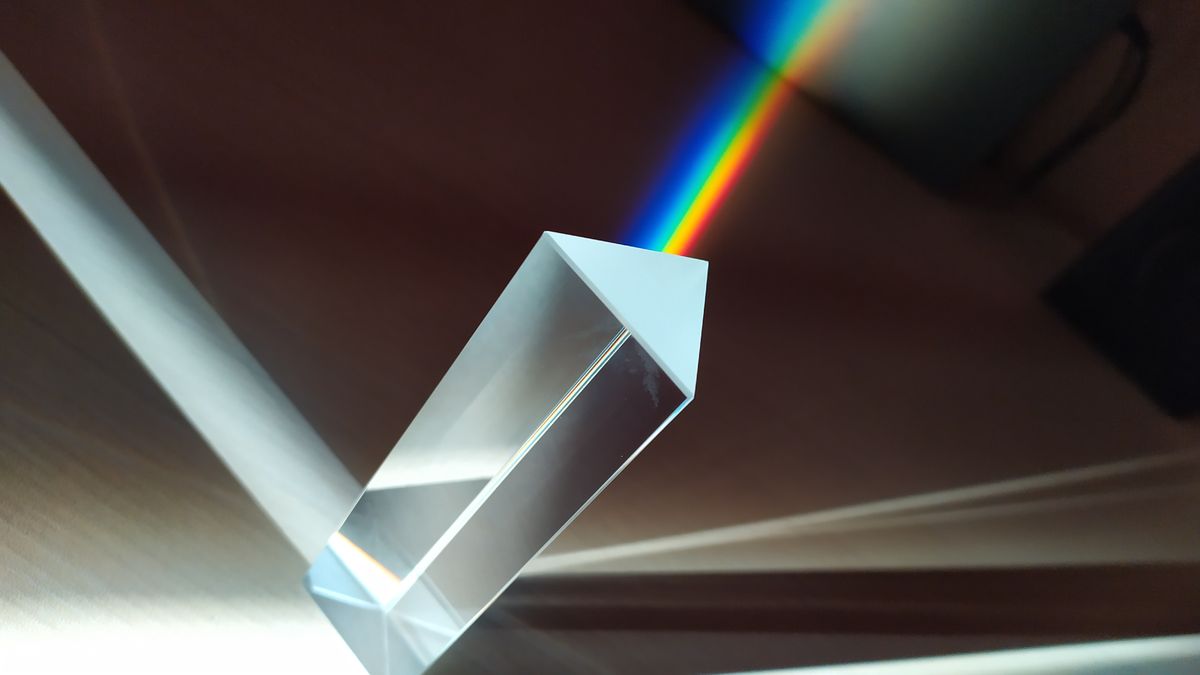
Refraction through a prism is what happens when light passes through a triangular block of glass and bends twice — once entering and once leaving — ending up in a direction different from where it started. The key difference from a flat slab is that the two surfaces aren't parallel, so the light emerges at an angle, not just shifted sideways. When that light is white, each colour bends by a different amount and the beam fans out into a rainbow spectrum. Here's the full physics — from Snell's law at both faces to the angle of minimum deviation.
What is refraction through a prism?
A prism is a transparent block — usually glass or acrylic — with two flat, polished surfaces that meet at an angle called the apex angle (or refracting angle), typically 60° for laboratory prisms. The third side is the base.
Refraction through a prism works like this:
- Light enters the first face travelling from air (rarer medium) into glass (denser medium) — it slows and bends toward the normal
- Inside the prism, light travels in a straight line, now angled relative to the base
- Light exits the second face travelling from glass back into air — it speeds up and bends away from the normal
Because the two faces are slanted toward each other, the two bends add up instead of cancelling out, and the beam emerges in a new direction. The total angular change — the difference between the original and final direction — is the angle of deviation.
This is where a prism differs from a flat glass slab. In a slab the faces are parallel, so the ray enters and exits at the same angle and the net direction doesn't change — only a small sideways shift. In a prism, there's real angular deviation. (The Physics Classroom's dispersion tutorial walks through the geometry in more detail.)
How light travels through a prism: step by step
Here's the picture that makes it stick. Think of a runner entering a patch of mud at an angle — one foot hits the mud first and slows, so the runner pivots toward the mud side. Then imagine the runner leaving the mud patch through a second edge that's also angled — the foot that leaves first speeds up first, and the runner pivots the other way. That's exactly what light does entering and exiting a prism.
Let's label the angles. Call the apex angle of the prism α (typically 60°). When a ray hits the first face at an angle of incidence θ₁ (measured from the normal):
- It bends to an angle φ₁ inside the glass, given by Snell's law: n_air sin θ₁ = n_glass sin φ₁
- The ray then travels to the second face, where it meets that surface at an angle φ₂ measured from the normal inside
- It emerges into air at an angle θ₂, again following Snell's law: n_glass sin φ₂ = n_air sin θ₂
The geometry of the prism links the internal angles: φ₁ + φ₂ = α (the apex angle). The total deviation D is the sum of both bends: D = θ₁ + θ₂ − α.
For crown glass (n ≈ 1.52) with a 60° prism and a typical incident angle of 40°, the ray emerges at around 65° — a deviation of about 45° from its original direction.
Why a prism splits white light: dispersion
Here's the part that makes refraction through a prism so famous. White light isn't a single colour — it's a mixture of every wavelength from about 380 nm (violet) to 700 nm (red). And here's the crucial fact: glass has a slightly different refractive index for each wavelength.
For crown glass at 20 °C:
- Red light (660 nm): n ≈ 1.512
- Yellow light (580 nm): n ≈ 1.518
- Blue light (470 nm): n ≈ 1.524
- Violet light (410 nm): n ≈ 1.530
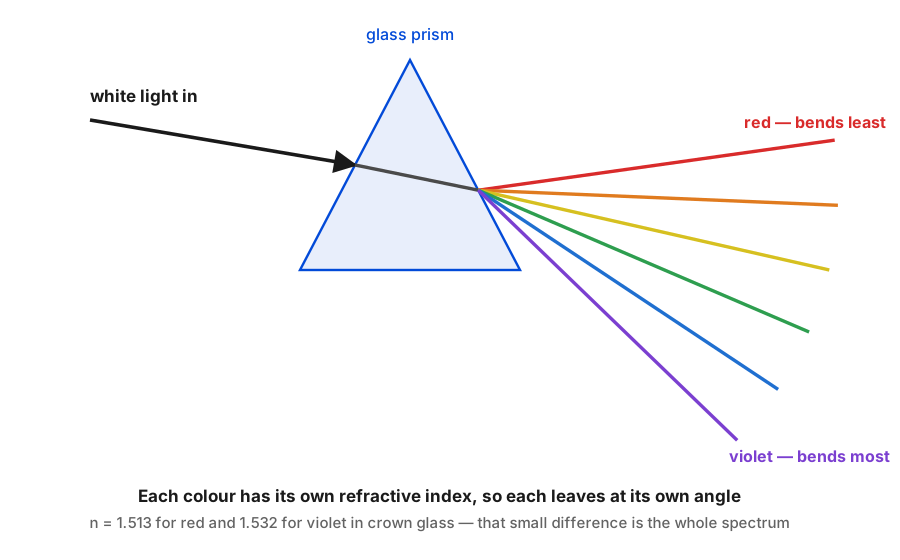
Violet slows the most and bends the most; red slows the least and bends the least. Inside the prism, the colours separate into a fan, and by the time they emerge, they're spread out into the familiar sequence: red, orange, yellow, green, blue, indigo, violet.
A common misconception worth correcting: people sometimes imagine the prism adds colour to white light. It doesn't. In the 1660s, Isaac Newton let sunlight through a prism, saw the spectrum, then passed just one colour through a second prism — it stayed that colour. He then recombined the colours back into white with a third prism. The colours were inside white light the whole time; the prism only separates them by how much each bends. (The Wikipedia article on optical prisms covers the different types of prisms and their uses in detail.)
The angle of minimum deviation
There's a special case that lab technicians and textbook writers love. If you rotate the prism while keeping the incident ray fixed, the deviation D changes. It reaches a minimum — the angle of minimum deviation, D_min — when the ray inside the prism travels parallel to the base. At this point, the angles on both faces are symmetric: θ₁ = θ₂ and φ₁ = φ₂.
The minimum deviation is important because it gives a very clean formula for the refractive index:
n = sin((D_min + α) / 2) / sin(α / 2)
This is how refractive indices are measured in optics labs: put a prism of the material on a spectrometer, find the angle of minimum deviation for a known wavelength, and plug it in. The method is accurate to several decimal places.
For a 60° crown glass prism, D_min is about 51° for yellow light, giving n ≈ 1.52 — right where it should be.
Glass slab vs prism: what's the difference?
| Property | Glass slab | Prism |
|---|---|---|
| Refracting surfaces | Parallel | Angled (apex angle α) |
| Emergent ray direction | Parallel to incident ray | Deviated by angle D |
| Net effect | Lateral shift only | Angular deviation |
| Dispersion | Negligible | Clear spectrum |
| Formula | No deviation term | D = θ₁ + θ₂ − α |
This is why a window doesn't produce a rainbow but a prism does — the parallel surfaces of a window cancel the bend on entry and exit, while a prism's angled surfaces add them up.
Real-world objects that work like prisms
Refraction through a prism isn't limited to triangular glass blocks. Any transparent object with non-parallel surfaces produces the same effect:
- Raindrops — Sunlight entering a raindrop refracts, reflects off the back, and refracts again on exit, producing a full rainbow at about 42° from the antisolar point
- Diamonds — A diamond's high refractive index (2.417) and strong dispersion produce the brilliant flashes of colour known as "fire"
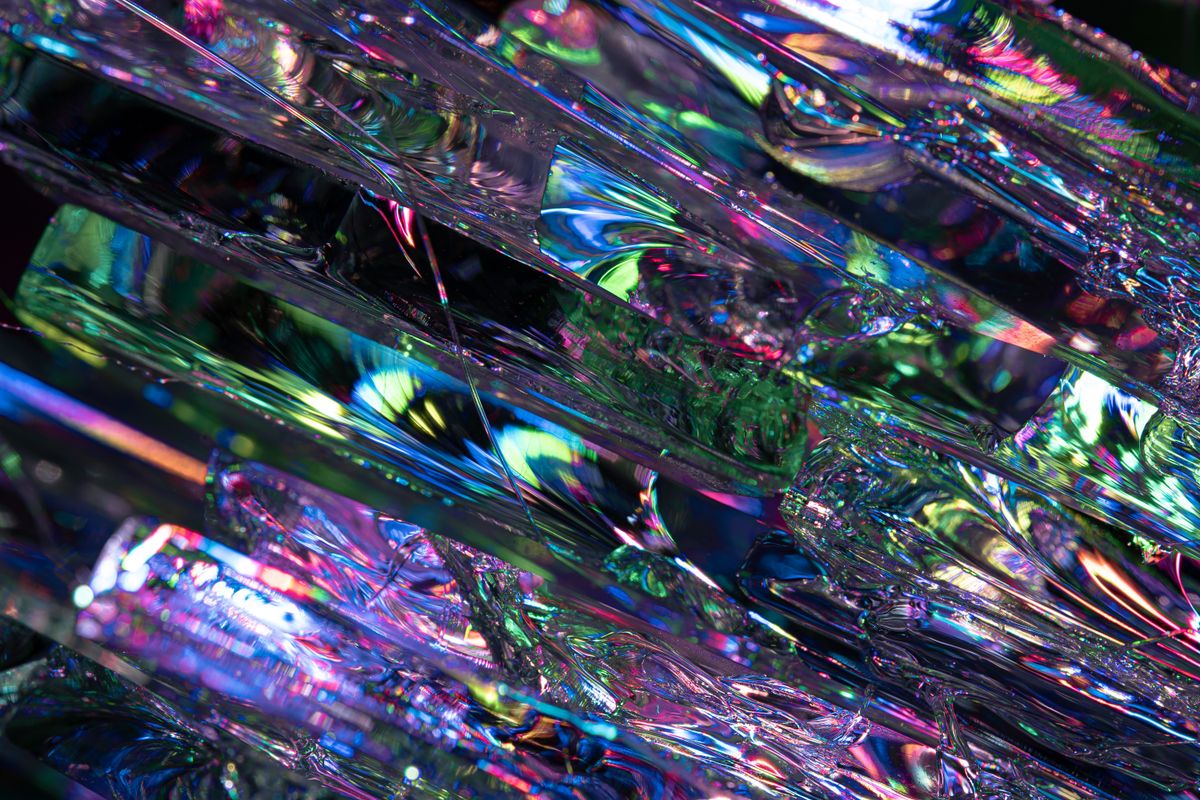
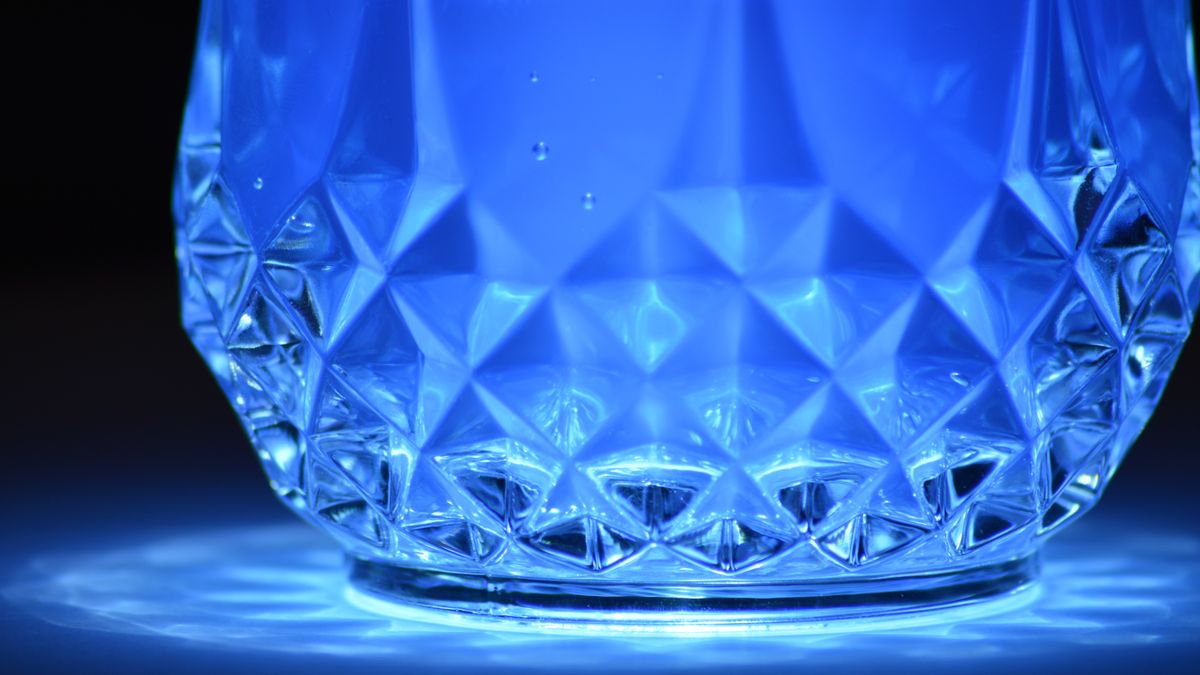
- Glass chandelier crystals — The angled cuts create tiny spectra that scatter coloured light around a room
- Ice crystals in the upper atmosphere — Hexagonal ice crystals act as prisms, producing 22° halos around the Sun or Moon
- Bevelled mirrors and glass edges — The angled cut on a mirror's edge can produce a thin spectrum
For more examples of light bending at boundaries, see our guide to refraction examples. To understand the deeper mechanism of why speed changes cause the bend, read what causes refraction. And for how water specifically bends light, see refraction of light in water.
Frequently Asked Questions
What is refraction through a prism?
Refraction through a prism is the bending of light as it passes through a transparent triangular block. Light refracts twice — once entering the glass and once leaving it — and because the two surfaces are angled toward each other, the emergent ray follows a different path from the incident ray. The total change in direction is called the angle of deviation.
Why does a prism split white light into colours?
A prism splits white light because each colour has a different wavelength, and glass has a slightly different refractive index for each wavelength. Violet light (shortest wavelength) slows the most and bends the most; red light (longest wavelength) slows the least and bends the least. This spread of colours is called dispersion. Newton proved the colours were inside the white light all along by recombining them with a second prism.
What is the angle of deviation in a prism?
The angle of deviation is the angle between the original direction of the incident ray and the direction of the emergent ray. It depends on the prism's apex angle, the refractive index of the glass, and the angle of incidence. There is a specific angle of incidence at which the deviation reaches its smallest possible value — the angle of minimum deviation — and the ray inside the prism travels parallel to the base.
What is the difference between refraction through a glass slab and a prism?
In a glass slab, the two refracting surfaces are parallel, so the emergent ray is parallel to the incident ray and there is no net deviation — only a lateral shift. In a prism, the surfaces are angled, so the emergent ray is not parallel to the incident ray and the light undergoes a net angular deviation. A prism also produces dispersion; a slab does not separate colours clearly.
What objects refract light like a prism?
Any transparent object with non-parallel surfaces can refract light like a prism. Common examples include raindrops (which create rainbows), cut diamonds (which sparkle because of high dispersion), glass chandelier crystals, bevelled mirrors, and the hexagonal ice crystals in the upper atmosphere that produce 22° halos around the Sun.
How do you calculate the angle of deviation through a prism?
The deviation D = θ₁ + θ₂ − α, where θ₁ is the angle of incidence, θ₂ is the angle of emergence, and α is the prism's apex angle. For the special case of minimum deviation (when the ray inside is parallel to the base), the refractive index n = sin((D_min + α)/2) / sin(α/2). This formula is used in laboratories to measure a material's refractive index very accurately.

About Umar Farooq
Umar Farooq writes in-depth guides on the physics of light and optics — from reflection, refraction, and lenses to diffraction, lasers, and fiber optics, explained from first principles.
Read more about Umar Farooq →