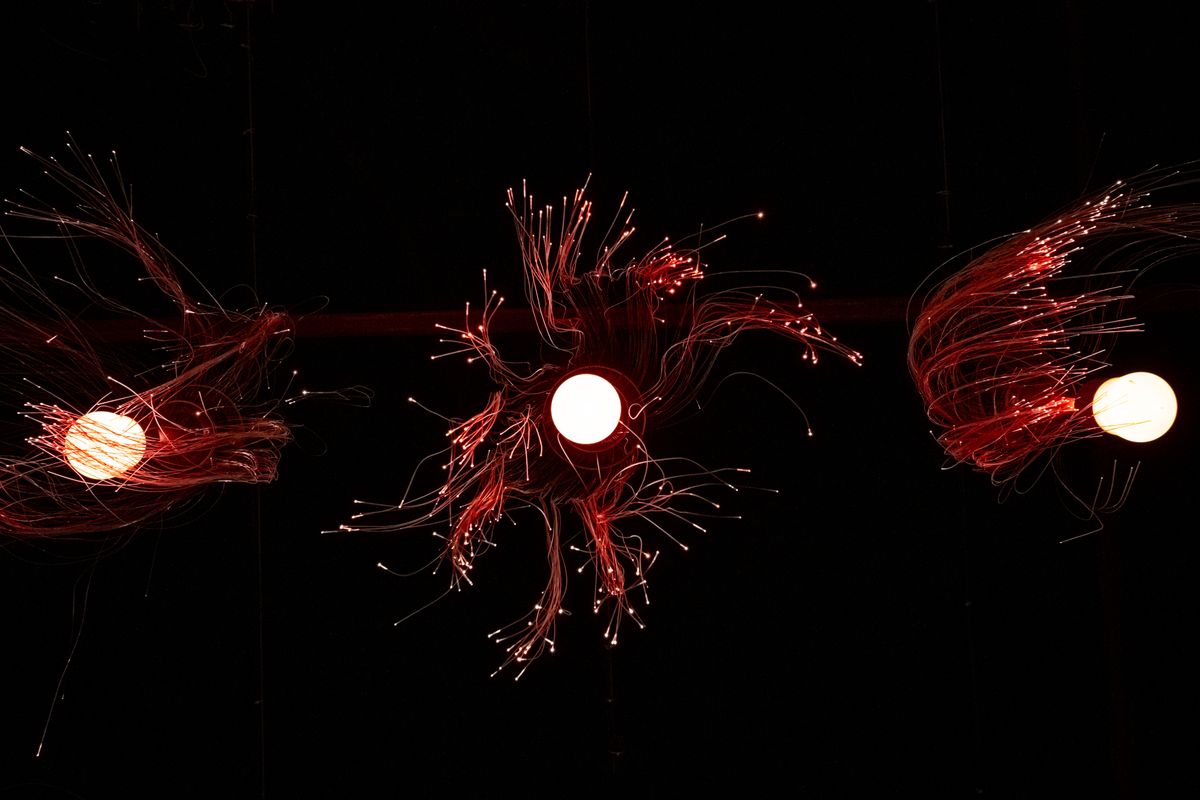
Fiber optic lighting works by piping light from a source through thin glass or plastic fibres using total internal reflection. Unlike a light bulb that glows everywhere at once, fibre optic lighting delivers light precisely where you want it — with no electricity at the delivery point, almost no heat, and colours that never fade.
Here is what we cover: how fibre optic lighting works (with the physics), the two main types of fibre, the system components, and the most popular applications — from swimming pools and museum displays to car dashboards and light piping that brings sunlight indoors.
What Is Fiber Optic Lighting?
Fiber optic lighting uses optical fibres — thin, flexible strands of glass or plastic — to transmit light from a source to a remote location. The fibre acts like a pipe for light: the source glows in one place, and the light travels through the fibre and emerges somewhere else.
This is fundamentally different from a conventional light bulb. In a standard bulb, the light source and the illumination point are the same place. In fibre optic lighting, they are separated — sometimes by many metres. The light source sits in a protected location, and only the passive glass or plastic strand reaches the installation site.
This separation is the whole point. It means you can put light where a bulb cannot go: underwater, inside a sealed museum case, through a wall cavity, or across a wet bathroom floor — with zero electricity and minimal heat at the delivery end.
How Fiber Optic Lighting Works
The physics behind fibre optic lighting is total internal reflection — the same principle that makes diamonds sparkle and lets the internet travel across oceans.
Here is the picture. In 1842, Swiss physicist Jean-Daniel Colladon wanted his lecture audience to see what happened inside a falling jet of water, so he piped sunlight into the stream. The light got trapped inside the curving water, bouncing off the inner surface and following the jet as it arced down into a basin. The audience saw a glowing, bending thread of light — a beautiful party trick that is exactly the physics behind modern fibre optic lighting.
Here is what is actually happening. Inside a fibre optic cable, light travels through the core — a thin cylinder of ultra-pure glass or plastic. The core is surrounded by cladding, a layer of material with a slightly lower refractive index. When light in the core hits the boundary with the cladding at an angle greater than the critical angle, it reflects entirely back into the core instead of escaping. This repeat reflection — total internal reflection — confines the light to the core for the entire length of the fibre.
The critical angle for a typical glass–air boundary is about 41.8°. For the core–cladding boundary inside an optical fibre, the critical angle is designed to be small enough that most of the light entering the core becomes trapped. Only light that enters within a narrow acceptance cone at the input end will propagate; anything outside that cone escapes through the cladding and is lost.
Light that enters the fibre in this way bounces down the core at hundreds of thousands of reflections per metre. The loss is remarkably small — modern fibres lose about 0.2 dB per kilometre at 1550 nm, meaning a beam can travel many kilometres before losing half its power.
End-Glow vs Side-Glow Fiber
There are two fundamentally different types of fibre used in lighting, and they produce very different visual effects.
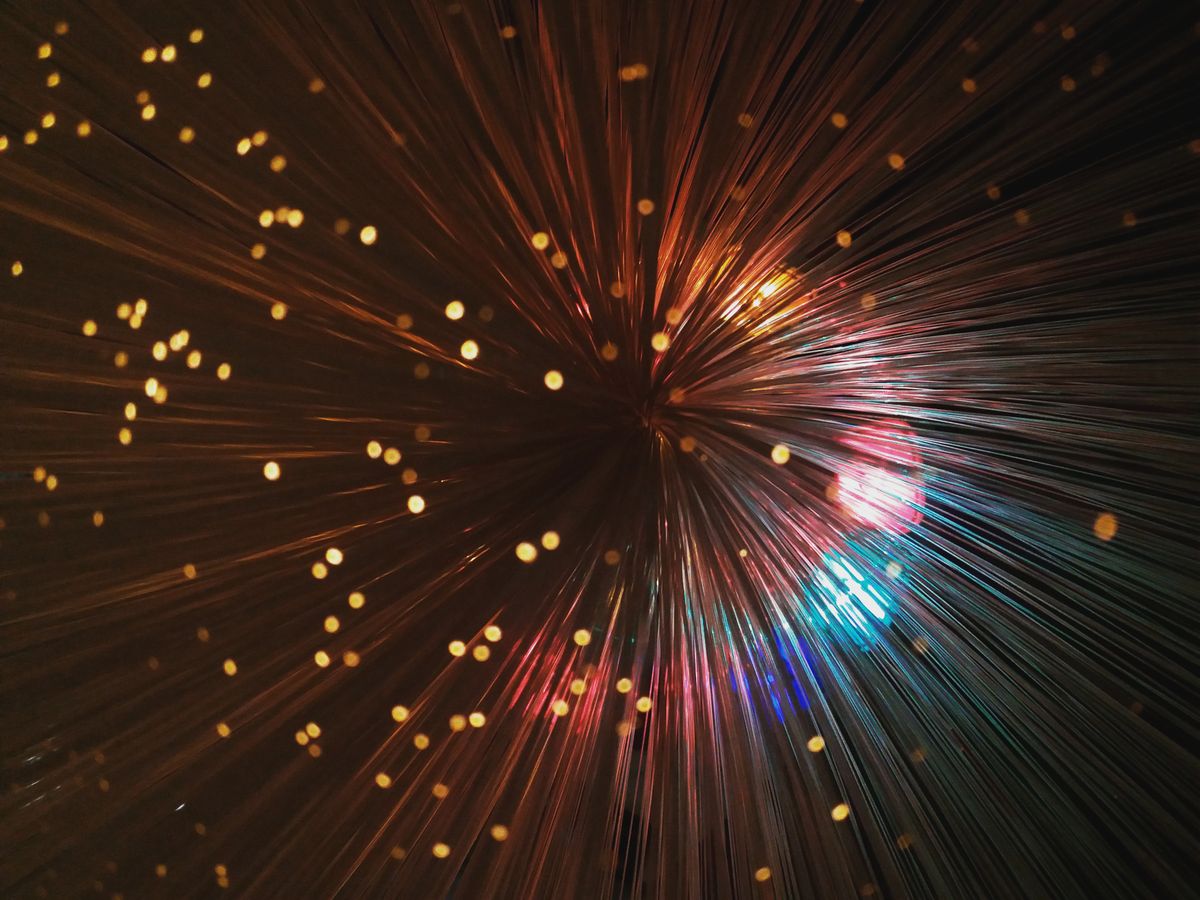
End-glow fibre is standard optical fibre. It transmits light from one end to the other with minimal loss along the way. The light only exits at the far tip. End-glow fibre is used when you need a focused spot of light at a specific point — a single bright star in a ceiling, a pinpoint accent on a museum exhibit, or a small illuminated indicator.
Side-glow fibre is manufactured differently. The core is deliberately roughened or doped with light-scattering particles so that some light leaks out along the entire length of the strand. The whole cable glows softly, like a neon tube. Side-glow fibre is used for decorative outlines, signage, and accent lighting where the cable itself is the visible element — think of the glowing strands in a fibre optic Christmas tree or the colourful light trails in a party decoration.
Side-glow fibre is less efficient than end-glow because it intentionally wastes light. A typical side-glow strand loses about 25–50% of its light over a metre of length, depending on the design. This is fine for short decorative runs but impractical for long-distance transmission.
Components of a Fiber Optic Lighting System
A complete fibre optic lighting system has three parts:
1. The light source (illuminator). This is the engine. It is usually a high-output LED or halogen lamp housed in a box that sits away from the illuminated area. The source may include a colour wheel — a rotating disc of coloured filters — to produce changing colours at the output end. Higher-end units use RGB LEDs that mix colours electronically for smooth transitions and millions of colour combinations.
2. The fibre optic cable. This carries the light from the source to the destination. For lighting, the fibre is typically plastic (POF — plastic optical fibre) for short decorative runs, or glass (silica) for longer distances or higher light output. Cable diameters range from 0.5 mm for tiny accent points to 20 mm or more for large light projects.
3. The end fittings. These are the fixtures at the delivery end. They include lenses that focus or spread the beam, bezels that mount flush into ceilings or walls, and decorative tips that shape the light into stars, points, or patterns.
The critical rule: the light source must be more powerful than the end result suggests, because some light is always lost in the fibre. A rule of thumb is that losses run about 10–15% per metre in glass end-glow fibre, and far more in side-glow or plastic fibre.
Decorative and Architectural Lighting
Fiber optic lighting is widely used in architecture and interior design for effects that are difficult or impossible with conventional bulbs.
Starry ceilings are the most recognised application. An end-glow fibre bundle is fed through a ceiling panel, and each fibre terminates in a tiny hole in the ceiling surface. The result is a ceiling covered in pinpricks of light, resembling a night sky. With RGB sources, the colours can shift slowly, creating a dynamic skyscape. High-end hotel lobbies, casinos, and home cinemas use this technique.
Museum and retail displays use fibre optic lighting because it emits no heat and no UV radiation. Heat can damage sensitive artefacts; UV can fade paints, fabrics, and photographs. Fibre optic lighting lets conservators illuminate exhibits safely, with the light source hidden in a service room metres away. The same principle applies to jewellery cases and retail showcases, where the absence of heat prevents glass fogging and keeps products cool.
Architectural accent lighting uses both end-glow and side-glow fibre. End-glow fibres create precise pools of light on walls, art, or architectural features. Side-glow fibres trace building outlines, highlight stair treads, or edge signs. The cables are thin enough to conceal in gaps that no light bulb could fit.
Light Piping: Bringing Sunlight Indoors
Light piping is one of the most surprising applications of fibre optic lighting. Instead of using an electric light source, it captures natural sunlight and channnels it indoors.
A light pipe system has a rooftop collector — essentially a lens or mirror array that tracks the sun — and a bundle of large-core optical fibres that carry the collected daylight into the building. The fibres terminate in interior rooms, providing natural illumination where windows cannot reach.
The idea is not new. William Wheeler patented a light pipe system in 1880 that used reflective glass pipes to distribute light through a building. Modern versions use fibre optics and active solar tracking to achieve much higher efficiency. A well-designed system can deliver the equivalent of a 100–200 W lamp to a windowless room using nothing but sunlight.
Light piping is used in basement offices, interior bathrooms, underground transit stations, and museum storage rooms. It is also installed in commercial buildings seeking LEED daylighting credits, since it reduces the need for electric lighting during daytime hours.
Pool and Underwater Lighting
Fiber optic pool lighting is the safest option for underwater illumination. Because the fibre carries light — not electricity — the water is completely isolated from the power source.
A typical pool installation uses one or more high-output illuminators mounted in a dry equipment room or enclosure. Large-core plastic optical fibres run from the illuminator to light fixtures embedded in the pool wall or floor. The fixtures contain no wiring, no bulbs, and no electrical connections of any kind. Only the passive fibre cable enters the water.
This arrangement has several advantages:
- Zero risk of electric shock — the most important safety benefit
- No bulb changes underwater — the light source is accessible on dry land
- Colour changing — an RGB illuminator produces any colour without modifying the pool fixture
- Corrosion resistance — the fibre and plastic fittings are immune to pool chemicals
The same approach is used for fountain lighting, pond lighting, and illuminated water features in commercial landscapes. Any location where water and electricity are a dangerous combination is a natural fit for fibre optic lighting.
Fiber Optic Art and Signage
Fiber optic cables have become a medium for artists and sign makers. The combination of thin, flexible strands and controllable colour opens possibilities that rigid light bulbs cannot match.
Fiber optic art installations use both end-glow and side-glow fibres to create illuminated sculptures, wall pieces, and interactive displays. The fibres can be bundled, woven, or spread into patterns. Because the fibres carry no electricity and generate no heat, they can be embedded in fabric, resin, paper, or wood without fire risk. Artists embed them in paintings so that selected elements glow, or suspend them from ceilings to create three-dimensional light landscapes.
Signage and channel letters use fibre optic lighting for the same reason as pools: safety and maintenance. Fibre optic signs have no bulbs to replace at height, no electrical connections inside the sign body, and no heat that could warp plastic letter faces. The light source sits inside the building, and fibre cables run to each letter. This is common in outdoor signage for hotels, restaurants, and retail stores.
Costume and fashion lighting is a niche but growing use. Fibre optic strands are sewn into fabric for dance costumes, festival wear, and stage performances. The fibres are thin, flexible, and light enough that performers barely notice them. A small battery-powered LED source clipped to a belt drives the whole garment.
Automotive and Instrument Lighting
Modern cars use fibre optics in several ways, but one of the most visible is interior ambient lighting. Thin fibre optic strands run along the dashboard, door panels, and footwells, producing a soft glow that changes colour with the drive mode or music. Fibre is preferred here because it distributes light evenly along its length (using side-glow fibre) without the bright spots that individual LEDs would create.
Instrument panel backlighting uses fibre to carry light from a single LED source to multiple dials and displays. This ensures uniform brightness across all instruments, even when the source dims for night driving.
Headlight systems in some luxury vehicles use fibre optics to pipe light from a central laser or LED module to the headlight housings. This allows smaller headlight units and more flexible design shapes, since the bulky light source sits elsewhere.
Beyond cars, fibre optic lighting is used in aircraft cabin mood lighting, where thousands of individual fibre end-points create a star-effect ceiling, and in marine instrument panels, where the absence of electrical sparks in the fibre path is a safety advantage in fuel-vapour environments.

Fiber Optic vs LED Lighting
A common question is how fibre optic lighting compares to LED lighting, since both are energy-efficient and long-lasting. The answer depends on the application.
When fibre optic wins: fibre is the better choice when the light source must be separated from the delivery point. This includes underwater lighting, museum display illumination, hazardous environments (where electrical sparks could ignite fumes), and installations where heat at the delivery point is unacceptable. Fibre also wins when the fixture must be extremely small — an end-glow fibre can be 0.5 mm in diameter, far smaller than any LED bulb.
When LED wins: LED is brighter, more efficient, and cheaper for most general lighting. A direct LED fixture produces more lumens per watt than a fibre optic system of equivalent output, because no light is lost in the cable. LED also has the advantage of simplicity — no separate illuminator, no fibre cables, no end fittings to install.
The hybrid approach: many installations combine both technologies. An RGB LED illuminator drives the fibre optic cables, and the fibre delivers the coloured light to locations where an LED fixture would be impractical. This gets the best of both worlds — the colour control and efficiency of LED plus the remote-delivery capability of fibre.
A Common Misconception: Fibers Are Not Hollow Tubes
A persistent myth is that fibre optic cables are hollow tubes or that they use mirrors on the inside. Neither is true.
A fibre optic cable is a solid glass or plastic rod — not hollow. Light is trapped by total internal reflection at the boundary between the core and the cladding, not by a reflective coating. There is no "mirror" inside the fibre. The reflection happens because the refractive index changes sharply at the core–cladding boundary, and light approaching at the right angle simply cannot cross it.
This matters because a hollow tube coated with a mirror would lose several percent of the light at every bounce. Over thousands of bounces per metre, the light would disappear almost instantly. Total internal reflection, by contrast, is perfectly efficient — it reflects 100% of the light. That is the only reason fibre optic lighting can work over metres or kilometres.
External resources
- How Fiber Optic Lighting Works — Lumitex Guide — detailed explanation of fibre optic lighting principles, components, and applications
- What Is Fibre Optic Lighting — Krislite Guide — practical overview of system components and installation considerations
- Wikipedia: Light Pipe — reference article covering light piping history, technology, and modern uses
Start with the physics that makes it all possible: total internal reflection. For the types of fibre used in lighting systems, see types of fiber optic cable. For the broader range of applications, read what are fiber optic cables used for.
Frequently Asked Questions
What is fiber optic lighting?
Fiber optic lighting is a technology that uses thin strands of glass or plastic to transmit light from a source to a distant location. The light is trapped inside the fiber by total internal reflection and emerges at the far end as illumination. Unlike a light bulb, fiber optic lighting separates the light source from the delivery point, so the end-point generates no heat and carries no electricity.
How does fiber optic lighting work?
Fiber optic lighting works through total internal reflection. Light enters the core of the fiber at one end. The core has a higher refractive index than the surrounding cladding, so light that strikes the core-cladding boundary beyond the critical angle reflects back inside instead of escaping. This bouncing continues along the fiber until the light emerges at the far end. The physics is the same as light trapped in a curving stream of water.
What is the difference between end-glow and side-glow fiber?
End-glow fiber transmits light from one end to the other, like a pipe. The light only exits at the tip. Side-glow fiber is manufactured to leak light along its entire length, so the whole strand glows like a neon tube. End-glow is used for spot illumination and starry ceilings. Side-glow is used for decorative outlines, signage, and accent lighting where the cable itself is the visible element.
Is fiber optic lighting safe for swimming pools?
Yes. Fiber optic lighting is one of the safest options for pool and underwater lighting because it carries light — not electricity — to the water. The light source sits safely on dry land, and only the passive fiber cable enters the pool. This eliminates the risk of electric shock underwater and is compliant with electrical safety codes for wet locations.
What are the components of a fiber optic lighting system?
A fiber optic lighting system has three main components: the light source or illuminator (usually an LED or halogen lamp), the fiber optic cable (glass or plastic strands that carry the light), and the end fittings (lenses or fixtures that shape how the light exits). The light source may include a colour wheel for RGB effects.
Can fiber optic lighting be used outdoors?
Yes. Fiber optic lighting works well outdoors for landscape lighting, pool illumination, deck lighting, and architectural accents. The fiber cable is weather-resistant and the light source can be housed in a protected location. Fiber optic lights are also used in Christmas decorations and holiday displays because they are safe and consume very little power.
Is fiber optic lighting brighter than LED?
No. Fiber optic lighting is typically less bright than a direct LED fixture because some light is lost as it travels through the fiber. However, fiber optic lighting's advantage is not raw brightness — it is the ability to deliver light to locations where an LED fixture cannot go, such as underwater, inside museum display cases, or through narrow gaps. For equivalent brightness, fiber optic systems need a more powerful light source or a shorter cable run.
What is light piping?
Light piping is a technology that captures sunlight from a rooftop collector and channels it through fiber optic cables or hollow light tubes to interior rooms. It brings natural daylight into windowless spaces like basements, interior bathrooms, and corridors. The first light pipe system was patented by William Wheeler in 1880. Modern light piping uses high-efficiency collectors and large-core plastic optical fibers.
How long do fiber optic lights last?
The fiber cable itself lasts indefinitely — glass does not degrade with use. The LED light source typically lasts 30,000 to 50,000 hours (roughly 10–15 years of nightly use). The light source is the only component that needs eventual replacement. Plastic optical fibers may yellow slightly over many years but glass fibers remain unchanged.
Can I install fiber optic lighting myself?
Basic fiber optic lighting kits for decorative use (strand lights, star ceilings, holiday decorations) are DIY-friendly and come with pre-terminated cables, an LED source, and simple instructions. Permanent installations like pool lighting, architectural accents, or light piping systems should be installed by a qualified professional to ensure proper sealing, cable management, and light source positioning.

About Umar Farooq
Umar Farooq writes in-depth guides on the physics of light and optics — from reflection, refraction, and lenses to diffraction, lasers, and fiber optics, explained from first principles.
Read more about Umar Farooq →