Light passes through two narrow slits. Instead of two bright stripes on the screen, a pattern of many bright and dark bands appears — like a barcode made of light. That pattern is interference, and it only makes sense if light is a wave.
The double slit explanation is straightforward: coherent light waves from two slits spread out, overlap, and interfere. Where the waves arrive in step, they produce a bright fringe. Where they arrive out of step, they cancel and produce a dark fringe. This alternating pattern is called an interference pattern, and the spacing between the fringes follows a simple formula: Δy = λD / d.
Here is how the experiment works, why it changed physics, and how to calculate everything from fringe spacing to wavelength.
Double slit explanation: the experiment that proved light is a wave
In 1801, English physicist Thomas Young performed an experiment that settled one of the biggest debates in science: is light a wave or a stream of particles? The double slit explanation he demonstrated was beautifully simple and remains one of the most important experiments in physics.
Young's setup was elegant. He let sunlight pass through a single slit to create a coherent beam, then directed that beam onto a second screen with two narrow parallel slits. The light spreading from each slit overlapped on a viewing screen behind them. Today we call this Young's interference pattern.
If light were a stream of particles, as Isaac Newton had argued, the screen should show two bright patches — one behind each slit. That is not what Young saw. Instead, he observed a series of alternating bright and dark bands, which he called interference fringes.
The only way to explain the bands was wave behaviour. Water waves passing through two gaps produce the same kind of pattern — crests pile up in some places and cancel in others. Light was doing the same thing.
Young's double slit experiment provided the first direct evidence for the wave theory of light and became the foundation of wave optics.
Double slit diagram: how the interference pattern forms
The pattern forms in four stages.
Stage 1 — the single slit creates coherence. Light from the source passes through a narrow first slit. This slit acts as a single point source, ensuring that the light reaching the two double slits is coherent — meaning it has a constant phase relationship.
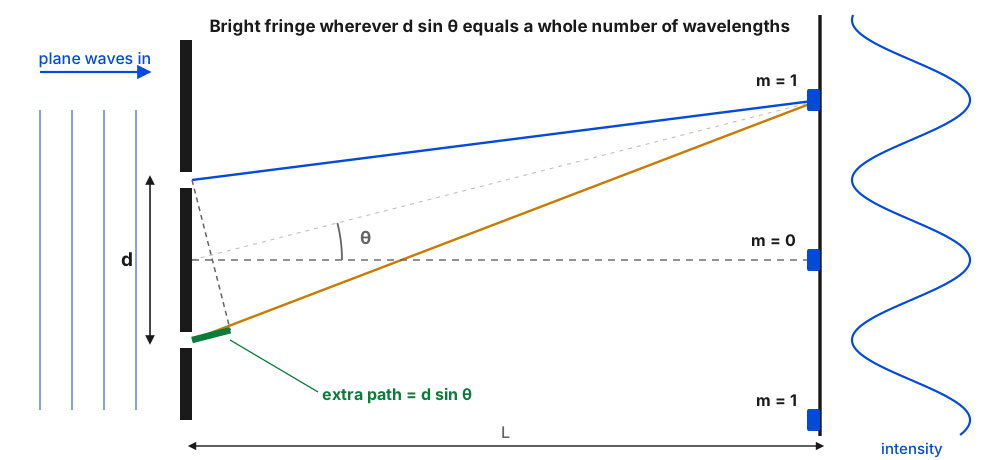
Stage 2 — each double slit becomes a new source. When the coherent light reaches the two slits, each slit diffracts the light, causing it to spread out in all directions. Each slit now behaves like an independent wave source.
Stage 3 — the waves overlap and interfere. The expanding circular waves from the two slits overlap in the space between the slits and the screen. At every point on the screen, the light from slit A and the light from slit B combine according to the principle of superposition.
Stage 4 — bright and dark fringes appear. At positions where the two waves arrive in phase — crest aligned with crest — the amplitudes add and a bright fringe appears. Where they arrive out of phase — crest aligned with trough — they cancel and a dark fringe appears. The result is a repeating pattern of fringes across the screen.
[Diagram description: a schematic of Young's double slit experiment showing the source, single slit, double slits separated by distance d, screen at distance D, and the resulting fringe pattern with labelled bright and dark bands. A triangle between the slits and the screen shows the geometry for deriving Δy = λD/d.]
The double slit equation: fringe spacing formula
The bright and dark fringes are not random. Their positions follow a precise mathematical relationship. A complete double slit explanation requires understanding the geometry behind the pattern.
The geometry
Consider two slits separated by distance d, located a distance D from the screen. A point P on the screen is at an angle θ from the centre line. Light from the nearer slit travels a shorter distance to P than light from the farther slit.
For small angles (which hold when D is much larger than d), the path difference Δr between the two waves is approximately:
Δr ≈ d sin θ
Bright fringe condition
A bright fringe appears where the path difference equals a whole number of wavelengths:
Δr = nλ (n = 0, 1, 2, 3, …)
Substituting the geometry: d sin θ = nλ
Dark fringe condition
A dark fringe appears where the path difference equals a half-integer number of wavelengths:
Δr = (n + ½)λ (n = 0, 1, 2, 3, …)
Substituting: d sin θ = (n + ½)λ
The fringe spacing formula
The distance from the centre to the nth bright fringe on the screen is:
y = nλD / d
The spacing between adjacent bright fringes (or adjacent dark fringes) is constant:
Δy = λD / d
This is the double slit equation. It tells you that fringes are evenly spaced, spread further apart with longer wavelengths and larger screen distances, and crowd closer together when the slits are further apart.
For a detailed comparison of constructive and destructive interference conditions, see our guide on constructive vs destructive interference.
Worked example: calculating fringe spacing
Let us put the formula to work with real numbers.
A student shines a red laser through two slits separated by 0.50 mm. The screen is placed 2.5 m from the slits. The laser wavelength is 633 nm.
Step 1 — write down the known values.
λ = 633 nm = 633 × 10⁻⁹ m d = 0.50 mm = 0.50 × 10⁻³ m D = 2.5 m
Step 2 — apply the fringe spacing formula.
Δy = λD / d Δy = (633 × 10⁻⁹ × 2.5) / (0.50 × 10⁻³) Δy = (1.5825 × 10⁻⁶) / (0.50 × 10⁻³) Δy = 3.165 × 10⁻³ m Δy = 3.2 mm
Step 3 — interpret the result.
Each bright fringe is about 3.2 mm from the next bright fringe. Over a screen width of 20 cm, you would see roughly 60 fringes.
Step 4 — calculate the position of the third bright fringe.
y₃ = 3 × 3.165 × 10⁻³ = 9.5 mm from centre
This matches the bright fringe condition y = nλD/d with n = 3.
Laser vs white light: what changes the pattern
The type of light source dramatically affects what you see on the screen.
Monochromatic light (laser). A single wavelength produces sharp, evenly spaced fringes. The contrast between bright and dark is high because all wavelengths constructively and destructively interfere at the same positions. This is why classroom demonstrations almost always use a laser.
White light. White light contains all visible wavelengths from roughly 380 nm (violet) to 700 nm (red). Each colour produces its own fringe pattern with slightly different spacing. The central fringe is white because all colours have zero path difference there (n = 0). Moving outward, red fringes (longer λ) spread further than violet fringes (shorter λ), producing a rainbow effect. Further from the centre, the different colour patterns overlap so much that the fringes merge into a blur.
White light fringes are useful in one way: they make it obvious that the effect depends on wavelength. The coloured bands are a direct visual demonstration of dispersion within an interference pattern.
The quantum twist: single photons and electrons
Young could not have imagined what his experiment would reveal a century later.
In the early 1900s, physicists began sending individual particles through the double slit — one photon at a time, then one electron at a time. The result was astonishing.
Each particle hits the screen at a single point, like a particle would. But over many detections, the points accumulate into the same interference pattern that Young observed. Each photon or electron interferes with itself, as if it passed through both slits simultaneously.
When detectors are placed at the slits to determine which path the particle took, the interference pattern disappears. The simple act of observation — measuring which slit — collapses the wave behaviour, and the particles behave like classical objects.
In 1927, Davisson and Germer demonstrated the same pattern with electrons, confirming that matter has wave-like properties. This is wave-particle duality, and the double slit experiment is its clearest demonstration.
For a broader introduction to interference and its history, start with our pillar guide on what is wave interference. To understand how diffraction relates to the spreading at each slit, read diffraction of a wave.
DIY: try the double slit experiment at home
You do not need a laboratory to see interference fringes. A basic double slit experiment at home is possible with just a few items. This hands-on double slit explanation brings the theory to life.
What you need:
- A laser pointer (red works well)
- Two razor blades
- A piece of card
- A dark room with a blank wall
Method:
- Make two parallel slits by taping two razor blades edge-to-edge on a piece of card, leaving a narrow gap (about 0.3–0.5 mm).
- Secure the card vertically with the slits aligned.
- Shine the laser pointer through the slits onto a wall about 2–3 metres away.
- Look for the pattern of bright and dark spots on the wall.
You can also try using a single human hair. Stretch it vertically across the laser beam. The hair acts as an obstacle, and the light diffracting around both edges produces a similar interference pattern on the wall. This variation is sometimes called the light through a crack experiment.
Key takeaways
- Young's double slit experiment (1801) provided the first direct evidence that light is a wave.
- Coherent light passing through two slits produces alternating bright and dark fringes from constructive and destructive interference.
- The fringe spacing formula is Δy = λD / d — fringes are evenly spaced.
- Bright fringes occur when Δr = nλ; dark fringes occur when Δr = (n + ½)λ.
- Monochromatic light produces sharp fringes; white light produces coloured fringes that blur with distance.
- The same experiment works with single photons, electrons, and atoms — demonstrating wave-particle duality.
- You can observe interference at home using a laser pointer and a pair of razor blades.
External resources
- Encyclopaedia Britannica: Young's Experiment — authoritative reference on the history and significance of the double slit experiment
- The Physics Classroom: Young's Experiment — clear diagrams and step-by-step explanation of the double slit setup and fringe formation
- Wikipedia: Double-Slit Experiment — comprehensive treatment including the quantum mechanics and wave-particle duality implications
Frequently Asked Questions
What is Young's double slit experiment?
Young's double slit experiment passes coherent light through two narrow, closely spaced slits and observes the pattern on a screen behind them. Instead of two bright spots (as particles would produce), the screen shows alternating bright and dark bands called interference fringes. This pattern proves light behaves as a wave and was first demonstrated by Thomas Young in 1801.
What is the double slit equation?
The double slit equation (fringe spacing formula) is Δy = λD / d, where Δy is the distance between adjacent bright or dark fringes, λ is the wavelength of light, D is the distance from the slits to the screen, and d is the separation between the two slits.
Why does the double slit experiment prove light is a wave?
It proves light is a wave because only waves can produce an interference pattern. If light were made of particles, you would see only two bright bands behind the two slits. Instead, light spreads out from each slit and overlaps, producing many bright and dark bands. This constructive and destructive interference is a defining behaviour of waves.
What happens when you use white light in the double slit experiment?
White light produces coloured fringes instead of monochromatic ones. The central fringe is white because all wavelengths have zero path difference. Moving outward, longer wavelengths (red) spread further than shorter ones (violet), creating rainbow-coloured fringes. Further from the centre, the colours overlap and merge into white light again.
Can you do the double slit experiment at home?
Yes. Shine a laser pointer through two parallel slits cut into a piece of card (about 0.5 mm apart) and project the light onto a wall a few metres away. You can also use the gap between two razor blades, or even a single human hair, which acts as a double-slit-like obstacle and produces a similar diffraction pattern.
What is the difference between bright and dark fringes?
Bright fringes occur where light waves from the two slits arrive in phase (path difference = nλ) and undergo constructive interference. Dark fringes occur where the waves arrive exactly out of phase (path difference = (n + 1/2)λ) and undergo destructive interference. The alternating pattern is a direct map of the phase relationship between the two wavefronts.
Does the double slit experiment work with electrons?
Yes. In 1927, Davisson and Germer demonstrated that electrons produce an interference pattern identical to light when passed through a double slit. This confirmed that matter — not just light — has wave-like properties (wave-particle duality). Modern experiments have repeated this with neutrons, atoms, and even large molecules.
How do you calculate fringe spacing?
Use the formula Δy = λD / d. Measure the distance D from the slits to the screen and the slit separation d. Look up the wavelength λ of the light source (for a red laser pointer, λ ≈ 650 nm). Plug these into the formula to predict the spacing between adjacent bright fringes.

About Umar Farooq
Umar Farooq writes in-depth guides on the physics of light and optics — from reflection, refraction, and lenses to diffraction, lasers, and fiber optics, explained from first principles.
Read more about Umar Farooq →