
When two stones drop into a pond, the ripples spread and cross. Where the crests meet, the water jumps higher. Where a crest meets a trough, the surface flattens. The resulting network of peaks and flat spots is an interference pattern.
An interference pattern is a stable arrangement of maxima and minima created when waves from coherent sources overlap. The bright spots (or loud spots for sound) are where waves arrive in phase and reinforce each other. The dark spots (or quiet spots) are where they arrive out of phase and cancel.
Interference patterns are the clearest evidence that a phenomenon is wave-like. Light produces them. Sound produces them. Water produces them. Even electrons and atoms produce them. The specific pattern depends on the source geometry, but the underlying physics is always the same: superposition of waves.
What is an interference pattern?
Interference patterns are the visible or measurable result of wave superposition. When two or more coherent waves overlap, the total displacement at each point is the sum of the individual displacements. At some points the waves add constructively — these are the maxima (bright fringes in light, loud spots in sound). At other points they cancel destructively — these are the minima (dark fringes, quiet spots).
The pattern is stable only when the sources are coherent — meaning they maintain a constant phase difference. If the phase relationship changes randomly, the pattern shifts and blurs into uniform intensity. This is why two independent light bulbs do not produce an interference pattern, but two slits illuminated by the same laser do.
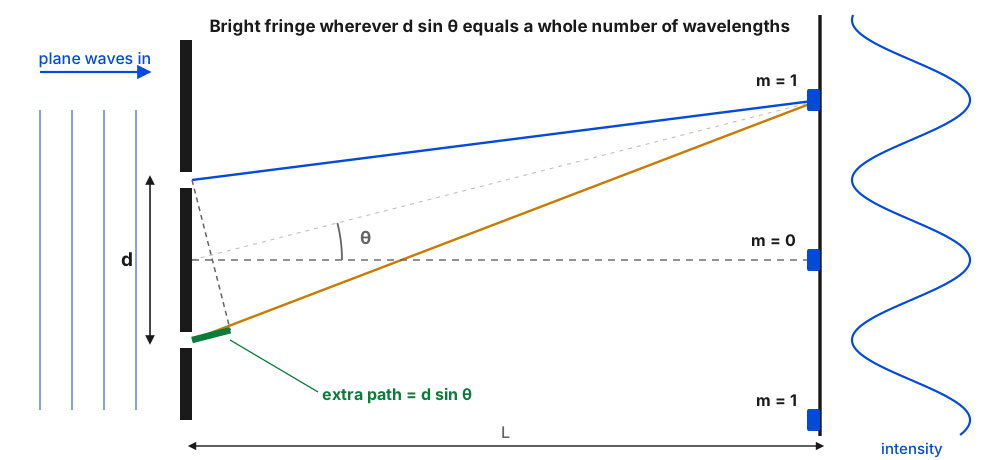
Double slit diagram: two paths to the same point
For a full introduction to the principle, see our guide on what is wave interference.
Conditions for a clear pattern
Three conditions must be met to observe a stable, high-contrast interference pattern.
Coherent sources — the waves must have a constant phase difference. Laser light is naturally coherent; thermal light sources require filtering through a single slit (as in Young's original experiment).
Comparable amplitudes — if one wave is much weaker than the other, cancellation is incomplete and the dark fringes are not fully dark. The best contrast occurs when the two waves have equal amplitude.
Matching polarisation — for light waves, complete cancellation requires the electric fields to oscillate in the same plane. If the waves are polarised at right angles, they cannot cancel regardless of their phase difference.
For a detailed breakdown of constructive and destructive interference, read constructive vs destructive interference.
5 types of interference patterns
1. Double-slit pattern (Young's fringes)
The classic interference pattern. Coherent light passes through two narrow slits and produces evenly spaced bright and dark fringes on a screen. The fringe spacing is constant and given by Δy = λD / d. All bright fringes have nearly the same intensity.
For a complete walkthrough of the double-slit experiment, see the double slit explanation guide.
2. Thin film interference pattern
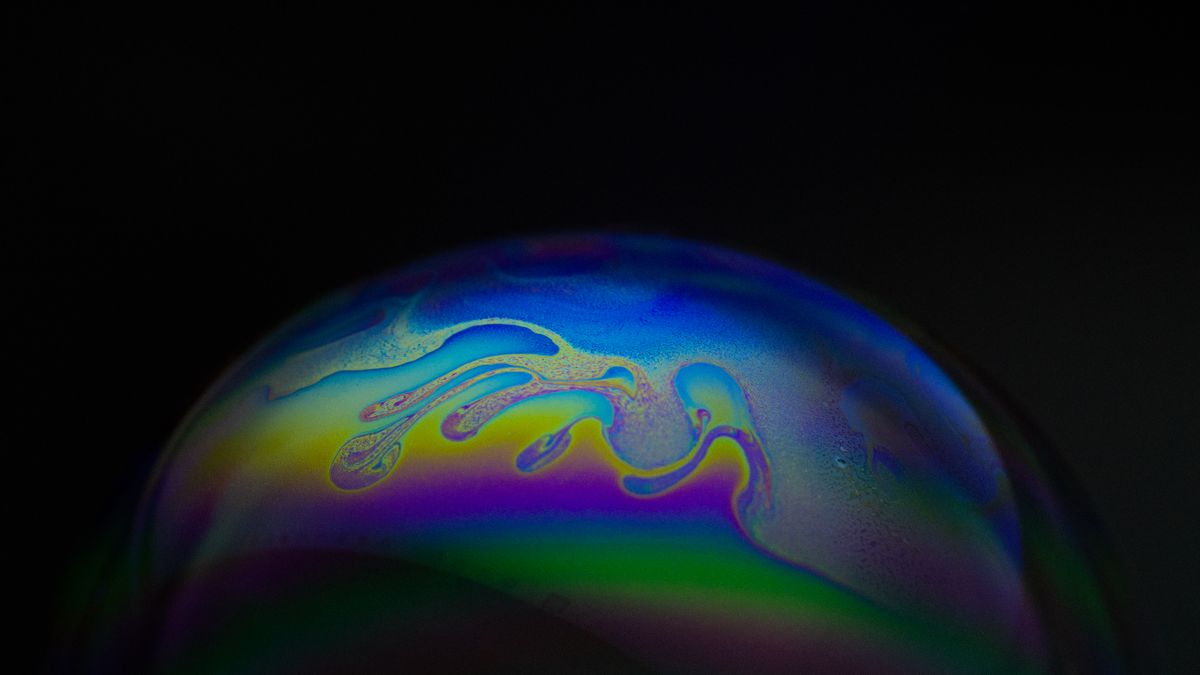
When light reflects from both the top and bottom surfaces of a thin transparent film, the two reflected waves interfere. The pattern appears as bands of colour across the film surface. These wave interference patterns are visible to the naked eye on any soap bubble or oil slick. The interference of light in thin films is one of the most accessible demonstrations of the phenomenon.
Soap bubbles and oil slicks are everyday examples. The film thickness varies from point to point, so different wavelengths interfere constructively at different positions — producing the characteristic rainbow colours. Anti-reflective coatings on camera lenses use the same principle in reverse: the film thickness is chosen so that reflected light undergoes destructive interference, reducing glare.
3. Newton's rings
Place a slightly curved glass surface (a lens) on a flat glass plate. The thin air gap between them varies from zero at the contact point to wider toward the edges. When illuminated, concentric circular fringes appear — bright and dark rings centred on the contact point.
Newton's rings are a practical tool in optics. They reveal microscopic surface imperfections and allow precise measurement of lens curvature. The spacing between rings tells you the shape of the surface to within a fraction of a wavelength of light.
4. Multiple beam interference (Fabry-Perot pattern)
When light bounces back and forth between two parallel, highly reflective surfaces, it interferes many times. The result is extremely sharp, narrow bright fringes separated by wide dark regions. This is called a Fabry-Perot interference pattern.
Fabry-Perot etalons are used in laser cavities, optical filters, and high-resolution spectroscopy. The sharpness of the fringes allows measurement of wavelengths to one part in a million or better.
5. Diffraction grating pattern
A diffraction grating is a surface with many closely spaced parallel slits or grooves — typically hundreds per millimetre. Each slit diffracts light, and all the diffracted beams interfere. The result is a pattern of very sharp, bright maxima at specific angles.
The grating equation is d sin θ = nλ, where d is the groove spacing. Because the maxima are so sharp, diffraction gratings are the standard tool for spectroscopy — analysing the wavelengths present in a light source.

How fringe spacing reveals information
The spacing and position of interference fringes are not arbitrary — they encode information about the wave source and the geometry. Every light interference pattern tells you something about the source that created it.
- In a double-slit pattern, measuring the fringe spacing tells you the wavelength of light (or the slit separation or screen distance, if you know the other two).
- In Newton's rings, the ring diameters reveal the curvature of the glass surface.
- In thin film interference, the colour pattern maps the film thickness.
- In a diffraction grating, the angles of the bright maxima allow precise wavelength measurement — the foundation of optical spectroscopy.
In every case, the interference pattern is a measurement tool. This is why interferometers are among the most sensitive instruments ever built — they can detect changes smaller than a single wavelength of light.
Key takeaways
- An interference pattern is a stable arrangement of maxima and minima formed by overlapping coherent waves.
- Three conditions are needed for a clear pattern: coherence, comparable amplitudes, and matching polarisation.
- Different source geometries produce different patterns: evenly spaced fringes (double-slit), coloured bands (thin film), concentric rings (Newton's rings), sharp lines (Fabry-Perot), and widely spaced maxima (diffraction grating).
- Interference patterns are not just demonstrations — they are precision measurement tools used in spectroscopy, surface testing, and optical engineering.
- For more on how interference relates to diffraction, see the comparison guide on interference vs diffraction.
External resources
- Encyclopaedia Britannica: Interference Fringe — authoritative reference on fringe formation, visibility, and types of interference patterns
- The Physics Classroom: Interference of Waves — clear diagrams and explanations of wave superposition and pattern formation
- Wikipedia: Interference (Wave Propagation) — comprehensive technical reference covering the theory, conditions, and applications of interference
Frequently Asked Questions
What is an interference pattern?
An interference pattern is a stable, repeating arrangement of bright and dark regions (or loud and quiet regions) that forms when two or more coherent waves overlap. The bright regions correspond to constructive interference where waves arrive in phase; the dark regions correspond to destructive interference where waves arrive out of phase. Interference patterns are evidence of wave behaviour.
What are the types of interference patterns?
The main types include: double-slit (Young's) interference patterns with evenly spaced fringes, thin film interference patterns (soap bubbles, oil slicks) showing rainbow colours, Newton's rings formed by curved glass on a flat surface, multiple beam interference patterns from Fabry-Perot etalons, and diffraction grating patterns with sharp, widely spaced maxima.
What conditions are needed for a stable interference pattern?
Three conditions are required: coherent sources (constant phase difference), similar amplitudes (for good contrast), and for light waves, matching polarisation. Without coherence, the pattern shifts randomly and averages out. Without similar amplitudes, the dark fringes are not fully dark. Without matching polarisation, the waves cannot completely cancel.
What is the fringe spacing formula for a double-slit pattern?
The fringe spacing for a double-slit interference pattern is Δy = λD / d, where λ is the wavelength of light, D is the distance from the slits to the screen, and d is the separation between the slits. This formula shows that fringes are more widely spaced for longer wavelengths and larger screen distances, and more tightly packed when the slits are further apart.
Why do soap bubbles show rainbow colours?
Soap bubbles show rainbow colours because of thin film interference. Light reflects from both the outer and inner surfaces of the soap film. The two reflected waves interfere. Depending on the film thickness at each point, different wavelengths (colours) interfere constructively or destructively, producing the characteristic swirling rainbow pattern.
What are Newton's rings?
Newton's rings are concentric circular interference fringes that appear when a curved glass surface (like a lens) is placed on a flat glass surface. The thin air gap between the two surfaces varies in thickness, creating circular fringes of equal thickness. Newton's rings are used to test the quality of optical surfaces and measure lens curvature.
What is the difference between a double-slit and a diffraction grating pattern?
Both produce interference patterns, but a diffraction grating has many slits (hundreds or thousands) instead of just two. The bright maxima in a grating pattern are much sharper, narrower, and more widely spaced than in a double-slit pattern. This makes diffraction gratings ideal for spectroscopy — measuring wavelengths with high precision.
How can you tell if a pattern is from interference or diffraction?
Pure interference patterns have evenly spaced fringes of nearly equal brightness. Diffraction patterns have a broad central maximum with fringes that get dimmer and wider away from the centre. In the double-slit experiment, the observed pattern is actually a combination: interference fringes modulated by a single-slit diffraction envelope.

About Umar Farooq
Umar Farooq writes in-depth guides on the physics of light and optics — from reflection, refraction, and lenses to diffraction, lasers, and fiber optics, explained from first principles.
Read more about Umar Farooq →